
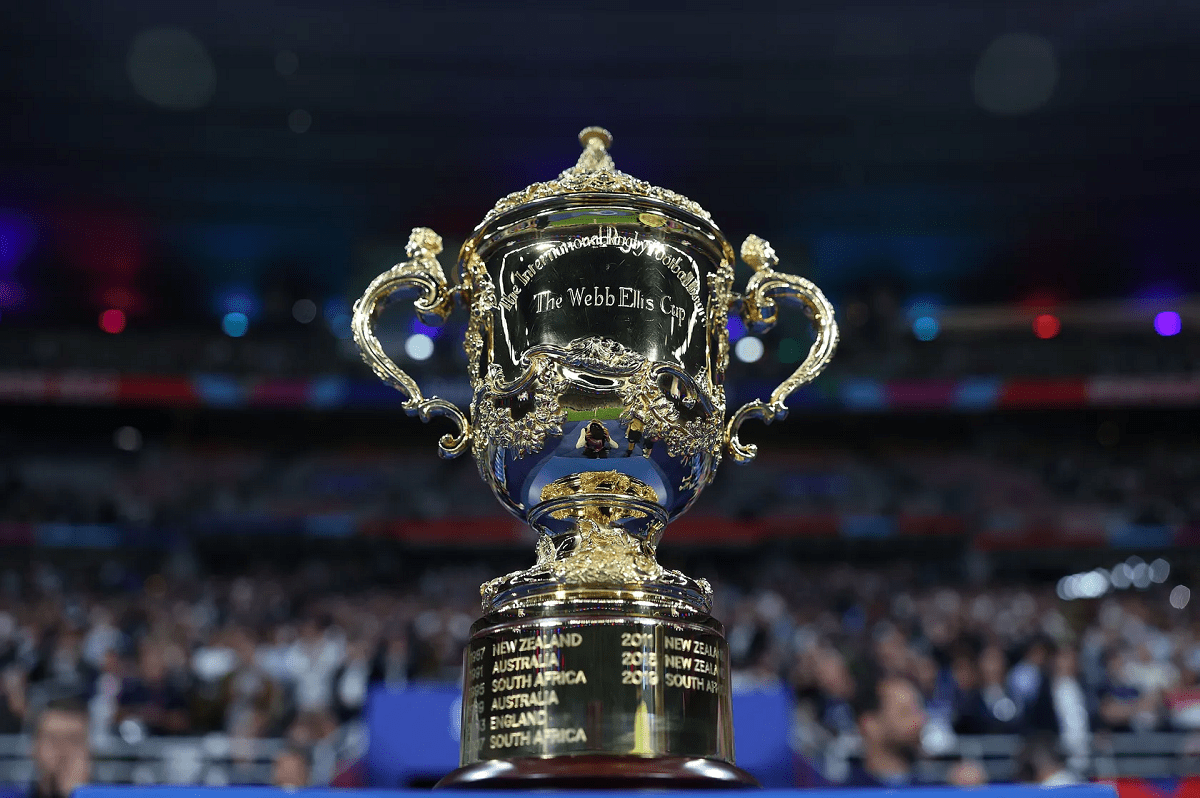
At the time of writing, 425 matches have been played in the entire history of the Rugby World Cup. Plenty of lists have been written about the greatest games from the tournament’s ten previous editions, from high-scoring tryfests, tense tug-of-war contests and games that go down to the final phase. However, this article will not be discussing France vs New Zealand from 1999, Wales vs Western Samoa from 1991 or even the 2003 Rugby World Cup Final. This post will instead look at the other end of the spectrum, where the matches are far more one-sided.
The Rugby World Cup has had its fair share of one-sided victories, where one team, through a combination of factors, is clearly better than its opponent. However, there is a subgenre of these types of games, a ‘blowout’ to use a better term, where the contrast in performance between the two sides is so stark that you can barely believe your eyes for the next 80 minutes. These blowouts deserve to be discussed, as the history of the Rugby World Cup is not complete without their inclusion. However, as you will soon read, these games can become pretty uncomfortable to watch, ultimately leading to you sympathising with the team on the losing end of this massive scoreline and resenting the team that provided said points. So here are 10 (the Internet’s favourite number) of the Rugby World Cup’s biggest blowout victories. (Although, fewer of these types of games in future Rugby World Cup tournaments would be well received by rugby fans everywhere.)
10. South Africa 87 Namibia 0, 2011
In 1990, Namibia received its independence from South Africa, ending a 34-year war between the South African Defence Force and the Namibian Liberation Army that also involved Cuba, Portugal, and Angola. Since then, the two neighbouring countries have rarely met on the rugby field, despite being present at every Rugby World Cup since 1999 (Namibia’s debut). Therefore, when South Africa and Namibia faced off in the pool stages of the 2011 Rugby World Cup in New Zealand, their match in Auckland marked just the second meeting between the two countries. The first meeting four years earlier had ended in a truly comprehensive 105-13 win for South Africa as the Springboks warmed up for the 2007 World Cup, a competition which they would eventually win in Paris while Namibia crashed out winless in the pool stages.
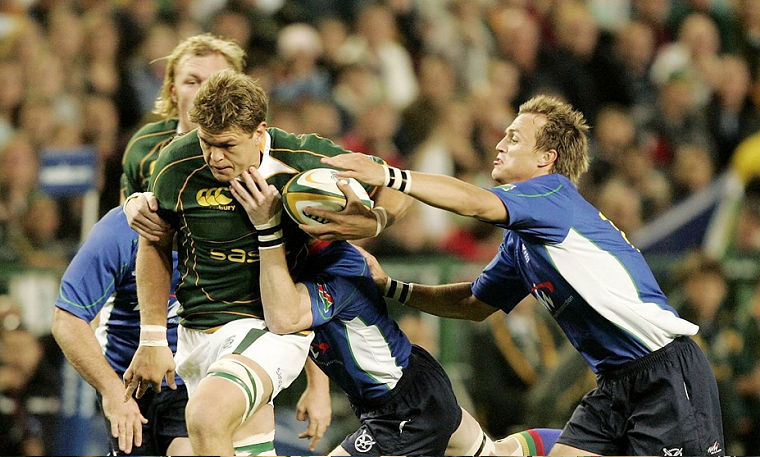
Unfortunately for Namibia, the second meeting would end similarly to the first: in a heavy South African victory. However, while Namibia had managed a converted try and two penalties in 2007, the Welwitschias would not even score a single point past the defending champion Springboks in their Pool D encounter at the 2011 World Cup. The two teams entered the match with opposing form books from their first two pool matches. South Africa had edged a tight encounter with Wales 21-20 before putting six tries and one point short of a half-century of points past Fiji. A third victory against Namibia would confirm the Springboks’ place in the World Cup quarter-finals. Meanwhile, a defeat against South Africa would confirm Namibia’s exit from the 2011 World Cup after two defeats in their two pool matches. The Welwitschias’ campaign had begun with one of the best games of the 2011 Rugby World Cup, losing 49-25 to Fiji in Rotorua. Then, Namibia had fallen to a less competitive defeat, losing 49-12 to Samoa. Considering these results, it would be a surprise if Namibia got anywhere close to their geographical neighbours on the scoreboard in Auckland.
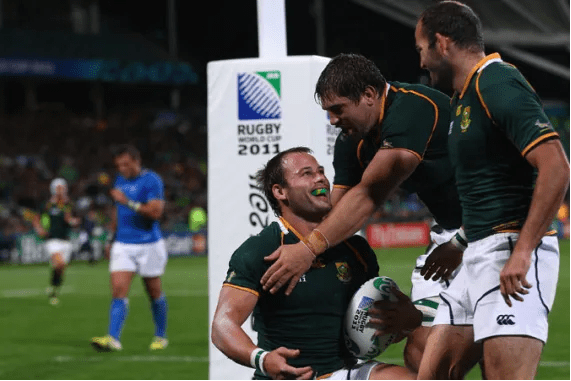
On 22nd September, South Africa would defeat their Southern African rivals 87-0 for their biggest-ever Rugby World Cup victory, beating a 72-6 victory over Uruguay from 2003. Gio Aplon, Juan de Jongh, and Francois Hougaard would all score braces as the Springboks ultimately put a dozen tries past their Tier 2 opponents. It would take 7 minutes for South Africa to reach double figures for points after a Morne Steyn penalty and Aplon’s first try. Another 15 minutes would pass before Bryan Habana went over for South Africa’s second try. Then, the Springboks would routinely cross the Welwitschias’ try-line for the remaining hour of the game.
Following Aplon and Habana’s early scores, a penalty try and one from Jaque Fourie would secure the four-try bonus point before half-time. Francois Steyn would score the team’s 5th try in the 49th minute before the Springboks’ ruthless streak truly came out, with 7 tries scored in the final 20 minutes. Morne Steyn, Gio Aplon, Juan de Jongh (x2), Francois Hougaard (x2) and Danie Roussouw would all cross the whitewash as Peter de Villiers’ men continued to ramp up the level of humiliation over the country they used to control. On top of all this, South Africa was 100% from the kicking tee with unrelated namesakes Morne and Francois Steyn, providing 15 and 12 points with the boot in addition to their tries.
For South Africa, a record win over Namibia was just another step on their journey to try and retain the Rugby World Cup. For Namibia, this defeat was bad, but far from the worst they’ve suffered in a Rugby World Cup.
9. Australia 91 Japan 3, 2007
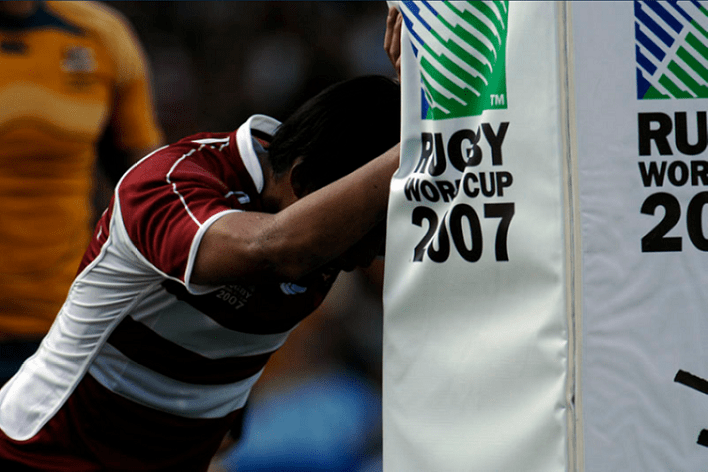
Australia and Japan are two teams that are not strangers to notable Rugby World Cup drubbings. Australia currently holds the biggest victory in World Cup history, while Japan was once on the end of the heaviest defeat in World Cup history. Both of those will be discussed later. With that previous knowledge in mind, Australia beating Japan 91-3 in the opening match of Pool B at the 2007 Rugby World Cup in France is not a surprising scoreline.
Australia entered the 2007 World Cup looking to win a record third Rugby World Cup trophy. However, since Jonny Wilkinson’s extra-time drop goal for England denied the Wallabies in the 2003 World Cup final, Australia had gone through plenty of upheaval through this World Cup cycle, winning 26 and losing 18 matches over the previous four years. Eddie Jones, who had led them to the 2003 World Cup Final, was sacked in 2005 after a run of 8 defeats in 9 matches, and replacement John Connolly had overseen a slight improvement of 12-1-7 during his 18-month tenure, consistently beating Wales, England and Scotland but swapping wins with Ireland, New Zealand and South Africa.
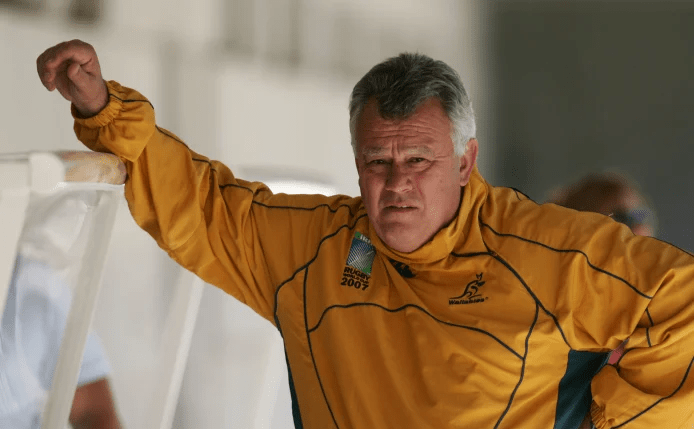
Japan travelled to France looking for their second-ever World Cup win and their first since 1991, having left the last three tournaments winless despite becoming increasingly competitive over the years and winning over neutral fans with their entertaining brand of rugby. The years leading into the 2007 World Cup had seen Japan compete in the Pacific Nations Cup and face high-quality opposition like Italy, Scotland, Wales and Ireland. However, Japan had finished last in the two most recent Pacific Nations Cup competitions, suffering comfortable defeats to Fiji, Samoa, Tonga and ‘A’ teams from New Zealand and Australia. The Cherry Blossoms had also suffered record defeats to Wales (98-0) and Scotland (100-8) during this World Cup cycle, in addition to falling at the hands of Romania (25-10), Uruguay (24-18), Canada (15-10) and Argentina (68-36). With the team’s notable victories since 2003 coming against such opponents as Spain and Georgia and lesser opposition like Hong Kong, South Korea and the Arabian Gulf, few would have given Japan a chance of even a losing bonus point when they faced Australia at Lyon’s Stade Gerland in the team’s opening match of the 2007 Rugby World Cup.
When the half-time whistle sounded in Lyon, Japan probably thought they had done well to only be behind 23-3 on the scoreboard. Two Stirling Mortlock penalties had been followed by tries by flanker Rocky Elsom (x2) and lock Nathan Sharpe, but Japan did have the last say of the first half, with a Kosei Ono penalty kick putting John Kirwan’s team on the scoreboard. However, the proverbial floodgates would quickly open after Elsom completed his hat-trick of tries less than a minute into the second half. The Wallabies would run in a further 9 tries in the remaining 39 minutes, an average of one every three minutes. Fullback Chris Latham (53’, 72’), fly-half Berrick Barnes (57’, 75’), and winger Drew Mitchell (59’, 66’) would all score twice, with Barnes getting his pair after coming on as a 54th-minute replacement for Stephen Larkham. Flanker George Smith and replacement hooker Adam Baxter would then complete the try-scoring. Of the 13 tries, Stirling Mortlock would convert 7 out of 10 kicks in addition to his two first-half penalties for a total of 20 points from his boot, while his centre partner Matt Giteau would 100% his three conversions in the second half once Mortlock had been substituted. Japan would not land a significant blow in the second half as Australia eventually cruised to a 91-3 victory in Lyon.
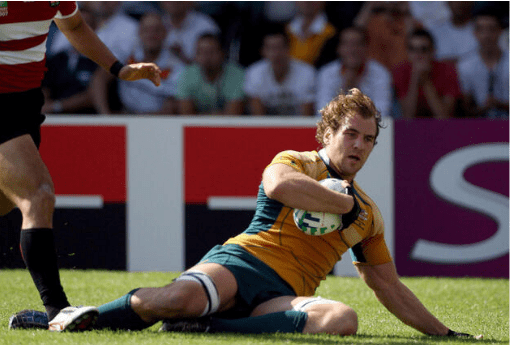
After suffering their second-biggest Rugby World Cup defeat (more on that later), Japan would fail to win any of their remaining Pool B matches. However, these other three games would see some impressive performances in defeat from the Cherry Blossoms. First, Japan would narrowly lose a thrilling match 35-31 to Fiji, with lock Luke Thompson’s second try getting John Kirwan’s team within touching distance with two minutes to go before the Fijians held out for the win. A heavy 72-18 loss to Wales in Cardiff would ultimately eliminate Japan with one game remaining. However, this game was mainly remembered for winger Kosuke Endo’s 19th-minute try, which saw the ball pinched from a Welsh ruck before the Cherry Blossoms went coast-to-coast, starting in the bottom-left corner of the pitch before Endo finished in the top-right corner of the Wales try-line. Finally, Japan would finish with a 20-20 draw with Canada, the first Rugby World Cup draw since 1987.
Conversely, Australia would ease through Pool B, comfortably beating Wales 32-20 in a scoreline that flattered the loser, thrashed eventual quarter-finalists Fiji 55-12, and the Wallabies’ third-string dispatched Canada 37-6. However, Australia would shockingly exit in the quarter-finals to defending champions England, who had been poor in the pool stages. A scrummaging masterclass and Jonny Wilkinson’s boot saw England progress to a 12-10 victory in a 2003 World Cup Final rematch.
8. Scotland 89 Ivory Coast 0, 1995
Of the four African countries to have competed at a Rugby World Cup, the Ivory Coast (Cote D’Ivoire) is the only team not to make a return following their debut. Eleven years before Didier Drogba led a golden generation of footballers to three straight FIFA World Cup appearances between 2006 and 2014, a team captained by fly-half Athanase Dali and coached by Claude Ezoua managed to surprisingly qualify for the 1995 Rugby World Cup, the first one to be held in Africa.
With South Africa qualifying as hosts, the sole African qualification slot for the 1995 World Cup was open among 16 teams. It would be decided by two rounds of qualifying. Ivory Coast would first top a three-team group containing Morocco and Tunisia, narrowly edging the former 19-16 on 26th October 1993 before defeating the latter 25-3 four days later. In June 1994, Cote D’Ivoire would again face Morocco along with Namibia and Zimbabwe as part of a final four-team qualifying group. All six matches would occur over five days between the 14th and 18th of June 1994 in Casablanca, meaning that all four teams would have to play three matches in six days. In a close-fought group, the Ivory Coast would begin with a 17-9 defeat to hosts Morocco, while Namibia edged Zimbabwe 25-20. However, Cote D’Ivoire’s 13-12 win over Namibia and Zimbabwe defeating Morocco 21-9 left the group and World Cup qualification in the balance heading into the final round of fixtures. Morocco and Namibia would draw their final match 16-16, meaning that qualification was now between Zimbabwe, looking for a third successive Rugby World Cup appearance and the Ivory Coast, looking for its first. Zimbabwe would lead Cote d’Ivoire 7-0 at half-time in Casablanca after a converted try from fly-half Dave Walters. However, the Elephants would come out firing in the second half, and three tries from wing Celestin N’Gabala, centre Lucien Niakou and debuting flanker Sam Swatson, plus a single conversion by Athanase Dali, would see the Ivory Coast win the match 17-10 and qualify for the 1995 Rugby World Cup in South Africa.
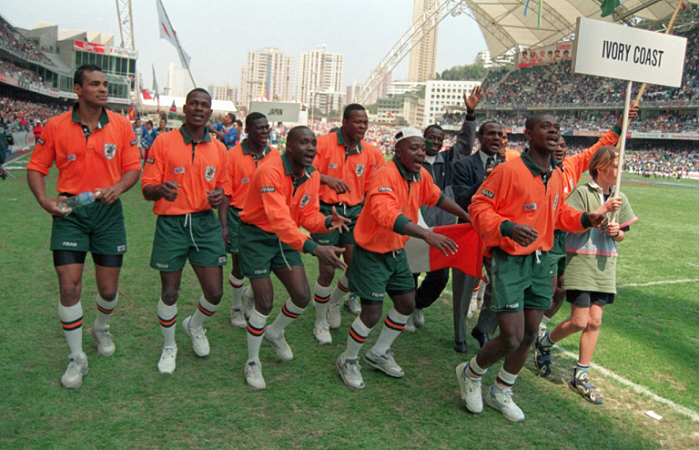
For their first Rugby World Cup, the Ivory Coast was drawn in a group with tournament veterans in France, Scotland and Tonga. With all three teams having played at the previous two World Cups, and with The Elephants lacking experience of top-level Test Rugby (none of the team’s 26-man squad had more than 5 caps to their name heading into the competition), it would be a big ask for Claude Ezoua’s team to even get a win, let alone qualify for the quarter-finals.
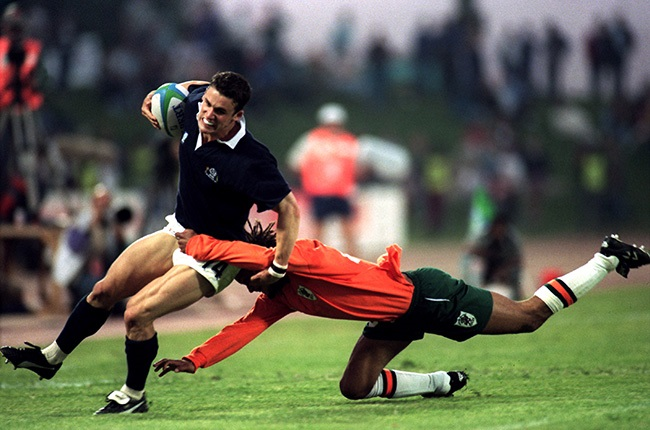
The Ivory Coast’s Rugby World Cup debut would come against Scotland on the second day of the competition, the day after the classic opening match between hosts South Africa and defending champions Australia. Cote d’Ivoire’s debut would ultimately end in a record 89-0 win for Scotland. In front of 24,000 spectators at Rustenburg’s Olympia Park, the Scots would run in 16 tries. Gavin Hastings would score four from fullback, becoming only the fifth man to score four tries in a single Rugby World Cup match and the first Scotsman to achieve such a feat. Hastings’ four tries would be the highlight of a performance where he single-handedly provided 44 of Scotland’s 89 points, successfully converting nine of Scotland’s tries and scoring with two penalty kicks. In addition to Gavin Hasting’s four, winger Kenny Logan and flanker Peter Walton would both score twice, and Paul Burnell, Peter Wright (props), Craig Chalmers (fly-half), Graham Shiel and Tony Stanger (centres) would also cross the whitewash.
The Scotland team on this day wasn’t particularly experienced, entering the match with an average of 19 caps. However, that was a huge amount of international experience compared to the Ivory Coast, for which four of their starting XV made their international debuts in this match. It would take 9 minutes for Gavin Hastings to score Scotland’s first try with an excellent chip-and-chase where the bounce of the ball favoured him. It would take until the 33rd minute for Scotland to score their second try, again through Gavin Hastings to put Scotland 20-0 ahead, and two more quick tries would give Jim Telfer’s side a 34-0 lead at half-time. However, conceding four tries in the first half was not the worst-case scenario for the debuting Ivory Coast, and the Elephants had even ventured inside the Scottish 22 on occasion. Yet, Scotland would be truly ruthless in the second half, scoring 12 tries without reply, as their less-experienced opponents started to flag physically.
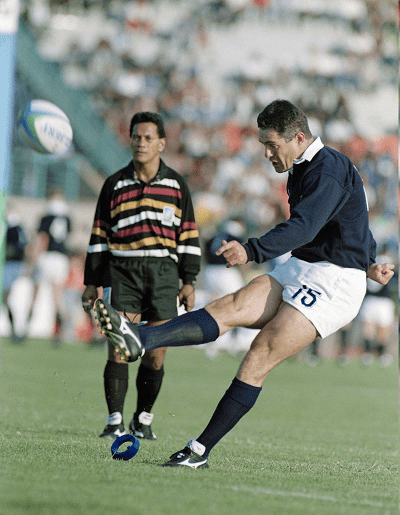
Following this match, the Ivory Coast would fail to win their other two matches in Pool D. However, these defeats would produce much healthier scorelines, with the Elephants scoring their first two World Cup tries in a 54-18 loss to eventual semi-finalist France and keeping Tonga down to 4 scores in a respectable 29-11 defeat. However, Cote d’Ivoire would ultimately end their first Rugby World Cup winless and bottom of Group D. At the same time, Scotland would finish second in the pool and eventually exit in the quarter-finals after losing an entertaining quarter-final to New Zealand.
Scotland’s 89-0 win over the Ivory Coast would last as their record victory until 2004, when the team defeated Japan 100-8 in an Autumn international at Murrayfield. However, the result remains their record Rugby World Cup victory and will likely remain unchallenged.
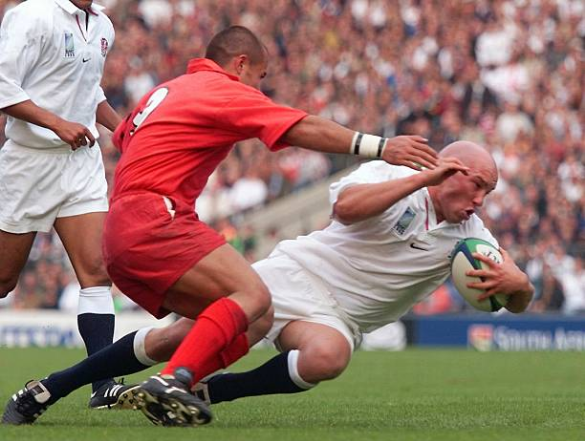
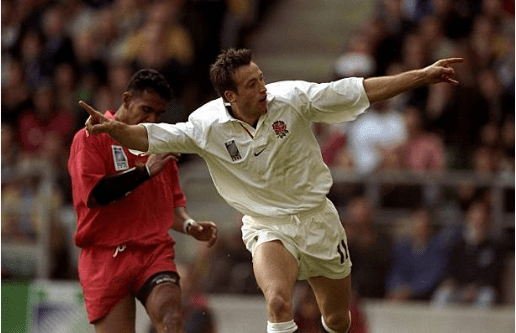
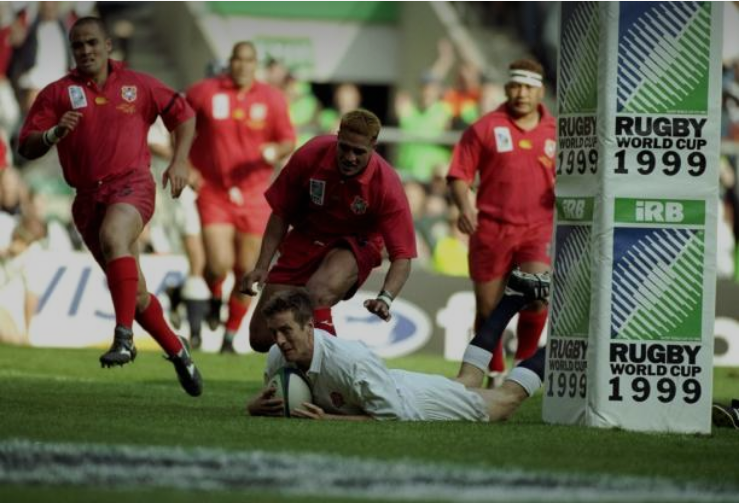
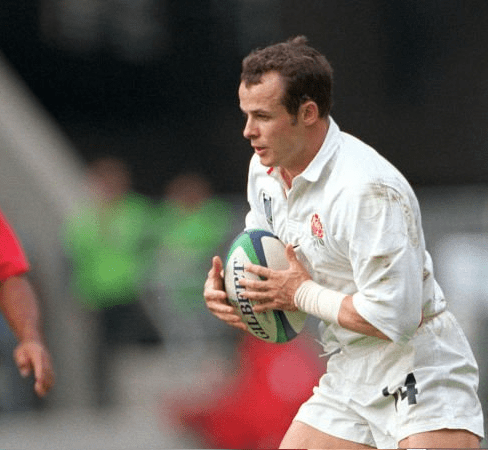
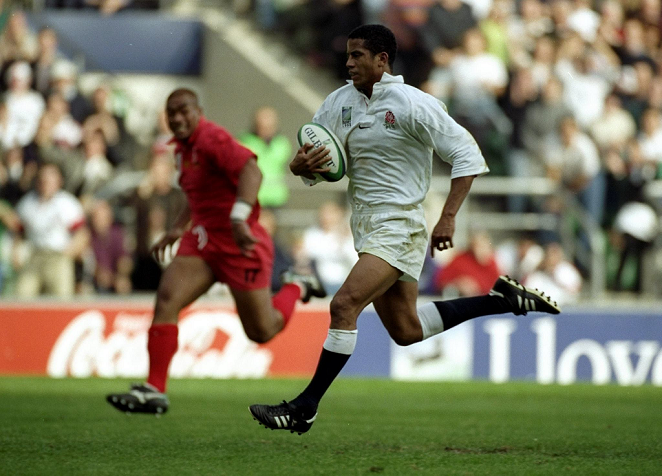
7. England 101 Tonga 10, 1999
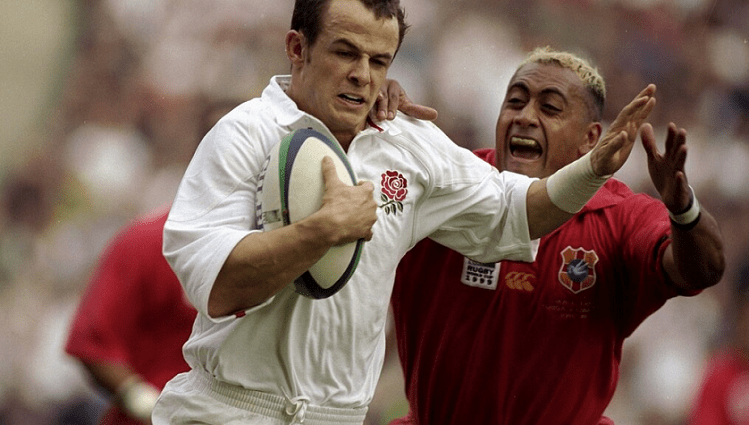
In their entire history, the England men’s rugby team have scored over 100 points in five different matches. All of these 100-point matches would come under the coaching of Sir Clive Woodward and would occur between 1998 and 2003. Two of England’s 100-point victories came in the Rugby World Cup, with the first coming against Tonga in the 1999 tournament. For the 1999 World Cup, England was drawn in a difficult pool with New Zealand, Italy and Tonga. However, due to being one of five countries hosting matches at this World Cup, England would have the luxury of playing all three Pool B matches at their home base of Twickenham.
When England faced Tonga in Twickenham in their final Pool B match, both sides entered the match with equal records of one win and one loss. England had opened with a comfortable 67-7 victory over Italy before losing 30-16 to Jonah Lomu and New Zealand. Tonga had the same manner of results, first losing 45-9 to New Zealand in Bristol before edging Italy 28-25 in an underrated classic at Welford Road. Now, with the All Blacks expected to polish off Italy and top Pool B to claim the automatic quarter-final spot, the match between England and Tonga would serve as a decider for 2nd place and a spot in the quarter-final play-offs.
England would enter this match as the favourite and was expected to win and claim 2nd place in Pool B. However, few observers would have predicted how Clive Woodward’s men eventually dispatched the Sea Eagles at Twickenham. The first 25 minutes was a fairly competitive match on the scoreboard. England would race into an 11-0 lead inside a dozen minutes after two Paul Grayson penalties and a try from Matt Dawson. However, a converted try from winger Dave Tiueti would put Tonga on the board in the 15th minute. Two further Paul Grayson penalties would extend England’s lead into double figures, but a penalty from Tongan kicker Sateki Tuipolotu would bring the Sea Eagles back within seven points after just 25 minutes. Little did the Pacific Island side know that their points scoring for the day was already over.
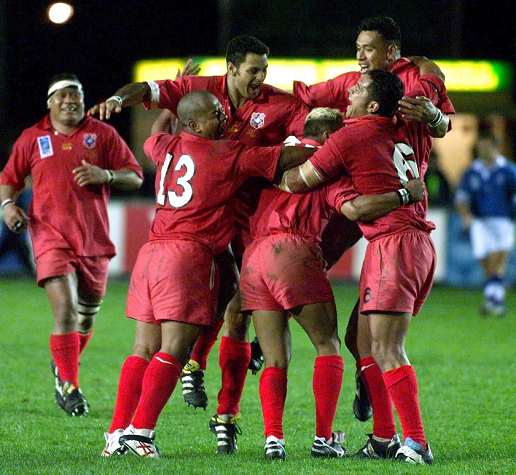
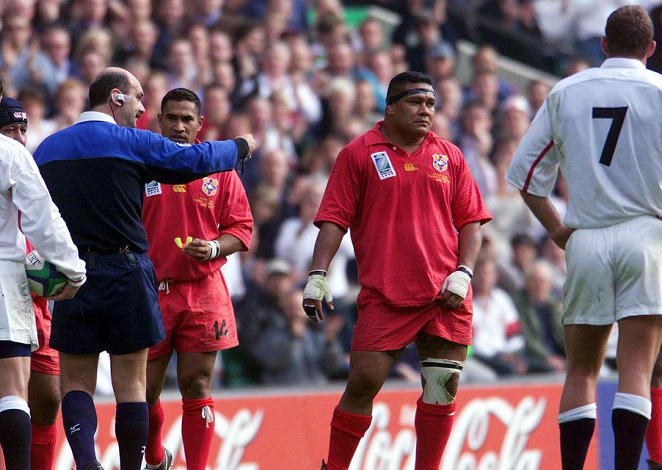
Hooker Phil Greening would quickly score England’s second try in the 27th minute (converted by Grayson) to extend England’s lead to 24-10. Then, Tonga’s day would get worse when they found themselves down two players for ill-discipline before half-time. First, ʻIsi Tapueluelu was sin-binned for tackling England fullback Matt Perry when the fullback was in the air. Then, prop forward Ngalu Taufo’ou received a 35th-minute red card for sucker-punching Richard Hill from behind during the mass player brawl that followed Tapueluelu’s tackle, leaving the Pacific Islanders down two players for the rest of the first half and one for the remainder of the game. England would, of course, take advantage of their man advantage as soon as possible, with tries from back three players Dan Luger and Matt Perry giving Clive Woodward’s men a healthy 38-10 lead at half-time.
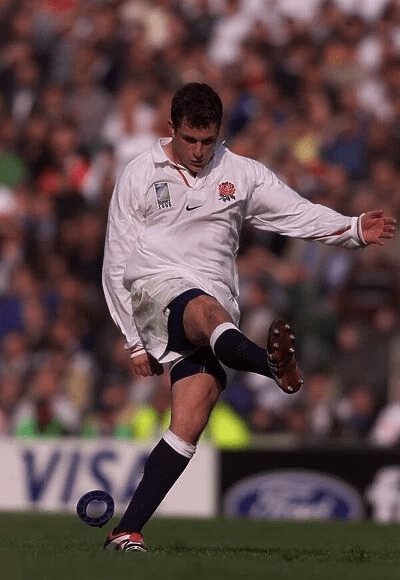
With one man fewer, Tonga were forced to chase the game and expend more energy trying to cover the hole left in their defence, only managing to create more holes for England to exploit. Four tries in the first 12 minutes of the second half would effectively kill the game as a contest, with Austin Healey, Richard Hill and Will Greenwood’s quickfire double stretching England’s lead to 66-10. The Eagles would eventually manage to hold out the Roses for all of 15 minutes before Healey and Jeremy Guscott crossed the whitewash. Then, as Tongan tiredness truly set in, second tries for Greening, Luger and Guscott would complete England’s try-scoring as England crossed into triple figures for scoring. All these scores were converted metronomically by Paul Grayson, who recovered from missing his first conversion to add two extra points to the following twelve tries. These twelve conversions, added to four first-half penalties, would give Paul Grayson a superb 36 points on this day.
Despite this scoreline, England would finish second behind New Zealand in Pool B, meaning a quarter-final playoff match against Fiji. England eventually won that match to set up a quarter-final against defending champions South Africa. On that day, Clive Woodward’s men were pummelled into submission by the kicking of Springboks’ fly-half Jannie De Beer, who successfully landed five drop goals in a 44-16 win for Nick Mallett’s champions.
6. New Zealand 108 Portugal 13, 2007
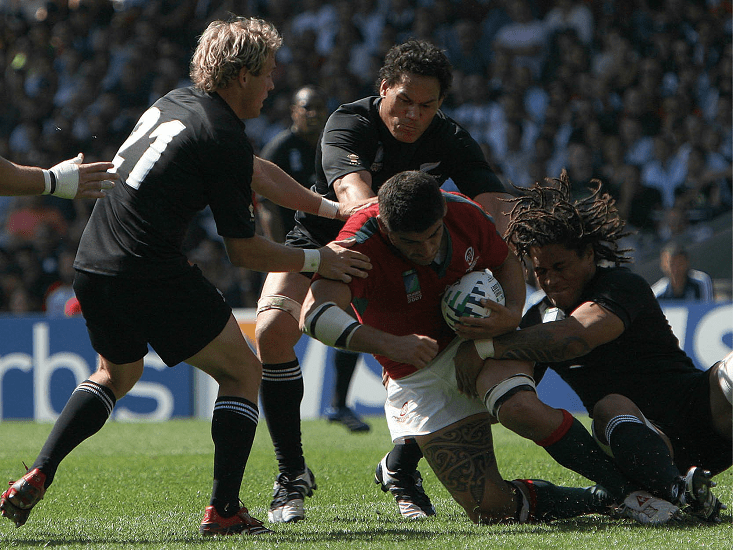
Until the most recent World Cup, New Zealand had never lost a Pool match at a Rugby World Cup. Over the first 9 tournaments, the three-time world champions were unbeatable. Even a typhoon in 2019 could only force a draw out of the All Blacks. The Rugby World Cup pool stage is often where New Zealand is at its most ruthless, raining down tries and points on the strong and weak in equal measure. If the country in question falls into the latter category of teams, the scoreline can get ugly, as shown by a trio of examples on this list. All three of these matches would see the All Blacks cross the 100-point barrier, a humiliating number of points for any team to concede. For Portugal in 2007, the latest team to suffer this fate at the hands of the All Blacks, the match was a true example of what the team could expect from the Rugby World Cup’s top teams.
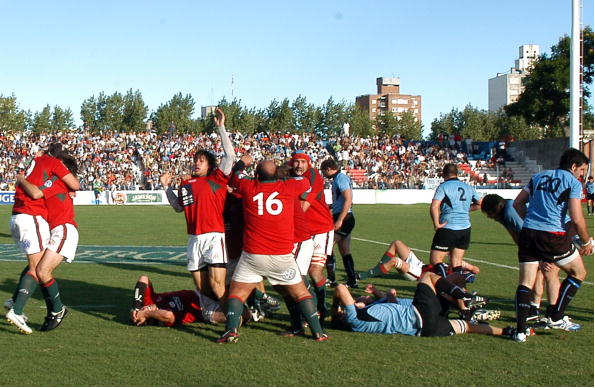
The 2007 Rugby World Cup marked the debut of Portugal. Os Lobos had gone through three rounds of European qualifying, plus a repechage, to reach the grandest stage in rugby for the very first time. After being edged out 28-14 over two legs by Georgia to claim the final European qualifying spot, Portugal was given one final chance to qualify through an intercontinental repechage. In the repechage, Os Lobos would squeak past Morocco after a 26-20 aggregate win to face Uruguay for the final World Cup spot. The home leg in Lisbon would be a low-scoring affair, with Portugal winning 12-5. The return leg in Montevideo would be even tighter. Once again, the home side would win the match. However, despite Uruguay winning 18-12, Los Teros’ winning margin of 6 points was not enough to overturn Portugal’s advantage from the first leg, meaning Portugal took the final 2007 Rugby World Cup spot by a single point.
When Portugal met New Zealand in Lyon’s Stade de Gerland, one side had already recorded a heavy victory in their first game while the other had suffered a heavy defeat. To prove their tag as the pre-tournament favourites, the All Blacks had opened their 2007 World Cup campaign with a mammoth 76-14 win over Italy, who had finished 4th in that year’s Six Nations. One day later, Portugal’s Rugby World Cup debut had finished with a 56-10 defeat to Scotland. Os Lobos had performed admirably against the Scots, only trailing 28-10 at half-time after winger Pedro Carvalho made history by scoring Portugal’s first-ever World Cup try. However, Scotland had pulled away in the second half, scoring 28 unanswered points to hit home the difference between Portugal and the worst Six Nations side. Now, it was time for Os Lobos to face the best team in world rugby.
Now, nobody thought Portugal had a hope of beating New Zealand or even coming close to the All Blacks on the scoreboard. For the match, New Zealand coach Graham Henry had made 12 changes to the team who had beaten Italy, but these changes saw Mils Muliaina, Conrad Smith, Aaron Mauger, and Joe Rokocoko enter the side. Talk about strength in depth. Even though star men Dan Carter and Richie McCaw had been rested, this was still a strong New Zealand side.
It would take less than three minutes for Joe Rokocoko to score the game’s opening try, and the winger would score try number two soon afterwards. Portugal would not be fazed by this early All Blacks charge as fly-half Goncalo Malheiro nailed a drop goal for 12-3. However, the difference in quality was on display throughout the rest of the first half as Isaia Toeava, Ali Williams, Aaron Mauger, captain for the day Jerry Collins, Chris Masoe and Andrew Hore all crossed the whitewash to give New Zealand a 52-3 half-time lead. Game over already. The bonus-point win already belonged to New Zealand. Job done. However, Portugal were not ready to lie down just yet.
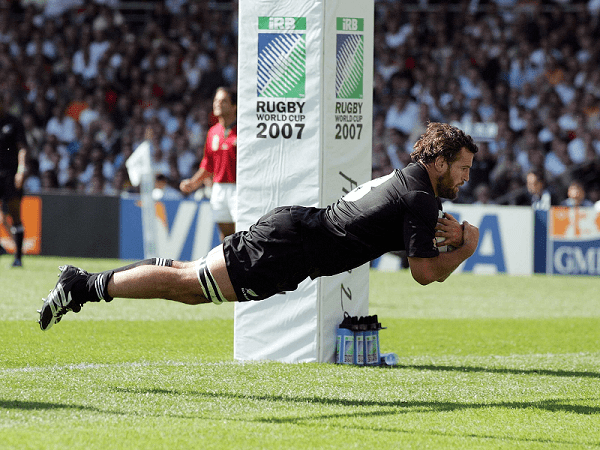
The first try of the second half would actually be scored by Portugal. In the 48th minute, loose-head prop Rui Cordeiro, who had come on at half-time, would burrow over from close range as the neutral crowd in Lyon went wild. Portugal had already earned plenty of supporters in France for their passion, particularly for the performances of their national anthem. Now, Rui Cordeiro had a moment he could remember forever, scoring a World Cup try against the All Blacks. Duarte Pinto would convert Cordeiro’s try for 52-10, and Portugal had left their mark on this game. However, scrum-half Brendon Leonard would take only two minutes to restart New Zealand’s try-scoring barrage. Fly-half Nick Evans would then stroll over, closely followed by Leonard’s replacement Andy Ellis, Leon MacDonald, Conrad Smith and a second try for Aaron Mauger. Portugal would again briefly halt New Zealand’s scoring with a 75th-minute penalty kick for 94-13. However, late tries by Smith and prop Carl Hayman would complete a 108-13 win for New Zealand, the heaviest victory of the 2007 Rugby World Cup.
New Zealand had scored 16 tries, and fly-half Nick Evans had scored 14 out of 16 conversions for a personal haul of 33 points. However, for a professional side dominating an amateur side, the All Blacks had fallen short of the 145 points they’d put on Japan in 1995. In the post-match interviews, Portugal coach Tomaz Morais would be positive despite the heavy defeat, hailing the day “an excellent day for rugby in Portugal and rugby across the world.” Morais would also praise his team’s performance, saying, “They have beaten good teams by 70 or 80 points, but we scored a try and played very well. All the players that came back today came as survivors, we couldn’t resist their physicality but we played rugby from the first to last.”
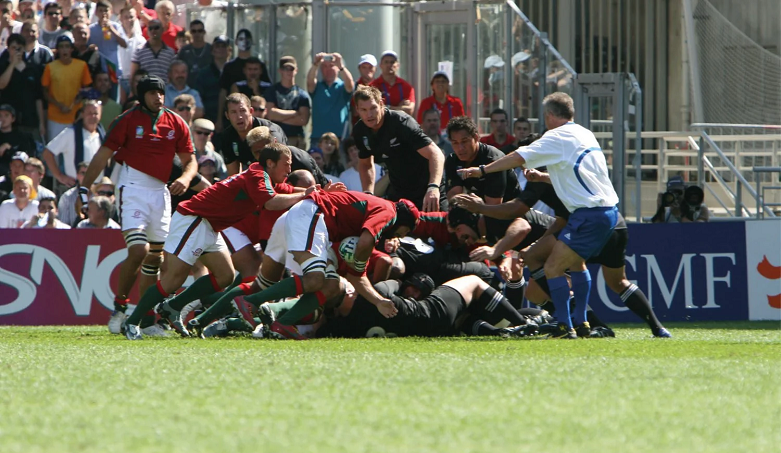
Portugal would end their first Rugby World Cup winless but remained competitive in a 31-5 defeat to Italy and a narrow 14-10 defeat to Georgia. They would leave France with plenty of new fans, and the mere presence of Portugal at the Rugby World Cup would help grow the game in Lisbon and beyond, producing a generation of players that would end up taking Portugal to a second Rugby World Cup when the competition returned to France in 2023.
5. France 96 Namibia 0, 2023
After Namibia’s heavy 87-0 defeat to South Africa in 2011 (see No.10), the next two Rugby World Cup tournaments would not see a single scoreline to challenge South Africa’s 87-point victory margin in Auckland. Namibia would still suffer comfortable defeats during this time as their search for an elusive first World Cup victory continued on fruitlessly, including a 64-19 defeat to Argentina in Leicester, a 58-14 loss to New Zealand in Wembley Stadium, a 57-3 drubbing by South Africa in Toyota and a 71-9 thrashing by the All Blacks in Chofu, the latter being the heaviest scoreline of the 2019 Rugby World Cup. However, while losing by 62 points still constitutes a heavy loss, it was far from the ‘training run’ scorelines of years past, as it seemed the gap between the best and worst teams in the Rugby World Cup was narrowing with each tournament.
However, the pool stages of the 2023 Rugby World Cup would see the return of some of those scorelines that many had thought were a thing of the past. After Romania had opened their World Cup campaign with an 85-8 to pre-tournament favourites Ireland, followed by a 76-0 shutout to defending world champions South Africa (the largest victory margin since the 2011 World Cup) in Pool B, Namibia would soon suffer a much heavier loss to another top side. The Welwitschas had remained fairly competitive with Italy before losing their opening match 52-8. However, the reality of the African team’s position was soon underlined with a 71-3 defeat by New Zealand, still smarting from their first-ever pool-stage defeat in a Rugby World Cup six days earlier. (This result alone constituted Namibia’s heaviest World Cup defeat since the loss to South Africa in 2011.)
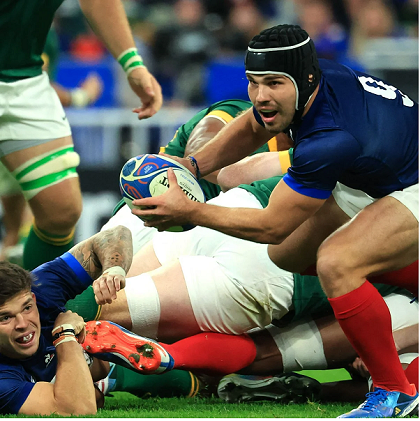
Having conceded 123 points in their first two matches, Namibia’s 2023 Rugby World Cup would not get any easier as the Welwitschas faced tournament hosts France, who had opened the World Cup by beating New Zealand 27-13 before a much-changed outfit was frustrated by an impressive Uruguay in a 27-12 victory six days later. However, for this game against Namibia in Marseille, French coach Fabien Galthie had picked a squad worthy of playing a World Cup final rather than a pool game against a team that had lost all 25 of its Rugby World Cup matches to date. While Namibia had made 10 changes to strengthen their side, France would call in world-class operators Thomas Ramos, Damian Penaud, Cyril Baille, Charles Ollivon, Jonathan Danty and captain Antoine Dupont. Barring the injured No.8 Gregory Alldritt, this was a full-strength France side looking to make a statement.
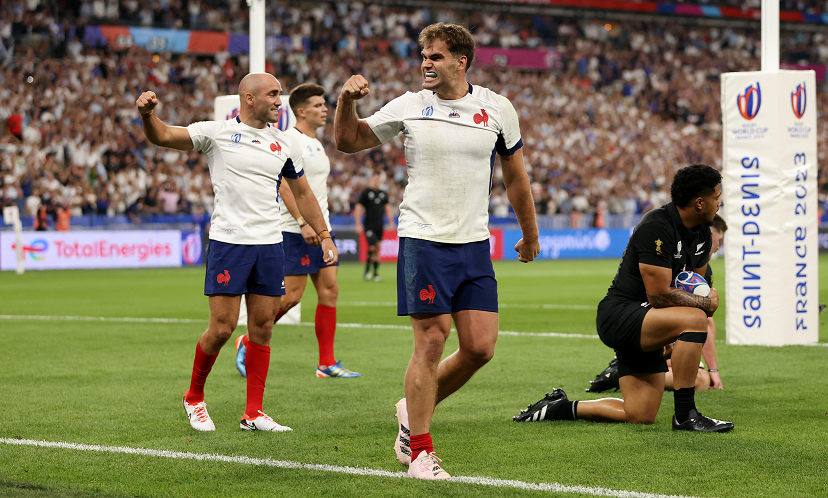
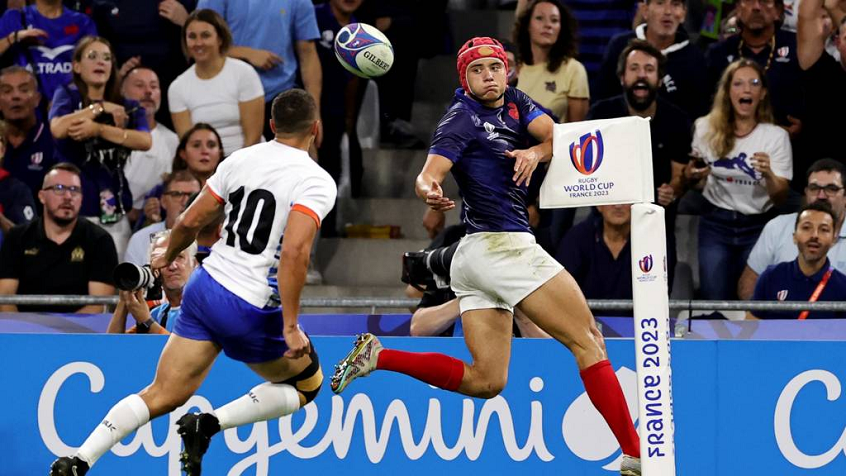
In the end, it wasn’t even close. In front of an amazing home crowd on the South Coast, France would put 14 tries past a sorry Namibia in a national record 96-0 victory. However, this statement result would be overshadowed by an incident during the match. The first score would come through France’s most lethal try-scorer, Damian Penaud, after 6 minutes. From a driving maul on the far left, Antoine Dupont would receive the ball before sending a superb crossfield kick across to the opposite touchline and into the waiting arms of Penaud, who would beat the covering defender to finish in the corner. It was the Clermont winger’s 10th international try of an extraordinary year. This try would also be the first of an eventual hat-trick that Penaud would score against the Namibians. After Penaud’s opener, the floodgates would open. A combination of fast ruck speed, a great passing variety and a devastating kicking game meant that the Namibian players were often left chasing shadows. By half-time, France had racked up 8 tries and a 54-0 lead at half-time. It was clear that the two teams were playing on different levels as the Namibia side, who had played 8 games between World Cups, were no match for the France team, which had played 39 matches during the same four-year period.

France’s onslaught would continue in the second half, but not at the same pace as in the first half. France would score a further six tries against a tiring Namibia, who failed to fire a single significant shot against their hosts in terms of points scoring. However, one single shot from a Namibian would create this game’s most memorable moment. Five minutes into the second half, Namibian captain Johan Deysel would try to tackle Antoine Dupont. However, in his attempt to tackle the little magician, the centre’s head would collide with the head of the scrum-half, with the pair hitting side-on. However, instead of a cheek-to-cheek collision bringing back memories of Fred Astaire and Ginger Rogers dancing, the force of the hit from Deysel would fracture Dupont’s right cheekbone. Within a minute, Dupont was off the field receiving treatment, and Deysel was sin-binned, a yellow card which would later be upgraded to a permanent red following a review from the referee bunker. Namibia would now play the remainder of the game without their captain and one player fewer, while Fabien Galthie and his players would have to hope that their captain hadn’t suffered a serious head injury.
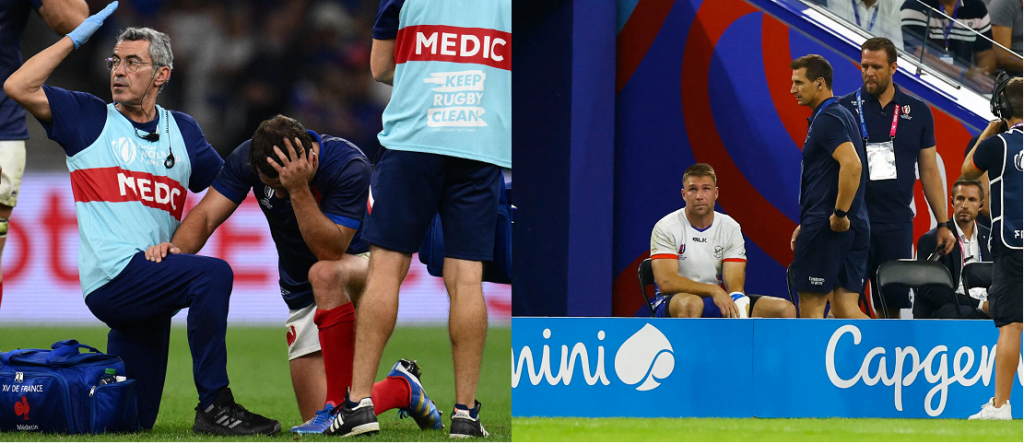
In total, France would put 14 tries past Namibia, with all but the opener and a final-minute penalty try being converted by the reliable boot of fullback Thomas Ramos. The victory was a World Cup record for France, replacing a 77-10 win from the 2007 World Cup, which also took place in France and was against Namibia. Along with Damian Penaud scoring France’s first World Cup hat-trick since 2011, centre Jonathan Danty, flanker Charles Ollivon and fellow winger Louis Bielle-Biarrey would cross the try-line more than once. The remaining tries would come from lock Thibaut Flament, Antoine Dupont, his replacement Baptiste Couilloud and replacement back Melvyn Jaminet, in addition to a penalty try. For Namibia, this defeat marked the second-largest of all their World Cup defeats, beaten only by one which happened 20 years earlier in Australia.
For those wondering, Antoine Dupont would later receive surgery on his fractured cheek and remarkably return to France’s starting XV for the team’s quarter-final against South Africa three weeks later. Wearing a scrum cap to cover his face, Dupont would put in an excellent yet bittersweet performance as the hosts were edged out by defending champions South Africa in an all-time classic World Cup game. Johan Deysel would receive a five-match suspension from World Rugby for his tackle on Dupont, missing Namibia’s final pool match against Namibia, where Uruguay would win an entertaining match 36-26, condemning Namibia to another winless World Cup and leaving the Welwitschas record at 0 wins and 27 losses.
4. New Zealand 101 Italy 3, 1999
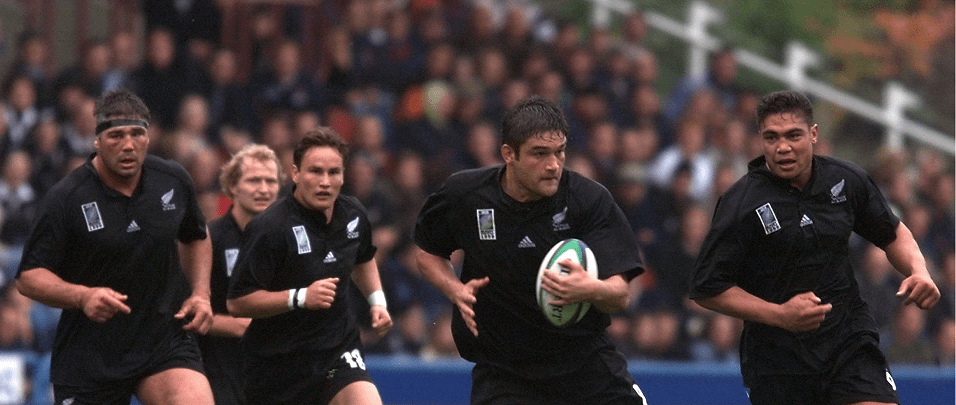
The day before England put 101 points past Tonga at Twickenham at the 1999 Rugby World Cup (see No.7), New Zealand put the same amount of points past a sorry Italian team in Huddersfield. In their two matches before facing Italy, the All Blacks had put four tries past Tonga and three past England. In their two matches before facing New Zealand, Italy had conceded eight tries against England and three against Tonga. At the McAlpine Stadium, a stadium normally used for rugby league, New Zealand would run riot, scoring 14 tries in a 101-3 victory.
This match in Huddersfield marked only New Zealand and Italy’s third Rugby World Cup meeting. The first occasion came back in 1987, as the two countries played out the first-ever match in the competition’s history. On that day, New Zealand had run riot, scoring a dozen tries in a 70-6 win, where a dog even ran onto the pitch to help John Kirwan score. Four years later, New Zealand had won a much closer affair 31-21 at Leicester’s Welford Road. The All Blacks entered half-time with a 16-3 lead after two tries and two Grant Fox penalties, and an early second-half try would extend this lead out to 22-3. Italy would attempt to come back as a Diego Dominguez penalty, and a Marcello Cuttitta try cut the All Blacks lead in half at 25-12. However, a fourth New Zealand try would secure victory, and a late Azzurri fightback would not change that.
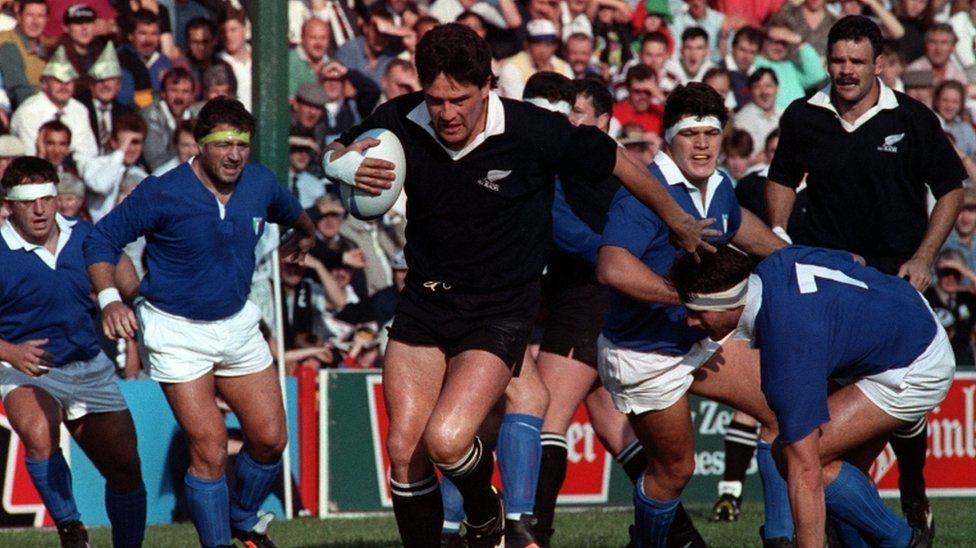
When New Zealand and Italy met in the final round of pool matches at the 1999 World Cup, Italy had improved since 1991, landing a series of victories over Tier 1 rugby nations between 1995 and 1999, beating France, Scotland and Ireland three times. However, the Azzurri’s World Cup campaign had not gone well, with two defeats putting them at the exit door before they even faced New Zealand. If they failed to beat the All Blacks this time, Italy would suffer their first winless World Cup tournament, having registered one win in each of the previous three. However, the All Blacks had never lost a pool match at the Rugby World Cup, and the record seemed likely to remain unblemished after their match with Italy.
In Huddersfield, fly-half Tony Brown would open New Zealand’s account with a 5th-minute penalty before fullback Jeff Wilson accentuated the All Blacks’ fast start with a try two minutes later. Winger Glen Osborne would break the line on halfway and make 15 metres, and the next phase would finish with centre Daryl Gibson moving through a gap, holding a defender and passing to Wilson to run in. Brown would convert to take the All Blacks into double figures after 8 minutes, but Italy would get on the scoreboard with a Diego Dominguez penalty to end the first 10 minutes. Another Brown penalty in the 16th minute would extend New Zealand’s lead to 10 points before the fly-half scored his team’s second try six minutes later to take his team out to a 20-3 lead. The score would remain unchanged heading into the final 10 minutes of the first half when New Zealand upped the pressure on Italy and scored 4 tries in 8 minutes. Flanker Dylan Mika would pick up and dive over from five metres (30’), Jonah Lomu would carry the ball over from the back off a dominant New Zealand maul (34’), Jeff Wilson would score his second try from a breakaway one minute later, and Glen Osborne would complete the try-scoring for New Zealand’s back three by finishing an excellent 80-metre team try (38’). The flurry of scores would boost New Zealand’s score to 51-3 at half-time, effectively ending the match as a contest.
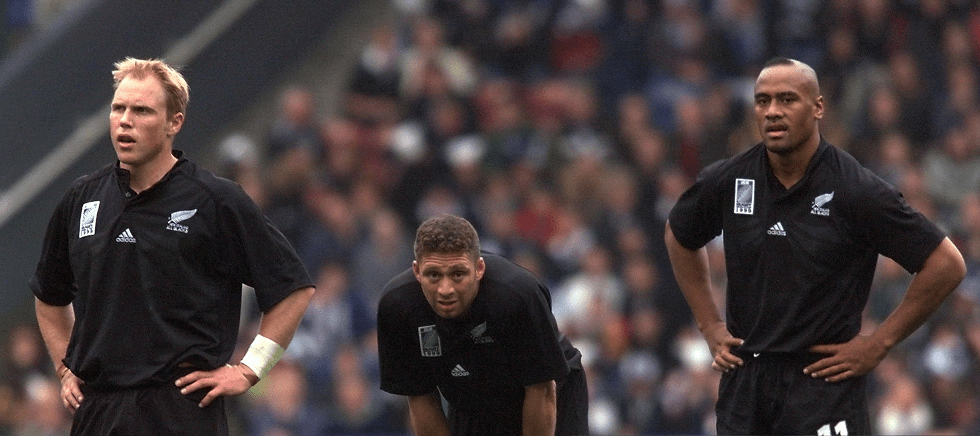
The second half would follow a similar pattern to the first, with the All Blacks scoring tries in short flurries of action. The first eleven minutes would pass by without a score before Jeff Wilson completed his hat-trick, Jonah Lomu rampaged down the wing for his second try, and All Blacks captain Taine Randell even got on the board, all within the 53rd and 58th minute to take New Zealand’s score to 70-3, eclipsing the score from 1987. Italy would manage to stem the onslaught for a full 10 minutes, only for the All Blacks to fire up once more and land five more tries in the final 12 minutes of the match. Daryl Gibson would go over the corner in the 69th minute to score his first All Blacks try after great work from Tony Brown, Jeff Wilson and Glen Osborne. Those same three players (in that order) would then set up replacement Scott Robertson to score an almost carbon-copy try four minutes later. The great Christian Cullen would then score his only World Cup try by combining with Brown, Wilson and Osborne, supporting the latter’s break on halfway to go over unopposed. Hooker Mark Hammett would then charge over after receiving a tap penalty before Glen Osborne ended proceedings with a deserved second try in overtime. Tony Brown would then land an impressive touchline conversion to take New Zealand past the 100-point mark and finally end Italy’s humiliation.
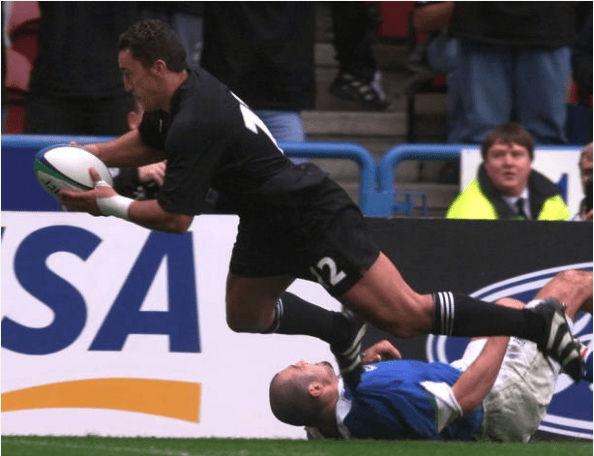
While this match was only New Zealand’s second-biggest World Cup victory, the 101-3 scoreline was a record Rugby World Cup defeat for Italy, beating the 70-6 loss to New Zealand from 1987. However, this 1999 game was not the first time Italy conceded 100 points in an international test. This match wasn’t even the first time Italy had conceded 100 points in a test match in 1999. In a warm-up match for the 1999 World Cup, Italy had lost 101-0 to South Africa in June, conceding nine tries in Durban. Diego Dominguez’s first-half penalty in Huddersfield was the only thing keeping the World Cup match from equalling that scoreline. Italy was set to join the Five Nations Championship four months after this World Cup, forming the Six Nations. Losing all three matches and finishing bottom of their 1999 World Cup pool, plus twice conceding 101 points in defeats to South Africa and New Zealand within the same calendar year, did not make for good news ahead of that move.
3. England 111 Uruguay 13, 2003
England’s 2003 Rugby World Cup win is now enshrined as one of the greatest moments in English and even British sporting history. The team coached by Clive Woodward (later knighted for his efforts) and captained by Martin Johnson went to Australia as the best team in international rugby and returned as world champions and sporting icons. Jonny Wilkinson’s match-winning extra-time drop goal in the World Cup final has become one of the defining images of rugby union while turning the fly-half into one of the few rugby stars to become famous outside of the sport. However, none of that stuff is important here. The only reason this England team is being talked about here is because this team produced the 3rd-biggest victory in World Cup history en route to lifting the gold trophy.
This record World Cup victory for England occurred in the team’s final pool match, by which point qualification to the knockout stages had already been secured. Clive Woodward’s team had opened their World Cup campaign with an 84-6 victory over the debuting Georgia. Ben Cohen and Will Greenwood would score braces in an easy 11-try win for the Six Nations champions. However, the tournament favourites would require two big second-half performances to win matches against South Africa and Samoa. In what was predicted to be the most difficult match beforehand, a second-half try from Will Greenwood plus 14 points (including two drop goals) from Jonny Wilkinson saw England defeat South Africa 25-6 after the two teams were drawn at half-time. Then, the World No.1 side was given a huge scare by an impressive Samoan side. With 17 minutes to go, Samoa was on the verge of pulling off the World Cup’s biggest-ever upset, leading 22-20, only for two tries and a Wilkinson penalty to bring England home 35-22 winners, with a winning margin that flattered them. The Samoa win secured England’s place in the quarter-final. As a result, the team that produced England’s record Rugby World Cup victory in the team’s final pool match was a much-changed second-string team featuring 11 changes and captained by prop Phil Vickery.
The victim of England’s three-figure points scoring was a Uruguay team whose pool-stage elimination was already secured but had also managed to achieve their goal for the tournament. The 2003 Rugby World Cup was the second to feature Uruguay. In 1999, Los Teros won their first Rugby World Cup match, defeating fellow debutants Spain 27-15 before falling to comfortable defeats against Scotland and South Africa. In Australia, Uruguay had again lost to South Africa, this time by a much heavier 72-6 scoreline, before getting pasted 60-13 by a good Samoa side. However, Uruguay had entered this 2003 World Cup intending to win at least one match, and Diego Ormachea’s side would achieve this by defeating Georgia 24-12 in Sydney. With that box now ticked, the game against England was a free hit. Anything other than a comfortable victory for England would be a huge shock, but Uruguay would try their best to remain competitive for as long as possible.
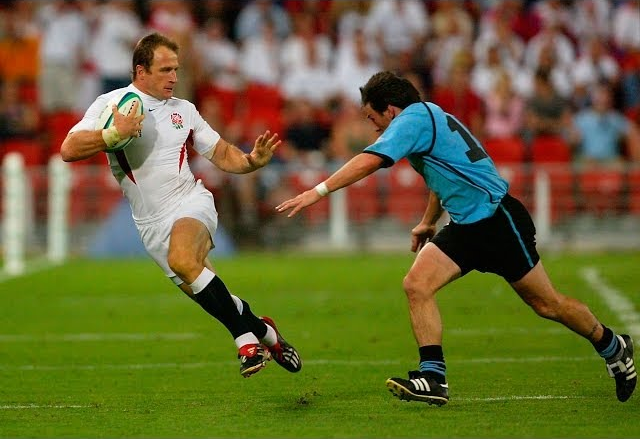
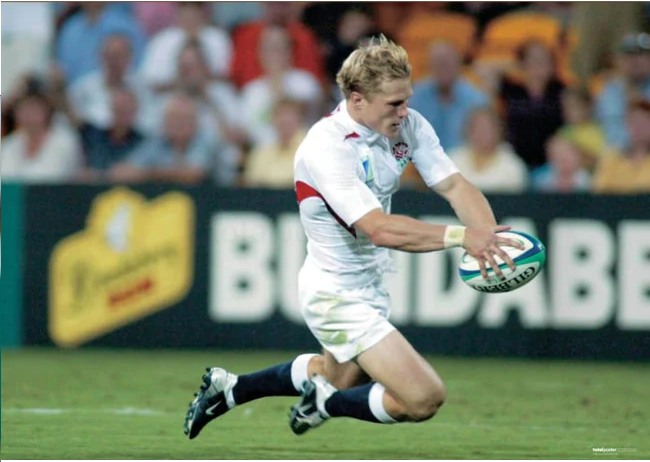
England would start quickly in Brisbane, as the first try would come when flanker Lewis Moody jogged over in the corner after three minutes. However, Uruguay would respond immediately, forcing a penalty in England’s 22 that fullback Juan Menchaca would kick through the posts for 7-3. The South American underdogs would then frustrate the World Cup favourites in these early stages, making life hard in the scrum and even earning themselves another penalty that Menchaca would miss from wide on the left. That missed opportunity to go one point behind England on the scoreboard so early would soon cost Uruguay as England would quickly score three tries in six minutes to create a significant buffer that Uruguay would never breach. Dominant scrums would lead to fullback Josh Lewsey and winger Iain Balshaw sprinting past retreating defenders with ease before the latter scored his second try, weaving through the Uruguayan defence despite first dropping the ball behind himself. With fly-half Paul Grayson note-perfect on the conversion kicks, England was now 28-3 up midway through the first half and could now start to relax. They almost relaxed too much as Uruguay spent the next 10 minutes in the England 22, looking for a historic try. After these long passages of play eventually ended in Uruguay knocking the ball forward, England would get two more tries before half-time, both involving the influential Andy Gomarsall. Firstly, the scrum-half’s quick lineout in his own half would lead to Iain Balshaw again breaking the Uruguay defence before an exchange of passes with Josh Lewsey would eventually finish with centre Mike Catt scoring a truly incredible try. Then, Gomarsall would himself cross the try line, dodging his way through a gap from close range. After all these England tries, Uruguay would have the last say of the first half with a second successful penalty from Juan Menchaca, but the South American side had already been run ragged by the Six Nations champions, who led 42-6 at half-time.
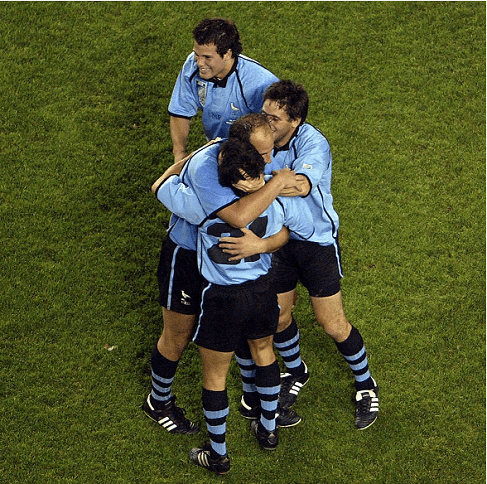
It would not take England too long to get back into scoring form after the break, with Josh Lewsey (scoring his second) and Dan Luger both getting tries inside four minutes of the restart. However, the most significant moment of the game would come in the 47th minute of play. Uruguay would earn a series of penalties in the England 22, kicking to the corner each time. Eventually, scrum-half Juan Campomar would send a reverse pass to Pablo Lemoine on his inside, and the prop would break through two tackles to score his second try of the World Cup, but Uruguay’s first-ever try against England. It was a significant try as Lemoine was Uruguay’s first-ever professional rugby player, so for him to score against the best professional side in the world was certainly something for fans to celebrate back in Montevideo. Lemoine’s try was only the second that England had conceded in four matches at this Rugby World Cup, the former Bristol Shogun breaking through a stern English defence. Juan Menchaca would convert Lemoine’s try for a 52-13 scoreline early in the second half.
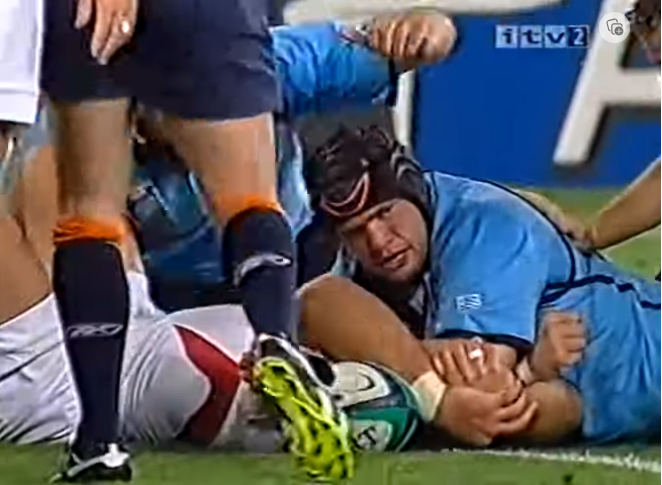
However, Uruguayan celebrations were short-lived as centre Stuart Abbott sidestepped his way through would-be tacklers to get England back to scoring less than two minutes after Uruguay’s try. From then on, it was one-way traffic in favour of the World’s No.1 side. Abbott’s try was the first of five England tries in 10 minutes as England’s lead jumped from 52-13 to 87-13. Josh Lewsey would add tries three and four to his personal account, Andy Gomarsall would get a second, and even replacement winger Jason Robinson would take advantage of great handling to speed past tiring Uruguayan bodies. Uruguay would stop the rot for all of five minutes before England scored four more tries to complete their rout. Will Greenwood would cross, Jason Robinson would complete his brace, Mike Catt would break the century of points for England, and a fifth and final try for Josh Lewsey would bring England’s score up to 111-13. Uruguay would have one last passage of attack before the final whistle, but winger Joaquin Pastore would knock on from his own kick forward, and the game was over. A record Rugby World Cup victory for England, a dominant performance from England heading into the knockout stages, but still something for Uruguay to take away and celebrate from this game.
England would score 17 tries against Uruguay, with nine players crossing the whitewash. Josh Lewsey would take the headlines with his five tries, becoming only the second England player (after Mike Harrison in 1987) to register a World Cup hat-trick and only the third player in Rugby World Cup history to score five or more tries in a single match. Meanwhile, Iain Balshaw, Mike Catt, Andy Gomarsall and Jason Robinson would all score twice, and Lewis Moody would be the only England forward to cross the try-line in this back-heavy display. England’s fly-half Paul Grayson would also have a lucrative day from the boot, getting 22 points from conversions. Not a patch on the 36 he managed against Tonga four years earlier, but still a good return.
Uruguay would exit the 2003 Rugby World Cup following this heavy defeat, finishing 4th in Pool C but still heading home with a victory their names. England, meanwhile, would famously go on to win the 2003 Rugby World Cup, becoming the first, and so far, only Northern Hemisphere country to lift the William Webb Ellis Trophy.
2. New Zealand 145 Japan 17, 1995
Over the past decade, Japan has been one of the best international teams to watch outside the established Six Nations and Rugby Championship teams. Under the stewardship of Eddie Jones and then Jamie Joseph, the Brave Blossoms have wowed rugby fans worldwide with their exciting brand of attacking play and never-say-die spirit. The work put into developing the Japanese system resulted in the 34-32 victory over South Africa at the 2015 World Cup, now known as the ‘Brighton Miracle’, and a run to the quarter-finals of a home World Cup in 2019 after victories over Scotland and World No.1 side Ireland saw them top their pool with a 100% winning record. All this work saw World Rugby ratify Japan as a Tier 1 rugby nation in 2023.
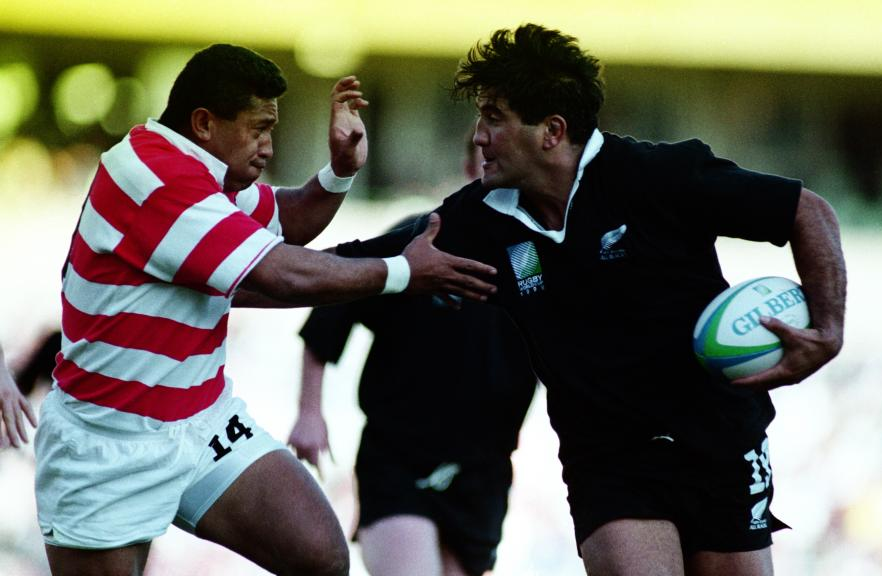
However, alongside those historic recent Rugby World Cup victories, Japan is also burdened by having the unwanted record of conceding the most points in a single Rugby World Cup match. That unfortunate record was earned in a 145-17 defeat to New Zealand at the 1995 Rugby World Cup in South Africa. The game was the final one for both teams in the pool stage of the competition. New Zealand was set to top Pool C and progress to the quarter-finals, while Japan knew they were heading home. The victor and scoreline were also very predictable, with New Zealand having comfortably beaten Ireland 43-19 and Wales 34-9, while Japan had let in half a century of points against those two countries in 57-10 and 50-28 losses. However, no one expected New Zealand to become the first team to register triple figures in a Rugby World Cup game. Not that people wouldn’t expect New Zealand to achieve such a feat. It’s just that for one team to concede over 100 points in a rugby match was unheard of then.
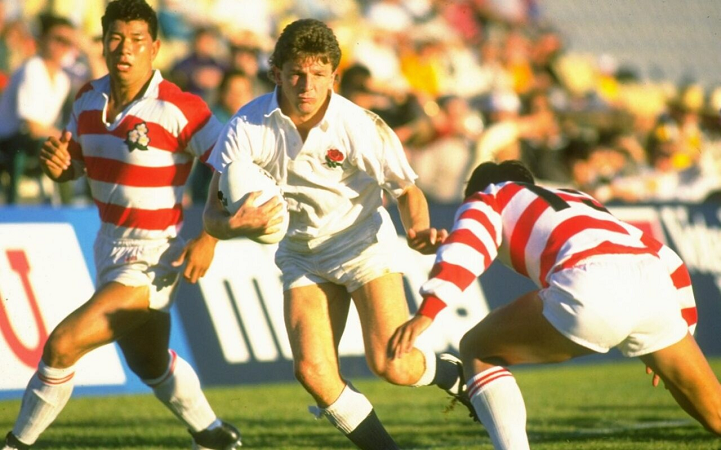
The record scoreline for a World Cup game before New Zealand vs Japan was the 89-0 drubbing that Scotland gave to the Ivory Coast at the beginning of the 1995 pool stages. Scotland’s pasting of the Ivory Coast could be attributed to the tournament veterans Scots, who also played more regular rugby, teaching a harsh lesson to the debuting Elephants. Japan had appeared in every Rugby World Cup to this point. The Brave Blossoms entered this match against New Zealand with an overall World Cup record of 1 from 8 matches. The team had received their fair share of hefty World Cup defeats, but their largest had also occurred on their competition debut in 1987, losing 60-7 to England. Therefore, while a comfortable victory was expected for New Zealand over Japan in Bloemfontein on 4th June, nobody would even dare to predict the size of the All Blacks’ victory on this day.
It would take less than two minutes for winger Eric Rush to score New Zealand’s first try of the afternoon, with fly-half Simon Culhane (in place of the rested Andrew Mehrtens) converting the try. By the 20-minute mark, New Zealand had already crossed the Japanese try-line six times, all converted by Simon Culhane for a 42-0 advantage. Culhane would even get five points for himself in the 25th minute, converting his touchdown to take the All-Blacks lead to 56-0. Japan would finally get on the scoreboard in the 33rd minute when fly-half Keiji Hirose landed a penalty between the posts, ending the All Blacks’ run of 10 tries and 70 unanswered points. The minute after Hirose’s successful kick, Jeff Wilson would cross the whitewash for New Zealand’s 11th try, and the onslaught would resume. When Canadian referee George Gadjovic blew his whistle for half-time, New Zealand led Japan 84-3, only 8 points short of Scotland’s record winning margin over the Ivory Coast. Two tries in the first three minutes of the second half would quickly take New Zealand into the history books.
The second half would see Japan score two tries of their own, even if these scores only acted as brief respites to break up the mechanical scoring of the 1987 world champions. In the 48th minute, Japan outside centre Akira Yoshida bounced off a New Zealand tackler before feeding blindside flanker Hiroyuki Kajihara to dive over from five metres out. Keiji Hirose would convert the try and take Japan into double figures. Two minutes later, loose-head prop Craig Dowd would burrow over from close range to take New Zealand into triple figures at 103-10. Japan’s second try in the 65th minute would also come from Kajihara. Fullback Tsutomu Matsuda would make a line break into the New Zealand 22 before finding the flanker on a support line to score his second try of the afternoon. Hirose would again convert to make the score a slightly healthier 110-17. However, as mentioned previously, these Japanese tries were only breaks from the All Blacks’ hunger for tries. A further five converted scores in 14 minutes would come from the men in Black as New Zealand eventually finished 145-17 winners.
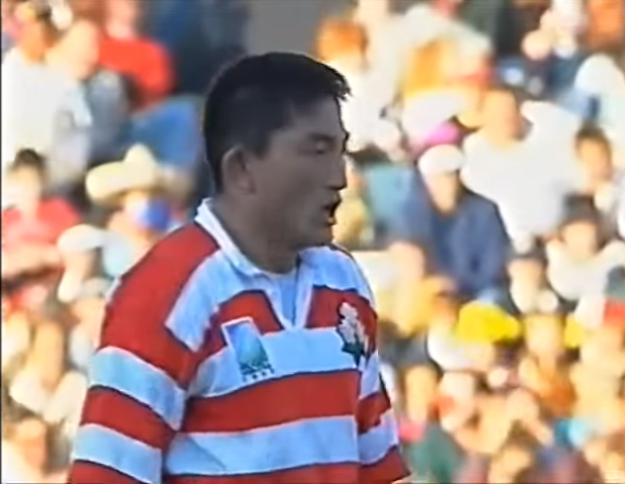
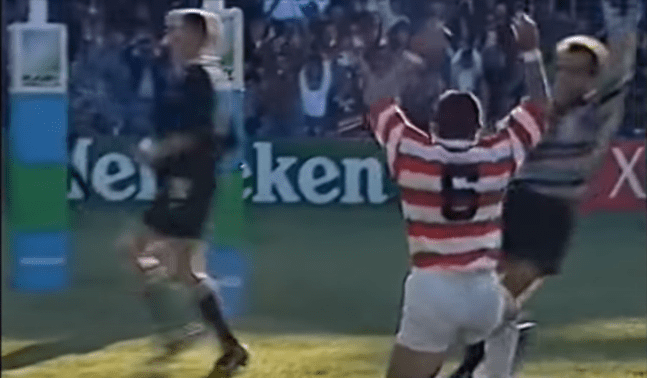
On this day, New Zealand scored 21 tries past Japan, with 10 different players crossing the whitewash. Fly-half Simon Culhane, props Craig Dowd and Richard Loe, centre Alama Ieremia and flanker and captain Paul Henderson would all cross once. Fullback Glen Osborne and lock Robin Brooke would end up with braces. The two All Blacks wingers, Eric Rush and Jeff Wilson, would both score their first World Cup hat-tricks, eventually being among three New Zealand players to finish the game with three or more tries. However, no All Blacks player could match outside-centre Marc Ellis, who would end the game with an almighty six tries, providing 28.5% of his team’s touchdowns. Before this game, no player in Rugby World Cup history had scored more than 4 tries in a single tournament match. Ellis had smashed that record with his half-dozen, setting a record that is unlikely to ever be broken. Another record from this match came from the metronomic boot of Simon Culhane. Along with his single try, Culhane would successfully convert all but one of his team’s 21 tries. The fly-half would finish this match with 45 points, the most ever recorded by one player in a single Rugby World Cup match. He would take the record off Gavin Hastings, who had set the standard with 44 points in the 89-0 victory over the Ivory Coast mentioned earlier.
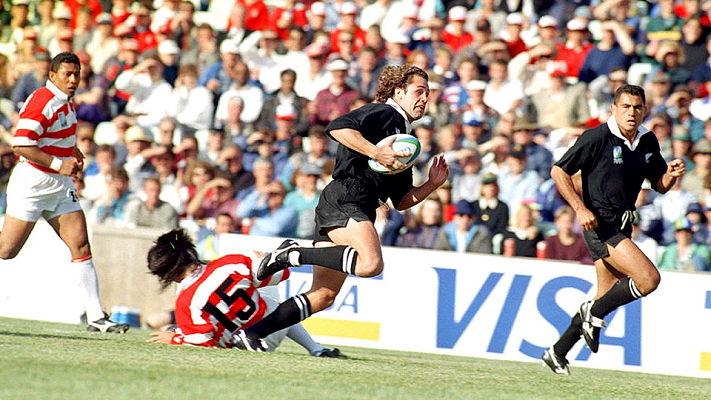
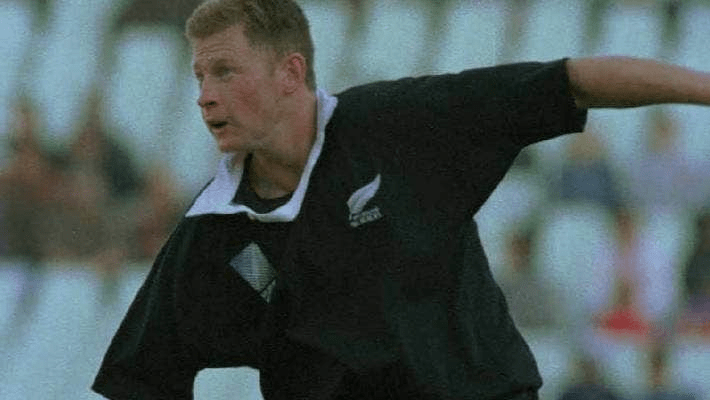
Following this match, New Zealand would eventually reach the 1995 World Cup Final to face the home nation South Africa after high-scoring but competitive wins over Scotland and England. The All Blacks would eventually fall short to Francois Pienaar and his men.
Neither New Zealand nor Japan has managed to beat their match in Bloemfontein. The 145-17 scoreline remains a record win for the All Blacks and a landmark defeat for the Brave Blossoms. The score would stand as a Rugby World Cup record thought unbeatable for eight years, a record that could have lasted even longer if a young Jonah Lomu hadn’t been rested for this match. However, in 2003, one game would ludicrously better this scoreline.
1. Australia 142 Namibia 0, 2003
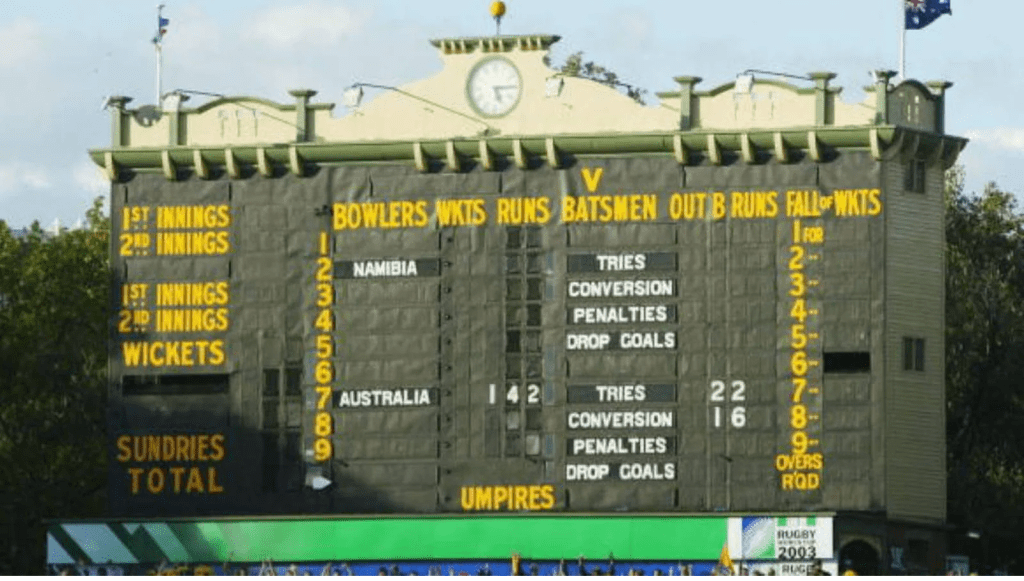
We end this list how we began, with Namibia suffering a heavy loss in the Rugby World Cup pool stages. After discussing the Welwitschias’ drubbings by South Africa in 2011 and France in 2023, it is time to look back at Namibia’s worst rugby experience, an experience that the rugby world will never forget, for better or worse. On 25th October 2003, Namibia would face defending world champions and World Cup hosts Australia in the Adelaide Oval in the third round of the 2003 Rugby World Cup pool stages.
Namibia would enter their match against Australia still looking for their first-ever Rugby World Cup win after five defeats from five across two tournaments. After finishing bottom of the group on debut at the 1999 tournament, the Welwitschas had conceded 60 points in both of their 2003 pool matches in defeats to Argentina (67-14) and Ireland (64-7). Across both matches, Namibia had scored three tries and conceded twenty, scoring 21 points and conceding 131. They would face an Australia team who had recovered from an unimpressive opening-night 24-8 win over Argentina by putting a baker’s dozen of tries past Romania in a 90-8 battering. With Namibia considered a weaker side than Romania, Australia would aim to top that performance against Namibia in Adelaide.
Knowing that his team was facing one of the weakest sides in the World Cup, Australia head coach Eddie Jones would make 12 changes to his starting XV, including giving Stirling Mortlock, Matt Giteau and Lote Tuqiri their first starts of the tournament, all of whom would later become regulars in the knockout stages. He wouldn’t have thought these changes would lead to such an expansive performance.
Ultimately, things might have been better for Namibia in Adelaide if they hadn’t shown up. At times, the rate of tries scored and the ease by which Australia scored them resembled a training match for the Wallabies rather than anything competitive. It would take less than three minutes of play for Australia to score their first try. Winger Lote Tuqiri would break down the flank before sending a one-handed offload outside to fullback Chris Latham to stroll in. Loose forward David Lyons would evade two tackles to score from close range three minutes later, and Latham would double his account for the day three minutes after that. Stirling Mortlock would then secure Australia’s bonus point after a dozen minutes (12 MINUTES) when he broke between two tackles and shrugged off another to score right next to the posts. Chris Latham would then complete his second international hat-trick inside 24 minutes to score Australia’s seventh try after Lote Tuqiri and a penalty try had also helped to give the Wallabies a 47-0 advantage. Winger Mat Rogers would receive the ball on the halfway line and sprint down the left wing before cutting inside and dodging three drifting Namibian tacklers to take Eddie Jones’s team over a half-century of points just past the half-hour mark. Hooker Jeremy Paul, a second try for Tuqiri and a fourth for Latham would then send the reigning world champions into half-time with a 69-0 lead.
With this deficit, Namibia had already conceded more points in this first half against Australia than they had conceded across 80 minutes against Argentina or Ireland. At this point, the gulf in quality between the two teams was gaping. The Welwitschias were already chasing shadows as Australia seemed to gain ground with every Namibian tackle, with little chance of being stopped. With the threat of more points on the way and Namibia having to expend energy just to stop their more experienced opponents, this match was already set to become a nightmare for Namibia.
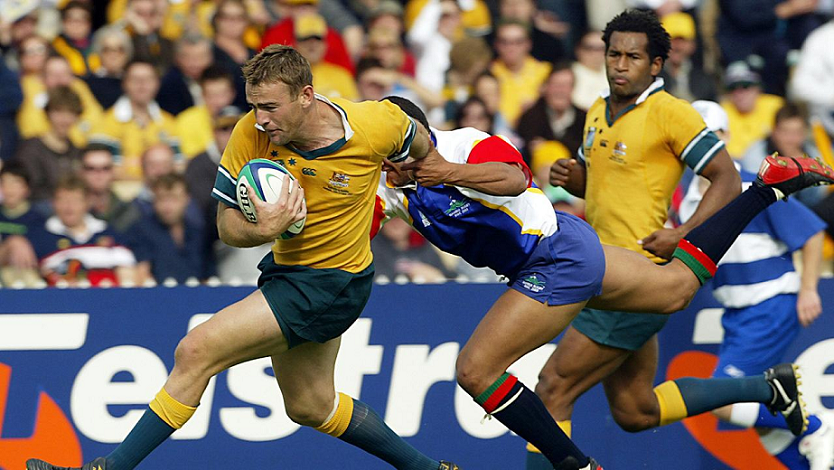
In the second half, Namibia would have to limit the damage they took while hoping to take whatever chances they could get to score any points and avoid being shut out on the scoreboard. Two minutes after the restart, fly-half Matt Giteau would touch down for his first of an eventual hat-trick of tries and take Australia out to 76-0. In the third quarter, Giteau would complete his hat-trick in 12 minutes, Lote Tuqiri would complete his personal treble of tries, and centre Nathan Grey and his replacement Morgan Turinui would also touch down. All these tries would send Australia into the final 20 minutes leading 109-0. By this point, the Wallabies had already smashed their record Rugby World Cup victory over Romania from the previous week, yet they were still not done. The World Cup holders would instead run in a further five tries in 15 minutes to deepen Namibia’s humiliation. Replacements Turinui, Matt Burke and John Roe would leave their mark on proceedings, Mat Rogers would complete a personal brace and Chris Latham, the man who had started the try procession, would score his 5th and final try with three minutes remaining to leave Australia as 142-0 winners. When the final whistle blew, Australia didn’t celebrate their record victory, almost feeling embarrassed for their unfortunate opponents.
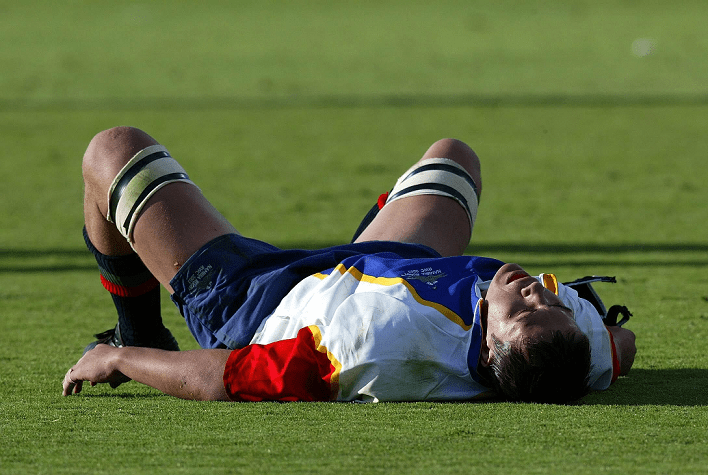
Australia’s 142-0 win over Namibia would become the Rugby World Cup’s biggest-ever victory. The Wallabies had become only the third country (after New Zealand and England) to score over 100 points in a single World Cup match. They had achieved both feats by scoring a World Cup record 22 tries past their Southern African opponents (an average of one try every 3.5 minutes) and 32 points from Mat Rogers’ boot. Adding two tries to his tally, Mat Rogers would finish with 42 points to his name, the most an Australian player had ever scored in an international Test match. However, his kicking record and Australia’s record winning margin could have been even more incredible. Of the twenty-two conversions he attempted throughout the game, Rogers only successfully kicked 16, leaving a possible 12 points on the field. If the winger had finished with a 100% record from the kicking tee, Australia would have ended as 154-0 winners over Namibia, with Rogers finishing with a World Cup record of 54 individual points. However, I doubt neither Australia nor Namibia cared too much about those statistics.
Following this match, Namibia would lose 37-7 to Romania (the second-weakest team in Pool A) in their final pool match, finishing bottom of Pool A without a win. The Welwitschias record would leave them the worst-performing team at the 2003 Rugby World Cup. Meanwhile, Australia would edge Ireland 17-16 to top Pool A and eventually reach the World Cup final before losing 20-17 to England after extra time after Jonny Wilkinson’s now-iconic, last-minute drop goal.
 the-score-board.co.uk