
The nine months that ‘King George’ spent playing in England…
When experts write lists detailing the best players to never feature at a FIFA World Cup, George Weah’s name is often ranked highly. To be put in the same company as players like Alfredo di Stefano and George Best, two icons of their respective eras, helps you understand how vital George Weah was to his era of football. Playing internationally for Liberia, a country not known for its footballing prowess, the closest Weah came to international success was two group-stage exits at the 1996 and 2002 African Cup of Nations tournaments. The closest he would get to a World Cup was the 2002 edition in Japan and South Korea when Liberia finished 1 point behind Nigeria in their final qualifying group. You may wonder how a player from Liberia is talked about in the same conversations as Alfredo di Stefano and George Best, but then you wouldn’t know George Weah. As the only African player to win the Ballon D’or and FIFA World Player of the Year awards, to never grace the biggest stage in international football is a shame. I’m sure George Weah doesn’t mind though, considering he is now his country’s head of state.
George Weah’s impact on African football is equivalent to that of Samuel Eto’o and Didier Drogba, two players who reached the peak of European club football. During his time playing for Monaco, Paris St-Germain and AC Milan, Weah was one of the best players of the 1990s. He is also credited, along with Ronaldo and Romário, for revolutionising the centre-forward position, changing it from being a player who stays within the 18-yard box to one who can receive the ball deep, run with the ball towards goal and score from anywhere. Weah’s FIFA.com profile even describes him as “the precursor of the multi-functional strikers of today. Quick, skilful and boasting a powerful physique, fierce shooting power and deadly finishing skills”.
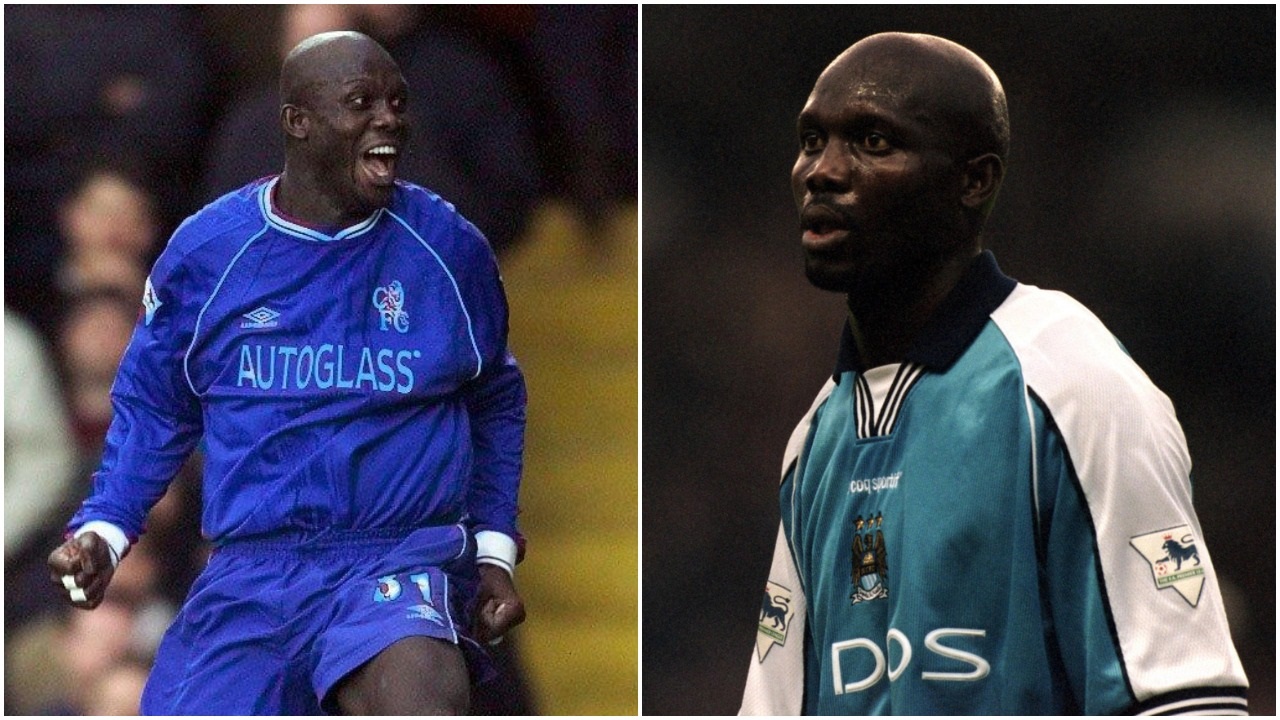
A man who won eleven domestic trophies during his career but never a European club competition, George Weah is remembered well for his time at Monaco, PSG and AC Milan between 1988 and 1999. However, a less regarded period is the nine months that a 33-year-old Weah spent playing for Chelsea and Manchester City in 2000. Twenty-four games played in all competitions across both clubs. A combined 18 Premier League appearances. Nine goals were scored, including four in the league. George Weah’s time in English football is a short but fascinating tale where you often whether it even happened. One of the best players of the previous decade turns out for an upwardly mobile team attempting a title challenge and a newly-promoted side looking to make a big splash. But what happened once the man nicknamed ‘King George’ arrived on England’s shores? Find out soon.
Before The Premier League: Building George Weah’s Legend
“Weah was a real surprise. For me, it was like a child discovering a chocolate bunny in his garden at Easter. I have never seen any player explode onto the scene like he did.“
That quote comes from the one and only Arsene Wenger. Wenger brought a 21-year-old George Weah to Monaco in 1988 for the small sum of £12,000. After debuting aged 18 in 1985, Weah would end his first two seasons of senior football as a league champion, taking the Liberian national title with Mighty Barrolle and Invincible Eleven. After a brief stint in the Ivory Coast, Weah would move to Tonnerre Yaoundé, the champions of Cameroon, later in 1987. Impressing with 14 goals in 18 league matches, Weah’s performances would catch the eye of the Cameroon national team coach, who would recommend him to Arsene Wenger, suggesting that he should take him to Monaco. Wenger would take this advice and sign the young striker to the French champions in August 1988, adding him to a squad featuring Patrick Battiston, Mark Hateley and Glenn Hoddle.
George Weah would make his Monaco debut as a 59th-minute substitute in a 2-1 defeat to Auxerre on 17th August 1988. In his fourth match, Weah would star in a 4-1 win over Strasbourg, scoring twice. He would also score in his next three games in all competitions, in the league against Montpellier and Marseille and in the European Cup against Valur Reykjavik. From there, Weah was off to the races. During his first season in European football, he would score 17 goals in 28 matches in all competitions, with an impressive 14 scored in 23 games in the league. Weah’s goals would not be enough to see Monaco defend their French crown, but the team would reach the Coupe de France final, where they would lose 4-3 to Marseille. George Weah’s performances during his first season in Monaco would earn him the African Footballer of the Year award for 1989.
Injuries would limit Weah to 5 goals in 17 league appearances the following year, but he would play every game but one in Monaco’s run to the semi-finals of the UEFA Cup Winners’ Cup, scoring 3 in 7 games. The 1990-91 season would finally see George Weah earn his first silverware in European football as Monaco would beat Marseille 1-0 to win the Coupe de France. This result was a reversal of the Ligue 1 season where Arsene Wenger’s team had lost out on the league title by four points to Raymond Goethals’ side. George Weah would play the full 90 minutes in the Coupe de France final, ending a season where he had been Monaco’s top scorer, with 18 goals in 40 matches. The following year, he would improve, finding the net 23 times in 47 games (18 in 34 in the league) as The Monégasques again finished as league runners-up and reached the 1992 final of the UEFA Cup Winners’ Cup. However, Weah’s first shot at continental glory would end in defeat, as Werder Bremen would defeat Arsene Wenger’s team 2-0 in Lisbon.
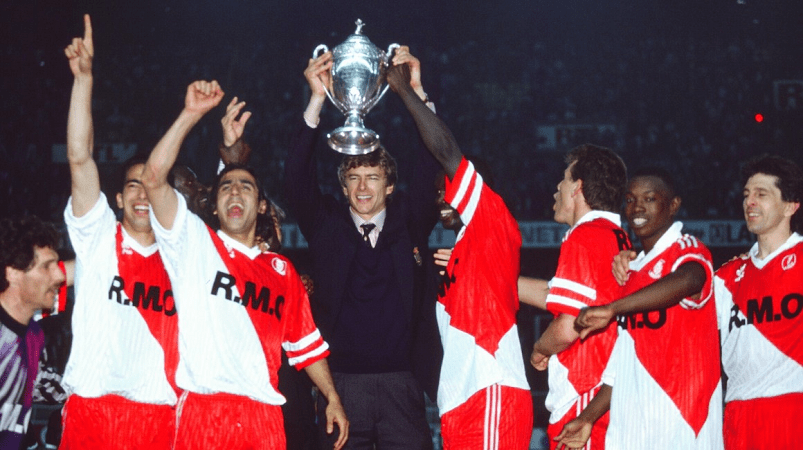
The summer of 1992 would see George Weah move to Paris St-Germain, who had finished 3rd in Ligue 1 the previous year. His first season in the French capital would see Weah win his second Coupe de France, finish league runner-up to Marseille for a third successive season and reach the semi-finals of the UEFA Cup. Weah would top score for PSG in the league (14 in 30) but he would be most effective during the team’s European campaign, netting 7 goals in 9 matches. The following season would finally see George Weah lift the Ligue 1 trophy as PSG ended Marseille’s run of five titles in a row to become national champions for the first time since 1986. Notably, this campaign would see the Parisians go a record 27 league matches without defeat en route to claiming the gold. Unfortunately, history would soon repeat itself in another European competition for George Weah as PSG would fall short in the UEFA Cup Winners’ Cup semi-finals to Arsenal. However, he would get to add a second African Footballer of the Year award to his Ligue 1 title.
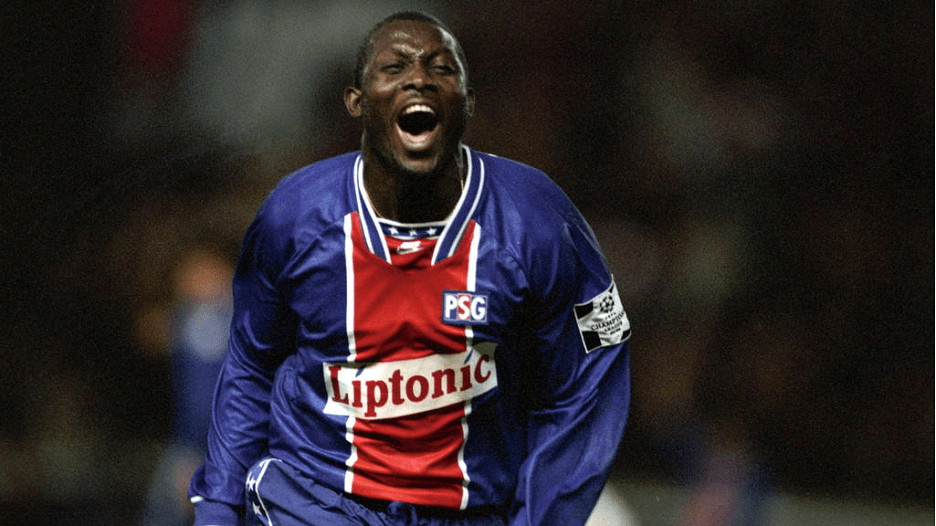
Weah’s third season in Paris would be another successful one. Despite failing to hold on to the Ligue 1 title, PSG would still achieve a unique double of the Coupe de France and the brand new Coupe de la Ligue, beating Bastia in the final of the latter competition. However, the 1994-95 season would turn out to be one of Weah’s best. Even though he would only score seven goals in 34 league matches for PSG, he would finish the campaign as the Champions League’s top scorer. After beginning with a wonder goal against Bayern Munich, Weah would fire 7 goals in 10 matches, including one in a quarter-final first-leg draw with Barcelona. Yet, despite his goalscoring efforts, George Weah’s quest for European gold would again end at the semi-final stage. Still, his outstanding performances for Paris St-Germain drew him to the attention of Fabio Capello and Champions League runners-up AC Milan. Milan had seen Weah in the flesh as they had faced and defeated PSG in the Champions League semi-finals, and they now wanted to add the Liberian striker to their ranks.
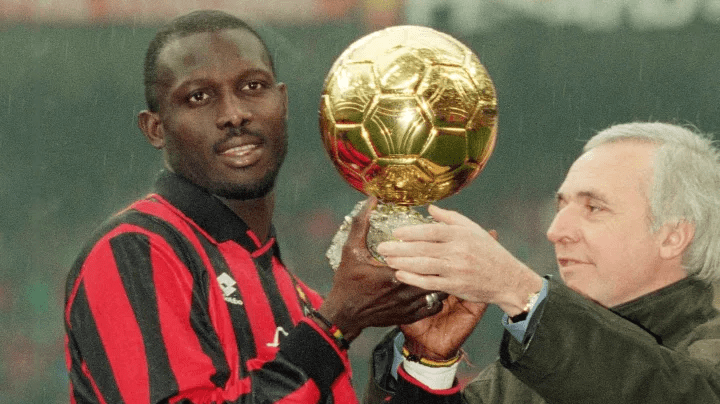
Joining AC Milan for £5 million in the summer of 1995, George Weah would become part of a devastating attacking set-up with Roberto Baggio, Roberto Simone and Dejan Savicevic. At Milan, Weah would add assists to his game, setting up goals for his teammates in addition to scoring them. In his first four months at the San Siro, George Weah had already registered 10 goals and 8 assists in 22 matches. Come the end of 1995, the Liberian would be the toast of world football. For his performances for PSG and AC Milan during 1995, Weah would win the Ballon D’or (the first non-European winner), the FIFA World Player of the Year award (the first African winner), the Onze D’or, the RSSSF Player of the Year, the BBC African Sports Personality of the Year and a third African Footballer of the Year Award. Weah would quickly prove that these award wins were merited by helping AC Milan win the 1995-96 Serie A title. The striker’s incredible record of 15 goals and 15 assists from 36 matches would European Sports Media feature him in the 1995-96 Team of the Season along with teammate Paolo Maldini.
The 1996-97 and 1997-98 seasons would be difficult for AC Milan, as poor form and frequent managerial changes would see the team record consecutive mid-table finishes in Serie A (11th and 10th) and fail to win a trophy. However, George Weah would still excel for the Rossoneri during these turbulent times, registering a combined 29 goals and 11 assists across the two seasons. One of these goals was a now-legendary one in a 4-1 win against Hellas Verona on the opening weekend of the 1996-97 season. Receiving the ball inside his own penalty area, Weah would turn and begin to dribble the ball. Reaching the centre circle, Weah would find himself surrounded by three defenders. Despite a tackler taking the ball away from his right foot, Weah would ride the tackle, keep control of the ball and continue his run. After using his speed to breeze past a centre-back, Weah would finish with a shot into the far corner of the net. During this turbulent time for Milan, George Weah almost achieved back-to-back Ballon D’or and FIFA World Player of the Year victories in 1996, eventually finishing runner-up to Ronaldo and Matthias Sammer, respectively. He would also win the 1996 FIFA Fair Play Award, despite receiving a six-match ban for breaking the nose of Porto defender Jorge Costa during a Champions League match.
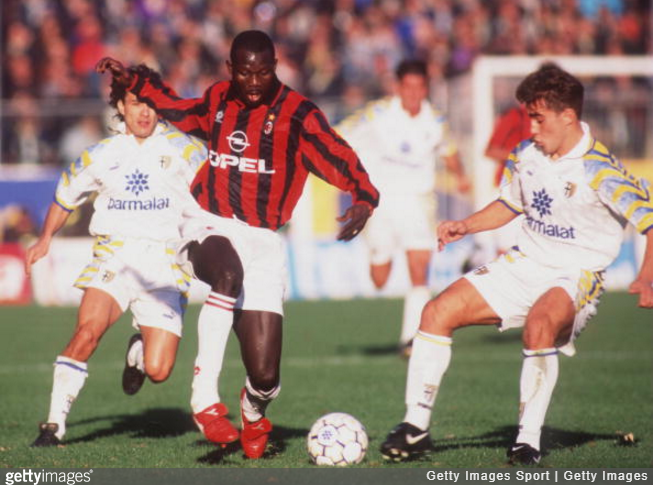
This level of individual performance from George Weah would pay off in the 1998-99 campaign when Milan overcame their troubles to win their 16th Serie A title. This season would see the arrival of Oliver Bierhoff at the San Siro, and he and Weah would strike up an effective partnership. Bierhoff would serve as Milan’s central striker, while Weah would be utilised on the left wing of a front three, though the Liberian would sometimes start alongside the German as a duo. Operating off the flanks would hurt Weah’s goal record, but he would still score nine and contribute seven assists in 30 games as Milan won the Scudetto on the last day of the 1998-99 season.
King George Moves To England (Temporarily)
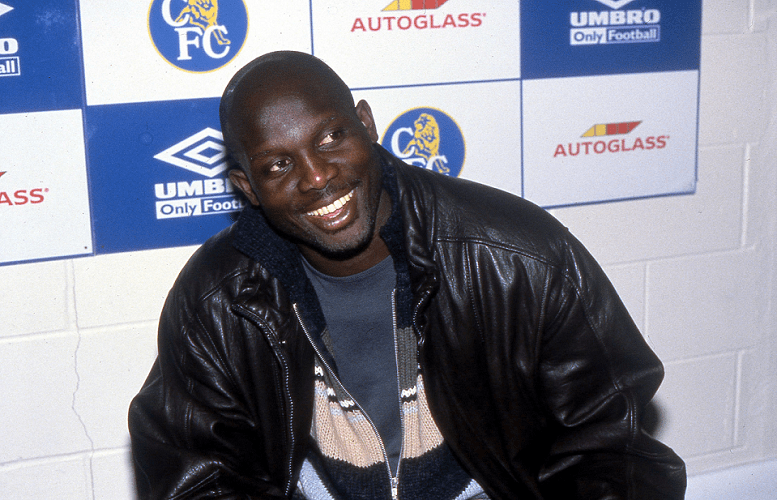
George Weah had ended the 1998-99 season as a regular starter for AC Milan. This would also be the case at the start of the 1999-00 season. Weah would start 8 of Milan’s first 10 Serie A matches. His form would remain consistently strong, as he would contribute 4 goals and 5 assists in these games, despite mixing between being a striker and left-winger. He would even produce a hat-trick of assists in a 4-4 draw with Lazio in early October 1999. However, the summer of 1999 saw a 22-year-old forward called Andriy Shevchenko arrive from Dynamo Kyiv. After trying different striking duos of Weah, Shevchenko and Oliver Bierhoff and even fitting all three into a three-man attack, manager Alberto Zaccheroni would decide to drop the now 33-year-old Weah to the bench following a 3-1 defeat to Juventus in late November 1999. George Weah would then spend the next few weeks watching as an unused substitute as Shevchenko and Bierhoff forged a new strike pairing.
Wondering where his next minutes would come from, George Weah’s agent would hear that Premier League club Chelsea, managed by Gianluca Vialli, would be interested in taking the Liberian forward on loan for the rest of the 1999-00 season. Encouraged to play English football for the first time, Weah agreed to the move and would sign for the Blues on 11th January 2000.
One day after his arrival, George Weah would find himself on the bench for Chelsea’s London derby with Tottenham. Before the game, Spurs manager George Graham would throw some scorn Chelsea’s way for signing the Liberian legend. He would say that he was not surprised that George Weah signed for Chelsea as he and Gianluca Vialli knew one other from their time in Serie A. However, Graham would say that when it came to signing strikers, it depended on whether you were looking for “a quick fix” (like Weah) or for younger players who you could build something with. In the 56th minute of a goalless stalemate between the two rivals, Gianluca Vialli would bring on George Weah for his Premier League debut, replacing the ineffective Tore Andre Flo. Brought on to get a goal, Weah would soon comply. In the 87th minute, he would bundle home a header to give Chelsea a late winner over their fierce rivals.
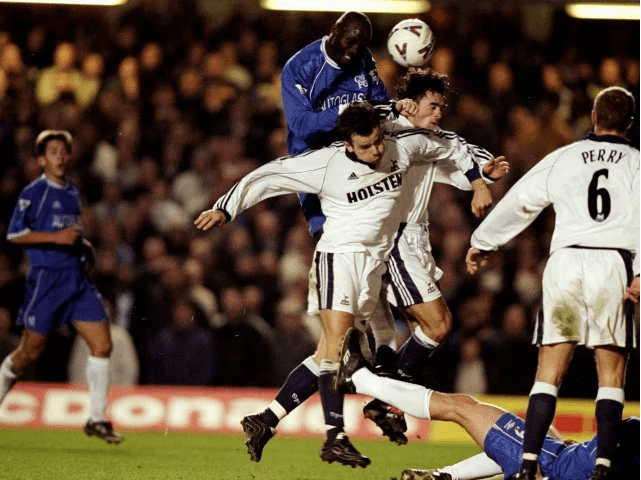
After his late heroics, George Weah would start and play the full 90 minutes in Chelsea’s next four Premier League matches. He would also make his FA Cup debut at the end of January, scoring in a 2-1 5th-round win over fellow Premier League side Leicester City. In February, Weah would score twice in eight days. First, he would register his second league goal in a 3-1 win over Wimbledon on 12th February. Losing 1-0 with eleven minutes to go, George Weah would set up Gustavo Poyet to score Chelsea’s equaliser. A minute later, Weah’s back-post header would put the Blues ahead before Jody Morris would score a crucial third in the 90th minute. One week after this, George Weah would score the third goal in Chelsea’s 5-0 thrashing of Gillingham in the FA Cup quarter-finals.
After missing four weeks due to injury, George Weah would return to the Chelsea starting XI for a 1-1 draw with Southampton on 25th March. He would then heavily feature in wins over high-flying Leeds and mid-table Coventry, defeat to struggling Sheffield Wednesday, and the team’s FA Cup semi-final against Newcastle. He would play 79 minutes as the Blues beat the Magpies 2-1 to reach the 2000 FA Cup Final.
Following another short lay-off, George Weah would return for Chelsea’s clash with 3rd-placed Liverpool on 29th April. The 33-year-old would be involved in both of Chelsea’s goals as two early finishes saw the Blues ting their opponents with a 2-0 win. In the second minute of play, Roberto di Matteo would play an inside ball to George Weah. The Liberian would finish low past Reds goalkeeper Sander Westerveld into the far corner. Twelve minutes later, Weah would return the favour, playing a one-two with strike partner Gianfranco Zola before stroking the ball into the path of Di Matteo for the Italian to double Chelsea’s lead, one which Liverpool would never recover. One week later, George Weah would play the full 90 in Chelsea’s 2-1 derby defeat to Arsenal before a back strain saw him miss the team’s final-day 4-0 win over Derby County.
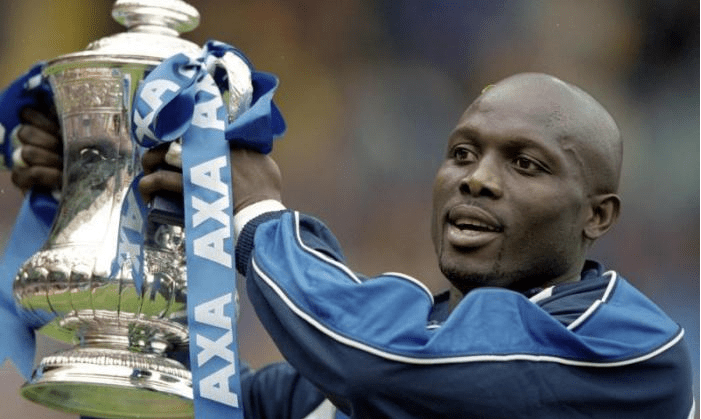
Despite missing out on the final league match of the season, George Weah would be selected to start the 2000 FA Cup Final ahead of the team’s top scorer Tore Andre Flo. Despite joining in the middle of the season, Weah had played a key role in Chelsea’s path to the final, having started the last three rounds and scored in two. During the final, George Weah would have chances to open the scoring with Chelsea, but his poor finishing would continue to keep the final scoreless. Three passes from Marcel Desailly, Didier Deschamps and Gianfranco Zola would carve through the Aston Villa defenders to set Weah free. However, the Liberian’s first-time effort from outside the area would skew wide of the far post. He would later meet a cross from Gianfranco Zola at the back post, only to shoot wide from six yards when it looked easier to score. He would even manage to cause a Chelsea goal to be disallowed. It seemed like team captain Dennis Wise had given the Blues the lead after capitalising on David James fumbling a shot. However, replays showed that Weah was offside when the first shot was taken. Considering that he had moved to try to hit the rebounded ball, the linesman deemed him as playing an active role in proceedings, and the goal was chalked off. Luckily, Roberto di Matteo would legally put Chelsea in front in the 73rd minute.
George Weah would be kept on the field deep into the final, finally being replaced by Tore Andre Flo in the 88th minute. Even though his performance left much to be desired, George Weah would end his loan spell at Chelsea with a trophy. The FA Cup victory would continue Weah’s run of earning silverware at every European club he had played for during his career.
King George Moves To England (Permanently)
At the end of his loan spell with Chelsea, George Weah would return to AC Milan in the summer of 2000. However, Alberto Zaccheroni could not confirm first-team football for the veteran Liberian striker after Oliver Bierhoff and Andriy Shevchenko had combined for 43 goals in all competitions the previous year. Milan would try to make contact with Chelsea to sign Weah permanently following his loan spell. However, despite a successful 5 goals in 15 games, Gianluca Vialli would instead decide to sign Jimmy Floyd Hasselbaink from Atletico Madrid, the correct decision in hindsight.
With seemingly no future at Milan and Chelsea looking elsewhere, who would be willing to invest in a 33-year-old former Ballon D’or winner? The call would come from Joe Royle, manager of newly-promoted Premier League side Manchester City. On 1st August 2000, George Weah would join the Sky Blues on a free transfer after refusing a £1m compensation offer from Milan chairman Silvio Berlusconi when the club agreed to cancel his contract. He would also sign a two-year contract with City worth £30,000 weekly. Weah would act as the big-name foreign signing in a summer window where Manchester City signed players with proven top-flight experience, like Newcastle defender Steve Howey, Leeds midfielder Alf-Inge Haaland and West Ham striker Paulo Wanchope. Weah and Wanchope were brought in to compete with incumbent forward duo Paul Dickov and Shaun Goater. Whether they would manage to replace the pair would remain to be seen.
Upon signing for Manchester City, George Weah would say:
“I will come here and give everything, and I think we will go into Europe. That is the aim, and a club like this deserves to be in Europe.
“I came here because they wanted me. I had talks with a few clubs, but I got the impression they only wanted to talk and weren’t that interested about signing me.
“As soon as I spoke to City, I realised they were determined to get me. As far as I’m concerned, the most important aspect for me is to prove myself within the squad.
“We want to be a winning team, and I see no reason why we cannot be that.”
(George Weah, “Weah joins Royle family”, BBC Sport, 1st August 2000)
City manager Joe Royle would speak highly of his new signing, calling him a “great man… you can feel a presence about him”. Royle would also accentuate Weah’s goalscoring abilities, as proven by his loan spell at Chelsea and his ability to speak three languages. He would describe Weah’s signing as “a big statement as to how the club feels and where we are going”.
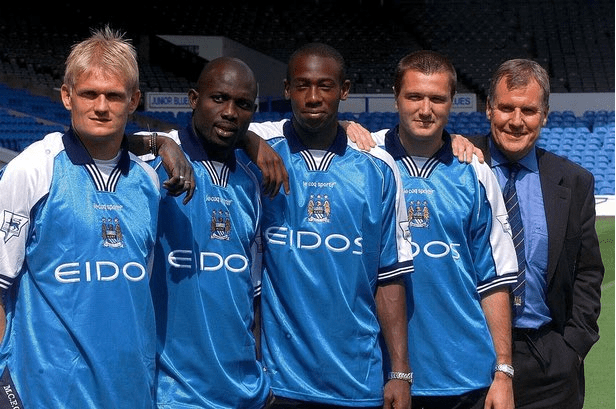
After completing pre-season, George Weah would be selected in the starting line-up for Manchester City’s opening Premier League match against fellow newly-promoted side Charlton Athletic. He would start alongside fellow new signing Paulo Wanchope in what was hoped to be a devastating partnership. Meanwhile, Charlton was at a striker shortage, and Alan Curbishley was forced to hand a debut to teenager Kevin Lisbie. Despite featuring all four of their summer signings, Manchester City would be shellshocked with a 4-0 opening-day defeat at The Valley. George Weah would not mark his debut with a goal as Charlton exposed City’s defence repeatedly and dominated the team in blue. The headlines would instead belong to Charlton forwards John Robinson and Andy Hunt as both men scored for the Addicks.
Four days later, George Weah would get his first victory in Manchester City colours as Joe Royle’s team would recover from their opening-day defeat with a 4-2 win over Sunderland. However, the day would belong to Weah’s strike partner Paulo Wanchope, who would register his first Manchester City goals with a hat-trick. Weah would set up the first after four minutes, scampering down the wing and crossing the ball in from Wanchope to score at the far post. Wanchope would then turn provider for Alf-Inge Haaland to make it 2-0 after 23 minutes. Sunderland would come back to 2-2 with goals from Niall Quinn and Kevin Phillips, but two more goals from Wanchope would get City their first points of the season. However, Manchester City would return to losing ways in their next match, falling 2-1 to Coventry City. Weah would have a chance to equalise when City was 1-0 behind, only to hit his shot directly at the goalkeeper. Then, once City had conceded a second, his cross would set up Paul Dickov, only for Dickov to find the goalkeeper.
After playing the entirety of Manchester City’s first three Premier League matches, George Weah would surprisingly be left out of the Sky Blues’ match against Leeds United. Weah could only watch from the sidelines as Paulo Wanchope played as a lone striker in City’s 2-1 win against the Whites. The following week, the Liberian could only make the substitutes’ bench for a match against Liverpool, with Royle preferring Paul Dickov. However, Weah would play a role in a topsy-turvy game. Coming on with Liverpool 2-0 up, the former Ballon D’or winner would bring Man City back into the game. In the 67th minute, Weah would receive the ball and escape the clutches of two Reds defenders before sliding the ball under the body of Sander Westerveld and scoring his first Manchester City goal. Kevin Horlock’s 81st-minute penalty would set up an entertaining finale, only for Dietmar Hamann to score his second goal one minute later and secure a 3-2 win for Liverpool.
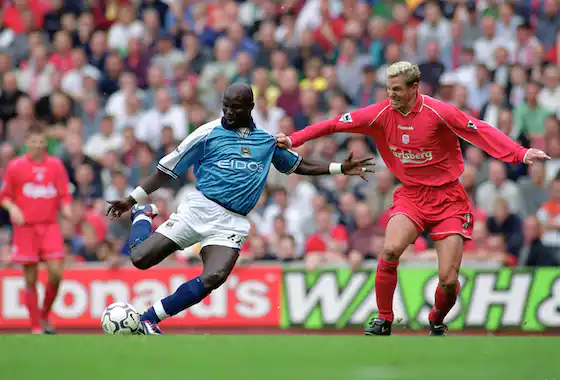
George Weah’s actions against Liverpool would see him start Man City’s next league match against Middlesbrough on 17th September. In a 1-1 draw, Weah would twice come close to giving City the lead. He would almost open the scoring after five minutes, bringing down a loose ball and unleashing a powerful shot that flew over the Middlesbrough bar. Then, with the game tied in the second half, Weah would meet Mark Kennedy’s corner with a dangerous header which goalkeeper Gary Walsh would need to tip over the crossbar. Weah’s second Manchester City goal would come in a League Cup first-leg against Gillingham three days later. With Gillingham seemingly taking a 1-0 advantage into the return match in Kent six days later, Weah would equalise six minutes from time, meeting Alfie Haaland’s cross. He would also have a chance to give City a first-leg victory, but his long-range drive would just miss the target as this first match ended in a 1-1 draw.
On 23rd September, Weah would return to the substitutes’ bench for Man City’s match against Tottenham. With the game goalless, Joe Royle would bring on Weah for Paul Dickov just past the hour mark. The 33-year-old would immediately threaten the Spurs’ defence. He would set up Paulo Wanchope for a potential deadlock-breaker, only for Wanchope to miss narrowly wide. He would also finish off a City counter-attack with an effort that needed to be saved by Neil Sullivan to keep the stalemate intact. Three days later, George Weah would start and scored twice in the League Cup 2nd leg against Gillingham. Andy Thomson would give Gillingham a 2-1 aggregate lead at half-time, only for Weah to level the score with a header two minutes after the break. Then, Weah would give City the lead after finishing a Mark Kennedy cross with a back-post shot. Unfortunately, Gillingham would come back to level the score at 2-2 (3-3 agg.) and take the game to extra time. However, extra-time goals from Kennedy and Paul Dickov would see the Premier League team progress to the 3rd round.
After the League Cup victory, Weah would be restored to the starting line-up for Manchester City’s game with Newcastle United on 30th September. However, he would be ineffective as Alan Shearer’s goal saw the Magpies take a 1-0 victory back to Tyneside. Following a two-week international break, George Weah would again find himself left out of the squad for Manchester City’s 2-0 win over Bradford on 14th October 2000.
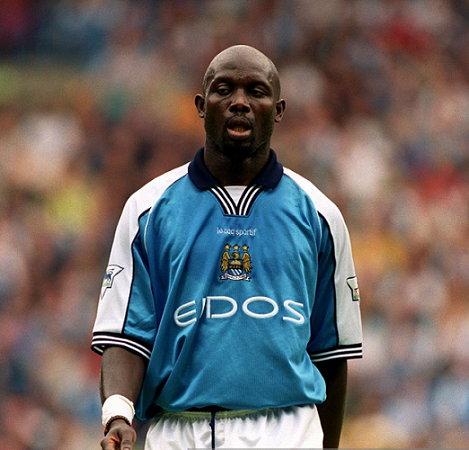
King George Leaves England
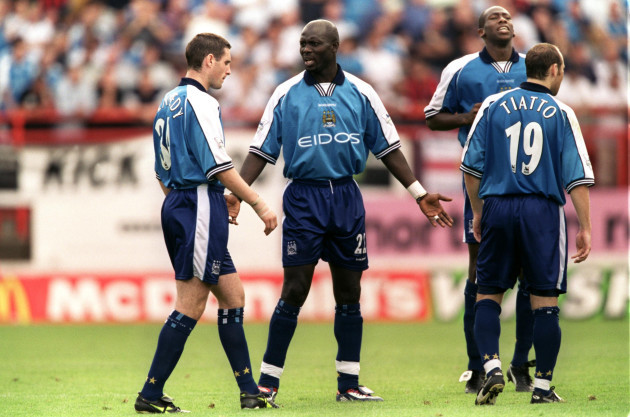
On 17th October 2000, Manchester City announced that George Weah had left the club by mutual consent. After seemingly arriving as the prized jewel of Joe Royle’s summer transfer business and coming in on big wages (£30,000), Weah had only started five of Man City’s first nine Premier League matches and had been left out of the matchday squad entirely for two of those games. He also failed to complete a full 90 minutes after his first three matches for the club. Not far from his 34th birthday, George Weah knew he did not have much time left in his football career but still harboured a desire to play at the highest level. To achieve this, he needed first-team football, which he felt Joe Royle and Manchester City could not provide. Therefore, after being left out of the squad for Man City’s match with Bradford, Weah would meet with Royle and ask to be released from his contract just two months after arriving at Eastlands. Royle would agree to Weah’s demands, and the Liberian’s time at Manchester City would end after just 9 matches. Within a few days of his release, George Weah would sign for Marseille, officially ending his time in English football.
On his departure, Manchester City manager Joe Royle would be respectful to the former Ballon D’or winner, saying:
“He’s 34 years old and he just wants to play all the time. I can understand that fully but I have to do what I think is best for Manchester City. It is always regretful when things do not work out between club and player. George is a true professional who has a great stature throughout European football and we wish him well.” (Joe Royle on George Weah’s Manchester City departure, October 2000)
However, George Weah would not be so complimentary to his now-former boss. He would explain that he wasn’t upset for not playing all the games and that at 34 years old, he didn’t expect to play every week. Weah would call Joe Royle “disrespectful” and “unprofessional” in his treatment of him and criticise the manager’s lack of confidence in his abilities. He would also cite a “lack of communication” from Royle, detailing that there had been times when the former Everton boss had sometimes included him in starting line-ups only to call him five hours later and tell him that he was now out of the team. Weah would say that situations like this made him “feel old and of no use to the club” and that he was only being used for advertising Manchester City to potential signings. A sad end to George Weah’s time in English football.
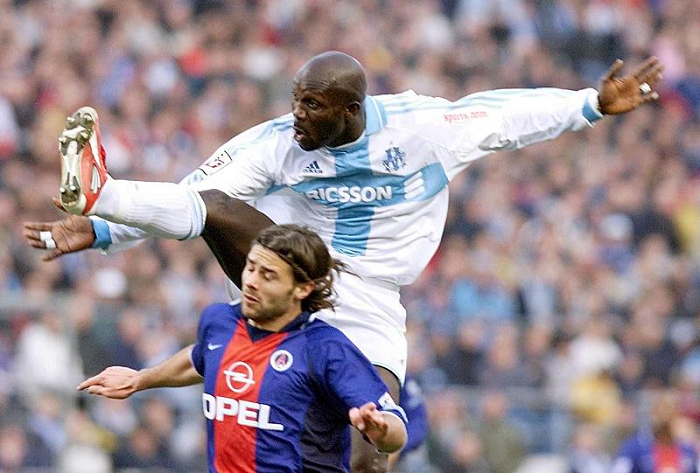
George Weah would join a Marseille side struggling for form and goals, meaning that he would instantly be pushed into the starting XI. After debuting as a starter in a 1-0 defeat to Lille on 22nd October, Weah would score his first goal in a 1-1 draw with Strasbourg, scoring a 54th-minute equaliser for his team. Weah would eventually appear in 19 of Marseille’s final 23 league matches, starting 17 of them. He would finish as the team’s second-highest scorer of the season with five goals and register two assists as Les Olympiens finished a disappointing 15th in the French First Division. However, George Weah would not stick around in the south of France, leaving Marseille in the summer of 2001 to join UAE side Al-Jazira. However, the seven months Weah spent with Marseille marked an improvement over the two months he had endured at Manchester City.
Conclusion
George Weah’s nine months in English football can be considered a period of mixed fortunes. He arrived at a Chelsea team who had spent big the previous summer in a bid to launch a Premier League title challenge, only for those plans to go awry due to inconsistent form. Joining a strikeforce that already contained Tore Andre Flo, Chris Sutton and Gianfranco Zola, George Weah was given his chance to shine by Gianluca Vialli. He played 11 of Chelsea’s final 18 league matches of the 1999-00 season, starting 9 of them. In all of his starts, Weah would play the full 90 minutes. Weah’s 11 league appearances would produce three goals and three assists, exemplifying the Liberian’s completeness as a centre-forward. He would be an impactful player for Chelsea in victories over Tottenham, Wimbledon, Liverpool and Coventry. He was even the best player on the pitch in a 0-0 draw against Aston Villa on 22nd January. The best of George Weah could also be found in the Blues’ FA Cup run, where the Liberian scored 2 in 4 matches. Despite making his competition debut in the fifth round, Weah played a part in every game on Chelsea’s run to the final. These performances were eventually rewarded with a start in the final.
However, George Weah’s performances were often as inconsistent as those of the team he was representing. He would often be caught offside, and his chance conversion left more than a little to be desired. During his loan spell with Chelsea, George Weah would manage an impressive 5 goals in 15 appearances in all competitions. However, that scoring tally could have been higher if Weah had converted more of his close-range efforts. George Weah’s sometime-profligacy was most evident during the 2000 FA Cup Final. Throughout the final, Weah had numerous clear-cut chances to give Chelsea the lead, only for the 33-year-old completely miss the target. Luckily for Weah, his afternoon at Wembley would end with an FA Cup victory.
After a successful period at Chelsea that Blues fans still fondly remember today, with match-worn shirts and signed memorabilia featuring George Weah’s signature still selling online today, the same cannot be said for his time at Manchester City. In fact, George Weah could be considered one of City’s worst-ever signings. The striker’s arrival at the newly-promoted club felt like a ‘big fish in a small pond’ scenario. It seemed like the former Ballon D’or winner was a shoo-in to start most of City’s league matches despite his advancing age. However, after starting the first three matches of the season, Weah found himself being moved around by Royle, either starting, coming on as a substitute or being left out of the matchday squad altogether. After those first three matches, Weah would never complete another 90 minutes for Joe Royle. The veteran striker would still produce decent performances for the Sky Blues, as a starter in games against Middlesbrough and Sunderland and as an impact substitute in the team’s 3-2 defeat to Liverpool and a 1-1 draw with Middlesbrough. However, he could equally be ineffective and sometimes go missing in matches entirely.
Weah’s relationship with manager Joe Royle would lead to his abrupt departure two months into the season. Weah felt he was disrespected by the former Everton manager and only signed for his marketable name value over any value he could offer the first team. He would later find a better home back in French football, the place that first discovered and nurtured his talent to make him the star he would eventually become.
English football would never get the best of George Weah. The Liberian striker arrived in England when his career was on the decline. At 33, Weah was still capable of scoring an incredible goal, producing a flick or cross to assist a teammate or just impacting an entire match with his sheer presence. However, he could no longer be the player that won all the awards in 1995 and almost repeated the feat in 1996. He could no longer consistently pull out these show-stealing performances, especially in a league he was unfamiliar with. As has been shown in more recent times by Edinson Cavani, Samuel Eto’o and Cristiano Ronaldo, bringing these world-class players to the Premier League past their peak can lead to mixed results. You sometimes get the player they were, other times the player they are now. However, for players with these heightened abilities, managers are still more than willing to take the risk. George Weah’s time in English football is not discussed or regarded as highly as his time at AC Milan, Paris Saint-Germain or Monaco. However, it is a fascinating tale that the only African Ballon D’or winner in football history once spent an interesting few months plying his trade in England towards the tail end of his legendary career.
 the-score-board.co.uk