
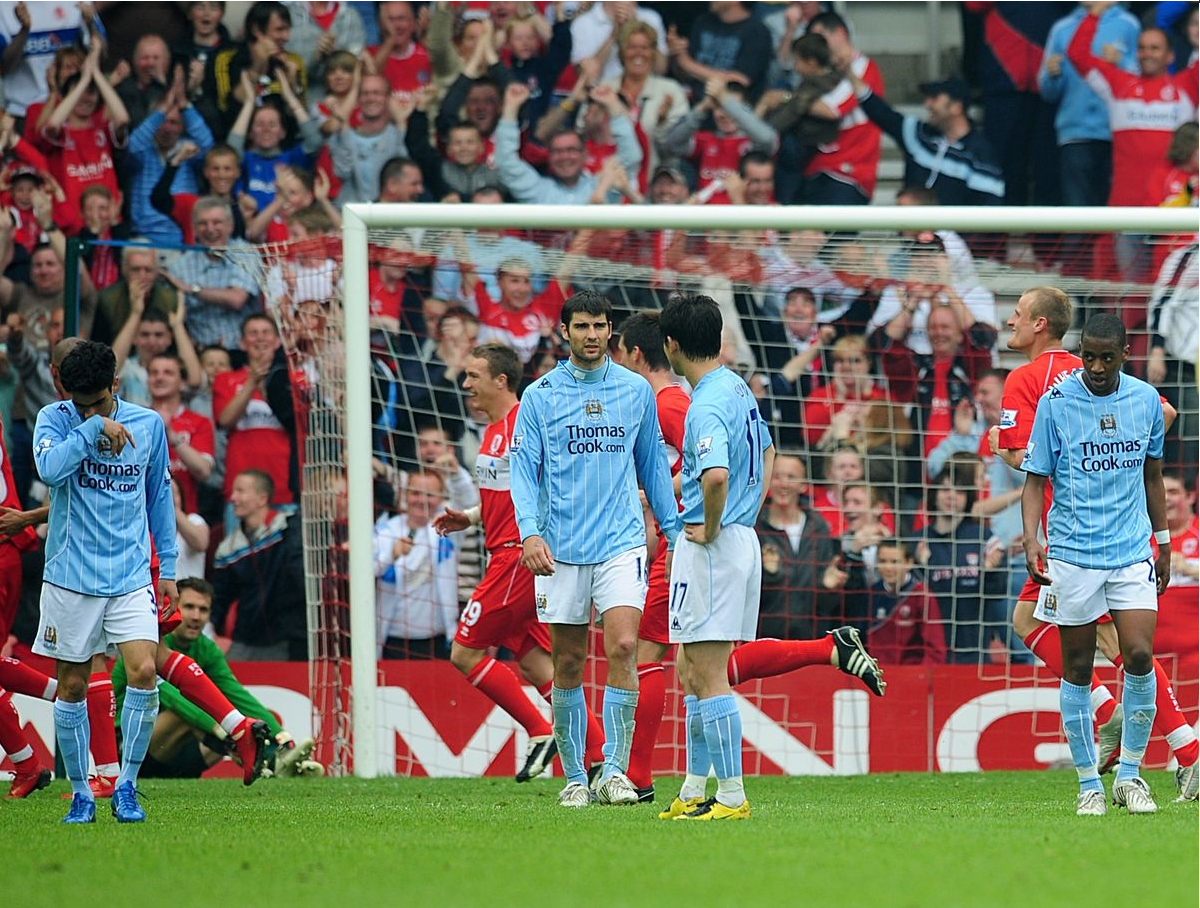
A remarkable final-day scoreline that would lead to a new empire forming in the blue half of Manchester…
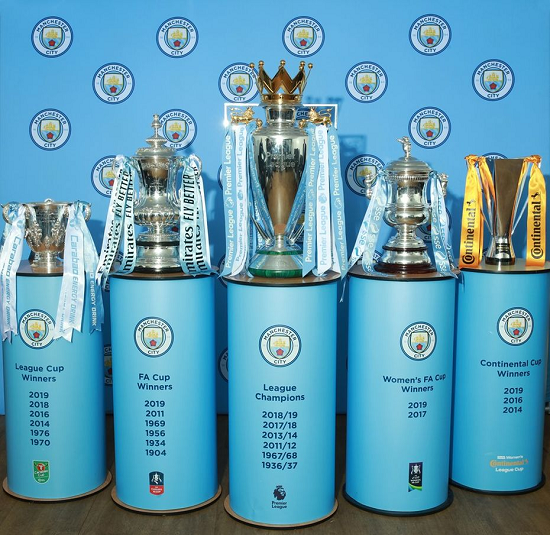
Since being bought by Sheikh Mansour and the Abu Dhabi United Group in August 2008, Manchester City has become the most dominant team in English football. Over the past decade and a half, fourteen trophies have been won by the blue half of Manchester, including six Premier League titles (2011-12, 2013-14, 2017-18, 2018-19, 2020-21, 2021-22), two FA Cups (2011, 2019) and six League Cups (2014, 2016, 2018-21). Manchester City has completed the league and EFL Cup ‘Double’ on three occasions (2014, 2018, 2021) and, in 2018, became the first team to ever complete the English domestic Treble. For the younger members of Manchester City’s fanbase, big-money signings, trophy-laden campaigns and runs to the latter stages of the UEFA Champions League are the accepted standard and are all they have ever known. However, their older relatives may want to remind them of a recent time in which Manchester City was not the Premier League powerhouse we see today.
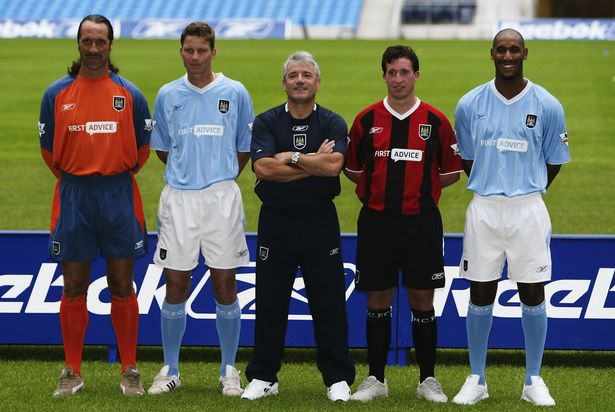
After relegation in 1983 saw the team drop out of the First Division for the first time in eighteen years, the next eighteen years would see Manchester City yo-yo between the top two divisions of English football. The club would become one of the Premier League’s founding members in 1992 but often competed in the bottom half of the standings. This run of form would culminate in top-flight relegation in 1996. However, instead of earning Premier League promotion, Man City would instead fall even further into the Second Division (now League One) in 1998, ten years before Abu Dhabi came calling. Back-to-back promotions would send City back into the top-flight as the Millennium was dawning. However, even that 2000-01 campaign would end with City immediately dropping back to the First Division. Then, finally, a Manchester City team managed by Kevin Keegan would earn immediate promotion back to the top flight on their first attempt, where the Sky Blues have remained since 2002.
The seasons between Manchester City’s Premier League return in 2002 and the season before Sheikh Mansour’s arrival (2007-08) were a mix of top-10 and mid-table finishes, finishing as high as 8th and as low as 16th. Manchester City attracted stars like Nicolas Anelka, Robbie Fowler, Steve McManaman and Claudio Reyna. Still, the team’s performances during this time would more often than not be described as ‘mediocre’.
However, one league result during Manchester City’s pre-Abu Dhabi period stands out more than any other, an 8-1 defeat to Middlesbrough on the last day of the 2007-08 season. This heavy loss stands out because of the events of the club being bought for hundreds of millions three months later. However, it is also worth remarking upon for numerous other reasons, all of which will be discussed soon.
On 11th May 2008, Manchester City would travel from west to east to play Middlesbrough at the Riverside. Both sides were set to finish in the Premier League’s mid-table. Sixteen points would separate 9th-placed Manchester City and 14th-placed Middlesbrough in the standings before their final-day meeting, with the Sky Blues having earned six more league wins than their opponents. One reason this match is notable is because both sides were coached by England managers. The hosts Middlesbrough were managed by a still wet-behind-the-ears Gareth Southgate, completing his second season in charge of Boro after retiring as the club’s captain in 2006. Meanwhile, Manchester City was led by Sven-Göran Eriksson, completing his first season of club management since receiving the England sack after the 2006 FIFA World Cup.
| Position | Team | Played | Wins | Draws | Losses | Goals For | Goals Against | Goal Diff. | Points |
|---|---|---|---|---|---|---|---|---|---|
| 9th | Manchester City | 37 | 15 | 10 | 12 | 44 | 45 | -1 | 55 |
| 14th | Middlesbrough | 37 | 9 | 12 | 16 | 35 | 52 | -17 | 39 |
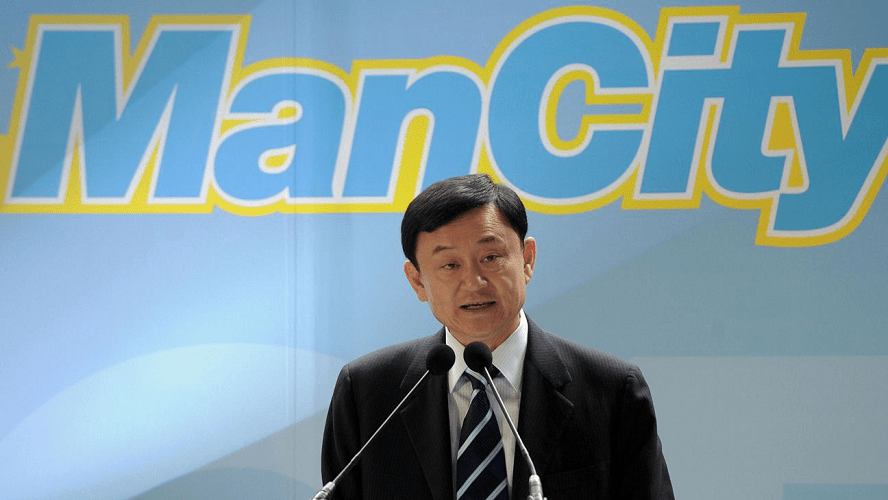
The decision to hire Sven-Göran riksson as the new Manchester City manager following the departure of Stuart Pearce in the summer of 2007 was a move to set out City’s stall as a Premier League club on the rise. In fact, the Sky Blues had recently been bought for £81.8 million by a foreign owner. That’s right. On 21st June 2007, former Prime Minister of Thailand Thaksin Shinawatra, who had made his money in the IT and telecommunications industry to become of the wealthiest people in his home country, bought Manchester City, ending the club’s status as a publicly traded company. For his first act, Shinawatra would convince Sven-Göran Eriksson to return to club management for the first time in six years.
The appointment of Sven was a big move for Manchester City. Aside from his England spell, Sven had been among the most successful club managers of the previous thirty years. He had won the Swedish, Portuguese and Italian league championships with IFK Gothenburg, Benfica and Lazio, with all three triumphs coming in different decades. He led Gothenburg to a UEFA Cup victory in 1982 while reaching the final with Benfica and Lazio in 1983 and 1998. Benfica had even reached the 1990 European Cup Final under his tutelage, coming up short against Arrigo Sacchi’s legendary AC Milan side. Then at Lazio, Sven had coached a star-studded team to the Serie A, Coppa Italia, Supercoppa Italiana, UEFA Cup Winners’ Cup and UEFA Super Cup. In total, the Swede had won 21 trophies with six different clubs during his 22-year club management career before taking the England job.

Now installed as Manchester City’s new manager, Sven-Göran Eriksson would start to build the squad that he thought could take Manchester City onwards and upwards. The close season had seen the £5.8m departure of Joey Barton to Newcastle United along with the releases of Hatem Trabelsi, Nicky Weaver, Trevor Sinclair, Stephen Jordan and former club captain Sylvain Distin. Eriksson would begin his summer transfer business by signing three players in five days in mid-July. The period covering 13th-17th July 2007 would see the arrivals of Italian striker Rolando Bianchi from Reggina (£8.8m), Swiss defensive midfielder Gelson Fernandes from FC Sion (£4.4m) and Brazilian attacking midfielder Geovanni from Cruzeiro (Free) for a combined £13m. Bulgarian winger Martin Petrov would be the next name through the door, joining from Atlético Madrid for £4.7 million on 26th July. Then, the first few days of August 2007 would see another flurry of transfer business inside the City of Manchester Stadium as Manchester City would sign four players in two days. On the 2nd and 3rd of August, defenders Vedran Ćorluka (Dinamo Zagreb, £8m) and Javier Garrido (Real Sociedad, £1.5m), creative midfielder Elano (Shakhtar Donetsk, £8m), and striker Valeri Bojinov (Fiorentina, £5.75m) would arrive at Eastlands. All four would pose emotionlessly with Sven-Goran Eriksson and their new shirts in a now famous photo.
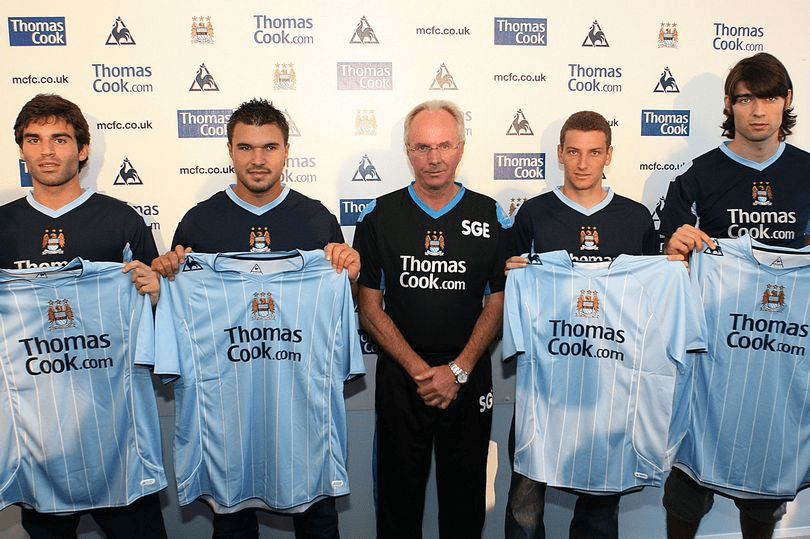
After signing these seven players for £40.95 million, Sven-Goran Eriksson and Manchester City would begin the new season on 11th August 2007. The Eriksson era would start with a 2-0 win away at West Ham, with debutants Rolando Bianchi and Geovanni scoring the goals. Promising young midfielder Michael Johnson would give City a 1-0 midweek win over newly-promoted Derby County four days later. Then it was time for the Manchester derby against reigning champions Manchester United on 19th August. In front of a packed City of Manchester Stadium, Manchester City would upset their local rivals 1-0, with Geovanni’s second goal of the campaign proving decisive. This victory would send Man City to the top of the Premier League standings after three games, with three wins and three clean sheets giving Sven-Goran Eriksson a very encouraging start to his Manchester City reign.
Successive 1-0 defeats to Arsenal and Blackburn at the turn of September would ruin City’s 100% record. However, the team would shrug off these losses and soon begin another impressive run, losing only 2 of the following 16 Premier League matches. This run of results would see Man City riding high in the Premier League’s Champions League qualification places for the rest of 2007. In fact, 16 of the Premier League’s first 20 matchdays would end with Manchester City inside the Premier League’s top four.
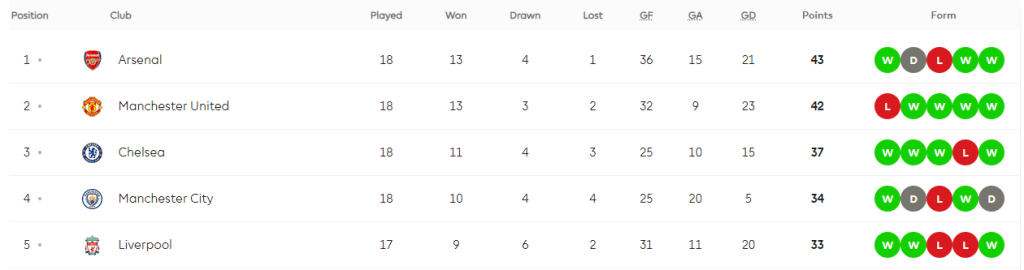
Manchester City would spend Christmas 2007 sitting 4th in the Barclays Premier League table behind Chelsea, Manchester United and league leaders Arsenal. However, the good times would not last for Sven and his men. After beginning 2008 with a 2-0 win over struggling Newcastle United, Manchester City would fail to win any of their next four league matches. These results, including a draw with Derby County, would drop City out of the top four down to 7th. Manchester City would never touch the top four for the rest of the campaign.
Sven-Goran Eriksson would look to improve the squad during the January transfer window, signing strikers Felipe Caicedo (£5.2m) and Benjani (£3.87m) from Basel and Portsmouth on deadline day. Benjani would help Man City complete the double over Manchester United with a 2-1 win at Old Trafford on 10th February, the 50th anniversary of the Munich air disaster. However, following this historic victory, City’s slide down the form table would continue. A run of 3 wins from 11 matches before the game against Middlesbrough (the subject of this article) had seen the Sky Blues fall down the table to 9th. Manchester City had spent Christmas inside the Premier League’s top four. Now, the team sat 18 points adrift of it and qualification for any European competition was out of the question.
On the last day of the 2007-08 Premier League season, Manchester City would travel to Middlesbrough, hoping to end their season-of-two-halves on a high note. They would face a Boro side that had spent the entirety of the campaign in the Premier League’s bottom half, with Gareth Southgate’s team having won nine, drawn twelve and lost sixteen of their 37 Premier League matches. The Teessiders had won just four of their seventeen league games in 2008, and a 2-0 victory over Portsmouth the previous week had ended a run of five matches without a win. With both teams lacking in form and wanting the season to end, how would this game play out?
| Middlesbrough | Manchester City | ||
|---|---|---|---|
| Formation | (4-4-2) | (4-4-2) | Formation |
| Mark Schwarzer | GK 1 | GK 1 | Andreas Isaksson |
| Luke Young | RB 2 | RB 17 | Sun Jihai |
| David Wheater | CB 31 | CB 16 | Vedran Ćorluka |
| Chris Riggott | CB 32 | CB 22 | Richard Dunne (capt.) |
| Emanuel Pogatetz | LB 6 | LB 3 | Michael Ball |
| George Boateng (capt.) | RM 7 | RM 15 | Martin Petrov |
| Julio Arca | CM 3 | CM 28 | Gelson Fernandes |
| Fábio Rochemback | CM 10 | CM 7 | Stephen Ireland |
| Stewart Downing | LM 19 | LM 24 | Javier Garrido |
| Tuncay Şanlı | CF 17 | CF 12 | Darius Vassell |
| Afonso Alves | CF 12 | CF 27 | Benjani |
| Substitutes | Substitutes | ||
| Ross Turnbull | GK 21 | GK 25 | Joe Hart |
| Andrew Taylor | LB 33 | DM 21 | Dietmar Hamann |
| Tony McMahon | RB 29 | AM 11 | Elano |
| Adam Johnson | RM 28 | RW 30 | Nery Castillo |
| Jérémie Aliadière | CF 11 | CF 20 | Felipe Caicedo |
| Gareth Southgate | Manager | Manager | Sven-Goran Eriksson |
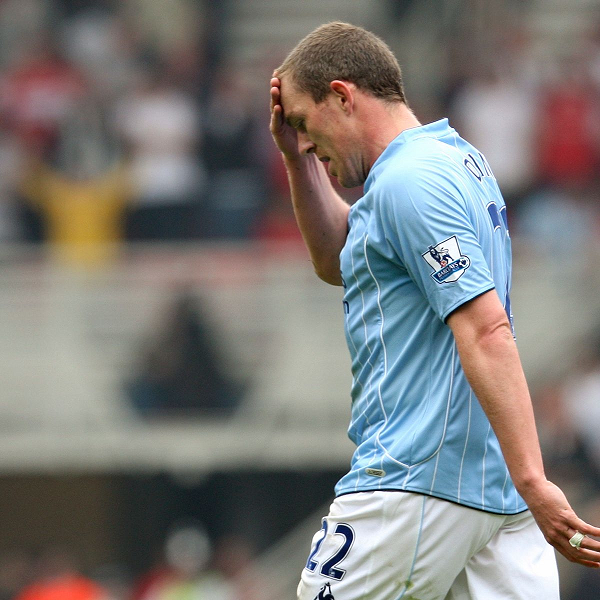
After the first 15 minutes of the match passed by without much incident, Manchester City’s day would soon get off to the worst possible start. Middlesbrough defender Chris Riggott would send a long ball downfield. Boro striker Tuncay Şanlı would beat Richard Dunne to the ball, and the Manchester City captain would clip the heels of the Turkish international, bringing him down inside the penalty area. Referee Phil Dowd would award Middlesbrough a penalty and issue a red card to last man Dunne for denying a goalscoring opportunity. Inside a quarter of an hour, Manchester City found themselves with one man fewer and without their captain for the remaining 75 minutes of regulation time.
After a brief delay, Middlesbrough’s talismanic winger Stewart Downing would step up to take the penalty kick. With the Teesside wind bristling his shirt against his back, Downing would step up and send the ball to the left of City goalkeeper Andreas Isaksson. Despite the Swede guessing the direction of Downing’s shot, he could not stop the ball from hitting the net for the winger’s eighth goal of the Premier League campaign.
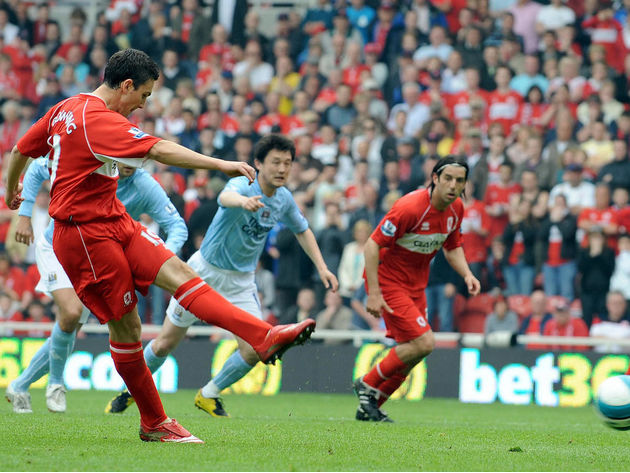
Despite the man disadvantage, Manchester City would manage to keep out Middlesbrough for much of the first half. However, Gareth Southgate’s team would eventually double their lead eight minutes before half-time. After playing a one-two with Tuncay, midfielder Fábio Rochemback would squeeze between Manchester City’s midfield pairing of Stephen Ireland and Gelson Fernandes. He would then lay the ball off to his fellow Brazilian Afonso Alves to sidefoot the ball home from inside the box and give Boro a 2-0 advantage.
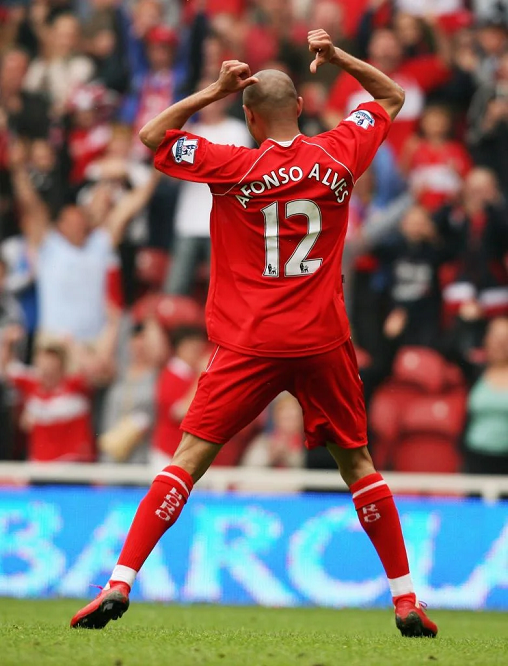
Middlesbrough would almost go into the half-time break 3-0 ahead. Julio Arca would send a diagonal ball out to Stewart Downing on the wing, and Downing would pass the ball inside to Tuncay in the box. Moving wide left, Tuncay would attempt a shot which deflected off left-back Michael Ball into the path of Afonso Alves. However, Alves would miscue his attempted back-flick into the net, and the ball would instead fall to George Boateng standing behind him. Boateng, who had scored one goal in 32 appearances this season, and just seven in 181 Middlesbrough matches leading up to this game, would tee himself with his left foot before smashing a close-range shot with his right foot that Isaksson would have to get his body in the way of to deflect wide. This was a let-off for Manchester City as a third goal would have killed the game off as a contest before half-time. However, Middlesbrough was up for giving their home fans a show on this final Sunday of the season. A 2-0 half-time lead could soon be extended into something worse unless City got their act together.
Once the match restarted, Manchester City would have the first decent chance of the second half. Michael Ball would send a long ball over the Middlesbrough defence, and Nery Castillo (who had come on for the injured Benjani after 13 minutes) would run onto it, bringing Mark Schwarzer away from his net. With no other City players around and Boro defenders quickly swarming him, Castillo would spot the oncoming Darius Vassell and cross the ball into empty space. Vassell would sprint to reach the airborne ball and would succeed. However, once there, the ball would glance off the head of a diving Vassell and end up miles wide of the Middlesbrough net. Vassell’s header was the best chance City had produced to get a foothold back into this match. However, the chance had been and gone, and soon Middlesbrough would capitalise on their failure.
In the 58th minute, Stewart Downing would send an out-swinging corner into the Manchester City penalty area. Downing’s cross would sail over the heads of everyone, but a touch from Emmanuel Pogatetz would keep the ball alive, sending it out to Fábio Rochemback to restart the attack. Rochemback would send a short pass to George Boateng on the wing and, after some jostling with Gelson Fernandes, the Dutch midfielder would send another ball into the City box. Afonso Alves would attempt a header, only to send the ball back towards an unmarked Stewart Downing. With all the time in the world, Downing would send an excellent outside-of-the-boot volley into the far corner of Andreas Isaksson’s net to score his second and Middlesbrough’s third goal of the day. It was a goal worthy of winning any football match. However, Downing’s strike put Middlesbrough 3-0 ahead in this particular game with 32 minutes left on the clock.
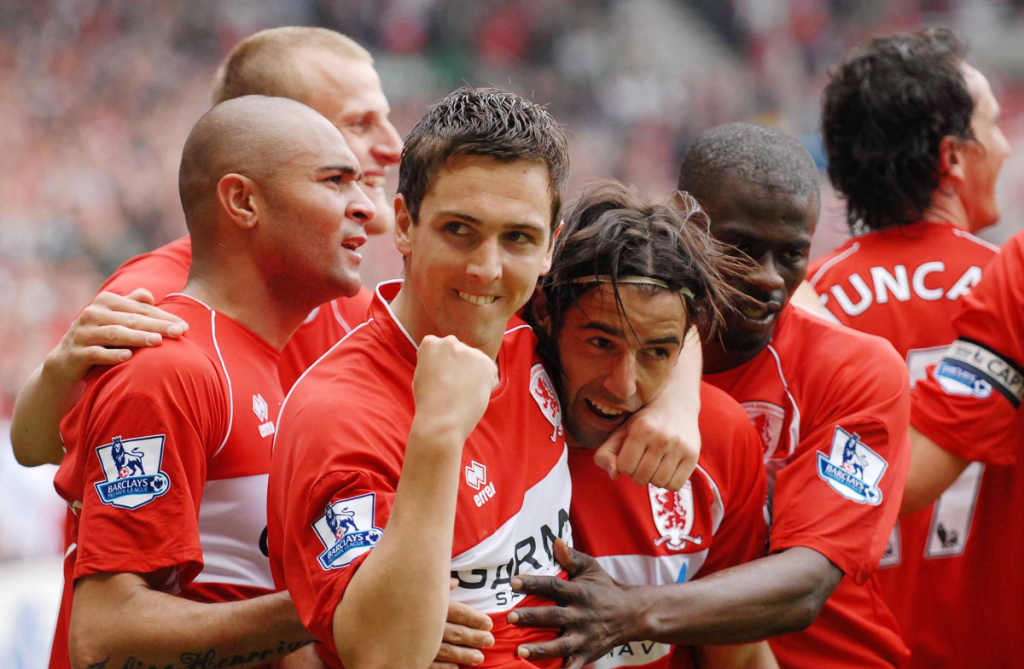
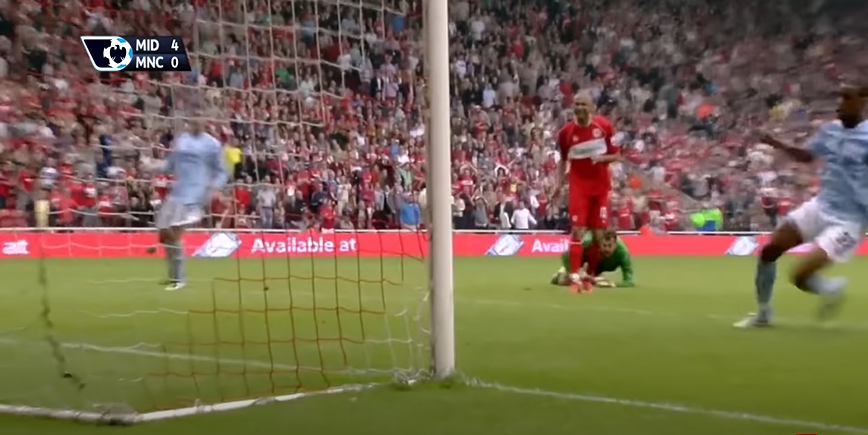
Two minutes after Downing scored his second, it would now be the turn of Afonso Alves to register his brace. After Downing dispossessed City right-back Sun Jihai in midfield, the ball would spill forward to Tuncay. After beating Gelson Fernandes, the Turk would find his momentum stopped by a tackle from City’s remaining centre-back Vedran Ćorluka. However, Ćorluka’s efforts would cause the ball to deflect off Tuncay into the air. With City players looking around for the ball, Julio Arca would send a lofted through-ball forward to an onside Afonso Alves. Once in the Manchester City box, the Brazilian striker would attempt to lift the ball over a seated Isaksson. Alves’s effort would instead hit the hand of Isaksson before bouncing down and continuing its path towards the Manchester City net. Then, just as the ball was about to cross the goal line, a retreating Fernandes would attempt to clear the ball for a corner, only to send the ball into the net with force.
Despite the combined efforts of Andreas Isaksson and Gelson Fernandes, the goal would still be credited to Afonso Alves for his second of the afternoon. Two goals in three minutes had doubled the scoreline from 2-0 to 4-0 in Middlesbrough’s favour. By this point, the game was effectively over as a contest. However, with half an hour left to play, there was a chance Middlesbrough could further add to their lead. Manchester City would now have to go into damage limitation mode to avoid this scoreline becoming an embarrassment.
After this fourth goal, Gareth Southgate and Sven-Göran Eriksson would turn to their substitutes’ bench. In the 62nd minute, Eriksson would replace Darius Vassell with the experienced Dietmar Hamann, a sign that Manchester City had given up trying to win this match and was now looking to stop Middlesbrough from increasing their own winning margin. One minute later, Gareth Southgate would make a double substitution, replacing Julio Arca and Tuncay with winger Adam Johnson and striker Jérémie Aliadière. These replacements showed Southgate was not entirely content with taking a 4-0 victory.
Soon enough, a Middlesbrough player would find the back of the Manchester City net for the fifth time. A Boro free-kick wide on the right-hand side would be headed into the box by Adam Johnson, and the ball would fall to Chris Riggott. Not known for his scoring prowess, the centre-back would finish with aplomb to net only his 9th Middlesbrough goal. However, his celebrations would be cut short by the linesman on the far side and his raised offside flag. Even the officials were showing mercy to Manchester City by this point.
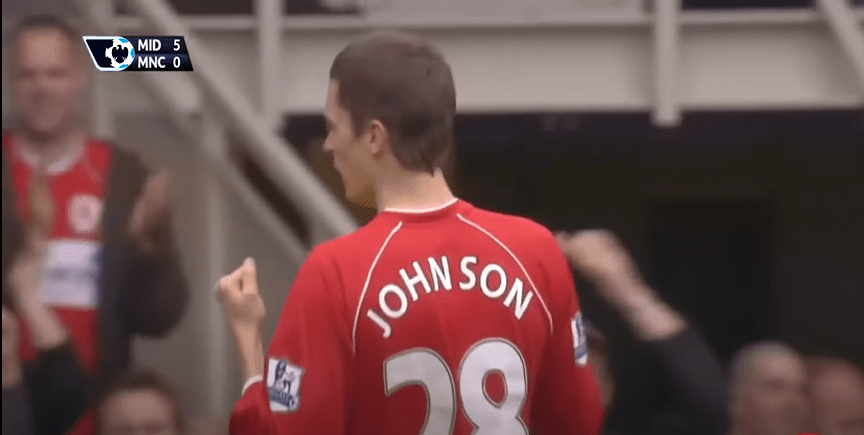
However, Middlesbrough would score the fifth goal in the 70th minute. A tackle from Fábio Rochemback would send Adam Johnson into clear space, and the 20-year-old winger would try his luck from 25 yards. Deflections had not been kind to Manchester City on this day. This lousy luck would soon continue as Johnson’s shot would deflect off the raised leg of Michael Ball, sending the ball to the opposite side of a wrong-footed Andreas Isaksson. The youngster, who had enjoyed a fruitful loan spell at Watford earlier in the season (5 goals in 12 matches), had scored just his second-ever goal for his parent club.
After Adam Johnson’s goal put Middlesbrough 5-0 up, Manchester City manager Sven-Göran Eriksson would replace winger Martin Petrov with attacking midfielder Elano. Eriksson would hope that the Brazilian midfielder, City’s top goalscorer for the season with eight, could at least grab a consolation for his beleaguered side.
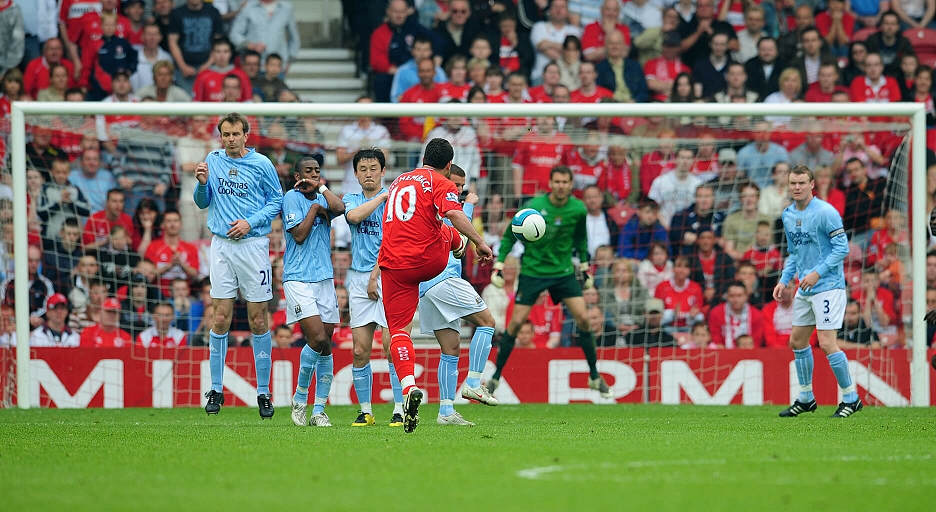
A further 10 minutes would pass following Adam Johnson’s goal, perhaps suggesting that Middlesbrough were starting to slow down. However, Gareth Southgate’s side was far from done. In the 80th minute, Boro would receive a direct free-kick 35 yards from goal. Up would step Fábio Rochemback. Rochemback was known for his free-kick abilities, having scored a notable one from 30 yards in an FA Cup replay against Charlton the previous year. However, this free-kick would soon confine that other goal to the pages of forgotten history. With no teammates near him, the Brazilian midfielder would build up a head of speed before hitting the ball with such velocity that the ball had already found the top corner before the goalkeeper could even begin his dive. A bona fide goal-of-the-season contender, Fábio Rochemback had scored a career-defining goal to increase Middlesbrough’s lead to 6-0. However, if anybody after this day talked about this match besides the scoreline, they would mention this free-kick.
If that goal wasn’t enough punishment, it was now time for another Middlesbrough substitute to get in on the goalscoring act. With five minutes remaining, a well-worked Middlesbrough move around the Man City penalty area would end with Stewart Downing feeding a ball through to Jérémie Aliadière. The French striker would add his two cents to proceedings and send Boro into the proverbial ‘seventh heaven’.
While Aliadière celebrating, cameras would cut to a crestfallen Sven-Göran Eriksson standing on the Manchester City touchline. After such a promising first half to their Premier League season, Manchester City’s second-half decline would be ended with an abrupt full stop in the form of this Middlesbrough defeat. Eriksson’s future would certainly be up in the air following this result.
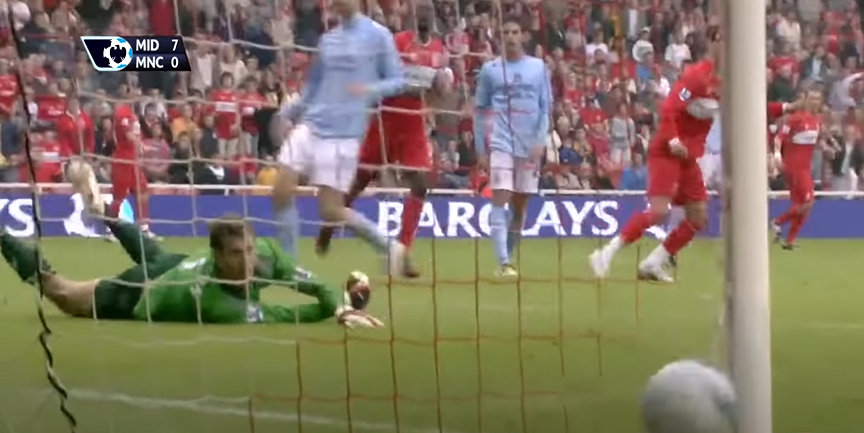
After 86 minutes of misery, Manchester City fans would finally be given something to cheer about. After Stephen Ireland managed to pinch the ball from George Boateng to launch a counter-attack, the Irishman would send the ball wide to Elano. Elano would cut inside three Middlesbrough players before unleashing an impressive shot into the far corner. Even though his effort was scant consolation on this day, Elano’s goal was good enough that the away fans behind the net cheered it like he had just given Manchester City the lead. However, the score would still read 7-1.
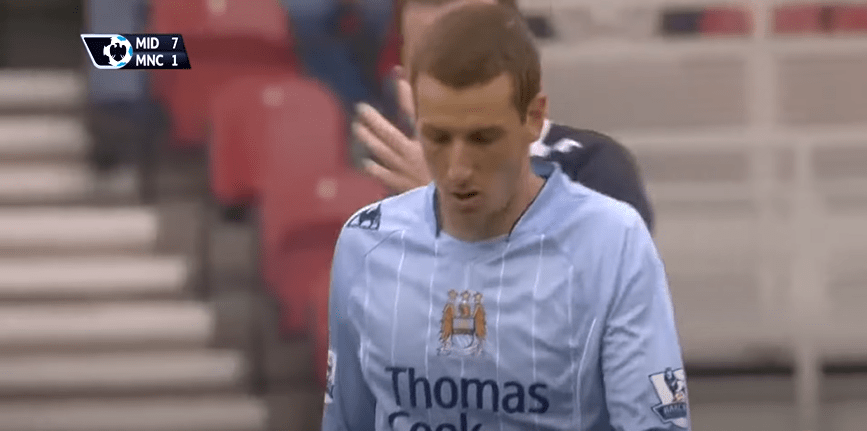
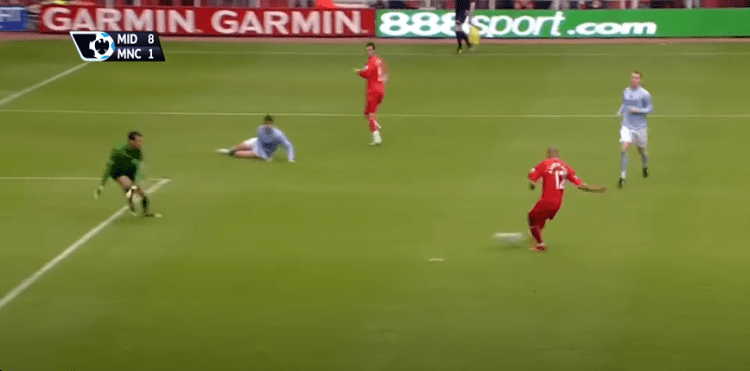
However, Middlesbrough would not allow Manchester City to have the last say in this game. As the clock ticked past 90 minutes, the Manchester City defenders began to pass the ball between one another. However, as Michael Ball attempted to pass the ball forward, his pass would deflect off Stewart Downing’s boot back into his own face. This moment of comedy would end with the ball going to Jérémie Aliadière. Aliadière would slide the ball to Afonso Alves, and the Brazilian would stroke the ball past a despairing Andreas Isaksson to complete his hat-trick and score Middlesbrough’s eighth goal.
The final whistle at the Riverside would be greeted with warm applause from the home support as they celebrated a famous victory. The result did little to change either team’s final finishing positions in the 2007-08 Barclays Premier League standings. Manchester City would remain 9th, while Middlesbrough would move up one spot to 13th, overtaking Wigan Athletic to finish six points clear of the relegation zone. However, Gareth Southgate’s team had produced an end-of-season masterclass at the Riverside. After Richard Dunne’s early red card, Boro had been ruthless, scoring eight goals past Andreas Isaksson. Six goals had come in the second half, and three had arrived in the final ten minutes. Afonso Alves had scored a hat-trick to take his final tally to an impressive 6 goals in 11 matches following his January transfer from Dutch side Heerenveen. Stewart Downing had helped himself to a brace while Fábio Rochemback had produced a goal to remember with a stunning free-kick.
This 8-1 result was the biggest win of the 2007-08 Premier League campaign and marked Manchester City’s heaviest Premier League loss. What would happen to these Manchester City players or their manager Sven-Goran Eriksson after this day? It remained to be seen.
Aftermath
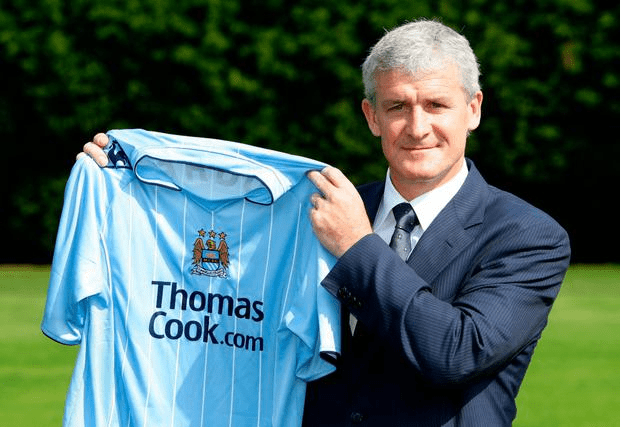
In June 2008, Sven-Goran Eriksson was sacked as Manchester City manager. His 45 matches in charge had produced 19 wins, 11 draws and 15 defeats, finishing with a win ratio of 42.22%. On 4th June 2008, Blackburn manager Mark Hughes would be unveiled as Eriksson’s replacement. During his four seasons at Ewood Park, Hughes had led Blackburn to three consecutive top-ten finishes and twice qualifying for the UEFA Cup. These achievements would convince Thaksin Shinawatra that he was the man to lead Manchester City forward.
From the team that started against Middlesbrough, goalkeeper Andreas Isaksson, right-back Sun Jihai and centre-back Vedran Ćorluka would all leave Manchester City in the summer of 2009. Also among the departures were Geovanni and Rolando Bianchi, the two men whose debut goals had ensured a 2-0 win for Sven-Göran Eriksson in his first Premier League match in charge the previous August.
Early summer transfers would see Brazilian striker Jô arrive from CSKA Moscow for £18.5m and defender Tal Ben Haim join from Chelsea for £5m. Then, after much radio silence, Manchester City’s transfer business would start to seriously pick up in late August, with five players arriving in the last 10 days of the transfer window as rumours emerged that a change in the club’s ownership could occur. Defensive midfielder Vincent Kompany would join from Bundesliga side Hamburg for £6m, while Shaun Wright-Phillips would return to Manchester City after three years at Chelsea one week later. On 31st August, two defenders, Nuremberg centre-back Gláuber and Espanyol right-back Pablo Zabaleta would join. Then, on 1st September, Manchester City would change forever.

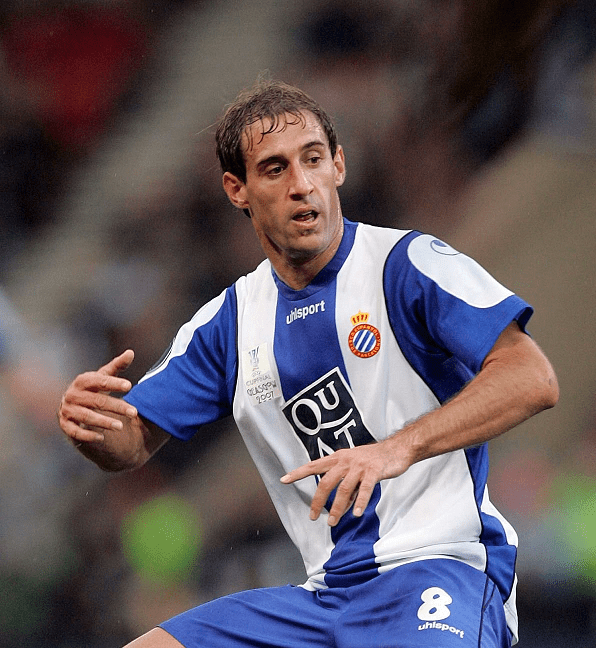
On transfer deadline day, Manchester City would announce that current owner Thaksin Shinawatra (who had only bought the club one year earlier) had sold the club to the Abu Dhabi United Group for £200 million. United Arab Emirates Sheikh Mansour bin Zayed Al Nahyan would become the club’s new owner, with Khaldoon al Mubarak becoming the club’s new chairman. With this takeover becoming official just minutes before the closure of the summer transfer window, Manchester City would announce that they had signed Real Madrid forward Robinho for a British transfer record fee of £32.5 million. With Chelsea seemingly being Robinho’s preferred destination for days beforehand, this last-minute swoop from Manchester City showed off the new ownership’s considerable financial clout. After Robinho’s arrival, Wayne Bridge, Craig Bellamy, Nigel de Jong and Shay Given would all arrive at Eastlands the following January.

With Zabaleta, Bridge, Wright-Phillips, Kompany and Robinho all quickly becoming Manchester City regulars alongside previous signing Elano and homegrown talents Joe Hart, Micah Richards, Stephen Ireland and Daniel Sturridge, the Sky Blues would finish 10th in Mark Hughes’ first season in charge. However, this was just the beginning of a journey that would produce fourteen trophies over the next thirteen years.
 the-score-board.co.uk