
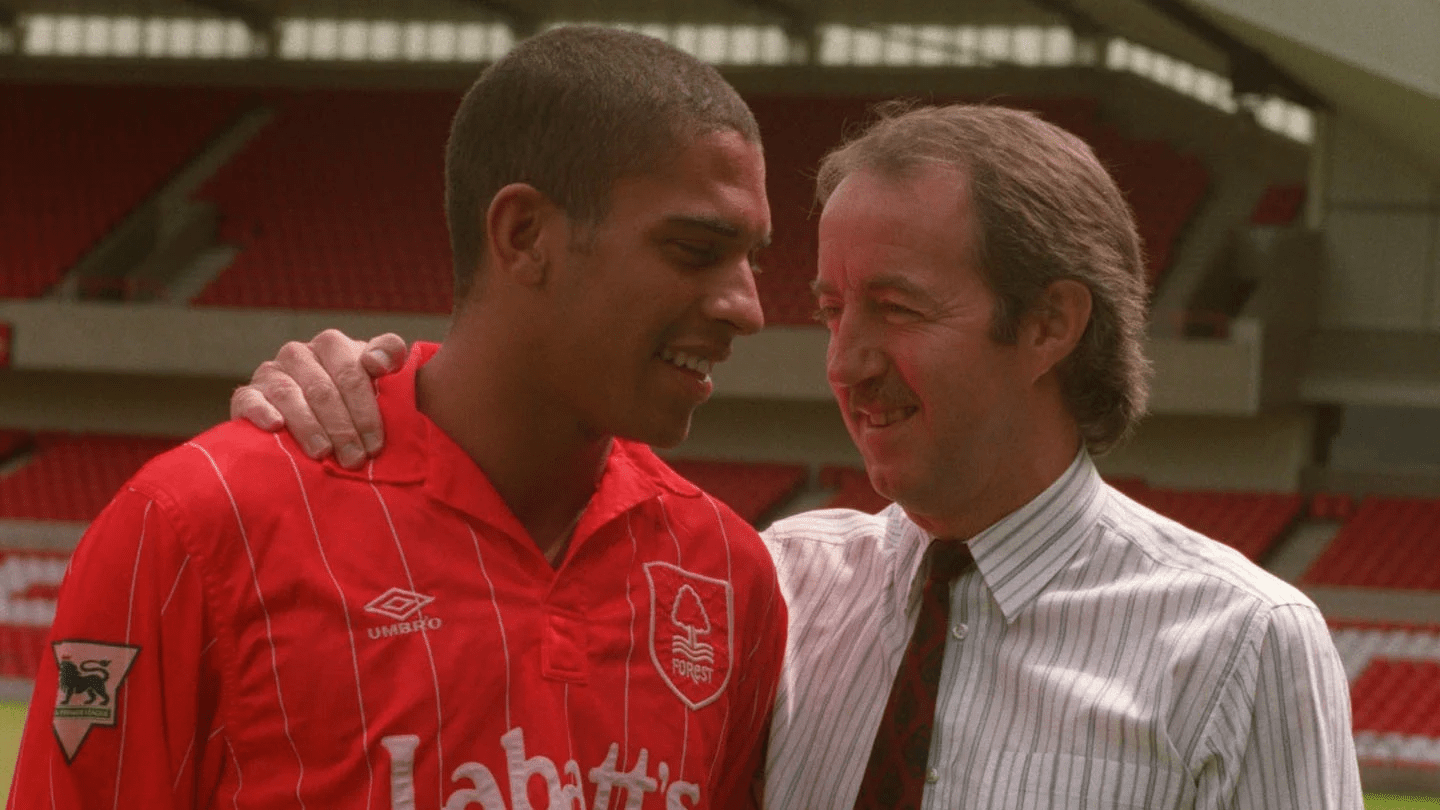
1993/94: The End of One Era, And The Beginning of Another
Manager: Frank Clark
Top Scorer: Stan Collymore (25)
First Division: 2nd (promoted)
FA Cup: 3rd round
League Cup: Quarter-finals
Anglo-Italian Cup: Qualifying Round Group Stage
League record: 23 wins, 14 draws, 9 defeats, 74 goals scored, 49 goals conceded
Transfers: £+1.225 million
Transfers in: £6.175 million
| Date | Position | Player | From | Transfer Fee |
|---|---|---|---|---|
| 21st June | DF | Colin Cooper | Millwall | £1.7 million |
| 5th July | FW | Stan Collymore | Southend | £2.25 million |
| 21st July | FW | Gary Bull | Barnet | Free |
| 27th July | DF | Des Lyttle | Swansea | £375,000 |
| 20th August | MF | David Phillips | Norwich | £500,000 |
| 24th September | GK | Tommy Wright | Newcastle | £450,000 |
| 5th November | MF | Lars Bohinen | Young Boys | £450,000 |
| 25th January 1994 | DF | Alf-Inge Håland | Bryne | £250,000 |
| 4th March 1994 | FW | Jason Lee | Southend | £200,000 |
Transfers out: £7.3 million
| Date | Position | Player | To | Transfer Fee |
|---|---|---|---|---|
| 21st May | FW | Gary Bannister | Stoke | Free |
| 7th June | FW | Nigel Clough | Liverpool | £2.25 million |
| 5th July | DF | Chris Hope | Scunthorpe | £50,000 |
| 19th July | MF | Roy Keane | Manchester United | £3.75 million |
| 29th July | DF | Gary Charles | Derby | £750,000 |
| 5th August | MF | Þorvaldur (Thorvaldur) Örlygsson | Stoke | Free |
| 8th October | GK | Andy Marriott | Wrexham | £200,000 |
| 7th February | MF | Ray McKinnon | Aberdeen | £300,000 |
Introduction
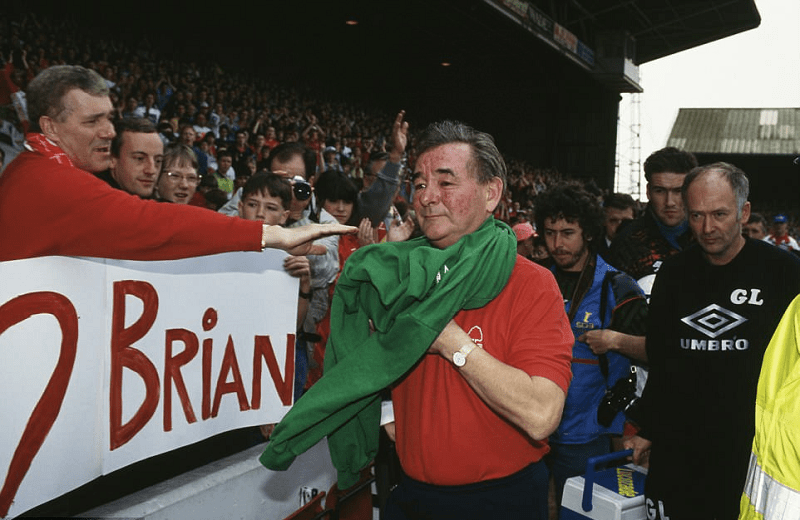
At 4:45pm on Saturday 8th May 1993, referee Mike Reed would blow the final whistle on Nottingham Forest’s 16-year run in the top division of English football. Despite a valiant effort, a 2-1 defeat away to Ipswich Town on the final day of the first Premiership season would see Forest suffer relegation along with Middlesbrough and Crystal Palace. However, this loss to the Tractor Boys would serve as the final match of Brian Clough’s managerial career. A few days after his side’s relegation to the Football League First Division, the 58-year-old would call time on his 18-year-spell with the East Midlands club and his 28-year career in football management. This career had seen him take charge of Hartepools United (as they were known at the time), Derby County, Brighton and Hove Albion, Leeds United and Nottingham Forest. His time at Derby saw him take the Rams from the lower reaches of the Second Division in 1967 to becoming English champions in 1972. However, Clough’s time at Forest would mark him out among the managerial greats.
Arriving at the City Ground on 3rd January 1975, just 112 days after his ill-fated 44 days in charge of Leeds United, a wounded Brian Clough would take over a Nottingham Forest side sitting 13th in the Second Division 25 games into the 1974-75 season. In the remaining 21 matches of that season, Clough could only lead Forest to three wins, eight draws and ten defeats, and the team would end the season 19th in the Second Division table. However, Nottingham Forest would knock top division Tottenham out of the FA Cup after a replay, so the promise was there.
Within two seasons, Clough (now with Peter Taylor back by his side) would lead Nottingham Forest back into the First Division after a five-year absence. In that same promotion season, Forest would earn their first trophy under Clough in the Anglo-Scottish Cup (the cup competition for the best British teams who had not qualified for European competition). The next year (1977-78), following the signings of Archie Gemmill and Peter Shilton, an unfancied Forest team would first win the League Cup, beating reigning English and European champions Liverpool in a replay. Then, this newly-promoted team would upset the odds further by becoming champions of England for the first time in their 113-year history. However, if becoming champions of England wasn’t enough, the next two years would see this East Midlands club twice reach the top of European football as Nottingham Forest won back-to-back European Cups in 1979 and 1980. These two seasons would also see the addition of another League Cup and the UEFA Super Cup.
After this incredible run of success, the thirteen years following the team’s second European Cup would see another four trophies head through the doors of the City Ground. Forest would win successive League Cups in 1989 and 1990 and become record two-time winners of the Full Members’ Cup, with the latter of these victories coming in Clough’s penultimate year in charge in 1992. Therefore, having provided a steady stream of twelve trophies in eighteen years, including four League Cups, two European Cups and a First Division title, 8th May 1993 was a sad day for Nottingham Forest fans. To see Brian Clough, who had given them success beyond their wildest dreams walking down the Portman Road touchline defeated and visibly upset as he walked back to the dressing room, many would not have expected the great man to fall on his sword just days later. As news of his retirement circulated, Nottingham Forest fans would begin a new football season without Brian Clough controlling the team for the first time in seventeen years.
Pre-season
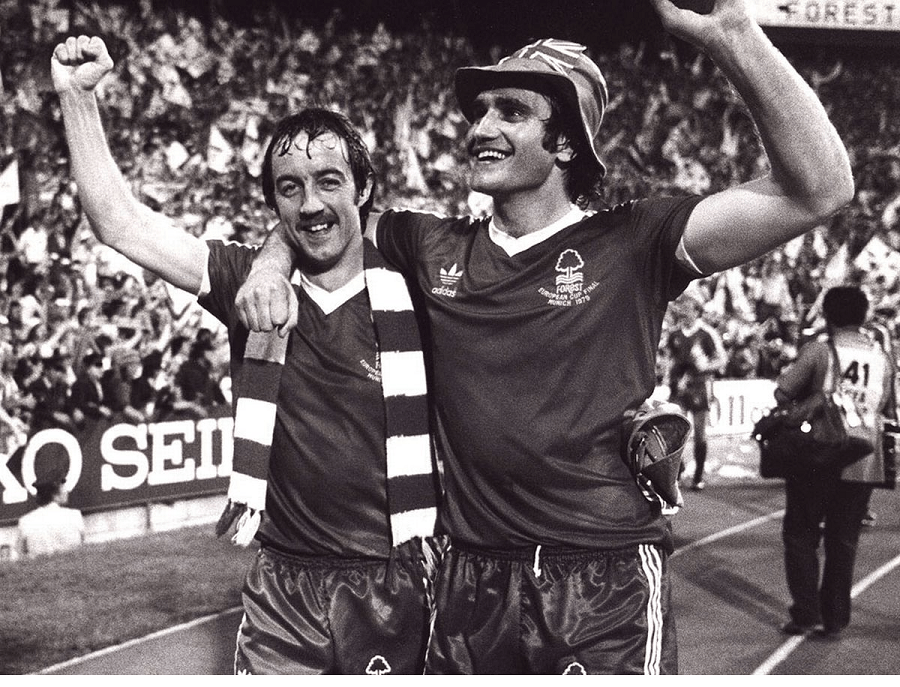
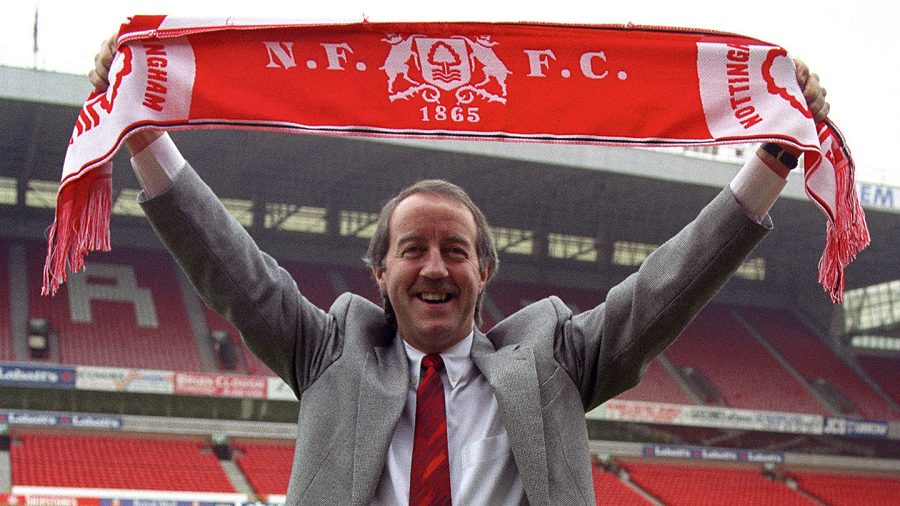
The Nottingham Forest board would take five days to appoint the club’s new manager. For Brian Clough’s successor, the board would choose the man he had picked as a potential successor years earlier, Frank Clark. Clark was one of the first players signed by Brian Clough as Nottingham Forest manager, joining the club on a free transfer from Newcastle United in July 1975. Despite being 31 when he joined, Frank Clark would become an-ever-present on the left side of the Nottingham Forest defence as the club rose to the top of English and then European football. Clark would start in both of the club’s League Cup final victories in 1978 and 1979. He would even play the full 90 minutes in Forest’s 1979 European Cup Final win over Malmö in what would be the last match of his career.
However, when the Nottingham Forest board chose to appoint Frank Clark as their new manager, they were hiring someone who had been out of work for 22 months. In addition, Frank Clark had never managed a club as big as Nottingham Forest or at a level as high as the First Division. Following the end of his playing career, Clark had served as assistant manager at Sunderland for three seasons, helping the club earn promotion to the top-flight of English football. After this apprenticeship, Frank Clark would take the top seat at Third Division Leyton Orient in May 1983. Clark could not stop the O’s suffering relegation to the Fourth Division in 1985 but would later lead the team back into Division Three (via the play-offs) in 1989. After two mid-table finishes in Division Three, Clark would move upstairs at Brisbane Road, becoming Leyton Orient’s managing director in 1991. In this position, Frank Clark would remain until Nottingham Forest came calling in May 1993.
Frank Clark’s first significant acts as Nottingham Forest manager would see the club’s two leading strikers leave for new pastures. First, on 21st May, Gary Bannister would move to First Division new boys Stoke City on a free transfer. Bannister had only joined Forest from West Brom the previous August. He had gone on to play 32 Premiership matches, scoring eight goals, including braces against Chelsea and Oldham. However, with Frank Clark looking to reduce the age of his strikeforce, selling the 33-year-old Bannister was a straightforward decision to make.
The end of May would also see the sad retirement of left-back Brett Williams at 25 years old. Williams had joined Nottingham Forst as a 15-year-old apprentice in 1983. He would later move up through the academy to make his debut as a 17-year-old in 1985. Williams would often find himself behind Stuart Pearce in the pecking order and was thus loaned out to five different clubs (Stockport County, Northampton Town, Hereford United, Oxford United, Stoke City) between 1987 and 1993. However, an injury to Pearce would see Williams start against Manchester in the 1992 League Cup Final. Most recently, he had appeared in nine matches during the team’s 1992-93 Premiership campaign, even starting in Brian Clough’s final home game in charge against Sheffield United on 1st May 1993. However, following relegation, Frank Clark would choose to release the left-back from his contract on 31st May, and Williams would not return to football until 1996.
Around the same time, another Nottingham Forest academy graduate was forced to call time on his career early. Centre-back Terry Wilson would retire at 24 years old due to problems with a persistent knee injury. Brian Clough had signed Wilson as a junior from boyhood club Tynecastle FC in 1986. Still aged 18, Wilson would make his Forest debut against Southampton in September 1987. Despite his youth, Terry Wilson would quickly become a fixture in the Forest midfield, playing 45 matches during the 1987-88 season. Despite later moving to centre-back, Wilson kept his place in the starting XI, starting in Forest’s victories in the 1989 finals of the League Cup and the Full Members’ Cup. Later, he would begin both the 1990 League Cup Final and the 1991 FA Cup Final.
However, Wilson would lose his spot to Steve Chettle during the 1991-92 season, and after loan spells at Norwegian club Hønefoss BK and Second Division Newcastle United, he would never claim his place back. Wilson would make seven appearances for Forest during the 1992-93 season, with his final one coming in a League Cup victory over Arsenal on 12th January 1993. With opportunities limited, a deal was agreed for Wilson to move to Dunfermline Athletic. However, knee troubles would cause him to retire from football rather than pursue the move. Having spent all his senior career at Nottingham Forest, Terry Wilson would retire, making 178 appearances for the Reds, scoring 13 goals.
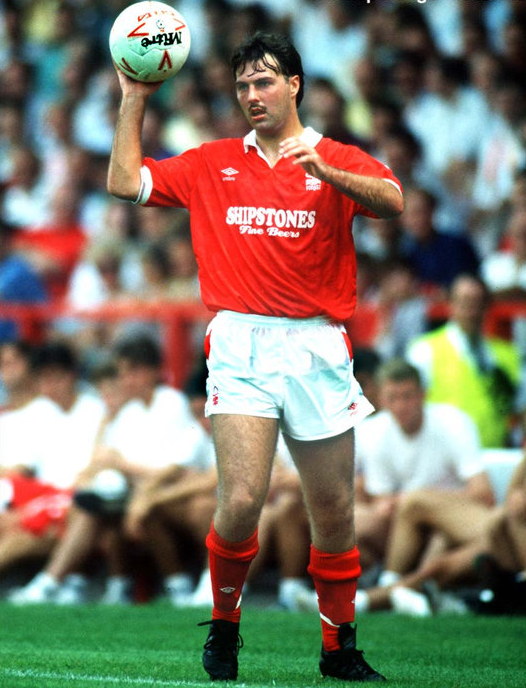
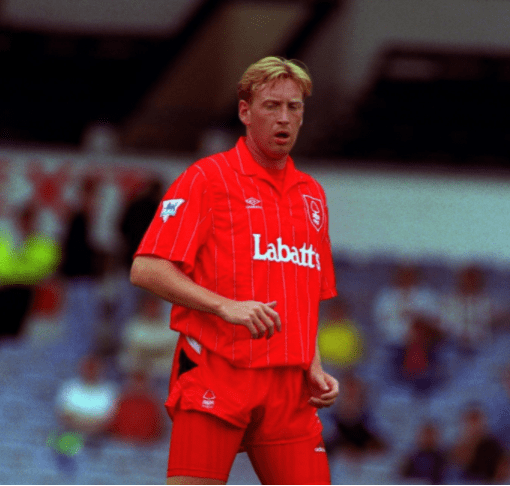
While Gary Bannister had played just one season of football for Nottingham Forest, his striking partner Nigel Clough had made 402 appearances for the Reds when Liverpool came calling for his services in June 1993. Clough had been part of Nottingham Forest since joining as a 16-year-old apprentice in 1982. After his dad gave him his professional debut at 18 in 1984, Nigel would become a regular part of the Forest squad for the next nine seasons. He would end six of those nine seasons as Forest’s top scorer, helping the team to successive third-placed league finishes in 1988 and 1989 and scoring twice in the 1989 League Cup Final. These numbers had earned the younger Clough 13 England caps and, unfortunately, the interests of some of the bigger clubs in England. Therefore, on 7th June 1993, Nigel Clough would choose to remain a Premiership player, joining Liverpool for £2.25 million, making him one of the most expensive footballers in the world. Overall, in nine years at the City Ground, Nigel Clough would net 130 goals in 402 matches for Nottingham Forest, with 101 coming in the league.
Now, in the month following their top-flight relegation, Nottingham Forest had sold their two leading strikers and leading goalscorers from the previous league campaign. Between them, Nigel Clough (10) and Gary Bannister (8) had provided 18 of Nottingham Forest’s 41 Premiership goals in the 1992-93 season. Frank Clark would have to replace either one or both of these players with forwards who could fire Forest back into the big time.
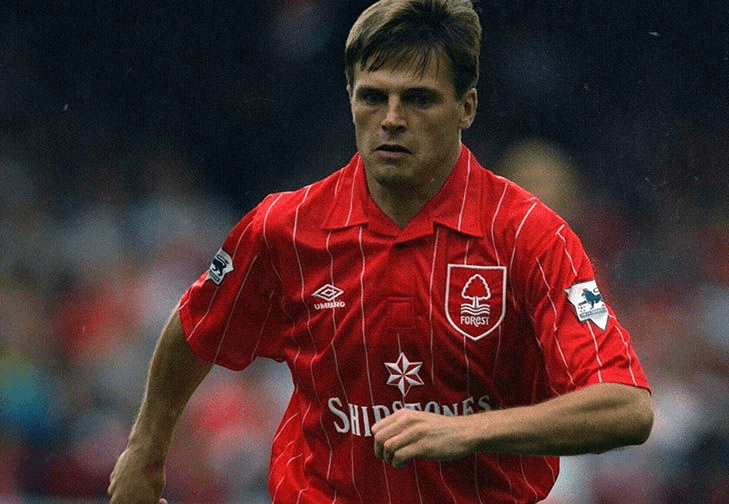
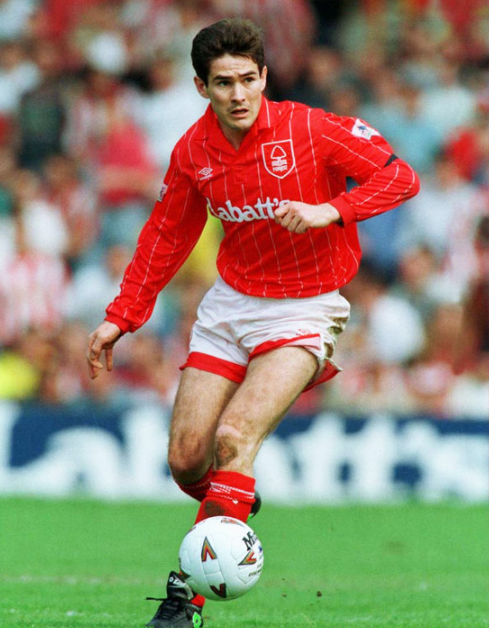
After beginning his transfer business in a selling mood, Frank Clark would switch to buying towards the end of June. He would look to his team’s defence for his first signing as Nottingham Forest manager. With several of the team’s top defenders now the wrong side of 30 years old, Clark would look to a player who had plenty of league experience but was just beginning to enter his prime. On 21st June, Millwall centre-back Colin Cooper would join Forest for £1.7 million. The 26-year-old had plenty of second-tier experience, with 184 of his 265 career league appearances coming at this level. He also knew how to earn top-flight promotion, having achieved the feat with Middlesbrough in 1988. For Frank Clark, the signing of Cooper would hopefully add some energy and steel to an ageing backline.
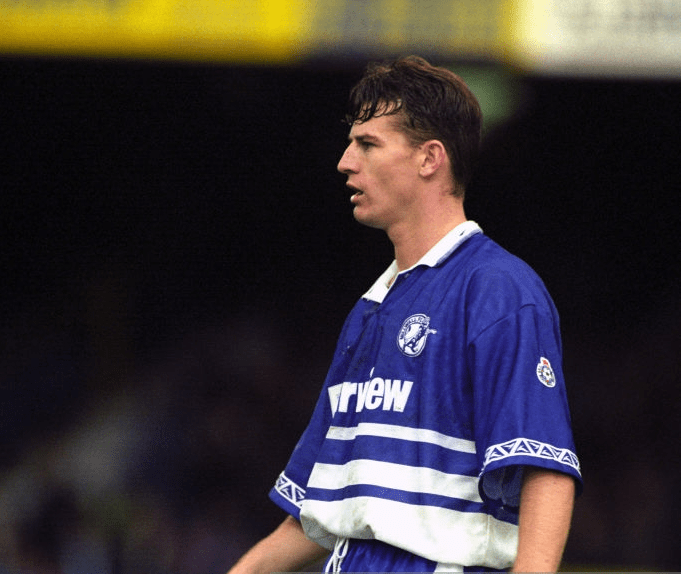
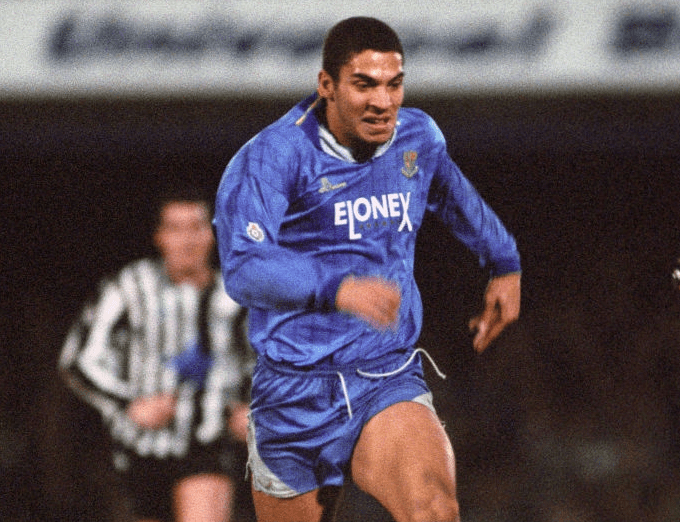
Having already sold Gary Bannister and Nigel Clough for a combined £2.25 million earlier in the summer, Frank Clark would reinvest all of that money to sign Southend United striker Stan Collymore for a club-record fee on 5th July. The 22-year-old had shone in a Southend side that had finished 18th in the First Division the previous season, scoring 15 goals in 30 matches to help the Shrimpers avoid relegation. Like Colin Cooper, he also had top-flight experience. However, 4 starts (20 appearances) across 22 months at Crystal Palace would lead the young striker to seek more playing time elsewhere.
When Stan Collymore arrived at Nottingham Forest, defender Chris Hope would leave the club for Third Division Scunthorpe United for £50,000. Signed by Brian Clough at the age of 17, Chris Hope would join Forest from another Third Division (then Fourth Division) side in Darlington in August 1990 based on the recommendation of his manager Brian Little. However, unlike many of his peers, Chris Hope would not become a regular in Nottingham Forest’s starting XI. In fact, he would not make a single league appearance for Forest during his three seasons at the club. Now, after spending the previous season on loan at non-league Kettering Town, the 20-year-old centre-back would now try his chances down in the Third Division with The Iron.
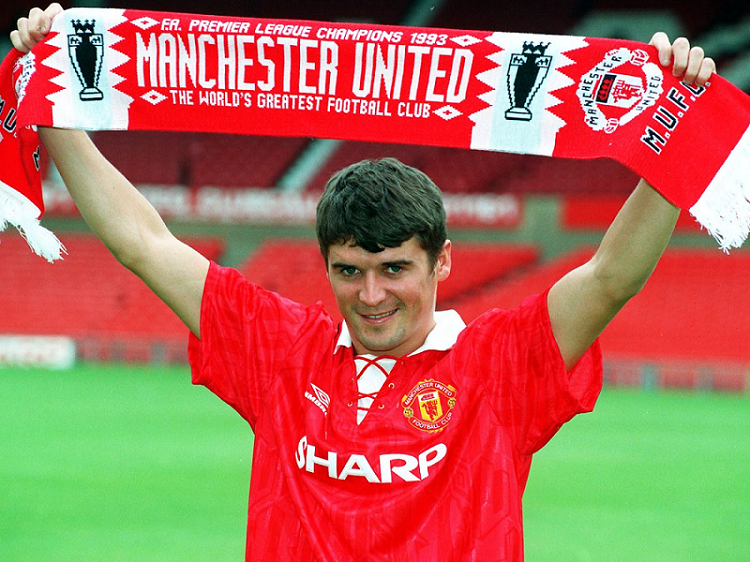
As Nottingham Forest was starting to build their squad for the upcoming First Division season, another of the club’s most prominent stars would choose to continue playing their football in the Premiership for another year. On 19th July, Premiership champions Manchester United would sign Forest midfielder Roy Keane for an English transfer record fee of £3.75 million.
After being scouted by Forest scout Noel McCabe and impressing Brian Clough during a trial, an 18-year-old Keane would join the Reds for £10,000 from second-division Irish side Cobh Ramblers in June 1990. Despite his age and lack of professional football experience, Keane would immediately impress, playing 49 matches during his debut season. He would become a near-fixture in the Forest midfield between 1990 and 1993, making 156 appearances in all competitions during his four seasons at the club. He would start in the club’s 1991 FA Cup Final defeat to Tottenham and their 1992 Full Members’ Cup victory over Southampton. Keane would also become a regular goalscorer for Forest. Behind Nigel Clough and Gary Bannister, Keane had been the club’s third-highest scorer the previous Premiership season, scoring 6 goals in 40 games. Now, still aged 21 and considered the hottest young midfield prospect in English football, Alex Ferguson would move to add the young Irishman to his clutch of talented young players.
Two days after Keane’s departure, Frank Clark would add to his forward line again, picking up Barnet’s Gary Bull on a free transfer. The cousin of Wolves striker Steve Bull, Gary Bull had played a crucial role in Barnet’s rise from the Conference to the Second Division between 1990 and 1993, scoring 37 goals in 83 league matches. He also helped the Bees reach the FA Cup 3rd round in 1991 and 1992. Despite Bull playing most of his career in non- and lower-league football, Frank Clark believed that the 27-year-old could add something to his striking options.
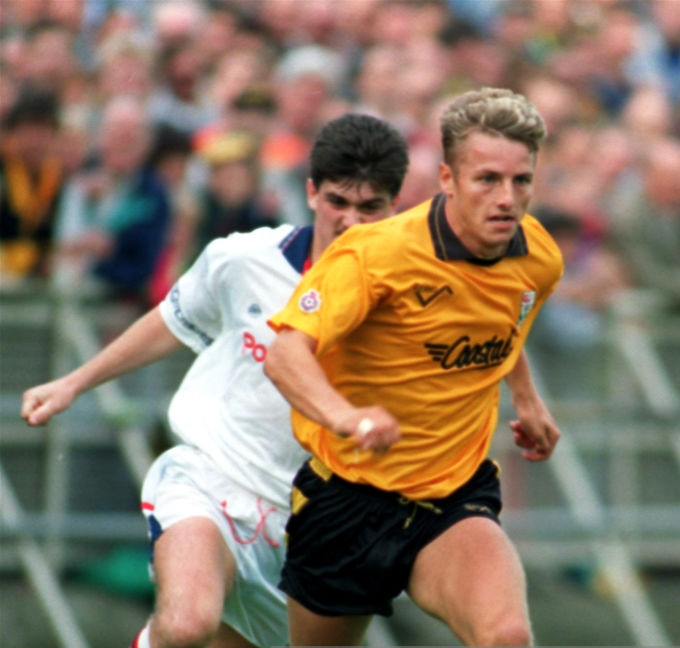
On 27th July, Nottingham Forest would add another young defender to their squad in Swansea City right-back Des Lyttle. The 21-year-old did not miss a single league match the previous season as Swansea qualified for the Second Division play-offs before a semi-final loss to West Brom. With regular starting right-back Brian Laws exiting his peak years, Lyttle was another signing for both the present and future as Forest looked to reduce their team’s age while keeping their best and most experienced players.
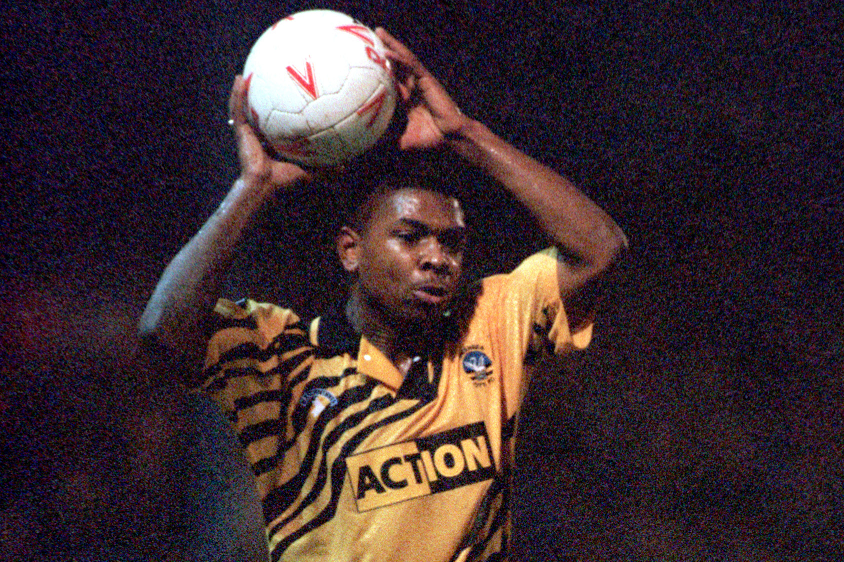
However, the signing of one young right-back would soon lead to the departure of another full-back. Two days after Des Lyttle joined Nottingham Forest for £375,000, the club would sell Gary Charles to regional rivals Derby County for twice that amount. Charles had spent his entire career at Forest, coming through the academy and making his first-team debut at 17 in November 1987. Despite his youth, Charles would proceed to make 108 first-team appearances for the Reds over six seasons, including 81 league games. Even though he often ended up second-choice to the more-experienced Brian Laws, Charles would start big matches like the 1991 FA Cup Final and the 1992 Full Members’ Cup Final. However, he had made just 14 appearances during the most recent league campaign, and the recent signing of Des Lyttle had forced him to start looking for game-time elsewhere.
Finally, Frank Clark would complete his pre-season transfer business by selling Icelandic midfielder Þorvaldur (Thorvaldur) Örlygsson. Örlygsson would join Nottingham Forest from Icelandic club KA Akureyri in December 1989 for £175,000. However, he would struggle to find his place in Brian Clough’s trophy-winning side. He would make twelve league appearances during the 1989-90 campaign after his mid-season signing but would only make five more over the next two years. After a total of 22 appearances (in all competitions) in two-and-a-half seasons, Örlygsson would finally get something close to a break during the 1992-93 Premiership season. The Icelandic international would make a total of 20 league appearances (15 starts) in the Forest midfield during the team’s relegation fight. However, he could not displace Roy Keane and Scot Gemmill from the first team. After the change in management, Frank Clark could not find a place for Örlygsson in his plans, and the midfielder would join former teammate Gary Bannister at Stoke City on 4th August 1994.
August
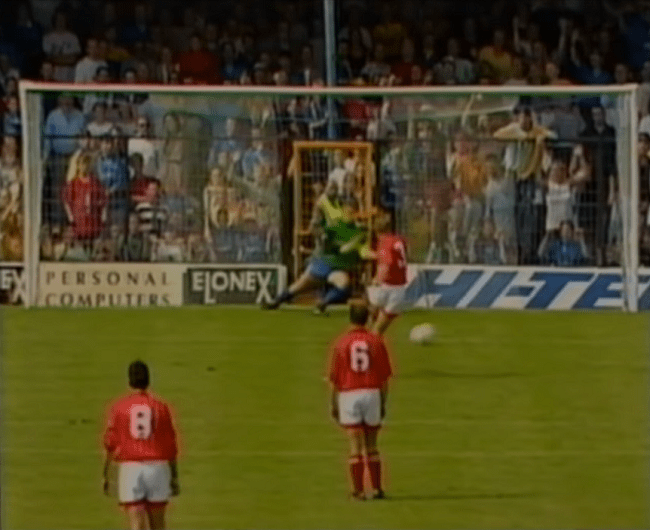
After an interesting few months, Nottingham Forest would begin their first season back in the First Division with an away trip to Southend United on 15th August 1993. However, in a rude awakening, Forest would be forced to be content with an opening-day draw against the Shrimpers. Forest captain Stuart Pearce would play a part in both of the goals scored on this day. An elbow in the back from the England international would lead to a Southend free-kick and a yellow card for Pearce 45 seconds into the match. Then, a long ball downfield would immediately cause confusion in the Forest defence, and United striker Andy Sussex would touch the ball home while colliding with Forest goalkeeper Mark Crossley. Southend would take the lead 75 seconds into the first game of the new season. However, Pearce would redeem himself from the penalty spot later in the first half. A one-two between centre-forwards Lee Glover and Robert Rosario would take the former into the Southend box only for defender Pat Scully to bring him down and concede the spot-kick. The usually reliable Pearce would level the score despite the Southend goalkeeper guessing correctly.
Minutes before half-time, Frank Clark’s men would come close to taking the lead, but Southend defender Chris Powell would head Lee Glover’s effort off the goal-line. Later in the match, Kingsley Black would find fellow midfielder Steve Stone in open space. The winger would centre the ball to Ian Woan only for the left winger to side-foot the ball directly at the on-rushing keeper. At the end of 90 minutes, the match would end in a 1-1 draw, with those involved with Nottingham Forest rueing missed chances in a game that they should have won.
Three days after the Southend draw, Derby County would travel to the City Ground for Nottingham Forest’s first home match and the first East Midlands derby of the new season. Forest would have the better early chances against Derby, but the form of Rams keeper Martin Taylor would keep them at bay. Then, the home defence’s failure to clear their lines would lead to Derby defender Michael Forsyth firing the visitors ahead. However, Forest would get back on level terms. Robert Rosario would flick on a high ball, and Ian Woan would turn inside the Rams defence before lashing a shot past Taylor from the edge of the box. The Reds would have a late opportunity to win all three points, but Rosario would drag his effort wide of the post with Taylor beaten. The match would end 1-1, and Nottingham Forest would begin life in the First Division with back-to-back draws.
On 20th August, Frank Clark would bolster the Nottingham Forest midfield by signing David Phillips from Premiership side Norwich City for £500,000. The 30-year-old would bring a wealth of top-flight experience with him to the City Ground, having played 291 matches over eight consecutive seasons with Manchester City, Coventry City and the Canaries. He was even a decent goalscorer, having provided nine during Norwich’s 3rd-place Premiership finish the previous year. With Nottingham Forest lacking goals following the departure of Roy Keane, Phillips could offer both this and his experience to help the East Midlands club achieve promotion back to the Premiership.
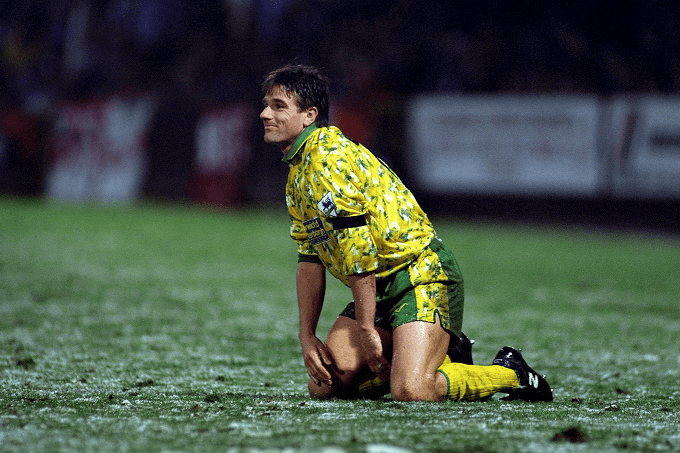
After starting the season with two draws, Nottingham Forest would finally get their first win against Grimsby Town on 21st August. However, this match would turn out to be a classic for both teams. Forest would open the scoring in the 14th minute through Kingsley Black, the midfielder finishing after a knock-down from Colin Cooper. Then, Grimsby would help Forest double their lead through a rather comical own goal. Grimsby defender Paul Futcher would send a lifted backpass back to his goalkeeper Paul Crichton, only for Crichton to completely miss his kick and allow the ball to roll into the net. Minutes before half-time, Grimsby would pull a goal back through Clive Mendonca’s lifted shot over Mark Crossley, and Forest would lead 2-1 at the break.
After the break, Frank Clark’s men would re-establish their two-goal cushion through a near-post header from striker Lee Glover, only for Jim Dobbin to halve the lead once more at the 60-minute mark. However, as soon as Grimsby were back in touch, great work from Glover and Robert Rosario would set up Ian Woan for his second goal in successive matches and Forest’s fourth. Grimsby would not lie down, though, and Mendonca would score his second goal of the afternoon to make the score 4-3 after 66 minutes. After three goals in six minutes, the home side would finally settle this topsy-turvy affair when Robert Rosario finished off Lee Glover’s cross with a near-post header. Nottingham Forest had their first three points of the season, handing Frank Clark his first victory as the club’s manager, but they had needed to beat Grimsby Town 5-3 to do it.

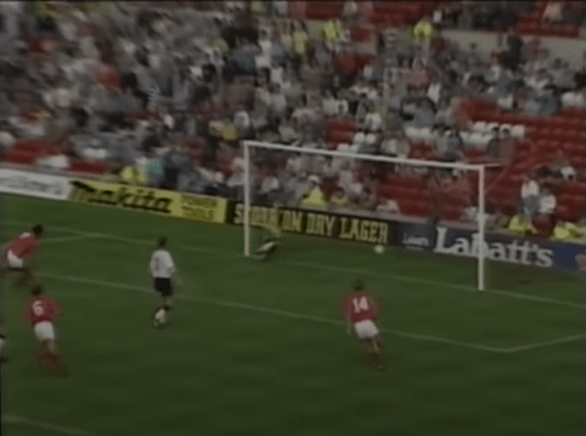
As soon as Nottingham Forest had experienced their first victory in the First Division, the team would suffer their first defeat at fellow relegated side Crystal Palace on 24th August. Defenders Eric Young and Dean Gordon would give Alan Smith’s side the win as Forest drew their first blank. Young would open the scoring from a corner after 17 minutes before Gordon powered a free-kick through the Forest backline and Mark Crossley to seal the victory.
Nottingham Forest would end the month with their first away win of the new campaign against Luton Town. However, for the third time, Forest had to recover from going behind to earn any points from this game. A flicked-on long throw would land at the feet of John Hartson, and the tall Welsh striker would head the ball past Mark Crossley for the opening goal. However, Forest would equalise quickly as Kingsley Black scored against his former club following Carl Tiler’s parried effort. Even though the match would remain as close as the score suggested, the visitors would have the final say five minutes from time. A through-ball would send Ian Woan clear of the Luton defence, and the winger would score his third goal in four games to give Forest a 2-1 victory.
At the end of their first month back in the second tier, Nottingham Forest sat 4th in the First Division table. Frank Clark’s men had started encouragingly, producing two wins, two draws and one defeat from their opening five matches. These results gave them 8 points, putting them 4 points behind early pacesetters Middlesbrough and Charlton. The team had started the season well but had things to improve upon in their upcoming matches.
| Position | Team | Played | Wins | Draws | Losses | GF | GA | GD | Points |
|---|---|---|---|---|---|---|---|---|---|
| 1st | Middlesbrough | 4 | 4 | 0 | 0 | 13 | 5 | +8 | 12 |
| 2nd | Charlton Athletic | 5 | 4 | 0 | 1 | 9 | 6 | +3 | 12 |
| 3rd | Crystal Palace | 5 | 3 | 1 | 1 | 11 | 5 | +6 | 10 |
| 4th | Nottingham Forest | 5 | 2 | 2 | 1 | 9 | 8 | +1 | 8 |
| 5th | Southend United | 3 | 2 | 1 | 0 | 8 | 2 | +6 | 7 |
| 6th | Wolves | 4 | 2 | 1 | 1 | 9 | 6 | +3 | 7 |
September
After the first international break of the season, Nottingham Forest’s attention would turn to the Anglo-Italian Cup, a European tournament for teams competing in the second-tier leagues of both respective countries. However, Forest would first have to top a qualifying group featuring their two biggest rivals, Notts County and Derby County, to qualify for the main competition. The first of these two qualifying matches would take place at Derby’s Baseball Ground on 8th September. Against Derby, Nottingham Forest would take the lead as Stan Collymore would find Des Lyttle on the right flank, and the full-back’s cross would be fired home by Lee Glover. Scot Gemmill would then double Forest’s lead, capitalising on a poor touch from a Rams defender to stroke the ball past Martin Taylor. However, the Rams would pull a goal back through Paul Simpson’s deflected free-kick. Then, tight ball control on the edge of the visitors’ box would result in Paul Kitson scoring an equaliser. Finally, Derby would complete their comeback from a corner as midfielder Martin Kuhl would blast home a first-time shot to give the Rams a 3-2 win.
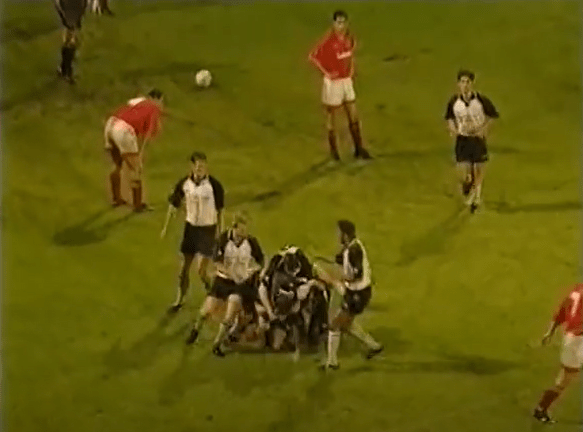
After that loss, Forest would return to league action against Barnsley three days later. However, they would carry their Anglo-Italian Cup form into the First Division as Viv Anderson’s Tykes would earn a 1-0 victory through Owen Archdeacon’s penalty kick. Four days later, and Forest were back in the Anglo-Italian Cup. This time, the Reds would face arch-rivals Notts County. County had defeated Derby 3-2 in their previous match, and with the Rams having triumphed over Forest, Frank Clark’s men would need to beat the Magpies by a two-goal margin to progress to the main tournament.
Unfortunately, poor Forest defending would hand the opening goal to Notts County. Kinglsey Black’s backpass would reach Mark Crossley, but the goalkeeper’s attempt to return the pass would fall only at the feet of striker Gary Lund, who would re-adjust his position before stroking the ball into the empty net. Black would later atone for his backpass by scything an excellent through-ball into the path of Ian Woan. The winger would square the ball to Stan Collymore to score his first Nottingham Forest goal. However, despite the Reds’ best efforts, the derby match would end in a 1-1 draw. Notts County would top qualifying Group 3 and advance to the main group stage of the Anglo-Italian Cup, while Nottingham Forest would exit at the first stage, missing out on a chance to play European football.
1993-94 Anglo-Italian Cup-Qualifying Group 3
| Team | Played | Wins | Draws | Losses | GF | GA | GD | Points |
|---|---|---|---|---|---|---|---|---|
| Notts County | 2 | 1 | 1 | 0 | 4 | 3 | +1 | 4 |
| Derby County | 2 | 1 | 0 | 1 | 5 | 5 | 0 | 3 |
| Nottingham Forest | 2 | 0 | 1 | 1 | 3 | 4 | -1 | 1 |
If losing out to their city rivals had not been difficult enough, Nottingham Forest would follow up their Anglo-Italian Cup disappointment by losing their first home match of the season on 19th September. Their opponents Stoke City would take a 16th-minute lead through striker David Regis, the Englishman reading the flick-on of strike partner Mark Stein before sliding the ball into the far corner. Nine minutes later, calamitous Forest defending would result in a Stoke penalty due to Steve Stone’s foul on Micky Gynn. Mark Stein would fire the ball into the bottom corner to double the Potters’ advantage. Four minutes after half-time, things would get even worse for Forest. Micky Gynn would flick the ball onto Mark Stein’s left boot, and the South African would lift a first-time shot over an ailing Mark Crossley for an excellent third. Now 3-0 down with 41 minutes left to play, Frank Clark’s men would need to turn this match around to avoid further embarrassment. They would, to a certain extent.
A minute after Mark Stein’s second, Stan Collymore would show off his crossing abilities, finding fellow recent signing David Phillips. The former Norwich man would score his first Nottingham Forest goal. Later on, Steve Stone would earn Forest a free-kick on the edge of the opposition box, and captain Stuart Pearce would rocket the ball into the far corner of Mark Prudhoe’s net. Midway through the second half, the Reds had got back to 3-2. However, try as they might, the Reds could not stop themselves from falling to a fourth consecutive defeat in all competitions.
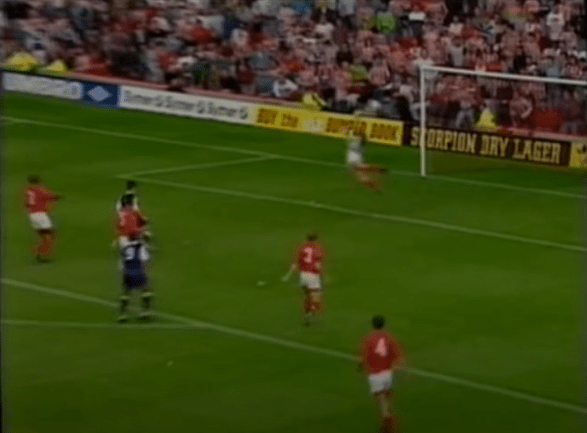
Two days after that entertaining game, Nottingham Forest would play out another with Second Division Wrexham in the first leg of their League Cup second-round tie. This night would turn out to be a special one for Stan Collymore, who would score his first hat-trick for his new club. The 22-year-old would open the scoring in the 21st minute with a header from David Phillips’ hanging ball into the area. The same provider-scorer duo would put Forest 2-0 up, as a low ball from Phillips would produce a first-time finish from Collymore into the far corner of the Wrexham net. However, a penalty kick would bring the Welsh side back seven minutes into the second half. Scot Gemmill would foul Gary Bennett inside the area, and the striker would pick himself to make the score 2-1. Then, Stan Collymore would complete his treble, latching onto a through-ball before sliding the ball past the on-rushing goalkeeper. However, the result was not entirely in the bag, and Wrexham would continue to push in this first leg. An unmarked John Paskin would bring the winning margin back to one goal before Bennett would score his second of the game to level the score at 3-3. That is how the match would end, with this second round tie still in the balance heading into the return match at the City Ground two weeks later.
On 24th September, Nottingham Forest manager Frank Clark would add experience to his goalkeeping division. Incumbent keeper Mark Crossley had failed to keep a single clean sheet across 10 matches and had produced multiple errors leading to opposition goals. Clark would turn to former club Newcastle United to find 30-year-old Tommy Wright to find that experience. Wright had entered English football late, joining Newcastle at the age of 25 in January 1988 after plying his trade with Linfield. He had become the Magpies’ first-choice goalkeeper in 1989 and kept his place between the sticks until the arrival of Pavel Srníček in 1991. The two keepers would battle over the Magpies’ starting position, but the Czech would eventually win out. However, Wright would still play 14 matches during Newcastle’s First Division title win during the 1992-93 season. These performances were enough for Frank Clark to spend £450,000 and bring Tommy Wright to the East Midlands.
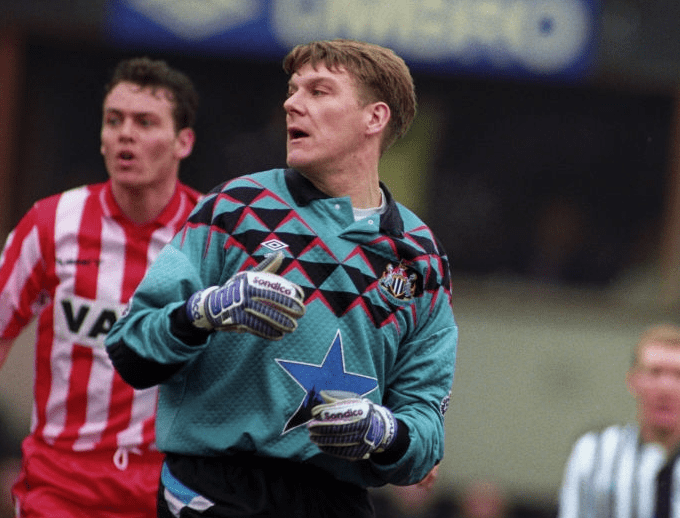
Returning to league action, Nottingham Forest would complete a trilogy of classic matches in September 1993 when they travelled to face Bolton on the 26th of the month. Like those two previous encounters with Stoke and Wrexham, Forest would again fail to end up on the winning side. However, Stan Collymore would put the Reds ahead at Burnden Park, flicking the ball past his marker before speeding away and sliding the ball home. Later, excellent passing triangles in midfield would set up David Phillips, and the Welsh midfielder would hit an excellent 30-yard-effort past Bolton goalkeeper Keith Branagan for Forest’s second. However, Bolton would respond on the verge of half-time, with midfielder David Lee halving the deficit.
In the second period, youngster Alan Thompson would draw Bolton level, prodding the ball into the far corner from the edge of the box. The momentum would soon shift back towards the visitors, as Bobby Howe’s scuffed effort would turn into a near-post pass for Stan Collymore to score his second goal of the match and his fifth in four games. However, David Lee would soon net his second to tie the game again at 3-3. Then, Mark Patterson would guide the ball into the Forest net to settle the tie in Bolton’s favour, leaving Nottingham Forest crestfallen.
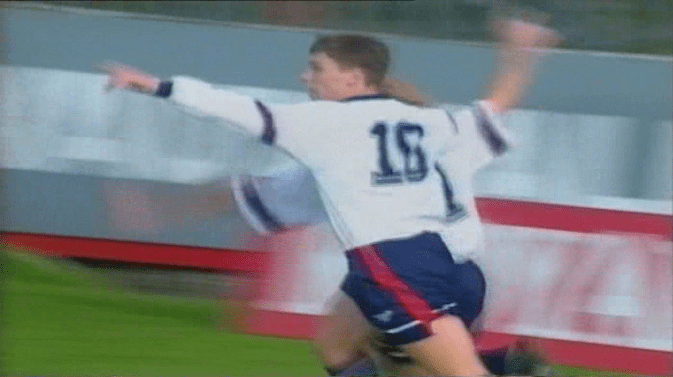
The turnaround at Bolton meant that Nottingham Forest had gone through September failing to find a single win in six matches across three different competitions. More importantly, three defeats from three league games had severely dented Forest’s early promise. After sitting 4th in Division One after five matches, Frank Clark’s team now resided in 19th place, still with eight points to their name. Furthermore, two wins from eight games and zero clean sheets kept were not the kind of promotion form that Reds fans expected at the start of the season.
| Position | Team | Played | Wins | Draws | Losses | GF | GA | GD | Points |
|---|---|---|---|---|---|---|---|---|---|
| 17th | West Brom | 8 | 2 | 3 | 3 | 11 | 13 | -2 | 9 |
| 18th | Millwall | 8 | 2 | 3 | 3 | 5 | 11 | -6 | 9 |
| 19th | Nottingham Forest | 8 | 2 | 2 | 4 | 14 | 16 | -2 | 8 |
| 20th | Peterborough | 8 | 2 | 2 | 4 | 10 | 12 | -2 | 8 |
| 21st | Bristol City | 8 | 2 | 2 | 4 | 8 | 12 | -4 | 8 |
October
Nottingham Forest would begin October by halting their three-match losing streak in the First Division. However, with a 1-1 home draw against Portsmouth on 2nd October, they would extend their winless run to seven matches in all competitions. Darryl Powell would put the visitors ahead at the City Ground, skilfully slicing through the Forest defence before firing the ball past Tommy Wright. However, Steve Stone’s would send a late 30-yard stunner into the top corner to spare the Reds’ blushes and earn his side their first points in over a month. It was only the second goal he had ever scored for the club, his first coming against Middlesbrough the previous February.
Wrexham would travel to the City Ground for a League Cup second-round second leg four days later. With the match-up balanced at 3-3, the second leg would prove crucial in deciding which team would progress to the next stage. The higher-placed team in the football pyramid would strike the first blow on the night. In the 16th minute, Forest midfielder Kingsley Black would pick the ball up on the left flank, pass the ball to Colin Cooper and receive Lee Glover’s flick before hitting a 15-yard effort. Forest would double their one-goal advantage on the night (and on aggregate) in the 55th minute. Scot Gemmill would send in a corner, and Gary Crosby would head home at the far post.
Despite being 5-3 behind on aggregate, Wrexham would make things interesting fifteen minutes from time as the Welshmen would pull a goal back. However, Stan Collymore would soon kill off the tie. Nottingham Forest would win the second leg 3-1 and win the tie 6-4 on aggregate to reach the third round of the League Cup. The team had also ended their seven-match winless streak in all competitions. Frank Clark could only hope that his side could transfer their League Cup form into their next First Division match against Tranmere Rovers.
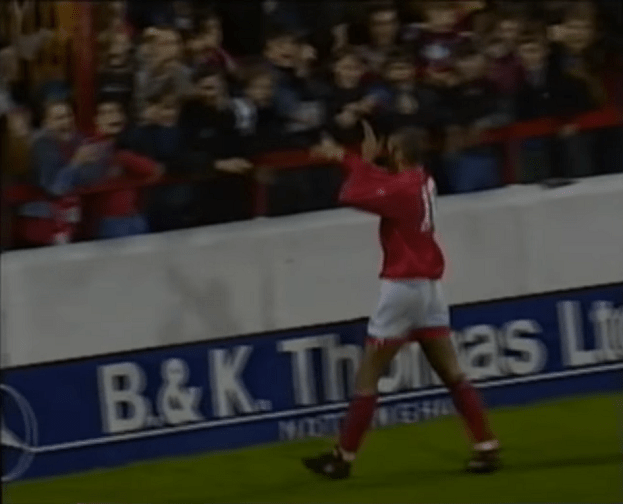
On 8th October, Nottingham Forest would announce that they had sold goalkeeper Andy Marriott to Second Division new boys Wrexham for £200,000. After joining Forest from Arsenal in June 1989, Marriott would spend most of his time at the City Ground as a back-up to either Steve Sutton or Mark Crossley. Therefore, Brian Clough would send the youngster out on loan to West Brom, Blackburn Rovers, Colchester United and Burnley to gain experience between 1989 and 1991. Instead of loaning him out again, Frank Clark would allow the 22-year-old to leave permanently, considering that the recent arrival of Tommy Wright from Newcastle would limit his playing time further. Andy Marriott would play 13 matches during his four-and-a-bit seasons at the City Ground. However, he would start for Forest in the 1992 League Cup Final and Full Members’ Cup Final.
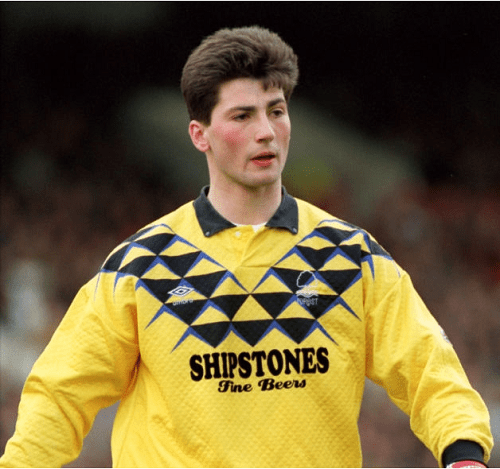
Ten days after their League Cup success, Nottingham Forest would earn their first league win in five matches when Tranmere Rovers came to town. In the 16th minute, excellent defensive work from Scot Gemmill would allow midfield partner Kingsley Black to set up Stan Collymore to put Forest ahead and score his eighth goal in six games. Later on, Collymore would play a part in creating the Reds’ second as Robert Rosario would flick his cross back into the path of Scot Gemmill, and the Scotsman would finish from the edge of the area. Despite Tranmere pulling a goal back through Chris Malkin, Frank Clark’s team would hang on to earn back-to-back wins in all competitions for the first time all season.
Eleven matches into the 1993-94 league season, Nottingham Forest would finally achieve their first clean sheet. However, they would accomplish this feat on the same day as their first 0-0 draw, with both situations coming against Oxford United on 20th October. However, the team would suffer their fifth loss in twelve matches against Leicester City in the East Midlands derby four days later. Veteran midfielder David Speedie would score the only goal in a 1-0 win for the Foxes at Filbert Street.
After mixed fortunes in the league, Nottingham Forest’s next match would see them take on Premiership side West Ham United in the third round of the League Cup. Both teams would enter the tie with matching league records: 3 wins, 4 draws and 5 defeats for a total of 13 points from 12 games. Less-than-stellar starts for both teams following a promotion (West Ham) and relegation (Nottingham Forest) meant that only a couple of points separated each side from their respective relegation zones. Therefore, both sides would look to the League Cup to escape their present problems.
On the night, the First Division team would strike first. Stan Collymore would chase down a long pass forward before crossing the ball to the far side of the penalty area. Colin Cooper would flick the ball into the centre, and Kingsley Black would deliver a first-time volley that Luděk Mikloško could only parry into his own net. Later on, after providing the first goal, Stan Collymore would grab one of his own. On the edge of the area, Lee Glover would move the ball wide to Steve Stone. From Stone’s resulting cross, Glover would flick the ball towards his strike partner Collymore to fire a header past Mikloško for his ninth of the season. After 55 minutes, Nottingham Forest led Premiership West Ham 2-0. The top-flight team would pull a goal back through Trevor Morley’s assured finish, but the First Division side would claim the 2-1 upset win. Forest was now in the last 16 of the competition, where they would face more Premiership opposition in Manchester City.
After that excellent performance, Forest would end October with the second Nottingham derby in two months. While the earlier Anglo-Italian Cup encounter between Forest and Notts County had ended in a 1-1 draw, Stan Collymore’s fourth goal in six league matches after 74 minutes would give Frank Clark’s team a 1-0 victory at the City Ground. Forest would also emerge from this match with just their second clean sheet of the season (and second in three league games).
The derby victory over Notts County would also move Nottingham Forest up four places from 20th to 16th in the First Division standings. Compared to the winless September, four wins in seven matches in October across two competitions was undoubtedly an improvement. However, nearly a third of the way through the season, Nottingham Forest were still nowhere near where either themselves or their fans desired them to be. Thirteen league matches had produced four wins, four draws and five losses for 16 points. This set of results put them thirteen points off leaders Charlton at this early stage. Hardly promotion form. The Reds could celebrate being in the last 16 of the League Cup, but Frank Clark knew that his team had a lot of work to do to eventually achieve their desired goal for the season.
| Position | Team | Played | Wins | Draws | Losses | GF | GA | GD | Points |
|---|---|---|---|---|---|---|---|---|---|
| 14th | Sunderland | 13 | 5 | 2 | 6 | 14 | 18 | -4 | 17 |
| 15th | Grimsby Town | 14 | 3 | 7 | 4 | 19 | 17 | +2 | 16 |
| 16th | Nottingham Forest | 13 | 4 | 4 | 5 | 18 | 19 | -1 | 16 |
| 17th | Wolves | 13 | 3 | 6 | 4 | 18 | 17 | +1 | 15 |
| 18th | West Brom | 13 | 4 | 3 | 6 | 22 | 22 | 0 | 15 |
November
Nottingham Forest would begin November with a 3-1 home defeat to 9th-placed Millwall. John Goodman would put the Lions ahead in the 14th minute after a poor save by Forest goalkeeper Tommy Wright. Bruce Murray’s diving header would make it 2-0 three minutes into the second period before more terrible Forest defending would allow an unmarked Keith Stevens to poke home a third from a Millwall free-kick. Lee Glover would give the home fans something to cheer about, but his goal was only a consolation in a terrible performance from Nottingham Forest.
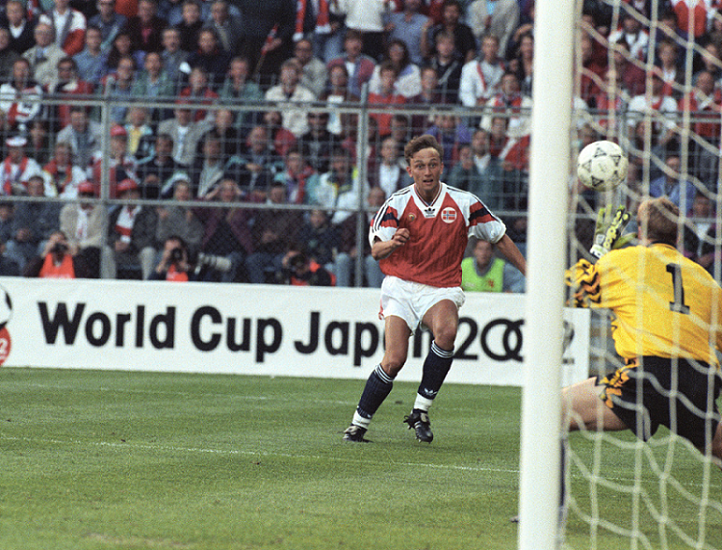
Two days after the Millwall game, Frank Clark would confirm that he had signed Norwegian international midfielder Lars Bohinen from Swiss side BSC Young Boys. Bohinen had made 58 appearances and scored six goals for the Swiss Nationalliga side after joining the club from Viking FK in 1990. However, after being a regular during his first two seasons in Bern, Bohinen would spend the 1992-93 campaign on loan at Lillestrom back in his native Norway, playing 23 matches in all competitions. Now, Young Boys manager Martin Trümpler was willing to let the 24-year-old leave the club. Bohinen had also earned 21 caps for his country, making his international debut in October 1989. England fans, in particular, would have recent bad memories of the midfielder scoring the second goal in Norway’s 2-0 1994 World Cup qualification win over the Three Lions on 1st June. Now, as the (Norwegian) Lions had qualified for their first FIFA World Cup since 1938, Lars Bohinen would travel to the country he had recently dispatched to join a Nottingham Forest side currently sitting 17th in the second tier of English football.
After suffering just their second home defeat of the season, Forest would spend the rest of November on the road with four consecutive league matches away to Birmingham City, Wolves, West Brom and Sunderland. A two-week tour of the West Midlands followed by a trip to the North East. Forest would begin with a 3-0 win at St Andrew’s on 6th November. Stan Collymore would open the shutters with his 5th league goal of the season (11th in all competitions), arcing a shot into the far corner from the edge of the box. Then, after heavy involvement in the build-up, Lee Glover would lash a shot into the top corner for the Reds’ second. Finally, Glover would score his second (and Forest’s third) fifteen minutes from time after a mazy run from Scot Gemmill.
Four days later, in Wolverhampton, a 1-1 draw at Molineux would see the points shared between Frank Clark and Graham Turner’s teams. David Kelly’s header would give Wolves the lead after 14 minutes. However, Stan Collymore would equalise for the visitors five minutes into the second half, turning away from the defence before beating the goalkeeper one-on-one.
After the international break, Nottingham Forest would travel to the Hawthorns and a clash with West Brom. Stan Collymore would steal the show on this day, scoring a brace in a 2-0 Forest win. For the first, Baggies goalkeeper Stuart Naylor would parry the striker’s left-footed effort, only for Collymore to immediately lift the rebound over his prone body. The second would see the 22-year-old run onto Kingsley Black’s long ball before cutting inside the West Brom defence and sliding the ball into the left-hand corner. Collymore had now scored for three league games in succession and had netted 14 goals in 14 games for Forest in all competitions.
Finally, Forest would finish their November road trip with a visit to Sunderland at Roker Park. This visitation would produce a five-goal thriller for those in attendance. Philip Gray would put the Black Cats ahead with a sliding effort in the 11th minute, but excellent build-up play would result in Scot Gemmill heading home an equaliser six minutes later. Then, a long ball fired downfield would land at the feet of Stan Collymore. Collymore would do the rest, rounding the last defender and sliding the ball under the goalkeeper to put the visitors 2-1 up eight minutes before the break. Now, it was Sunderland’s turn to respond, and they would through teenager Martin Smith a minute later. However, Stan Collymore could not be stopped in such a rich vein of form. After a one-two with Lars Bohinen on the right flank, the Staffordshire native would carry the ball over half the pitch’s length, cutting into midfield before unleashing a shot from 20 yards into the bottom corner. Collymore had given Nottingham Forest a 3-2 win over Sunderland with his second brace in consecutive matches. Frank Clark’s team would end November with their third win in four games.
Despite their demanding schedule, November would turn out to be Nottingham Forest’s most successful month of the 1993-94 season to date. Three wins from five matches, with all three coming away from home, had lifted Forest into the top half of the First Division for the first time since 19th September. Stan Collymore was sending every shot into the net and now had 16 goals in 15 Nottingham Forest matches, with his second against Sunderland putting him into double figures in terms of league goals. The Reds were still nowhere near their desired target, but continued good form would get them there in time.
| Position | Team | Played | Wins | Draws | Losses | GF | GA | GD | Points |
|---|---|---|---|---|---|---|---|---|---|
| 9th | Portsmouth | 18 | 7 | 7 | 4 | 27 | 27 | 0 | 28 |
| 10th | Stoke City | 18 | 8 | 3 | 7 | 27 | 31 | -4 | 27 |
| 11th | Nottingham Forest | 18 | 7 | 5 | 6 | 28 | 25 | +3 | 26 |
| 12th | Wolves | 18 | 5 | 9 | 4 | 29 | 21 | +8 | 24 |
| 13th | Middlesbrough | 17 | 6 | 5 | 6 | 25 | 20 | +5 | 23 |
December
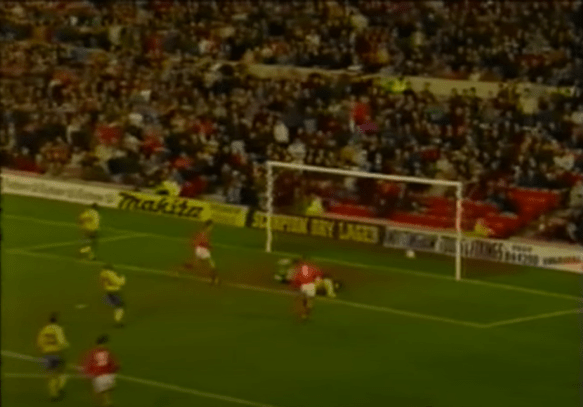
December would begin with Nottingham Forest’s League Cup 4th-round match against Manchester City on 1st December. Sixteen places separated the two teams in the football pyramid, with the Manchester club sitting 17th in the Carling Premiership. Brian Horton’s team had won just three of seventeen league matches and were winless in their last eight Premiership games. Meanwhile, Frank Clark’s team would enter the tie against Manchester City on a four-match unbeaten streak. This run would extend to five matches as Forest and City would play out a 0-0 draw at the City Ground. This fourth-round match-up would go to a replay held at Maine Road on 15th December.
Three days after their League Cup exploits, Forest would return to league action. Facing Birmingham City for the second time in five First Division matches, the Reds would triumph over the Blues at the City Ground. Stan Collymore would be involved in the game’s sole goal. It was his low cross across the middle that Birmingham centre-back Christopher Whyte would divert past his own goalkeeper. Forest would run out 1-0 winners, completing their first league double of the campaign.
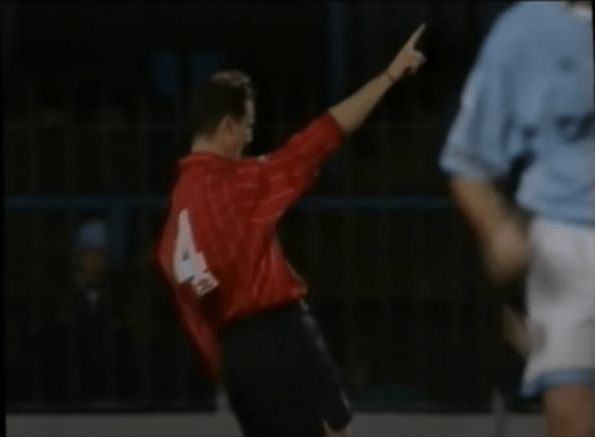
Eleven days later, Forest would travel northwest for their League Cup 4th-round replay against Manchester City. Both sides had continued their current form levels in the interim, with Forest now unbeaten in five and a 3-2 defeat to Leeds United extending City’s winless run to nine league matches. However, Manchester City would take the lead on the night. After a phantom take, a free-kick into the box would find the head of Michel Vonk, and the Dutch defender would put the Premiership side ahead.
Manchester City would hold this 1-0 advantage into the second half, and Stan Collymore could only hit the crossbar with a long-range effort. However, an unlikely source would score Forest’s equaliser. After a City clearance, Neil Webb would collect Ian Woan’s cross and hit a deflected shot into the City net for his first goal of the 1993-94 season. Three minutes from time, another Forest player would break his scoring duck. Colin Cooper, playing high up the field, would break free from the Manchester City defence on the edge of the box. He would play a one-two with Neil Webb before firing across Tony Coton into the far corner to win the game for Nottingham Forest. With a 2-1 win, Forest had claimed another Premiership scalp and were now through to the League Cup quarter-finals. Their last-eight opponents would be fellow First Division side Tranmere Rovers.
After another heroic League Cup performance, Nottingham Forest would register their fourth successive league win against 7th-placed Southend United on 19th December. Colin Cooper would open his league account for Forest two minutes before half-time, as his 30-yard free-kick would take a massive deflection off the Southend wall before finding its way past a bamboozled Shrimpers goalkeeper. Kingsley Black would double the home side’s advantage, meeting Lars Bohinen’s cut-back with his left boot to score his fifth of the season. A 2-0 home victory and back-to-back clean sheets in the league for the first time made for a welcome Christmas present for Nottingham Forest fans.
Forest would find their winning run halted two days after Christmas by a 1-1 draw with Middlesbrough. The visiting Teessiders would break the deadlock in the 51st minute, left-winger Alan Moore firing one home from 20 yards. However, Stan Collymore would end a four-match scoring drought to provide the home side’s equaliser, latching onto a long ball downfield before netting his 17th goal of the season. Forest’s winning run may have gone, but their unbeaten run now stood at nine matches in all competitions (seven league matches).
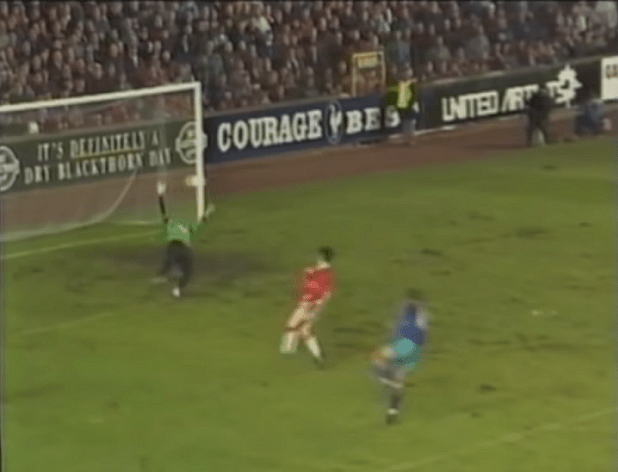
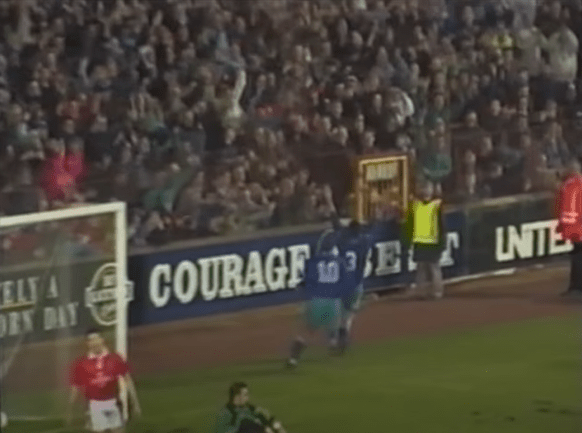
The team would extend this unbeaten streak into double figures the next day when they met Bristol City at Ashton Gate. After a goalless first half, Stan Collymore would open Forest’s account in the 57th minute, his shot deflecting off a City defender on its way into the net. However, the Robins would equalise a minute later. Mark Crossley could not hold a Bristol header, and Robins defender Rob Edwards would stab the ball home. The visitors would retake the lead as Neil Webb would slide home Des Lyttle’s ball across the middle. Forest would then double their advantage, as Lars Bohinen’s counter-attacking long ball would connect with Collymore. The young English striker would cut in from the left wing before sending a right-footed effort past the goalkeeper for his 19th of the campaign. Collymore would even assist Forest’s fourth, finding Ian Woan in the box with the winger registering his first goal since August to give Nottingham Forest a year-ending 4-1 win.
The victory over Bristol City was Forest’s 10th of the First Division campaign, with seven of these coming in the club’s last ten league matches. This run had seen them rise from 17th to 8th in the Division One table, and Frank Clark’s Reds now sat one point off the play-off places at the halfway point of the season, despite having played fewer matches than the teams around them. December was the first time that Nottingham Forest had been through a whole month without losing a game. The team would begin 1994 with a 10-match unbeaten streak in all competitions. However, the coming month would present Forest with six matches across three tournaments, including the FA Cup 3rd round and a League Cup quarter-final against Tranmere Rovers.
| Position | Team | Played | Wins | Draws | Losses | GF | GA | GD | Points |
|---|---|---|---|---|---|---|---|---|---|
| 6th | Southend United | 23 | 11 | 4 | 8 | 38 | 30 | +8 | 37 |
| 7th | Portsmouth | 24 | 9 | 10 | 5 | 31 | 29 | +2 | 37 |
| 8th | Nottingham Forest | 22 | 10 | 6 | 6 | 36 | 27 | +9 | 36 |
| 9th | Derby County | 22 | 11 | 3 | 8 | 35 | 35 | 0 | 36 |
| 10th | Bristol City | 24 | 10 | 6 | 8 | 29 | 29 | 0 | 36 |
January
Nottingham Forest would begin 1994 with a 1-1 draw against Charlton Athletic on New Year’s Day. Right-back Des Lyttle would open his account for Forest, sending a howitzer of a shot into the net to give his side the lead. However, Charlton would equalise through Garry Nelson, the striker volleying home from a corner. With the match ending in a tie, Nottingham Forest would start 1994 by extending their unbeaten run to eleven games.
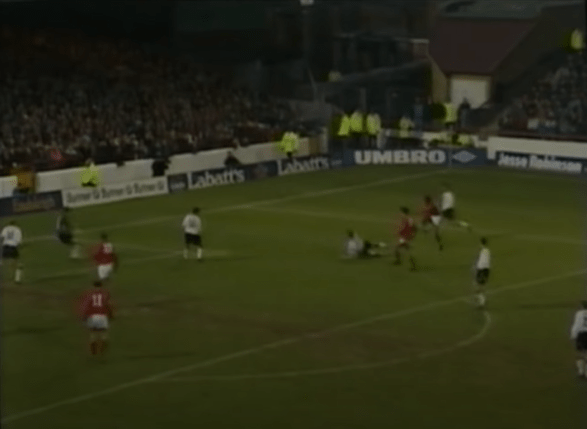
The Reds would return to winning ways away at Watford two days later. However, the Hornets would go ahead through an unfortunate own goal from Colin Cooper, the centre-back diverting a shot past Mark Crossley. However, Cooper would score for both teams, as his header after 57 minutes would put Frank Clark’s men back on level terms. Six minutes later, the visitors would take the lead. Collecting a square ball on the edge of the box, Scot Gemmill would dribble into the area and poke the ball past the Watford keeper for a goal that would secure the win for Forest. This win would take the Reds into the top six for the first time since late August.
On 8th January, Forest would turn their attention to the FA Cup. Entering at the 3rd round, Frank Clark’s men would make the trip to Hillsborough to meet Premiership side Sheffield Wednesday. The Owls were riding high in the top-flight, sitting 6th after 25 matches. Of those 25 games, Wednesday had drawn ten and lost six. Forest would face a difficult challenge in breaking down this Sheffield Wednesday side, and so it proved. In-form Owls striker Mark Bright would put Wednesday in front with his sixth goal in six matches, heading home from a free-kick. As it seemed that the Premiership side had done enough to reach the 4th round, Colin Cooper’s late headed effort would end the match in a 1-1 draw. The two teams would meet at the City Ground for the replay eleven days later.
Thirteen days after their last league match against Watford, Nottingham Forest would face another away encounter against Tranmere Rovers. The two sides were set to face off in the League Cup quarter-finals later in the month. However, before all that, the small matter of the league match, a potential dress rehearsal for the later meeting. Colin Cooper and Scot Gemmill would provide Nottingham Forest goals for the second away game in succession in a 2-1 win for the visitors. Once again, Forest would have to come from behind to earn their victory. After half an hour, Tranmere would take the lead through a John Aldridge penalty kick after Mark Crossley had brought down Pat Nevin in the area. Forest would leave it late to find an equaliser. In the 80th minute, Ian Woan would find Cooper running from deep, and the defender would beat Eric Nixon at his near post to score for the third game in a row. Five minutes later, a series of failed crosses would result in Lee Glover dragging the ball back for Gemmill to score Forest’s winning goal. Attentions would now turn to the FA Cup replay against Sheffield Wednesday.
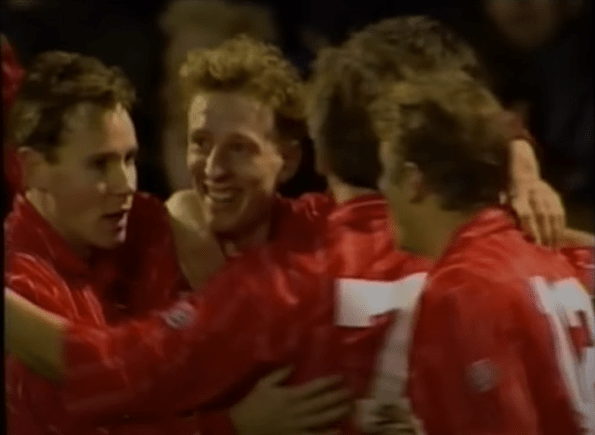
At the City Ground on 19th January, Nottingham Forest would see their 14-match unbeaten streak snapped as Sheffield Wednesday eliminated them from the FA Cup. In this third-round replay, Andy Pearce would put the Owls ahead in the 47th minute after Andy Sinton’s long ball into the penalty area. Another long ball into the area would result in Wednesday’s second goal. From an in-swinging corner, Chris Bart-Williams would score almost a carbon copy of the earlier finish, firing the ball across Mark Crossley into the far corner of the Forest net. Nottingham Forest could not find a response, and Trevor Francis’s team would move on to the FA Cup 4th round.
Following the loss of one unbeaten streak, Nottingham Forest would extend another in their match against Wolves. Despite the game ending 0-0, the draw meant Frank Clark’s team were now unbeaten in 12 consecutive league matches dating back to 6th November.
After that one-match break from cup competitions, Forest was back in action in a League Cup quarter-final against Tranmere Rovers. One point and a single placing separated the two teams in the First Division standings heading into the match. However, Forest would hold the pre-match bragging rights, having completed the double over John King’s team in the league, including a 2-1 win just 10 days earlier. The day before this match, Nottingham Forest would confirm that they had signed Norwegian defender Alf-Inge Håland from boyhood club Bryne for £250,000. This was a transfer that was 15 months in the making. Håland had initially agreed to join Forest back in October 1992, when Brian Clough was still in charge. However, due to situations involving money allegedly passing between then-Forest assistant manager Ron Fenton and Norwegian agent Rune Hauge, the deal was not completed until January 1994.

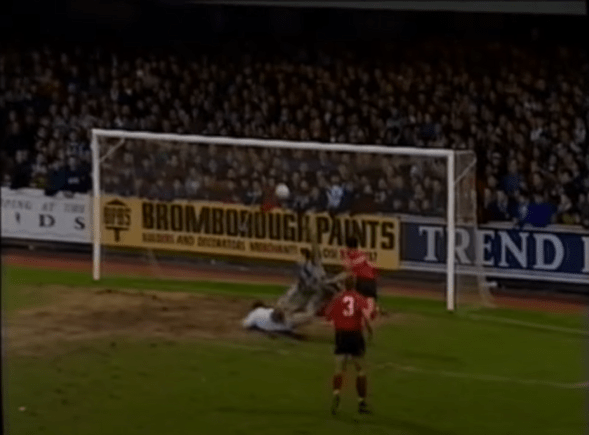
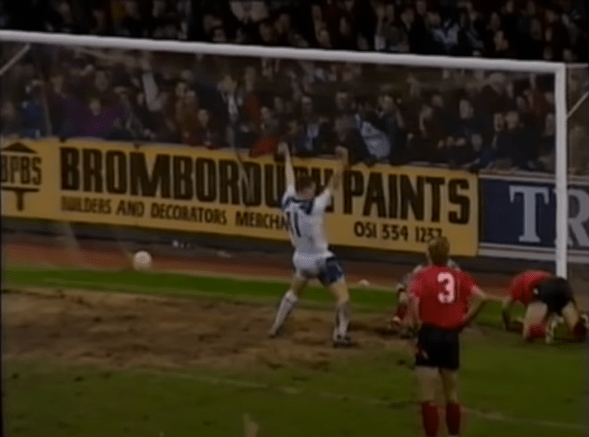
With so little separating the two teams heading into the match, it was unsurprising that the League Cup quarter-final between Nottingham Forest and Tranmere Rovers ended in a 1-1 draw. When the game was still goalless, Forest keeper Mark Crossley would keep out a point-blank header from John Aldridge. However, in the 51st minute, Tranmere would draw first blood. After a corner caused a scramble in the box, Chris Malkin would bundle the ball home from close range to score his second goal against Forest. However, Scot Gemmill would exchange the ball with Ian Woan and Lee Glover before driving into the box and rounding the goalkeeper to level the score. With his third goal in three games against the Rovers, Gemmill would ensure that this quarter-final went to a replay.
However, this replay would happen three days after the original match due to fixture congestion. In this rematch, the team from the Wirral would finally get their win over Frank Clark’s men. A looping header from Pat Nevin would put Rovers ahead before defender Tony Thomas would score the crucial second after John Aldridge had kept the ball on the field. With a 2-0 home win, Tranmere was in the League Cup semi-finals. After a series of excellent performances, Nottingham Forest was out of the competition they had won four times. Now, all of Forest’s attention would focus on the league and their plan to achieve promotion back to the Premiership.
Even though January saw the team exit two cup competitions after agonising replays, Nottingham Forest could be happy with their January performances. The team had gone unbeaten for the second successive month, bringing the run of unbeaten league matches to fourteen. This record had moved the team into the play-off positions, and only five points now separated Forest from First Division leaders Crystal Palace. In addition, the team’s many cup replays meant that the Reds had games in hand over every other side around them. Success in these games would move Frank Clark’s team into the automatic promotion places. However, they would first need to win these matches and keep up their excellent form to keep up and match their closest rivals. Nottingham Forest had now won twice as many league matches as they had lost. If the team could keep up this form, Premiership promotion might be on the cards.
| Position | Team | Played | Wins | Draws | Losses | GF | GA | GD | Points |
|---|---|---|---|---|---|---|---|---|---|
| 4th | Leicester City | 27 | 13 | 7 | 7 | 47 | 32 | +15 | 46 |
| 5th | Tranmere Rovers | 28 | 13 | 6 | 9 | 39 | 33 | +6 | 45 |
| 6th | Nottingham Forest | 26 | 12 | 8 | 6 | 41 | 30 | +11 | 44 |
| 7th | Wolves | 27 | 10 | 12 | 5 | 41 | 27 | +14 | 42 |
| 8th | Derby County | 27 | 13 | 3 | 11 | 43 | 41 | +2 | 42 |
February
Nottingham Forest’s February would begin with another East Midlands derby against Leicester City. The Foxes had edged the reverse fixture 1-0 back at Filbert Street in October and look to do the double over their regional and play-off rivals. However, the Reds would run riot at the City Ground, comfortably winning 4-0. Leicester entered the match two places and two points better off than Forest but had played one game more. In the end, the result reflected the respective formbooks of both teams. A bit of luck would help open Forest’s account as Leicester goalkeeper Kevin Poole’s attempted clearance would instead directly fall to Scot Gemmill. Gemmill would lift the ball over the ailing goalkeeper into the empty net for his fourth goal in six matches.
Later, Forest would counter-attack as Lars Bohinen would find Lee Glover with a long pass. A tackle would stop the centre-forward, but Gemmill would pounce on the loose ball, breaking free to score his and Forest’s second in first-half stoppage-time. For the team’s third, Steve Stone would surge into the right inside channel of Leicester’s box before squaring the ball to Glover to his 6th goal of the season. Finally, Ian Woan would add a fourth, blasting the ball home when left unmarked. Nottingham Forest had delivered a statement victory over one of their biggest rivals and was now unbeaten in fifteen league matches.
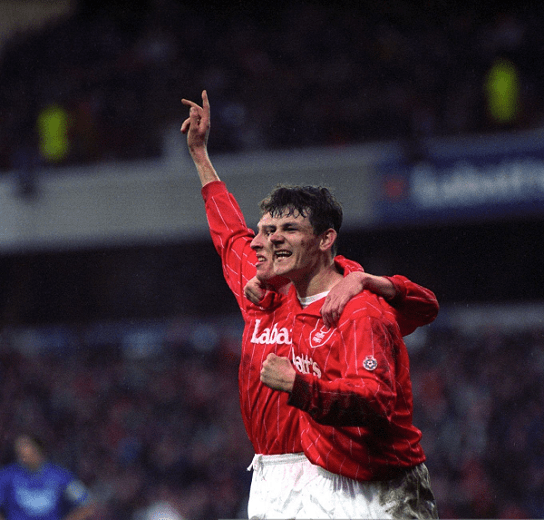
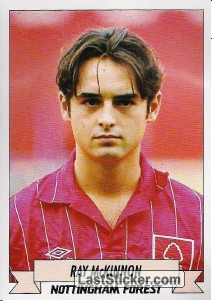
The day after the derby win, Forest would sell midfielder Ray McKinnon to Scottish club Aberdeen for £300,000. McKinnon had joined Forest from Dundee United for £750,000 in August 1992. However, he would make just six appearances during the team’s Premiership relegation campaign. McKinnon was yet to appear this season, and with his future first-team opportunities looking bleak, he decided to move back to Scotland.
The Leicester win had moved Nottingham Forest up to 3rd in the Division One table, one point off the automatic promotion places. They would hope to stay there by defeating Notts County in the Nottingham derby on 12th February. However, the 16th-placed Magpies would upset their city rivals 2-1, ending their three-month unbeaten run. County’s top scorer Gary McSwegan would put his team ahead, cutting inside the box from the left and moving inside two defenders before scoring inside the near post. A deflected Stuart Pearce effort would produce Forest’s equaliser as his shot would ultimately be turned home by David Phillips. However, Notts County would have the last say at Meadow Lane. Defender Charlie Palmer would rise highest at a free-kick to direct the ball beyond Mark Crossley for County’s winner. This defeat would drop Forest back down the table from 3rd to 6th.
One week after the derby loss, Nottingham Forest would perform much better in a 1-1 draw with leaders Crystal Palace. Lars Bohinen would put the Reds ahead with his first Nottingham Forest goal, firing through a sea of bodies from a corner. However, Forest’s defenders would fail to close down Damian Matthew, and the midfielder’s deflected effort (his first goal for Crystal Palace) would give Alan Smith’s team a point on home soil.
After going three months without a league defeat, Nottingham Forest would soon suffer two in three weeks. The Reds would lose 1-0 away at the First Division’s bottom side Oxford United to close out February. Alex Dyer would score an 88th-minute winner to settle a tight game at the Manor Ground.
After starting the month with the wind firmly in their sails, Nottingham Forest had stuttered their way through the rest of February. The team could not follow up on their best performance of the season. Instead, two defeats in three matches had seen Nottingham Forest drop out of the play-off places down to 8th. Frank Clark’s side were two points off 6th-placed Stoke with 16 games to play, but the team still had two games in hand on the Potters, which could lift them right back into the promotion mix. However, these matches would be played as part of an imposing March line-up, where Forest would have to play seven times in twenty-eight days. The number of games would make March a make-or-break month for Frank Clark and his players. It was now a matter of which scenario would play out.
| Position | Team | Played | Wins | Draws | Losses | GF | GA | GD | Points |
|---|---|---|---|---|---|---|---|---|---|
| 6th | Stoke City | 32 | 14 | 8 | 10 | 43 | 44 | -1 | 50 |
| 7th | Tranmere Rovers | 31 | 14 | 7 | 10 | 43 | 37 | +6 | 49 |
| 8th | Nottingham Forest | 30 | 13 | 9 | 8 | 47 | 34 | +13 | 48 |
| 9th | Wolves | 31 | 11 | 13 | 7 | 46 | 31 | +15 | 46 |
| 10th | Notts County | 31 | 14 | 4 | 13 | 45 | 51 | -6 | 46 |
March
The first of Nottingham Forest’s seven matches in March would see basement club Peterborough United travel to the City Ground. This was the first of the club’s two games in hand over their play-off rivals. On the day, a brace from the in-form Scot Gemmill would see Forest claim all three points. The first would see the Scot receive the ball from Steve Stone before almost passing it into the far corner of the net. For the second, Gary Bull receive the ball from a quick throw-in before backheeling the ball to the feet Gemmill. Gemmill would do the easy part, giving Forest a 2-0 win. This victory would move the Reds up to 4th, still with one game in hand.
Two days later, Southend United striker Jason Lee would join Nottingham Forest for a £200,000 fee. Southend had initially signed Lee as a replacement for Stan Collymore. However, a return of 3 goals from 24 matches meant that Shrimpers boss Peter Taylor was open to selling the 22-year-old when Frank Clark came calling. Clark was impressed by Lee’s time at previous club Lincoln City, where he had scored 21 goals in 86 games, including 12 during the 1992-93 season. Lee would supplement Clark’s forward options as Forest prepared for the end-of-season run-in.
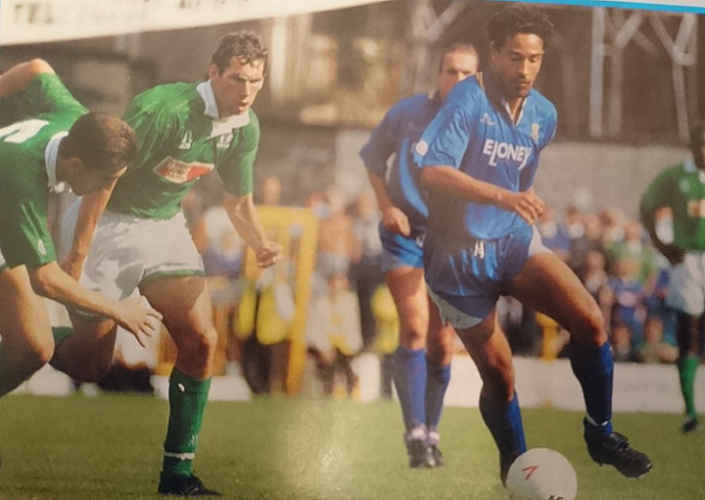
On 5th March, Nottingham Forest would host Luton Town. After a goalless first half, Forest would break the deadlock in the 60th minute through Colin Cooper’s 6th goal of the season. Stuart Pearce would try his luck from an indirect free-kick, and Luton’s American goalkeeper Juergen Sommer could only parry the ball back into the danger area, from which Cooper would profit. In the 81st minute, Forest would win a penalty when Sommer tackled Steve Stone with his legs. The American would receive a red card for his troubles. Stuart Pearce would blast the ball down the middle of the net to make the score 2-0. This win would take Frank Clark’s men up to 3rd, within one point of second-placed Charlton Athletic.
One week later, Forest would travel north to face 7th-placed Stoke City. The Potters had edged an entertaining reverse fixture 3-2 in September, and another win over Frank Clark’s men could help boost their play-off hopes. The match of the Victoria Ground would see Jason Lee make his first start in Nottingham Forest colours. However, the post-match headlines would belong to Neil Webb. In the 30th minute, Webb would efficiently finish from Steve Stone’s cut-back. Nottingham Forest would leave as 1-0 victors in a hard-fought game. Three games down in March, three victories, three clean sheets. Forest would move up into 2nd place in Division One with thirteen matches remaining.
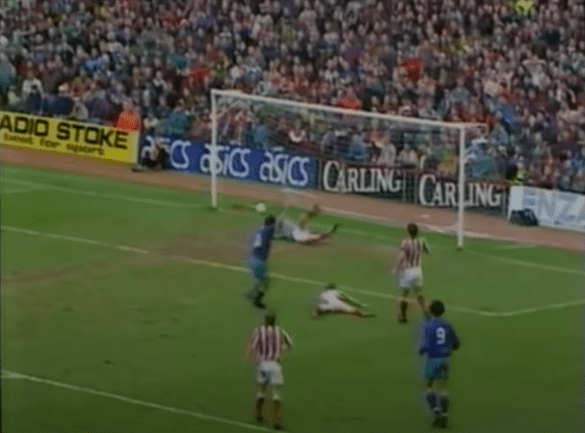
On 16th March, relegation-threatened Barnsley would travel down to Forest, who were starting to find their form again. Colin Cooper’s seventh goal of the season, a header from Neil Webb’s corner, would put the Reds in front at the City Ground. Barnsley would find an equaliser through defender Gerry Taggart midway through the second half after Mark Crossley missed a long ball into the penalty area. However, Jason Lee would soon provide his first Nottingham Forest assist, tackling a Barnsley defender so that the ball went loose, only for David Phillips to fire home a second goal for the hosts. With a 2-1 scoreline, Forest was now four from four in March. Next up: mid-table Bolton Wanderers.
The earlier encounter between Nottingham Forest and Bolton Wanderers had produced a 4-3 cracker at Burnden Park. The return match would result in another, if not as thrilling, game at the City Ground. The visitors would open the scoring after 23 minutes with a great goal from right-back Phil Brown. Brown would chip the ball into centre-forward McGinlay before volleying the striker’s return into the net. One-nil Bolton. However, Forest would equalise before half-time, as centre-back Steve Chettle would register his first goal since October 1991 by heading in a corner. Then, having witnessed what Phil Brown could do, Stuart Pearce would try to match it. Making a forward run, the Forest captain would play a one-two with Steve Stone before stroking the return ball into the far corner.
Forest would lead 2-1 at the break. Then in the second half, Stan Collymore would mark his return to the starting line-up following injury with his first goal of 1994 (and 19th goal of the season). However, after throwing his arm back into the face of an opposition defender, Collymore would find himself sent off just minutes after coming on as a substitute. With Forest now down to 10 men, Bolton would capitalise with defender Scott Green halving the deficit at 3-2. However, they could not find the crucial equaliser and Forest would edge this five-goal thriller and continue their recent winning streak.
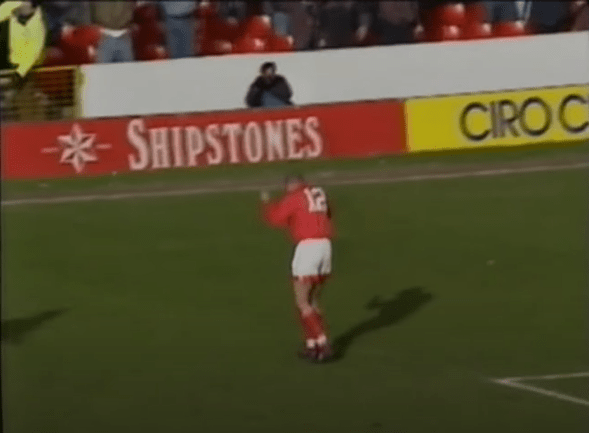

This winning streak would end at the hands of 17th-placed Portsmouth. Depending on other results, a win could have seen Nottingham Forest closing the gap to Crystal Palace. However, the South Coast club would have different ideas when the promotion-chasers came to Fratton Park. Pompey’s leading scorer Gerry Creaney would put the Southerners ahead, blasting the ball past Mark Crossley following a knock-down. Winger Paul Hall would impressively double his side’s lead. Galloping down the left, Hall would cut in-field and open up his body before rifling a right-footed effort inside the near post.
After having his red card rescinded, Stan Collymore was on the scoresheet again, dribbling his way past several defenders before finishing with aplomb. However, that would not be enough, and Forest would lose their first match in March. A win for Crystal Palace over Stoke would see Alan Smith’s team extend their lead at the top of the First Division to eight points. In addition, the gap to 3rd-placed Leicester City now stood at three points.
Nottingham Forest would end their manic March with their fifth home match of the month as Watford came to call. In early January, goals from Colin Cooper and Scot Gemmill had secured a 2-1 win for the Reds. Two months later, goals from Steve Stone and Neil Webb would give Forest another 2-1 win over the Hornets. Kingsley Black would set up the first, as his deep cross would find Stone at the back post. Stan Collymore would assist the second. Receiving the ball on the right flank, he would turn his marker and run in-field before slipping a through-ball to Neil Webb in open space, and the former Manchester United man would bag his 4th goal of the season. Watford would pull one back through Gary Porter’s 30-yard screamer, but Forest would end March on a high note.
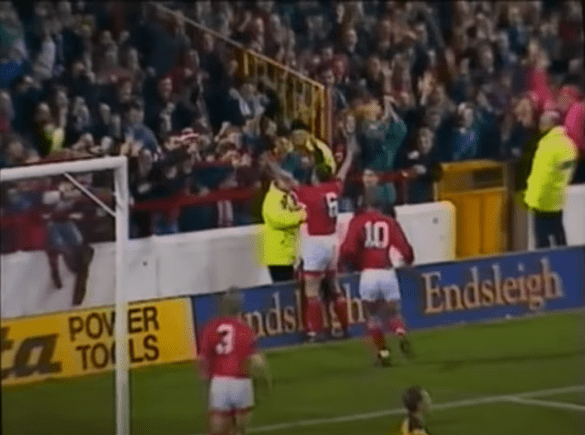
Beginning March in 8th place with seven matches to play, Nottingham Forest had won six and lost one to end the month 2nd in the standings. The Reds now had a six-point buffer to Crystal Palace above them and the chasing pack below. Automatic promotion now seemed a viable reality for the East Midlands club. However, there were still nine games left to play, and seven of those would occur during the next month. Four of these games were against teams currently residing in the top 10. If Frank Clark and his squad could make it through another seven-match month smelling like roses, Forest could end April having sealed a place in the Premiership.
| Position | Team | Played | Wins | Draws | Losses | GF | GA | GD | Points |
|---|---|---|---|---|---|---|---|---|---|
| 1st | Crystal Palace | 39 | 21 | 9 | 9 | 63 | 40 | +23 | 72 |
| 2nd | Nottingham Forest | 37 | 19 | 9 | 9 | 60 | 40 | +20 | 66 |
| 3rd | Leicester City | 37 | 17 | 9 | 11 | 58 | 47 | +11 | 60 |
| 4th | Millwall | 36 | 16 | 12 | 8 | 47 | 39 | +8 | 60 |
| 5th | Tranmere Rovers | 37 | 16 | 8 | 13 | 51 | 42 | +9 | 56 |
| 6th | Derby County | 37 | 16 | 8 | 13 | 55 | 54 | +1 | 56 |
April
Nottingham Forest would begin their season run-in with a 2-2 draw away at Middlesbrough. In a match filled with goalscoring opportunities for both teams, the visitors would strike the first blow. Kingsley Black would deliver another pinpoint cross, and Jason Lee would notch up his first Nottingham Forest goal with a header at the far post. Before the break, Middlesbrough would equalise through midfielder Jamie Pollock. Pollock would deftly flick the ball over Des Lyttle and evade the tackle of Steve Chettle before finishing from a tight angle. In the second half, Robert Rosario would put Forest 2-1 up after Middlesbrough had failed to deal with a corner kick. However, Boro was not done. After Paul Wilkinson’s header hit the post, Jamie Pollock would stroke the ball home from two yards for another equaliser. Both sides would leave Ayresome Park with a point added to their respective tallies.
Nottingham Forest would draw 0-0 with Bristol City at home two days later. This was a far cry from the 4-1 defeat that the Reds had inflicted upon the Robins back in late December, with both defences keeping opposition attacks at bay on this occasion. After successive draws, Forest would earn a narrow 1-0 victory away at 8th-placed Charlton Athletic on 9th April. Jason Lee’s second goal in three matches would prove the difference between the two teams, the 22-year-old latching onto a through-ball before slotting the ball between the legs of the Charlton keeper. This victory was Forest’s 20th league win of the First Division campaign.
On the 17th, Forest would record their second 2-2 draw of the month when they travelled to the Den to face 4th-placed team Millwall. The Lions entered the match having lost just three of fifteen league matches in 1994. They had also recorded six draws during that same period, so it was no surprise that Millwall gave as good as they got against this Forest side. The Lions would open the scoring inside their Den, as midfielder Jamie Moralee would head home at the far post following excellent build-up play. After Millwall led at half-time, ‘Stan The Man’ would get Nottingham Forest back on level terms. Colin Cooper would head the ball down from a corner, and Collymore would turn on a sixpence to score his 22nd goal of the season. After setting up his team’s first goal, striker Dave Mitchell would turn scorer for Millwall’s second. The Australian international would leap highest to Kenny Cunningham’s cross to direct the ball past Mark Crossley and restore the Lions’ lead.
However, in a game of three headers, Steve Stone would score the final one, finishing off Ian Woan’s ball into the box to equalise for Forest once more. However, the 2-2 draw would benefit Forest more than Millwall. While Frank Clark’s team would remain in 2nd with a six-point buffer to the play-off places, Milwall would drop down two placings to 6th, with Notts County, Stoke City and Wolves now right on the Lions’ tail. However, a win in their game in hand would see Mick McCarthy’s team rise up to 3rd, cutting the gap to Forest down to four points with five matches remaining.
After sparing Forest’s blushes against Milwall, Steve Stone would help his team win their next match at home to West Brom. The Baggies sat just three points above the relegation zone but had played fewer games than the rest of their survival rivals. However, they would miss the chance to steal a march on these teams when they travelled to the City Ground on 24th April. The opening goal on the day would involve Steve Stone. Eight minutes in, Ian Woan would send a long ball over the top for Stan Collymore to chase, and the striker would reach it. Collymore would find his shot blocked by two defenders and a goalkeeper, but the ball would ricochet to Stone, who had all the time in the world to pick the ball out from under his feet and score. Later in the first half, Stone would almost double his account, but his header from Des Lyttle’s cross would loop over the crossbar.
If the first goal was easy for Stone, the second was child’s play for Colin Cooper. At a Forest corner, an unmarked Cooper would powerfully head the ball past Stuart Naylor after making a run in the six-yard box, which no West Brom player had noticed. Cooper had scored eight goals for Forest during this season, with only Scot Gemmill (10) and Stan Collymore (22) having provided more. Not bad for a centre-back. Robert Taylor would pull one back for West Brom, but Frank Clark’s Reds would secure another home win and push the Baggies deep into relegation trouble.
27th April would see the last East Midlands derby of the 1993-94 season between Nottingham Forest and Derby County. This game was always a sight to see, but with both teams eyeing top-flight promotion, this particular encounter could contain an extra pinch of spice. A win for Derby would strengthen their play-off position amid pressure from Leicester, Wolves, Stoke and Notts County below them, while a win for Forest would keep them safe in the automatic promotion places. This game would also act as one of two games in hand that Frank Clark’s team had over their closest rivals, so a win in this derby would aid the Reds’ cause no end. The reverse fixture on 18th August had ended in a 1-1 draw, with Forest unlucky not to come away with all three points. However, they would avoid complacency on this occasion, winning 2-0 away at the Baseball Ground.
For the second game in a row, Steve Stone and Colin Cooper would come up with the goods for Forest. After fellow defender Steve Chettle dragged a shot across the face of Martin Taylor’s goal from a tight angle, Cooper would show him how to score. The defender would rocket a 30-yard free-kick past the Derby goalkeeper for his ninth goal of the season. After taking the lead, Forest would require the efforts of Mark Crossley to keep out a pair of notable efforts from John Harkes and Paul Kitson. However, Stone would score Forest’s second with a goal that had a bit of luck surrounding it. Stone would intercept an attempted backpass from former Forest full-back Gary Charles, diverting the ball past an ailing Taylor, who could not make it back following the earlier clash with Collymore. Stone would net for the third game in a row as Forest finally won bragging rights over their fiercest rivals following a draw in the league and a defeat in the Anglo-Italian Cup.
With three games to play (including a game in hand), Nottingham Forest sat 2nd in the Division table, in the second of two automatic promotion places. Nine points separated them, and long-time league leaders Crystal Palace (with the Eagles having played a game more but possessing a slightly superior goal difference) and six points kept the Reds above 3rd-placed Tranmere Rovers. However, if results went their way, Nottingham Forest could join Crystal Palace in achieving Premiership promotion if they beat bottom side Peterborough United away on 30th April. Peterborough already knew their fate. A 5-1 thrashing by Charlton the previous week had confirmed Posh’s relegation to the Second Division after two seasons in the second tier. In their match against Forest, Chris Turner’s team would play for pride in front of their home supporters.
Even though players and staff would treat this game like any other, anyone associated with Nottingham Forest knew that promotion could be secured with victory at London Road. However, the already-relegated Posh would make the Reds’ task difficult, putting up a fight against Frank Clark’s men. The home side would even take an early lead, as Kenneth Charlery set up Brian McGorry to fire across a stranded Mark Crossley. Then, in the 7th minute, Charlery would score a second goal all by himself, firing in a rebound after his original shot had been blocked. However, the visitors would recover before half-time. Stan Collymore would take on the Peterborough defence and would succeed, driving the ball into the far corner with the help of goalkeeper Fred Barber. Forest had one back, and Collymore had his 23rd goal of the season.
After the break, Stuart Pearce would bring Forest back level, diving in with a header from Kingsley Black’s corner. Finally, the Reds would complete the turnaround with ‘Stan the Man’ receiving the plaudits. Steve Stone would carry the ball deep into the Peterborough half before finding Collymore, and the striker would blast the ball into the top corner to assure Nottingham Forest’s promotion. This goal would cause a pitch invasion, as many fans would run onto the pitch to celebrate with their star man while police tried to control the situation. However, with Tranmere Rovers losing, a 3-2 win over Peterborough confirmed Nottingham Forest’s immediate promotion back to the Premiership after one season away.
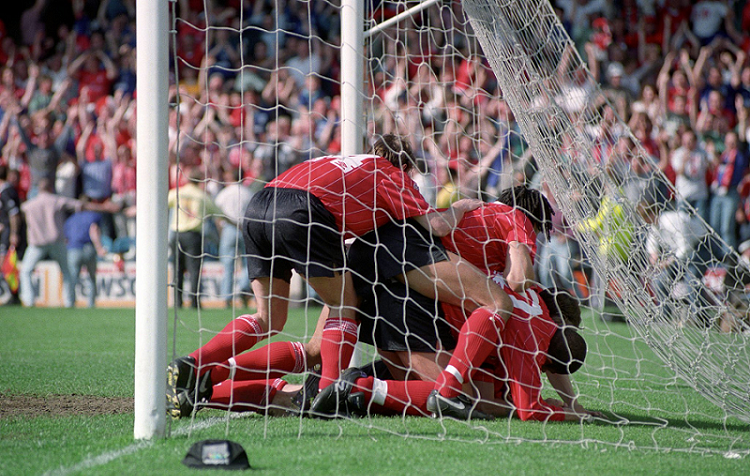
Nottingham Forest would go through the entirety of April unbeaten, winning four and drawing three out of seven matches. An accumulation of 15 out of a possible 21 points had seen Forest achieve their pre-season goal of Premiership promotion. The team had also earned impressive victories against some of their nearest rivals, including Derby and Charlton. In fact, with two matches remaining, Frank Clark’s team still had an outside chance at winning the First Division title. Forest sat six points adrift of leaders Crystal Palace. Still, maximum points from matches against mid-table Grimsby and Sunderland plus a minimum four-goal swing in their favour could see the championship head to the East Midlands rather than South London. However, Frank Clark would remind his players not to look that far ahead. They had met their goal for the season, and anything more was a bonus.
| Position | Team | Played | Wins | Draws | Losses | GF | GA | GD | Points |
|---|---|---|---|---|---|---|---|---|---|
| 1st | Crystal Palace | 44 | 26 | 9 | 9 | 70 | 42 | +28 | 87 |
| 2nd | Nottingham Forest | 44 | 23 | 12 | 9 | 72 | 47 | +25 | 81 |
| 3rd | Tranmere Rovers | 45 | 21 | 9 | 15 | 68 | 51 | +17 | 72 |
| 4th | Leicester City | 44 | 19 | 14 | 11 | 70 | 57 | +13 | 71 |
| 5th | Derby County | 45 | 20 | 11 | 14 | 70 | 64 | +6 | 71 |
| 6th | Millwall | 44 | 18 | 16 | 10 | 57 | 49 | +8 | 70 |
May
In their final two matches of the 1993-94 season, Nottingham Forest would meet two teams that had nothing else to play for except league position and personal pride. First up was a trip to Grimsby Town on 3rd May. Grimsby Town sat 15th in the First Division standings but could finish in the top half of the table with six points from their final two games. However, the Mariners were without a win in five and had scored just two goals during that same period. Grimsby had drawn a league-high 18 matches and had the 4th-best defensive record, conceding 47 goals in 44 games, the same amount as Forest. Therefore, the resulting 0-0 draw at Blundell Park was not a surprising result, given that it was Grimsby’s fifth of the campaign. The goalless draw for Forest would confirm Crystal Palace as First Division champions. The Eagles had defeated Barnsley 1-0 two days earlier, and the two points dropped by Forest would extend the gap between the two teams to an unassailable eight points.
Nottingham Forest would end the 1993-94 league season with a home match against Sunderland on 8th May. With the two teams assured of their final league positions, both sides would produce an entertaining game for the 27,010 fans in attendance at the City Ground. Forest would take the lead from the penalty spot. After Sunderland goalkeeper had fouled Scot Gemmill in the area, Stuart Pearce would hit the ball high into the net to put his team 1-0 up. Retaining this advantage at half-time, the home side would double their lead through their top scorer. Steve Stone would manage to squeeze his cross through a thicket of legs, and Stan Collymore would score his 25th and final goal of a magnificent campaign.
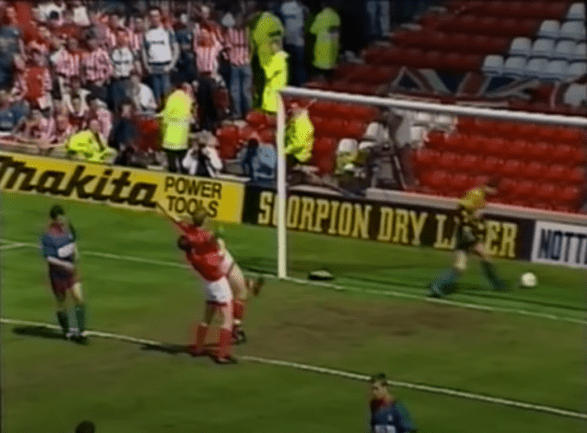
However, Sunderland would record two late goals to slightly dampen the mood around the ground. First, Don Goodman chip would halve the winning margin in the 82nd minute, before Mark Crossley would help Craig Russell’s shot over the line for the equaliser four minutes later. However, the 2-2 draw did not ultimately matter much to either side. For Forest, in particular, this was a day of celebration and the last chance home supporters would see them before the next season back in the top-flight.
Precisely 365 days earlier, on 8th May 1993, Nottingham Forest fans witnessed a 2-1 defeat to Ipswich Town relegate their team from the top division and end the managerial career of a visibly emotional Brian Clough. Now, one year later, on 8th May 1994, home fans were celebrating Nottingham Forest’s immediate return to the Premiership under the management of Clough’s former European Cup-winning full-back Frank Clark. After a start that saw the team sit one point above the relegation zone after 5 defeats in 12 matches, the Reds had recovered brilliantly, losing just 4 of the remaining 34 games. They had secured promotion with two games to spare and could start early preparations for their top-flight return the following season.
| Position | Team | Played | Wins | Draws | Losses | GF | GA | GD | Points |
|---|---|---|---|---|---|---|---|---|---|
| 1st | Crystal Palace | 46 | 27 | 9 | 10 | 73 | 46 | +27 | 90 |
| 2nd | Nottingham Forest | 46 | 23 | 14 | 9 | 74 | 49 | +25 | 83 |
| 3rd | Millwall | 46 | 19 | 17 | 10 | 58 | 49 | +9 | 74 |
| 4th | Leicester City | 46 | 19 | 16 | 11 | 72 | 59 | +13 | 73 |
| 5th | Tranmere Rovers | 46 | 21 | 9 | 16 | 69 | 53 | +16 | 72 |
| 6th | Derby County | 46 | 20 | 11 | 15 | 73 | 68 | +5 | 71 |
Statistics
Nottingham Forest would play 57 games during the 1993-94 season across four different competitions, finishing with an overall record of 26 wins, 19 draws, and 12 losses. This would leave manager Frank Clark with a win percentage of 45% in all competitions for his first season in charge at the City Ground. This percentage would rise to 50% when only league matches are included. Clark’s team would finish the 1993-94 First Division campaign with 23 wins, 14 draws and 9 defeats, enough to finish 2nd in the table and earn automatic promotion behind champions Crystal Palace.
However, despite officially being the second-best team in the First Division during the 1993-94 season, Nottingham Forest would come out on top in multiple statistics. The Reds would record four fewer victories than Crystal Palace but finish the season with the fewest defeats. Just nine of Forest’s 46 league matches would end in a loss, and five of those defeats had occurred by the beginning of November. Nottingham Forest would also finish as the division’s top scorers, racking up 74 goals, one more than their nearest competitor. These 74 goals would come from sixteen different players. Stan Collymore would lead the team with 19 goals, while six players would register five or more in the league. Most surprising among this list was Colin Cooper. The centre-back would score seven league goals during his debut season at Forest. Before arriving in the East Midlands, Cooper had scored a combined twelve league goals in 265 appearances for Middlesbrough and Millwall. Now, he had scored more than half of that total in a single season at the City Ground.
Every Nottingham Forest goalscorer in the 1993-94 season (all competitions)
| Player | Total Goals (league goals) |
|---|---|
| Stan Collymore | 25 (19) |
| Scot Gemmill | 10 (8) |
| Colin Cooper | 9 (7) |
| Stuart Pearce | 6 (6) |
| Lee Glover | 6 (5) |
| Ian Woan | 5 (5) |
| Steve Stone | 5 (5) |
| Kingsley Black | 5 (3) |
| David Phillips | 4 (4) |
| Neil Webb | 4 (3) |
| Robert Rosario | 2 (2) |
| Jason Lee | 2 (2) |
| Des Lyttle | 1 (1) |
| Lars Bohinen | 1 (1) |
| Steve Chettle | 1 (1) |
| Gary Crosby | 1 (0) |
As well as leading the First Division in terms of the fewest defeats and goals scored, Nottingham Forest would boost impressive match records both home and away. While Forest’s 45 points at home would give them the 8th-best home record (worse than seven of the top 11 teams in the final table), Frank Clark’s team would record just two home defeats all season, another divisional high. Away from home, Forest would top the charts with a record of 11 wins, 5 draws and 7 defeats for a total of 38 points. As well as recording the most wins, fewest draws and fewest losses away from home, the team would concede the fewest goals away from the City Ground, letting in 27 goals in 23 games. During the 1993-94 campaign, Nottingham Forest would perform better at home in all primary metrics, as shown below. However, when playing on their travels, no other team (other than Crystal Palace) could match Frank Clark’s Reds.
Nottingham Forest- 1993-94 home record
| Position | Played | Wins | Draws | Losses | GF | GA | GD | Points |
|---|---|---|---|---|---|---|---|---|
| 8th | 23 | 12 | 9 | 2 | 38 | 22 | +16 | 45 |
Nottingham Forest- 1993-94 away record
| Position | Played | Wins | Draws | Losses | GF | GA | GD | Points |
|---|---|---|---|---|---|---|---|---|
| 1st | 23 | 11 | 5 | 7 | 36 | 27 | +9 | 38 |
Despite Nottingham Forest playing a total of 57 matches in four different competitions throughout the 1993-94 season, Frank Clark would only utilise a small pool of players to play in all of these matches. Clark would select 25 different players across the First Division, FA Cup, League Cup, and Anglo-Italian Cup. Eleven players would appear in more than 50% of the team’s matches. Goalkeeper Mark Crossley, defenders Des Lyttle, Colin Cooper, Steve Chettle and Stuart Pearce, midfielders Steve Stone, David Phillips, Scot Gemmill, Ian Woan and Kingsley Black, and forward Stan Collymore would all make 30 or more appearances through the season. Seven would appear in over forty matches, and four (Pearce, Chettle, Stone and Phillips) would appear in more than fifty. In fact, Steve Chettle would be the only Nottingham Forest to play a part in all 57 of their matches during the 1993-94 season, with the 25-year-old starting every one.
The only position that would perhaps see significant changes throughout the campaign would be the centre-forward position. Even though Stan Collymore would play 33 matches in all competitions, he would miss the other 24 games either through early-season form or injury problems. In Collymore’s absence, Clark would select Robert Rosario, Lee Glover, Gary Bull and Jason Lee to occupy the young striker’s spot. The combined results of eight goals scored between the three men would necessitate the late-season addition of Jason Lee, who would work well both with Collymore and as the big striker’s replacement. However, during Collymore’s time on the sidelines, midfielders Scot Gemmill, Steve Stone and David Phillips would step up to provide the goals usually offered by the Staffordshire native. However, Frank Clark could rely on a settled and tight-knit squad through most of the 1993-94 promotion campaign despite these minor issues.
| Position | Player | Appearances (all competitions) |
|---|---|---|
| GK | Mark Crossley | 45 |
| Tommy Wright | 12 | |
| Andy Marriott | 0 | |
| DF | Des Lyttle | 46 |
| Stuart Pearce | 51 | |
| Steve Chettle | 57 | |
| Colin Cooper | 42 | |
| Brian Laws | 10 | |
| Alf-Inge Håland | 3 | |
| Steve Blatherwick | 5 | |
| Carl Tiler | 3 | |
| Vance Warner | 2 | |
| Stuart Thom | 0 | |
| Craig Armstrong | 0 | |
| Gary Bowyer | 0 | |
| MF | Steve Stone | 54 |
| David Phillips | 50 | |
| Scot Gemmill | 38 | |
| Kingsley Black | 35 | |
| Ian Woan | 30 | |
| Lars Bohinen | 25 | |
| Neil Webb | 22 | |
| Gary Crosby | 6 | |
| Bobby Howe | 3 | |
| Lee Harvey | 0 | |
| Ian Kilford | 0 | |
| Ray McKinnon | 0 | |
| Justin Walker | 0 | |
| FW | Stan Collymore | 34 |
| Lee Glover | 20 | |
| Robert Rosario | 18 | |
| Jason Lee | 10 | |
| Gary Bull | 5 | |
| Paul McGregor | 0 | |
| Steve Guinan | 0 |
Conclusion
When a team suffers relegation after a long period in the top-flight, it can often take a long time for the team to find its way back. Similarly, when a manager has been in charge of a club for a long time, it can often take the club in question years (plus multiple managers) to truly escape the shadows of that former manager’s legacy before they can establish a new dynasty. In May 1993, Nottingham Forest was, unfortunately, blessed with both of these problems. In one week, the team would drop out of the Premiership after a 16-year stay and lose their manager of 18 years, Brian Clough, to retirement. When Nottingham Forest announced Frank Clark as their new manager one week after Clough’s exit, they had hired a man who had a connection with the club and the fanbase. However, they had also appointed a man who had not managed above the third tier of English football and experienced relegation and promotion during his eight years in the hot seat at Leyton Orient. With the change in Nottingham Forest’s circumstances and coaching set-up, it was feared that the Reds would lose several of their best players to the top-flight. The summer before the 1993-94 season even enhanced these fears as two of the biggest clubs in the country, Liverpool and Manchester United, would spend big money (a combined £6million) to lure Forest’s best striker Nigel Clough and midfielder Roy Keane back to the Premiership.
However, despite these early losses, many of Nottingham Forest’s best and brightest would choose to stay with the club and spend a season down in the First Division, helping the Reds earn immediate promotion back to the big time. Goalkeeper Mark Crossley, club captain and England international Stuart Pearce, defender Steve Chettle and midfielders Neil Webb, Scot Gemmill, Ian Woan and Steve Stone would pledge their loyalty to the East Midlands club for another year. These men would play their part in Forest’s subsequent promotion story. In addition, manager Frank Clark would make astute signings in the transfer market throughout the 1993-94 season. He would add players to the squad who brought in a mix of youth and experience, both in age and significant histories playing in the Premiership and the First Division. Clark’s transfer dealings would give the Nottingham Forest fans new heroes to cheer like Des Lyttle, Colin Cooper, David Phillips, Lars Bohinen and the one and only Stan Collymore.
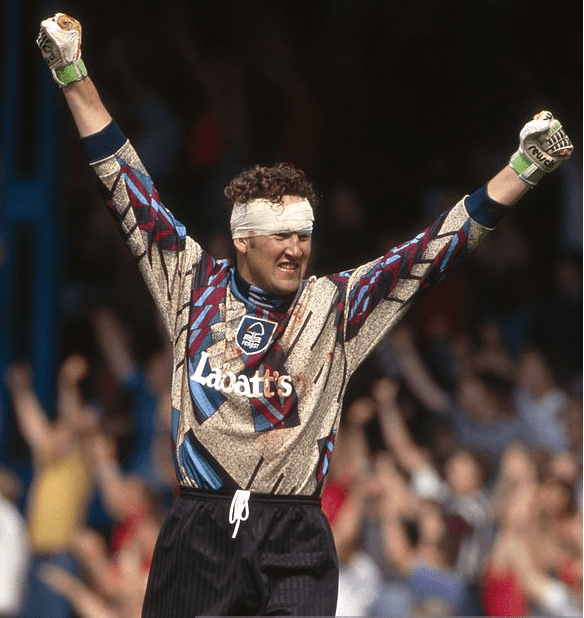
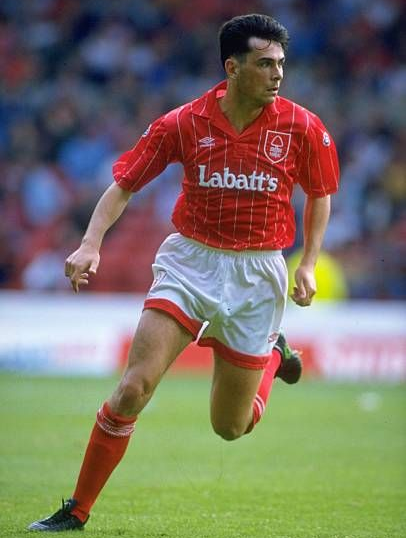
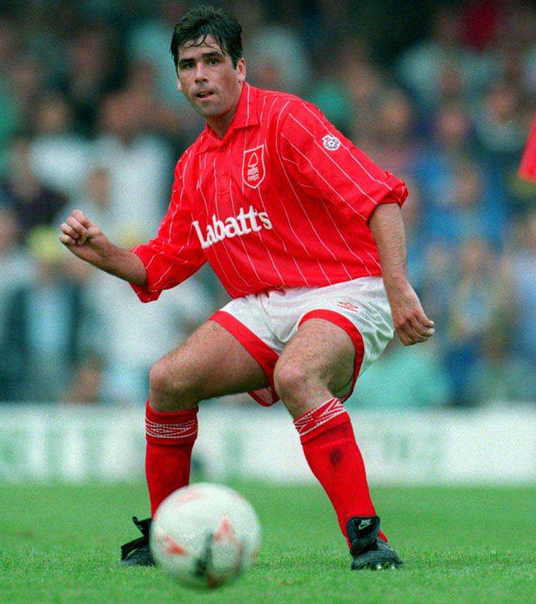
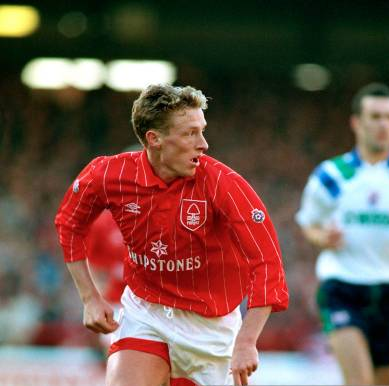
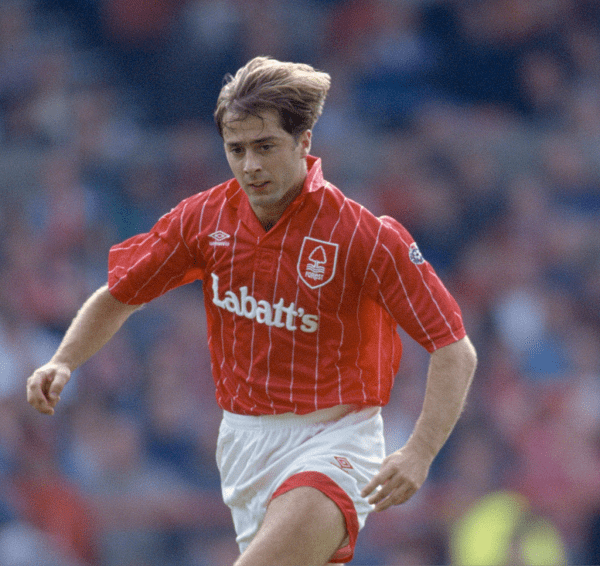
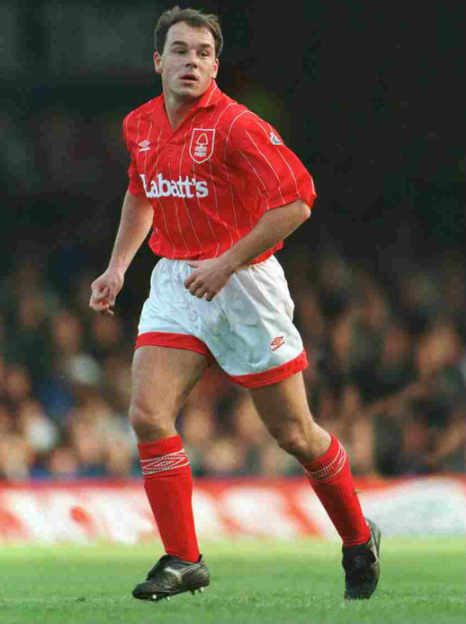
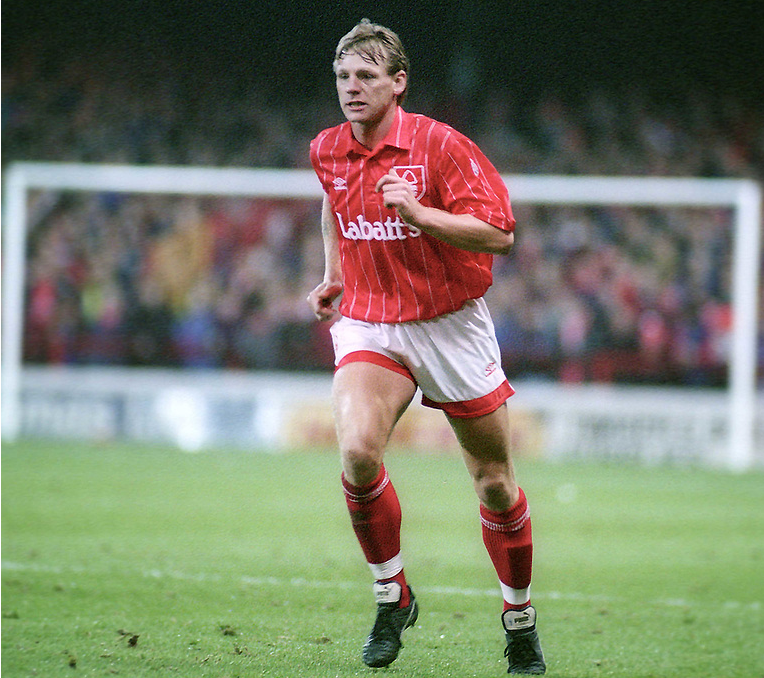
Despite pre-season expectations, Nottingham Forest would not start the 1993-94 First Division season well. The team would win just two of their first eight league matches and four of their first fourteen. However, following a defeat to Millwall at the start of November, things would suddenly start to click on the field for the East Midlands club. Between 6th November 1993 and 6th February 1994, Forest would go thirteen league matches unbeaten. After a brief three-match wobble in mid-to-late February, Forest would get back on track, losing once in their final sixteen games. The Reds would even end the First Division season with another ten-game unbeaten streak, sealing Premiership promotion with two matches to spare.
It is also important to acknowledge the League Cup’s role in Nottingham Forest’s change in fortunes during the 1993-94 season. Forest would save their best performances for wins over Wrexham and Premiership West Ham during the team’s early-season struggles. Even once the Reds had started to discover their form in the league, they would continue to perform in the League Cup, upsetting Manchester City to reach the quarter-finals. At one point, the combination of Nottingham’s league and cup results would amount to fourteen matches unbeaten between 6th November 1993 and 16th January 1994.
The League Cup would also kick-start the form of the man who would become Nottingham Forest’s most important player of the 1993-94 season. During a dark September, the team would draw 3-3 with Second Division Wrexham in the first-leg of a League Cup second-round tie. That match on 21st September would see Stan Collymore announce himself to the Nottingham Forest faithful, scoring his first hat-trick for the club. From that point onwards, Collymore would net 25 goals in 33 matches in all competitions, powering the Reds forward in both the league and cup. During Forest’s thirteen-match unbeaten run between November and February, 10 (40%) of the team’s 25 league goals would come from the boot or head of Collymore. The young striker would finish with 19 goals in 28 First Division matches. Two goals from Collymore (either side of a Stuart Pearce penalty kick) would turn a 2-0 deficit against Peterborough into the 3-2 win that confirmed Forest’s promotion back to the top-flight. Even when Collymore didn’t score or was absent, Scot Gemmill (ten goals), Colin Cooper (nine) and Steve Stone (six) would take on the responsibility of providing the goals that rocketed Nottingham Forest from 20th place in November 1993 to 2nd at the start of May.
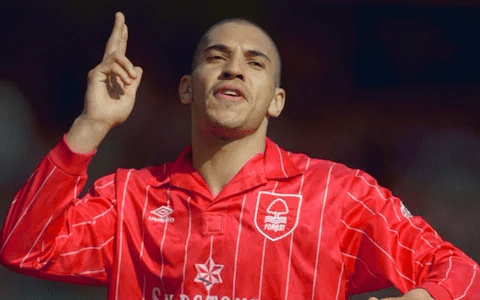
All these factors would contribute to Nottingham Forest recovering from Premiership relegation and the loss of their greatest-ever manager to return to the top division of English football at the first time of asking. What would occur during that next Premiership season? That is a story for another day. Would it be another struggle resulting in an immediate drop back to the second tier? Would it be a story of valiant survival involving a dramatic late-season surge in form or final-day escape? Would Forest even end up surprising people, equipping themselves well and finishing well clear of danger, perhaps finishing in the top half? Frank Clark and his players would find that out in a mere 104 days.
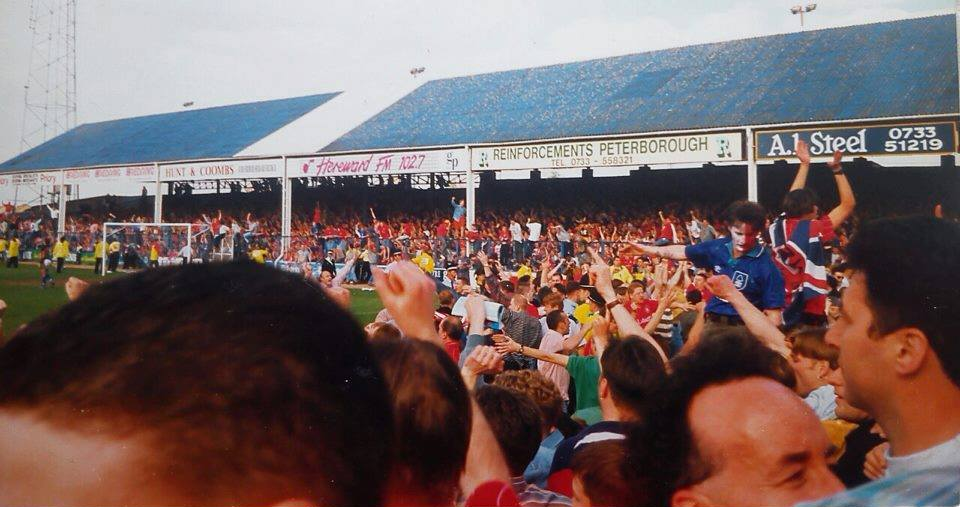
 the-score-board.co.uk