
You will never write off the outside lane again…
Let me ask you a question. When watching an athletics race, how often have you seen the person who began the race in the outside lane be the one to cross the finishing line first? This scenario is possible in races ranging between 100m and 800m in length, events that utilise lanes to separate the competitors. In particular track races like the 100m and 800m, the lane that an athlete starts in does not necessarily affect that same athlete’s chances of winning the race. However, the point remains that the chances of someone winning the final of an elite athletics event from the outside lane on the track is incredibly rare, particularly if that race lasts either 200m or 400m.
In 100m races, the fastest athletes on paper will start in the central lanes (3-6), with the ‘slower’ runners occupying the inside and outside starting blocks. However, since 100m races are run in a straight line, the lane is not likely to affect the race result. For example, Canadian sprinter Andre De Grasse has won four 100m bronze medals at the Olympic Games (x2) and the World Athletics Championships (x2). Of these four bronze medals, De Grasse managed to claim two from the same lane. Lane 9. In 2015, De Grasse started the World 100m final from lane nine and managed to earn a joint-bronze medal behind Usain Bolt and Justin Gatlin. Six years later, in the 2020 Olympics final, De Grasse once again started from Lane 9 and this time managed to become the outright bronze medal-winner behind Marcell Jacobs and Fred Kerley. This example shows that lane order does not affect the result of a 100m final.
In the 800m, the eight competitors start in separate lanes but soon move into a single lane once the race passes 200m. The only races at an elite level to which the lane draw can affect the athletes and potentially dictate the race result are the 200m and 400m. Today, we will be focusing on the longer of these two distances.
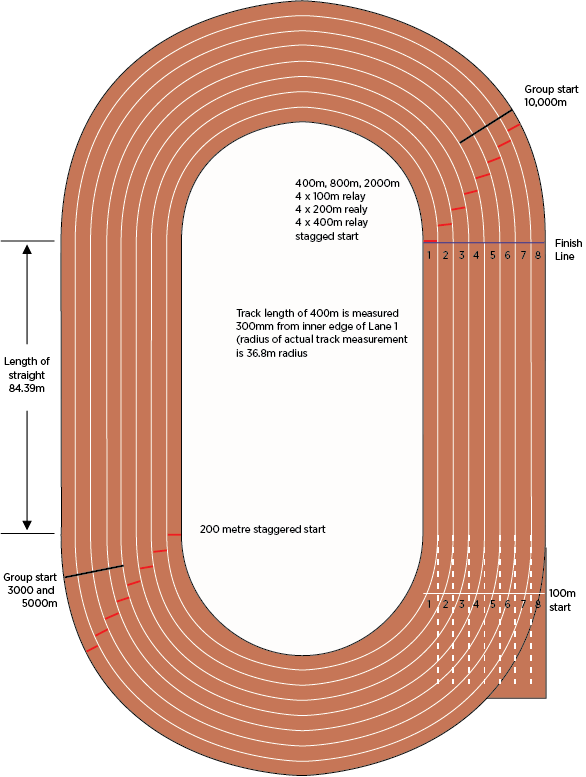
A 400m race involves eight competitors completing a full lap of the track as fast as possible. However, instead of all eight athletes starting from the same point, the shape of the track means that the competitors have to start in lanes staggered 7-8 metres apart (in front and to the side) to ensure that all runners run 400m and not a metre more or less. However, with each staggered lane comes a ‘staggering angle’ that each athlete has to run against and overcome during the course of the race.
Despite the staggered lanes, deciding which athlete starts in which lane for the 400m is the same as determining the lane draw for a 100m race. The better-performing runners begin in the middle (3-6 or 4-7 on a nine-lane track), and the ‘slower’ competitors start outside them (Lanes 1, 2, 7 and 8). In championship finals, heat winners from the previous round of competition will receive the best lanes along with those who ran the quickest times. Meanwhile, the flanking lanes will go to athletes with slower times or heat runners-up. Therefore, you could finish 2nd in your previous race and somehow end up in lane 8, ending up with a more difficult race than you were expecting. The unfortunate athlete who starts a 400m race in the outside lane starts their race around 53m ahead of the runner in lane 1. To ensure that the Lane 8 runner completes 400m exactly, the athlete has to compete with a staggering angle of 33.90° which really comes into play around the long bends. If that situation is not challenging enough, the person beginning the 400m in Lane 8 is blind to what is going on in the other seven lanes. They will not see another competitor until they pass into their peripheral vision and potentially overtake them. For this athlete, this 400m race turns into a time trial. It just so happens that this time trial also contains seven rivals that are all trying to run faster than them and claim the glory on offer.
With all that said, I’d like to return to our original scenario, although a slightly altered one. When watching an athletics race, a 400m race to be exact, have you ever seen someone win the entire race from the outside lane? If the answer to that question is ‘yes’, then you were a witness to the Olympic men’s 400m final held on 14th August 2016. On this night, inside the Estádio Olímpico João Havelange, 24-year-old South African runner Wayde van Niekerk would make 400m history, in more ways than one.
| Lane | Distance from starting line (m) | Staggering angle |
|---|---|---|
| 1 | 0 | 0.00° |
| 2 | 7.67 | 5.78° |
| 3 | 15.33 | 11.19° |
| 4 | 23 | 16.28° |
| 5 | 30.66 | 21.08° |
| 6 | 38.33 | 25.60° |
| 7 | 46 | 29.86° |
| 8 | 53.66 | 33.90° |
2015 World Athletics Championships
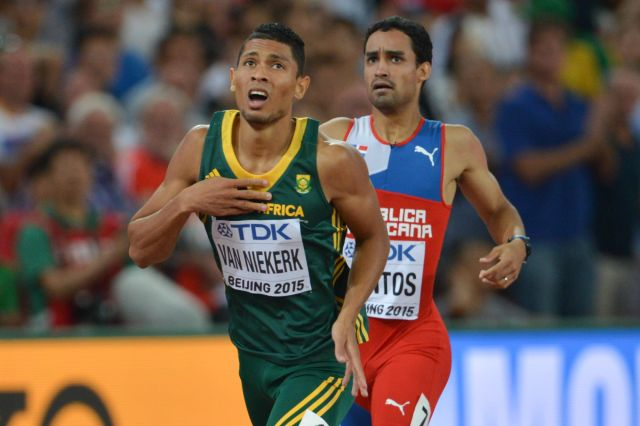
South African athlete Wayde van Niekerk would travel to the 2016 Rio Olympics as the reigning men’s 400m world champion. At the 2015 World Championships in Beijing, van Niekerk would qualify 4th-fastest for the 400m final. However, to win gold, he would have to overcome a talented field of runners. This field would include two-time world champion LaShawn Merritt, reigning Olympic champion Kirani James, 2012 Olympic silver medallist Luguelín Santos, world junior champion Machel Cedenio and world No.1 Isaac Makwala. Without a 400m title to his name heading into Beijing but with four victories on the 2015 Diamond League circuit, the 23-year-old van Niekerk would outpace this talented field and win the gold medal ahead of LaShawn Merritt in 2nd and Kirani James in 3rd.
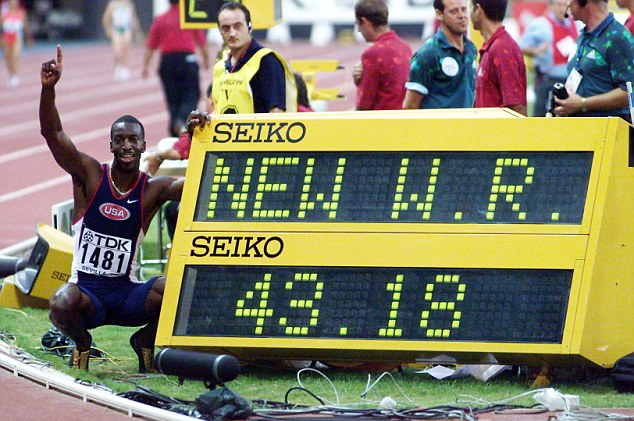
Van Niekerk’s winning time of 43.48 was not only a personal best, a South African record and the fastest 400m time of 2015. The time put him as the 4th-fastest 400m runner in the event’s entire history. Only Jeremy Wariner (43.45, 2007), Butch Reynolds (43.29, 1988) and Michael Johnson (43.18, 1999) had run faster. All of these men were from the United States, the leading nation for 400m runners, therefore making Wayde van Niekerk the fastest non-American 400m runner in history. With his World Championship victory, Wayde van Niekerk had become a global athletics star.
2016 Olympic Games
One year later, the three 400m world championship medallists from Beijing would also serve as the three favourites for Olympic gold in Rio de Janeiro. The 2016 Diamond League season would see LaShawn Merritt (Doha, Rabat), Kirani James (Eugene, Birmingham) and Wayde van Niekerk (Rome, Monaco) all claim significant race victories in the run-up to the Olympics. Each man was openly outlining their credentials as potential 400m champions in Rio.
Heats
The 2016 Olympic men’s 400m competition would occur between 14th and 16th August. Due to their outstanding records, the three main protagonists of this tournament would start in separate heats. After Machel Cedenio and Grenada’s Bralon Taplin won the first two heats, Wayde van Niekerk would begin his Olympic journey in Heat 3. Luguelin Santos, Jamaican champion Javon Francis and 2012 Olympic finalist Jonathan Borlée would also compete with the world champion for the three automatic places into the semi-finals the next day. Despite a talented heat, van Niekerk would have an easy ride, slowing down before the line to win in 45.26. Santos (45.61) and Francis (45.88) would join the South African in the next round. After van Niekerk’s victory, LaShawn Merritt would make up for his early exit at London 2012 by winning Heat 5 in 45.28, and defending champion Kirani James would clinch Heat 6 in 44.93, qualifying fastest for the semi-finals. Along with the primary trio and the earlier mentioned Cedenio and Taplin, Trinidad and Tobago’s Lalonde Gordon (45.24) and Bahrain’s Ali Khamis (45.12) would win the other two preliminary 400m heats.
2016 Olympics Men’s 400m Heat 3 Result
| Position | Athlete | Country | Time |
|---|---|---|---|
| 1st | Wayde van Niekerk | South Africa | 45:26 |
| 2nd | Luguelín Santos | Dominican Republic | 45:61 |
| 3rd | Javon Francis | Jamaica | 45:88 |
| 4th | Jonathan Borlée | Belgium | 46:01 |
| 5th | Alphas Kishoyian | Kenya | 46:74 |
| 6th | Brandon Valentine-Parris | St Vincent and the Grenadines | 47:62 |
| 7th | Alonzo Russell | Bahamas | DQ |
Semi-finals
The first semi-final of the men’s 400m would pair up Kirani James and LaShawn Merritt, renewing a rivalry that dated back to the 2011 World Championships. The pair were responsible for the last two Olympic gold medals in the event, with Merritt winning in Beijing in 2008 and James in London in 2012. The duo had even beaten each other to World Championship glory. A 19-year-old James would shockingly defeat defending world and Olympic champion Merritt in Daegu 2011, but Merritt would return the favour in Moscow two years later. The primary challengers to Wayde van Niekerk’s chances of Olympic gold would both routinely progress to a second Olympic 400m final. Kirani James would win Semi-final 1 in a season’s-best time of 44.02 seconds, with LaShawn Merritt following closely behind in 44.21.
The second 400m semi-final would see Wayde van Niekerk continue his quest for Olympic glory. Heat 1 winner Machel Cedenio would serve as his most significant threat. However, this field would also contain world indoor gold and silver medallists Pavel Maslák of the Czech Republic and Abdalelah Haroun of Qatar. With only the top two athletes qualifying automatically, van Niekerk would have to remain alert and avoid getting complacent in his run. Wayde van Niekerk would safely progress to the final in a time of 44.45, but he would finish in 2nd place behind Machel Cedenio’s time of 44.39. Even though both men were easing down towards the finish line, van Niekerk’s happiness for Cedenio to take the victory would potentially lead to an inferior starting position in the final, with the best lane draws going to the winners of each semi-final. In addition, van Niekerk’s time of 44.45 would only qualify him as the fifth-fastest athlete heading into the final the next day. Therefore, based on his finishing position and his time, Wayde van Niekerk had unintentionally made his job in the 400m final a little more challenging than it needed to be.
2016 Olympics Men’s 400m Semi-Final 2 Result
| Position | Athlete | Country | Time |
|---|---|---|---|
| 1st | Machel Cedenio | Trinidad and Tobago | 44:39 |
| 2nd | Wayde van Niekerk | South Africa | 44:45 |
| 3rd | Pavel Maslák | Czech Republic | 45:06 |
| 4th | Luka Janežič | Slovenia | 45:07 |
| 5th | David Verburg | USA | 45:61 |
| 6th | Rusheen McDonald | Jamaica | 46:12 |
| 7th | Abdelalelah Haroun | Bahrain | 46:66 |
| – | Baboloki Thebe | Botswana | DNS |
To round things off, Grenada’s Bralon Taplin would win the third and final semi-final in 44.44 ahead of Great Britain’s Matthew Hudson-Smith (44.48). Third-placed Bahraini athlete Ali Khamis would also qualify for the final as a fastest loser after running a new Bahrainan national record time of 44.49. The other ‘fastest loser’ spot would go to Botswana’s Karabo Sibanda, who had recorded a personal-best time of 44.47 to finish third behind Kirani James and LaShawn Merritt in Semi-Final 1. The line-up for the Olympic men’s 400m final was now set.
2016 Olympic Men’s 400m Final
2016 Olympics Men’s 400m Final Start List
| Lane | Athlete | Country | Qualifying Time (rank) |
|---|---|---|---|
| 1 | Karabo Sibanda | Botswana | q 44:47 PB (6th) |
| 2 | Ali Khamis | Bahrain | q 44:49 NR (8th) |
| 3 | Machel Cedenio | Trinidad and Tobago | Q 44:39 (3rd) |
| 4 | Bralon Taplin | Grenada | Q 44:44 (4th) |
| 5 | LaShawn Merritt | USA | Q 44:21 (2nd) |
| 6 | Kirani James | Grenada | Q 44:02 (1st) |
| 7 | Matthew Hudson-Smith | Great Britain | Q 44:48 (7th) |
| 8 | Wayde van Niekerk | South Africa | Q 44:45 (5th) |
Before 2016, there had been 27 Olympic men’s 400m finals, with the event having featured in every edition of the modern Olympic Games to that point. After the first final in Athens in 1896, just six countries had triumphed in the event: the United States, Great Britain, South Africa, Jamaica, Cuba, the Soviet Union, and Grenada. Unsurprisingly, the USA won the event more than anybody with 19 victories. Heading into the final in Rio, an American athlete also held the world and Olympic Games record for the men’s 400m. This man was called Michael Johnson.
Johnson achieved his first record in the 400m final at the 1996 Olympic Games in Atlanta. That final saw Johnson win his first 400m Olympic gold medal in a time of 43.49 seconds, breaking the previous Olympic record set by 1992 champion Quincy Watts by 1/100th of a second (43.50). However, despite setting a new Olympic record, Johnson’s time was still two-tenths of a second short of the world record set by Butch Reynolds in August 1988. However, at the 1999 World Athletics Championships in Seville, Johnson would break the 11-year-old record, winning his fourth successive 400m world title in a new world-best time of 43.18 seconds. In the seventeen years following, only two men had come within three-tenths (0.3 seconds) of the Texan’s personal best. One man was Jeremy Wariner, who had run 43.45 seconds to win the 400m final at the 2007 World Championships. The other was Wayde van Niekerk with his World Championship-winning time of 43.48 from 2015. Now, van Niekerk would hope to get closer to Johnson’s time by claiming victory in the 400m final at Rio de Janeiro. The problem was: van Niekerk would have to achieve this from the most challenging lane on the track inside the Olympic Stadium.
Due to his status as reigning world champion, Wayde van Niekerk would head into the 400m final as one of the favourites. However, his chances of winning a gold medal would be affected by his draw in lane 8. Due to van Niekerk’s lane draw, the South African’s closest rivals LaShawn Merritt (USA) (Lane 5) and Kirani James (Grenada) (Lane 6) would start with more substantial hopes of winning gold. In addition, both Merritt and James had already reached the top of 400m running, having won the last two Olympic finals. Outside of those two, other notable medal threats to van Niekerk would come from Machel Cedenio (Lane 3) (Trinidad and Tobago), who had a personal best of 44.34 seconds from 2015 and Kirani James’ Grenadian teammate Bralon Taplin (Lane 4), who had run 44.38 in Monaco one month earlier.
With all these men inside him on the track, Wayde van Niekerk knew that he would need the performance of his young career to add Olympic gold to his World Championship success. However, he could take solace from the fact that LaShawn Merritt had begun that 2015 World Championship 400m final from the outside lane and had proceeded to run a personal best time of 43.65 seconds to claim a silver medal and finish 0.17 seconds behind van Niekerk. However, the young South African would need more than just a career-best performance to win in Rio.
Wayde van Niekerk would be one of the slowest to react to the starting gun, with only Machel Cedenio in Lane 4 (0.208) having a slower reaction time than van Niekerk’s 0.181 seconds. However, the South African would quickly get into his rhythm and promptly move away from British athlete Matthew Hudson-Smith in the lane inside. Coming out of the first bend, van Niekerk had taken almost 10m out of Hudson-Smith, while Kirani James would overtake the Brit coming into the back straight with LaShawn Merritt not far behind the Grenadian. Even at this early stage in the race, it was clear that there were only three men who would win the medals in this 400m final. It was just a matter of which colour medal each man would win.
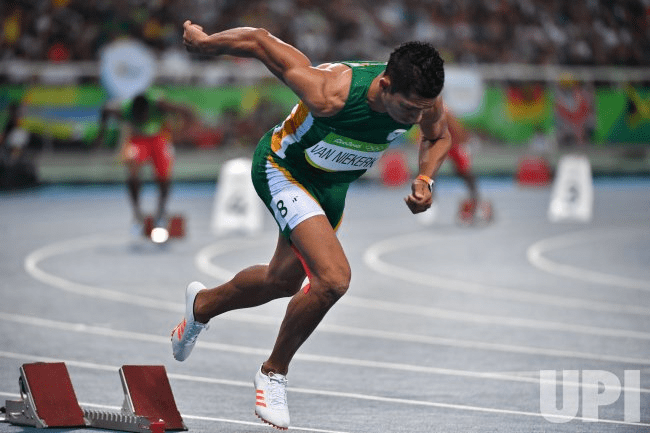
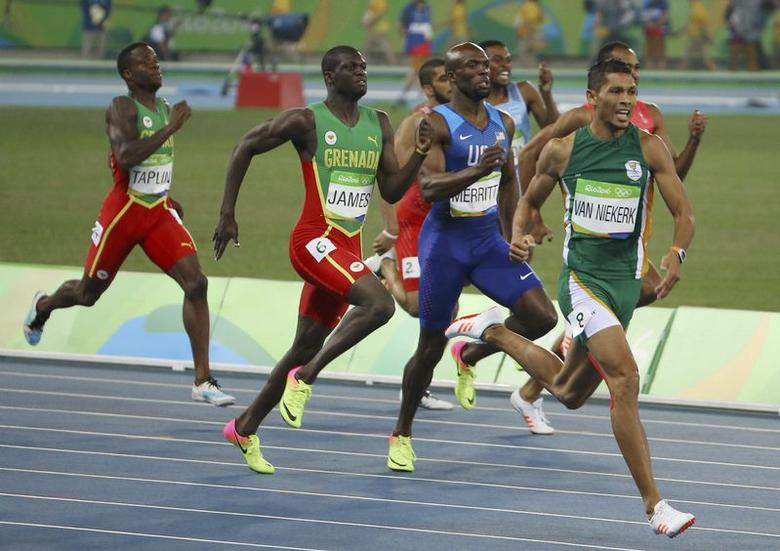
Wayde van Niekerk would start to lengthen his stride down the back straight, opening a gap to his closest rivals despite being in the outside lane. With the men who began in Lanes 2-5 already a non-issue, LaShawn Merritt would overtake Matthew Hudson-Smith, who was now caught in ‘no man’s land’ at the start of the final bend. As the track’s in-built ‘stagger’ started to level out, fans inside the Olympic Stadium would see that Wayde van Niekerk still led this final. However, Kirani James and LaShawn Merritt were beginning to close down on the young South African.
A sizeable gap now existed between van Niekerk, James and Merritt and the rest of the field but nothing more than a couple of metres separated van Niekerk in 1st, Merritt in 2nd, and James in 3rd. However, while the Grenadian and American battled it out down the final 100m in the latest instalment in their old rivalry, Wayde van Niekerk would stretch his legs one more time to extend his lead even further. As the rest of the field closed the gap to the leading three, Kirani James would overtake LaShawn Merritt to move into silver medal position. However, there was only one man in the field now streaking away towards Olympic gold.
Wayde van Niekerk would cross the finishing line around six metres ahead of everybody else, becoming the second South African winner of the Olympic men’s 400m and the first since Bevil Rudd at the 1920 Antwerp Games. Van Niekerk also became just the third man after Michael Johnson (1996, 2000) and Kirani James (2012) to win Olympic 400m gold while reigning as world champion. Speaking of Kirani James, the Grenadian would add a silver medal to the gold he won in London four years earlier, and 2008 gold medallist LaShawn Merritt would complete the podium with the bronze medal.
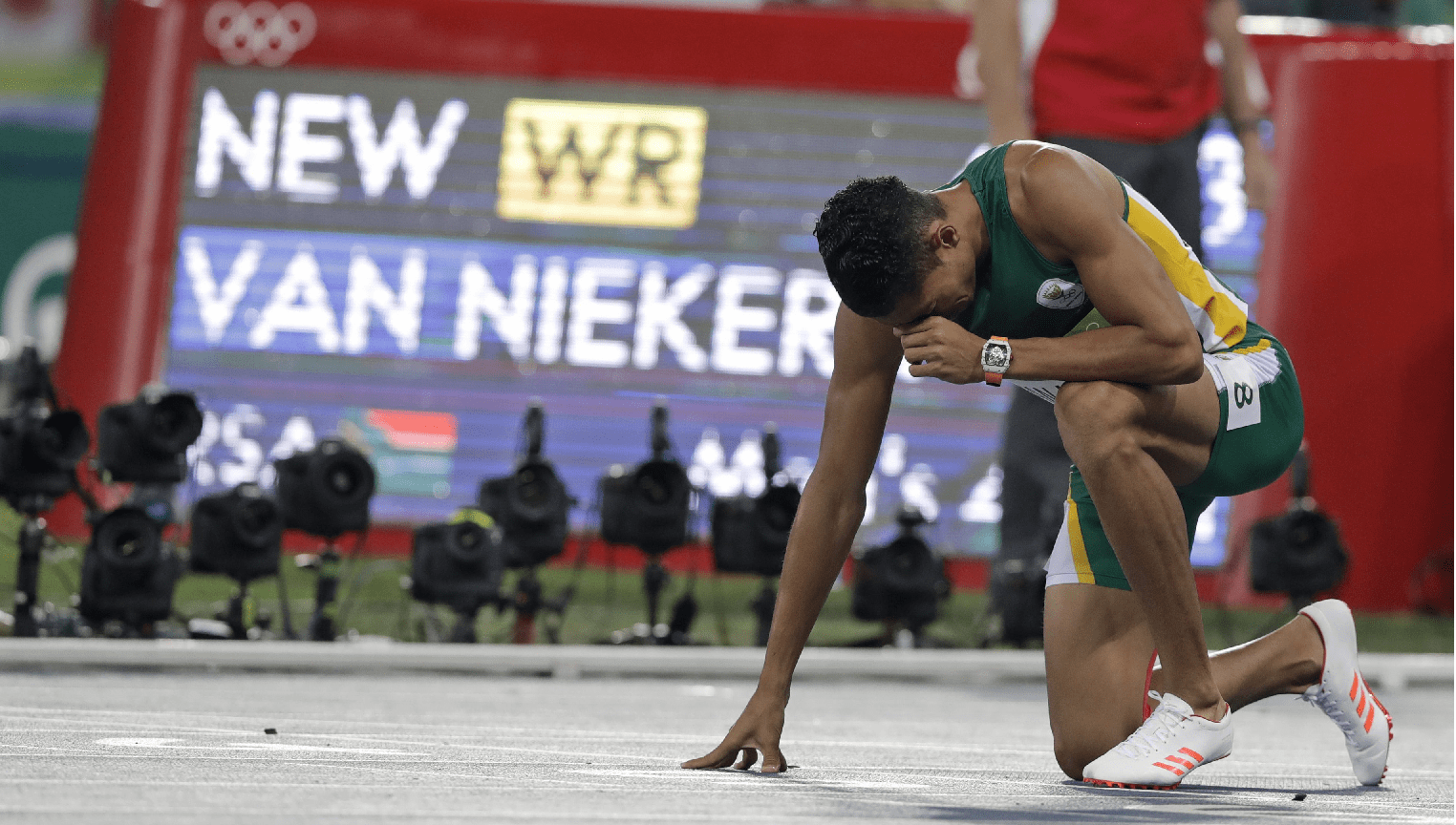
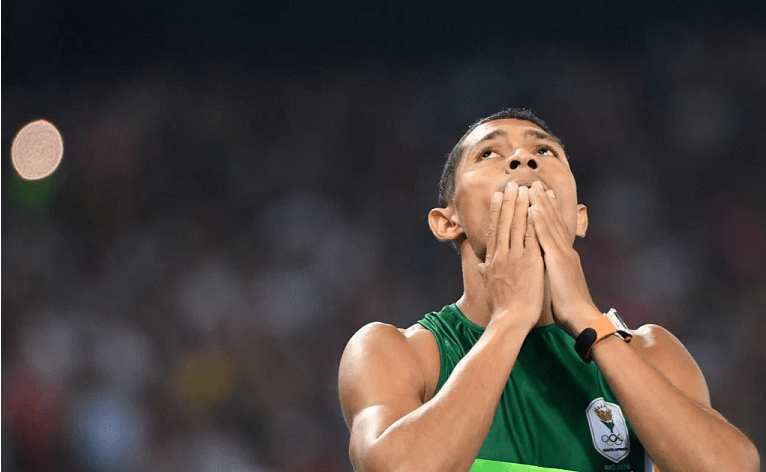
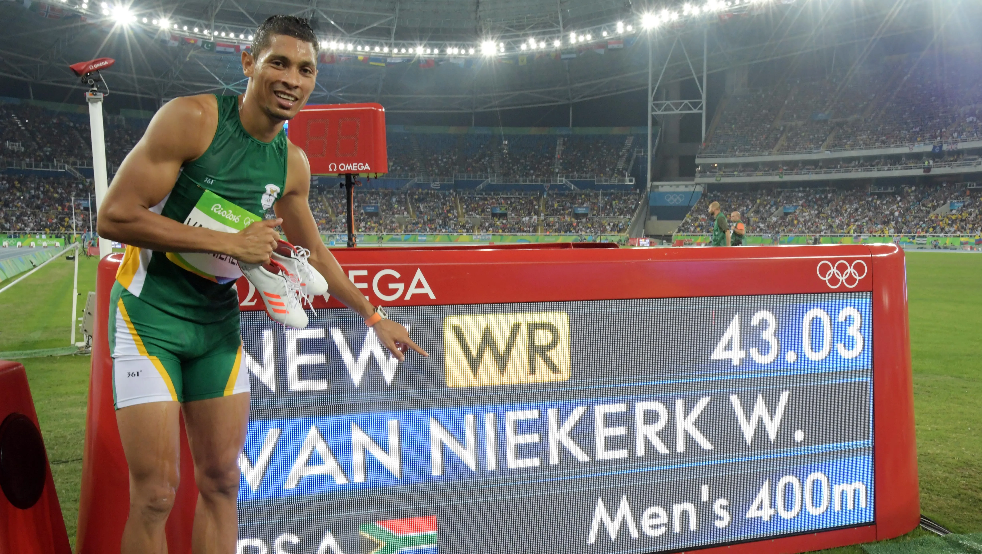
For those who watched the 400m final that night, they knew that Wayde van Niekerk had run a fast time. He had needed to perform well to offset his inferior lane draw. However, nobody knew that the 24-year-old from Kraaifontein, South Africa, had run as quick as he did. Crossing the line, van Niekerk stopped the track clock at 43.03 seconds. Immediately following the clock stoppage, the words ‘New WR’ flashed up next to van Niekerk’s time, and the crowd inside the Olympic Stadium erupted in celebration, having just witnessed sporting history. Wayde van Niekerk had become the first man to win an Olympic or world 400m final from the outside lane on the track. He had achieved this feat while running the distance faster than another man in history. After seventeen years, someone had finally bettered Michael Johnson’s 43.18-second run from Seville 1999, and a new man sat atop the 400m record books.
The 2016 Olympic men’s 400m final had proven to be a fast one. While Wayde van Niekerk had deservedly stolen the headlines with his new World, Olympic, African, South African and career-best time, six out of the eight 400m finalists would finish with either a season or personal best or even a national record. Kirani James and LaShawn Merritt would record season-best times of 43.76 and 43.85, 0.02 and 0.20 seconds off their respective personal bests. Machel Cedenio would finish in 4th place but set a new national record for Trinidad and Tobago in 44.01 seconds. Karabo Sibanda, who had started the final in lane 1, would impressively finish 5th with a new personal best of 44.25. Meanwhile, Ali Khamis would take over a tenth of a second off the Bahraini record of 44.49 he had set in the 400m semi-final one day earlier, recording a new personal and national best of 44.36.
In addition to many new records being set, the Olympic men’s 400m final would produce six of the eight fastest times of the 2016 season, with Wayde van Niekerk, Kirani James, LaShawn Merritt, and Machel Cedenio taking the top four places in the charts.
2016 Olympics Men’s 400m Final Result
| Position | Athlete | Country | Time |
|---|---|---|---|
| 1st | Wayde van Niekerk | South Africa | 43:03 (WR)(OR)(AR)(NR)(PB)(SB) |
| 2nd | Kirani James | Grenada | 43:76 (SB) |
| 3rd | LaShawn Merritt | USA | 43:85 (SB) |
| 4th | Machel Cedenio | Trinidad and Tobago | 44:01 (NR) |
| 5th | Karabo Sibanda | Botswana | 44:25 (PB) |
| 6th | Ali Khamis | Bahrain | 44:36 (NR) |
| 7th | Bralon Taplin | Grenada | 44:45 |
| 8th | Matthew Hudson-Smith | Great Britain | 44:61 |
Aftermath
After his astonishing run in the Olympic 400m final, Wayde van Niekerk would continue his incredible form into the 2017 season. After running 30.81 seconds in the 300m, taking Michael Johnson’s last world record, van Niekerk would successfully retain his 400m title at the World Athletics Championships in London and earn a silver medal in the 200m. By the end of 2017, Wayde van Niekerk was perhaps the best sprinter in world athletics.
Conclusion
Before he even arrived in Rio de Janeiro, the 2016 season was already turning out to be an exceptional one for Wayde van Niekerk. This campaign had seen the South African become the first sprinter in athletics history to run under 10 seconds for 100m, under 20 seconds for 200m and under 44 seconds for 400m. However, his world record run inside the Olympic stadium would blow all other performances out of the water. To achieve his record time of 43.03 seconds, van Niekerk had run the first 200m of the race in 20.5 seconds before running the second 200m in 22.5 seconds. He even ran the second 100m down the back straight in 9.80. All of these splits would result in van Niekerk finishing a full seven-tenths of a second (0.73) ahead of his nearest competitor.
Since van Niekerk set the world record, only two men have got within half a second of his time. American runner Michael Norman would run 43.45 in April 2019, while then-reigning world champion Steven Gardiner set a new personal best of 43.48 in October of the same year. Even van Niekerk himself has only managed to run as fast as 43.62 in the five years since. It is, therefore, a testament to van Niekerk that he made sure he saved his best run for the biggest race of his career.
It was a performance that shocked the world. Even though Wayde van Niekerk entered the 2016 Olympic Games as the reigning 400m world champion and the third-fastest man in history, few would have expected him to pull off what he achieved in Rio. For those who hadn’t heard of him before the men’s 400m final on 14th August 2016, they would undoubtedly end that day knowing the name Wayde van Niekerk.
 the-score-board.co.uk