
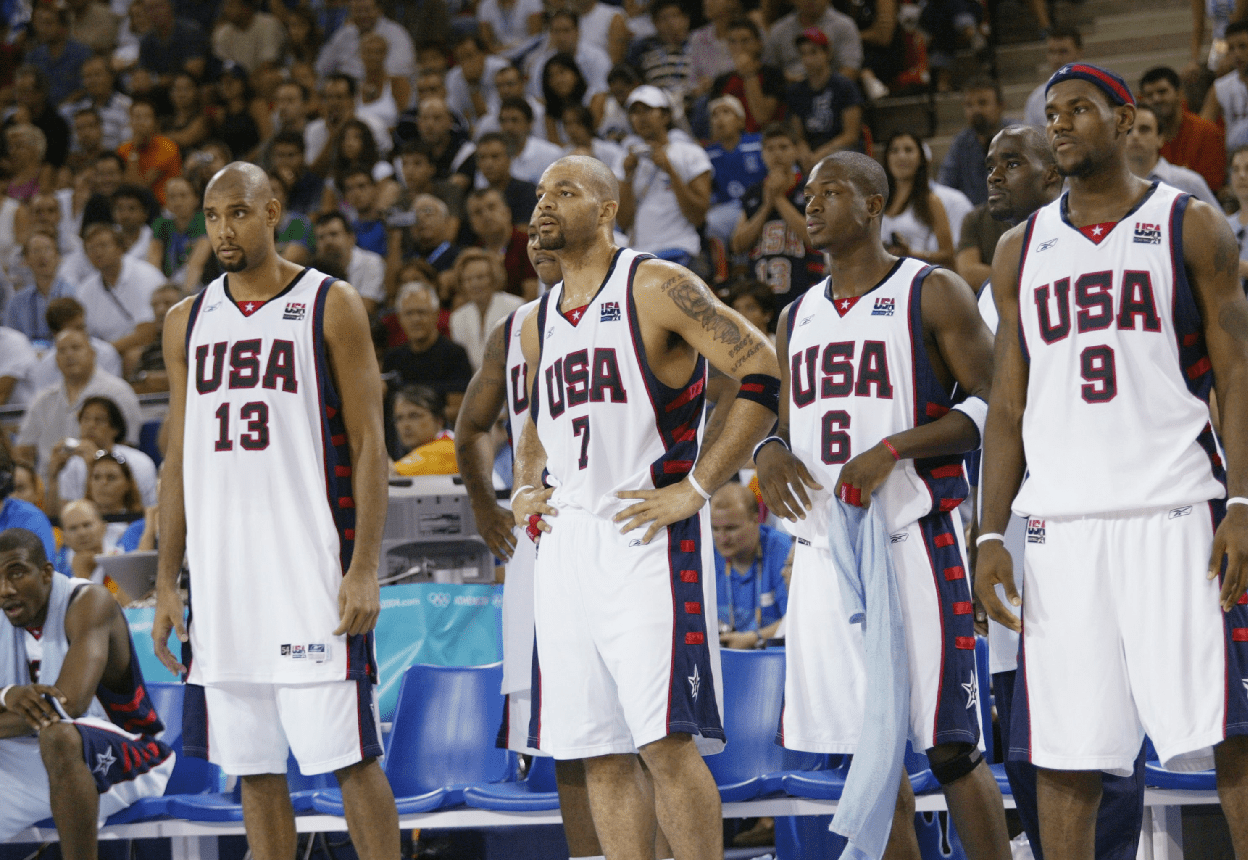
An occasion where they didn’t win the gold medal…
In 1988, the USA men’s basketball team would finish in third place at the Seoul Olympic Games, losing 76-82 to the Soviet Union in the semi-finals. A bronze medal in basketball would be termed a success by most Olympic nations. However, an Olympic bronze medal was viewed as an immediate crisis for anyone associated with USA Basketball. The Seoul Games would constitute only the second time since basketball’s inception as an Olympic sport in 1936 that the men’s competition had not ended with a United States victory.
Every time the USA fails to win the men’s basketball gold medal at an Olympic Games, the wider sporting world views this failure as a massive upset, with an inquest beginning shortly afterwards. After a controversial defeat to the USSR in 1972 and the US’s boycott of the Moscow Games in 1980, the team’s third-place finish in Seoul would lead to a review of which players were allowed to represent their country in the Olympic Games. At the time, basketball was still treated as an amateur sport by the IOC and the sport’s governing body FIBA. In 1988, the International Basketball Federation (FIBA) did not allow players from the NBA to participate in the Olympic Games, meaning that the USA basketball team in Seoul was solely comprised of collegiate players.
One year later, FIBA would reverse their previous decision, voting in a rule change that would give Olympic basketball professional status. Subsequently, at the 1992 Olympic Games in Barcelona, a USA team comprised of Michael Jordan, Larry Bird, Charles Barkley, Magic Johnson, Patrick Ewing, Scottie Pippen, and Karl Malone (amongst others) would dominate the men’s basketball competition, putting 100+ points on every opponent and winning every match by an average of 44 points. The squad christened ‘The Dream Team’ would defeat Croatia 117-85 on 8th August 1992 to win back the Olympic gold medal and create an unforgettable moment in Olympics history.
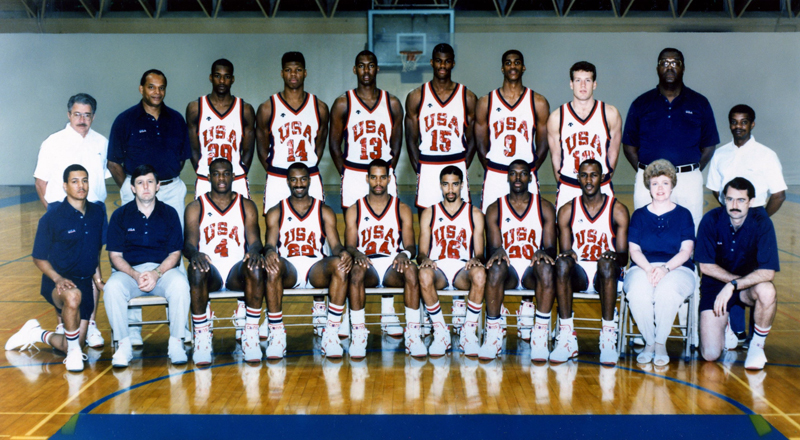
1988 USA Olympic Men’s Basketball Team: (Back row) Stacey Augmon, J.R. Reid, Danny Manning, David Robinson, Charles Smith, Dan Majerle (Front row) Mitch Richmond, Hersey Hawkins, Bimbo Coles, Charles Smith, Jeff Grayer, Willie Anderson 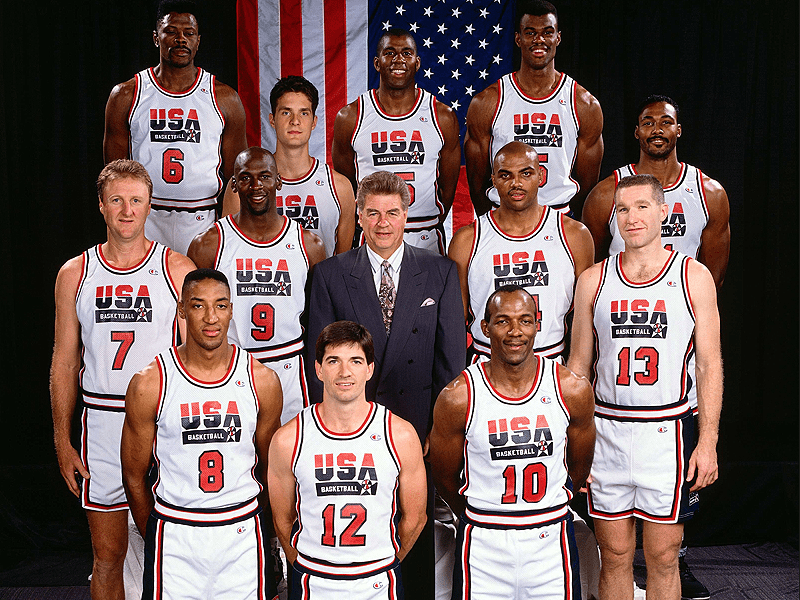
The 1992 Olympic ‘Dream Team’ (L to R): (Front Row) Scottie Pippen, John Stockton, Clyde Drexler (Middle row) Larry Bird, Michael Jordan, Chuck Daly (coach), Charles Barkley, Chris Mullin (Back row) Patrick Ewing, Christian Laettner, Magic Johnson, David Robinson, Karl Malone
Since the Dream Team’s birth in 1992, the USA has returned to dominate the Olympic men’s basketball tournament once more, winning seven out of eight possible gold medals. However, during this incredible run, there was one other occasion where the United States did not stand on the top step of the Olympic podium. This particular situation would occur at the 2004 Olympic Games in Athens, where a USA team lacking in star power and international experience would produce what would later be termed as the United States ‘worst-ever Olympic performance’. As I previously mentioned, every time the US men’s basketball team fails to win the gold medal, there is a huge reaction to ensure that such injustice does not happen again anytime soon. In today’s article, you will understand why the heavily-favoured US basketball team sent to the 2004 Olympic Games in Athens would end the tournament dubbed ‘The Nightmare Team’.
The Build-Up
The 2003-04 NBA season would end with Eastern Conference champion Detroit Pistons thrashing Western Conference champion Los Angeles Lakers 4-1 in the NBA Finals to win the Larry O’Brien Championship Trophy for the first time since 1990. After this victory, Pistons head coach Larry Brown would begin his other job, coaching the United States basketball team for the 2004 Olympics in Athens. However, despite the result of the NBA Finals, the 12-team US squad selected for the Olympics would contain zero players from either the LA Lakers or the Detroit Pistons or even losing conference finalists Indiana Pacers and the Minnesota Timberwolves. Lakers megastars Kobe Bryant and Shaquille O’Neal (a gold medallist in 1996) would pass up the opportunity to compete in Greece, while Pistons Chauncey Billups, Darvin Ham and brothers Ben and Rasheed Wallace would also evade selection. Similarly absent from Larry Brown’s squad were league MVP Kevin Garnett, top scorer Tracy McGrady, Defensive Player of the Year Ron Artest and Sixth Man of the Year Antawn Jamison.
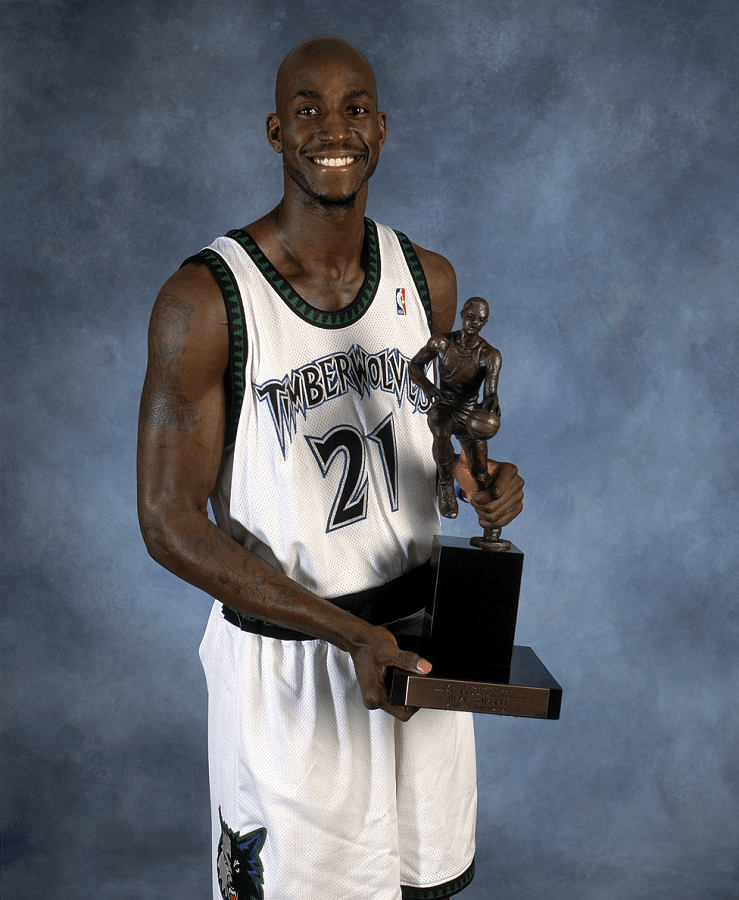
2003-04 NBA Season MVP Kevin Garnett (c) Twitter-NBA History 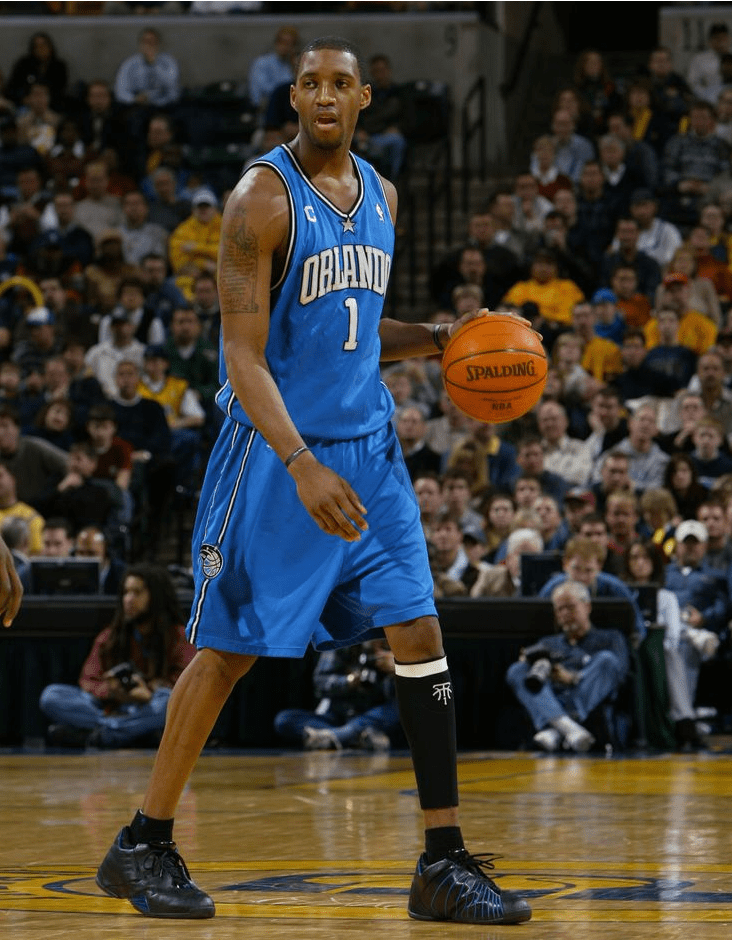
2003-04 NBA Top Scorer Tracy McGrady (c) Pinterest 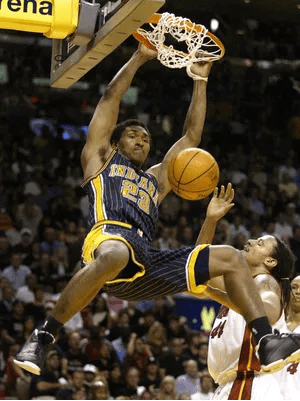
2003-04 NBA Defensive Player of the Year Ron Artest (c) IndyStar 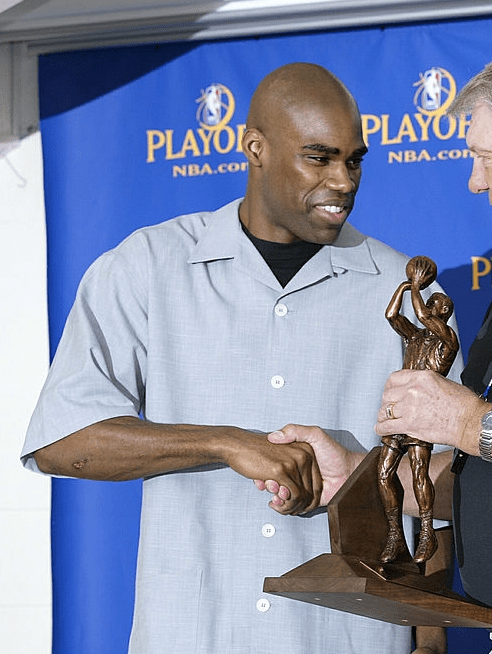
2003-04 NBA Sixth Man of the Year Antawn Jamison (c) NBA.com 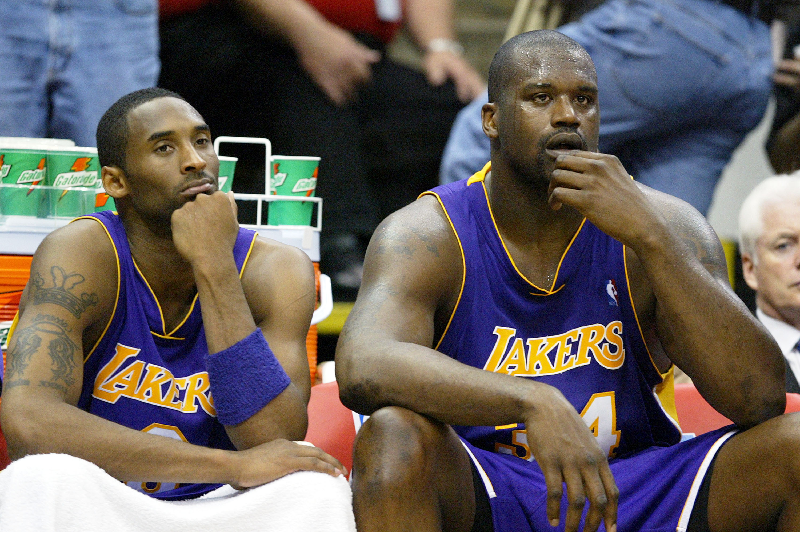
Kobe Bryant and Shaquille O’Neal (c) Bleacher Report 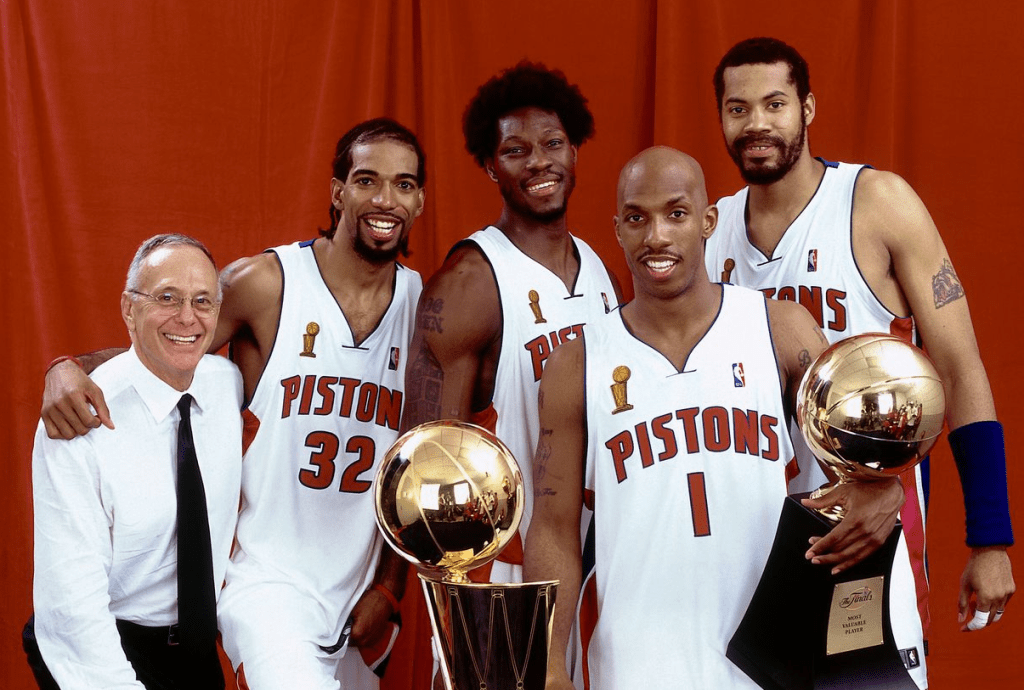
2003-04 NBA Champions Detroit Pistons (c) Detroit Bad Boys
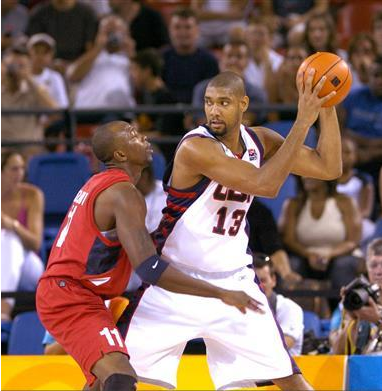
In fact, just two members of the 2004 US Olympic men’s basketball team had played in the NBA All-Star Game earlier that year, a record low for the US Team since the beginning of the ‘Dream Team’ era. These two All-Stars, Allan Iverson, 29, of the Philadelphia 76ers and Tim Duncan, 28, of the San Antonio Spurs, would also be the two oldest and most experienced members of the Olympic squad. Perhaps due to the above reasons, Larry Brown would select both Iverson and Duncan to serve as the team’s co-captains for the Games.
Iverson and Duncan (along with Richard Jefferson) were the only members of the Athens squad who had helped the USA qualify for the 2004 Olympics by winning the 2003 FIBA Tournament of the Americas. Other members of that squad, including Vince Carter, Jason Kidd, Ray Allen, Tracy McGrady, and Jermaine O’Neal, would choose not to return to the side one year later. Tim Duncan would also be the only member of the 2004 Olympic squad to make a season-ending All-NBA team, having made the All-NBA First Team and the All-NBA Defensive Second Team. This statistic was another record low for the US team during the professional era.
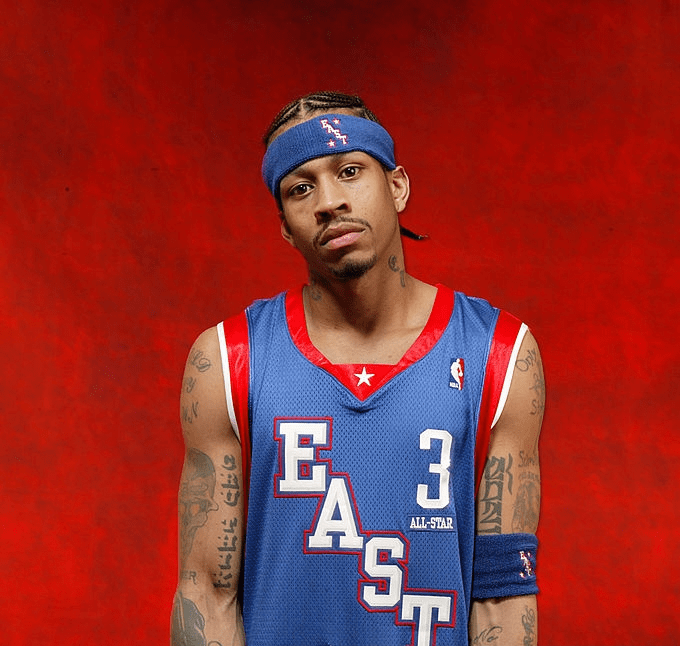
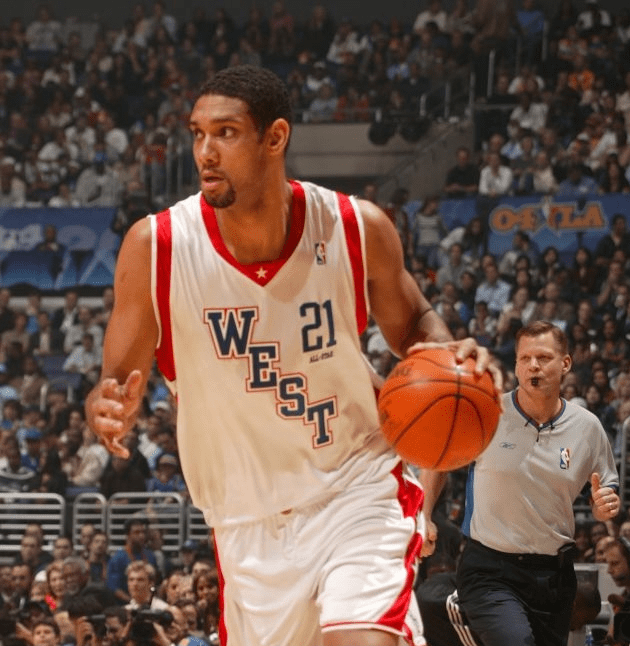
Allen Iverson and Tim Duncan aside, the 12-man American squad selected for Athens severely lacked professional basketball experience. Four squad members (Dwyane Wade, Emeka Okafor, Carmelo Anthony and LeBron James) had just completed their rookie NBA season, and Carlos Boozer and Amar’e Stoudemire had just two seasons of league experience under their belts with the Cleveland Cavaliers and the Phoenix Suns.
However, despite their lack of experience at the senior level, this batch of rookies were no ringers when it came to their abilities on the court. Wade, James, and Anthony had all featured in the NBA’s 2003-04 All-Rookie First Team. In addition, LeBron James, the first pick in the 2003 NBA draft aged 18, would shine during his debut season, ending it with the coveted Rookie of the Year award.

However, the USA national team would not head into the 2004 Athens Olympics in good form. In 2002, a US team featuring four recent NBA All-Stars (Baron Davis, Elton Brand, Ben Wallace, Paul Pierce) and led by the ageing Antonio Davis (33) and Reggie Miller (36) would travel to Indianapolis for the FIBA World Championship. On another occasion in which the NBA’s biggest stars would pass up the opportunity to represent their country at a home tournament, the host nation would top their preliminary group with an unbeaten record, comfortably beating Algeria (110-60), Germany (104-87) and China (84-65) to set up a quarter-final with the Federal Republic of Yugoslavia, the future Serbia and Montenegro.
However, despite the talent available for the United States and their impressive form in the competition thus far, the team would surprisingly come undone against a Yugoslavia squad led by 3-time NBA All-Star Peja Stojaković and featuring six active NBA players. In the Conseco Fieldhouse, 5,362 spectators would see Indiana Pacers Reggie Miller (19 points, seven assists) and Jermaine O’Neal (eight rebounds) lead the USA’s statistics on the night. However, Sacramento Kings Peja Stojaković and Vlade Divac would help the Yugoslavians come from a 58-52 third-quarter deficit to earn a shocking 81-78 victory and progress to the semi-finals. With this quarter-final defeat, the USA had failed to make a medal match at the FIBA World Championship for the first time since 1978. George Karl’s team would eventually finish 6th in the tournament after losing 75-81 to Spain in the 5th-place play-off match.
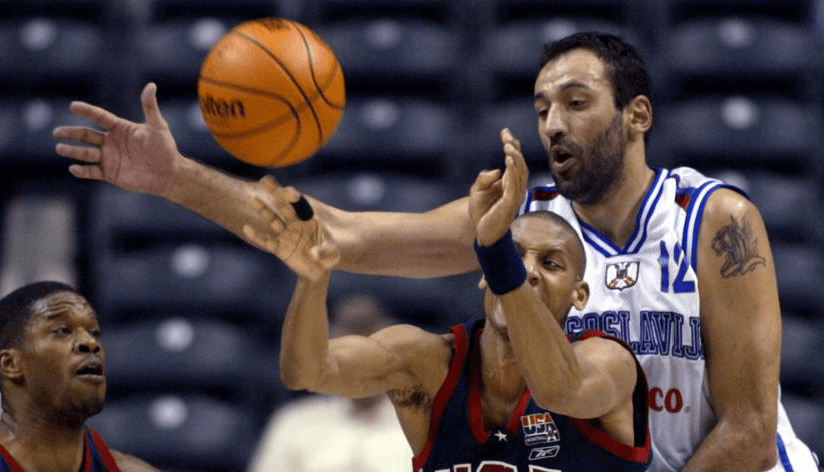
Following the poor performance at the FIBA World Cup, the national team selectors would manage to convince some of the bigger-name NBA players to return for the 2003 Tournament of the Americas and help the team qualify for the 2004 Olympics. However, despite leading the team to victory and earning Olympic qualification, many of these big-name players would resist the opportunity to return for the Olympics proper in 2004.
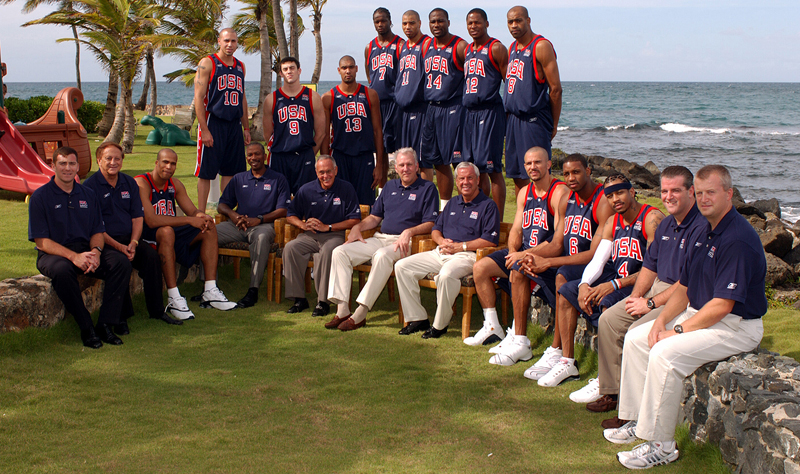
2004 USA Olympic Basketball Squad
| Position | Number | Player | Club |
|---|---|---|---|
| Guard | 4 | Allen Iverson | Philadelphia 76ers |
| Guard | 5 | Stephon Marbury | New York Knicks |
| Guard | 6 | Dwyane Wade | Miami Heat |
| Guard | 15 | Richard Jefferson | New Jersey Nets |
| Forward | 7 | Carlos Boozer | Cleveland Cavaliers |
| Forward | 8 | Carmelo Anthony | Denver Nuggets |
| Forward | 9 | LeBron James | Cleveland Cavaliers |
| Forward | 11 | Shawn Marion | Phoenix Suns |
| Forward | 13 | Tim Duncan | San Antonio Spurs |
| Forward | 14 | Lamar Odom | Miami Heat |
| Centre | 10 | Emeka Okafor | Charlotte Bobcats |
| Centre | 12 | Amar’e Stoudemire | Phoenix Suns |
2004 Olympic Games-Qualification
Twelve teams would take part in the 2004 Olympic men’s basketball tournament. Greece would qualify as the host nation, while Serbia and Montenegro would win the 2002 FIBA World Championship to earn their place in Athens two years before any other team. Aside from these two countries, the other ten competitors would need to either win or medal at their regional championships to qualify for the tournament in Athens. Three teams would come from America and Europe, two would come from Oceania and Africa, and one would come from both Asia and Africa. Angola would defeat Nigeria 85-65 to earn the solo spot from the African zone, while hosts China would beat South Korea 106-96 to win the spot for Asia.
In August 2003, the United States would easily triumph 106-73 over Argentina to win the FIBA Tournament of the Americas. Both teams would qualify for the Olympics along with bronze medallists Puerto Rico. Two weeks later, Lithuania, Spain and Italy would qualify from the European zone through the EuroBasket tournament, with Lithuania defeating the Spanish 93-84 in a close-fought final. Two points would separate France and Italy in the bronze medal match on the same day, with the Italians prevailing 69-67 to earn the final Olympic spot. Finally, Australia and New Zealand would earn their Olympic spots without any trouble at all, being the only two teams to participate in the FIBA Oceania Championship in Geelong, Victoria. This competition would take the form of a best-of-five series between the two teams, which would end in a 3-0 win for the Aussies.
2004 Olympic Games
Format
The twelve countries would begin by taking part in a preliminary round, where the teams would separate into two groups of six. Each team would play five matches against the rest of the teams in their section, with the top four in each pool progressing to the knockout stages. The knockout rounds would comprise three stages, with the potential gold medal winners playing quarter-finals, semi-finals and the gold medal final. The losing semi-finalists would compete for the bronze medal in a third-place playoff played on the same day as the final.
Pre-tournament
In the weeks leading up to the 2004 Olympics, the USA men’s team would play a series of five exhibition matches. These matches (mostly played against European sides) would hopefully give Larry Brown’s young squad the chance to gel while providing the best preparation for the country’s latest tilt at bringing home yet another basketball gold medal.
In their first exhibition match on 31st July 2004, the USA would comfortably beat Puerto Rico 96-71, the team that coincidentally would serve as their first opponents in the Olympics group stages. However, in their next match four days later, Team USA would suffer a headline-grabbing loss to Italy. In Cologne on 3rd August, the Italians would defeat Larry Brown’s team 95-78, exacting the largest margin ever suffered by a USA men’s basketball squad since NBA players were first allowed to represent the team in 1992. Two days after this shocking turnaround, a last-minute Allen Iverson buzzer-beater was required to give the USA a tight 80-77 victory over Germany, a team that would not be participating in the upcoming Olympic tournament.
After two unconvincing displays in Cologne, Team USA would leave Germany and travel to Belgrade to face Serbia and Montenegro. On 6th August, Larry Brown’s team would defeat the world champions 78-60, avenging the quarter-final defeat from the FIBA World Championship two years earlier. After this comforting victory, Team USA would conclude their Olympic preparations with a double-header against Turkey in Istanbul. However, if the team wanted to convince any potential doubters that the Italy defeat was nothing more than an off-day, the USA would struggle to a pair of nervous wins (79-67, 80-68) over a Turkey team that had also failed to qualify for the Olympics.
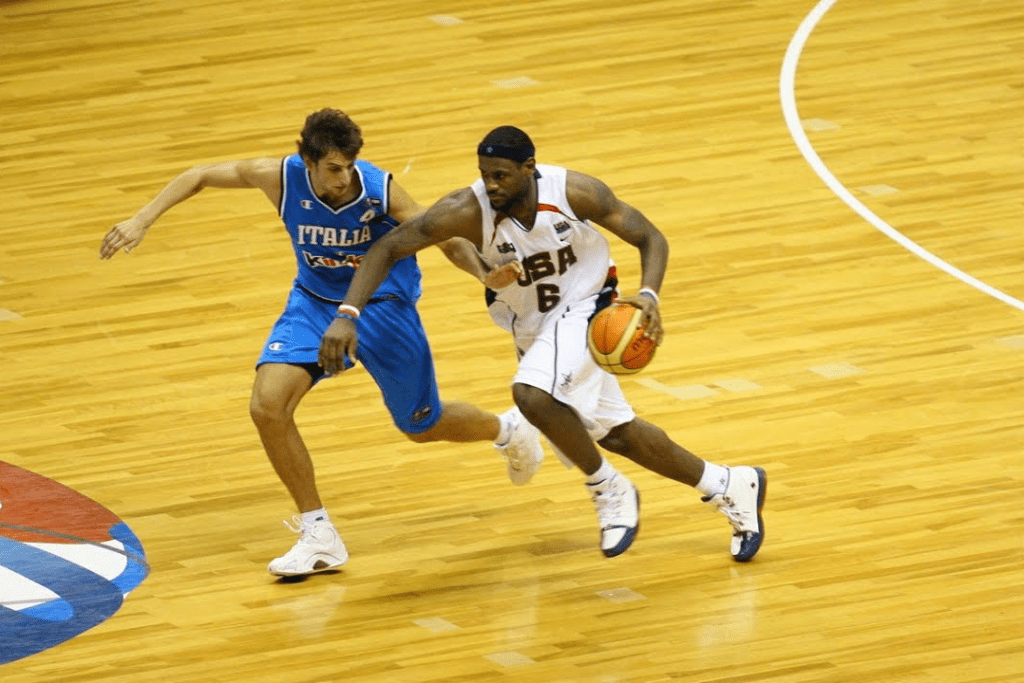
After these exhibition matches, noted Washington Post columnist Michael Wilbon would write, “So, the Olympics haven’t even started, yet the number one question seems to be, ‘What in the world is wrong with the men’s basketball team?’
“The U.S. team, coached by Larry Brown and featuring Tim Duncan and Allen Iverson, has lost an exhibition by 17 points to Italy, which doesn’t have one NBA player on its roster. Then the U.S. team needed a three-pointer at the buzzer to beat Germany, which did not qualify for the Olympics. A couple of nights ago in Istanbul, the U.S. team struggled to beat Turkey, which was without its best player, Orlando Magic forward Hedo Turkoglu. On Tuesday, the United States beat Turkey, 80-68, pulling away in the fourth quarter as the crowd jeered and whistled.
“Iverson said the loss to Italy should serve as a wake-up call for the Americans. I agree with Iverson. But it also served as a wake-up call to everybody else that there are teams in the Olympic tournament that can beat the United States.” (Michael Wilbon, Washington Post, 10th August 2004)
Even at this stage, there were some home-based journalists that were starting to get edgy regarding the USA’s chances of retaining their Olympic title in Athens, a campaign that was set to begin in just five days’ time.
Group Stages
In the preliminary round, Group A would feature world champions Serbia and Montenegro, New Zealand, Argentina, Spain, Italy, and China. Meanwhile, Group B would find defending champions United States drawn with hosts Greece, Oceanian champion Australia, European champion Lithuania, African champion Angola and Puerto Rico.
USA vs Puerto Rico
After less-than-stellar pre-tournament preparations, the USA would begin their 2004 Olympic campaign against Puerto Rico on 15th August 2004. However, the defending champions and gold medal favourites would get off to a bad start, losing 92-73 to a team they had defeated 96-71 just over two weeks earlier. After a close first quarter edged by Los Gallos (21-20), Puerto Rico would comfortably win a decisive second period 28-7 to take a 49-27 half-time lead. The United States would recover to take the third quarter 21-16 and bring the score back to 65-48, but Julio Toro’s team would edge a close fourth-quarter 27-25 and produce one of the biggest upsets in the history of the Olympics. For the first time since professional players were allowed to compete in the Olympics, the USA had lost a match, ending a 24-match unbeaten run dating back to 1988.
In this shock defeat for the USA, Tim Duncan would shine amidst a poor performance, topping the team’s standings in points (15, shared with Allan Iverson), rebounds (16) and assists (4). However, this opening group-stage match would belong to Carlos Arroyo. The Utah Jazz point guard would steal the show for Puerto Rico, producing seven assists and shooting nine out of sixteen field goal attempts for a game-high 24 points. With this performance, Arroyo would come away from this match knowing that he had helped his country inflict the heaviest competitive defeat in the history of the US basketball team.
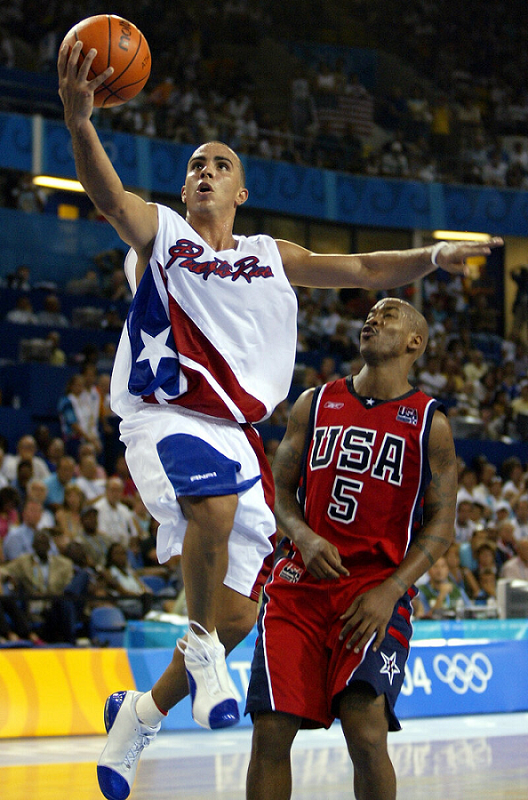
After the match, Helene Elliott would write in the LA Times: “In a hot, stuffy gym with exposed girders and blue plastic seats, far from the posses and palatial arenas to which its players are accustomed, the U.S. men’s Olympic basketball team lost its claim to international supremacy with a 92-73 loss Sunday to Puerto Rico.” (Helene Elliott, ‘U.S. Men’s Basketball Suffers Stunning Defeat’, Los Angeles Times, 16th August 2004)
USA vs Greece
Two days after the Puerto Rico loss, the United States returned to Helleniko Indoor Arena to face Greece in their second preliminary match. In this game, Larry Brown’s squad would return to winning ways but would need to work hard to defeat a Greek team that had reached the EuroBasket quarter-finals the previous year. Across four tightly-contested quarters (18-17, 19-14, 20-22, 20-18), a five-point difference in the second period would make the difference for the USA in a 77-71 victory. Allan Iverson would top score for the Americans with 17 points, Tim Duncan would follow close behind on thirteen points but provide nine rebounds, and Stephon Marbury would provide six assists. However, Lamar Odom would prove to be United States’s hero on the day. After blocking a shot that would have drawn the Greeks within two points with 18 seconds remaining, the Miami Heat forward would progress the ball up the court, earn a foul and land two free throws to seal the victory and spare American blushes. However, damning statistics of 4/21 three-pointers scored, 19 turnovers and 13 missed free throws would show that despite the victory, this USA men’s team was far from a ‘Dream Team’.

USA vs Australia
After two games, the defending champions were not exactly blowing the fans or the opposition away in Athens. The team would continue down this route when they defeated Australia 89-79 on 19th August. The United States would find itself behind at half-time to Australia but would show their quality in the final quarter and earn their second win of the group stage. The Australian team nicknamed ‘The Boomers’ (seriously) would threaten another upset win after winning the first quarter 31-21. However, the USA would recover from this poor start and chip away at their opponent’s lead as the game progressed. The US would win the second quarter 26-20 to reduce the scoreline deficit to four points and later edge the third period 18-16 to further halve Australia’s advantage. Finally, Larry Brown’s team would pull away in the final period, winning 24-12 to earn their second win in Group B.
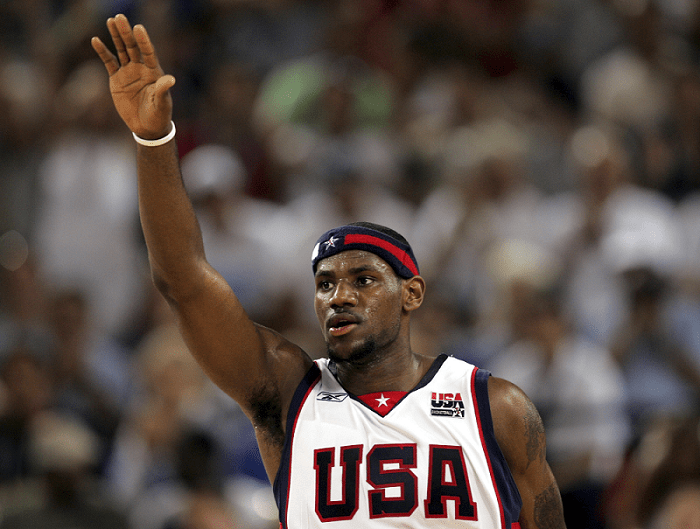
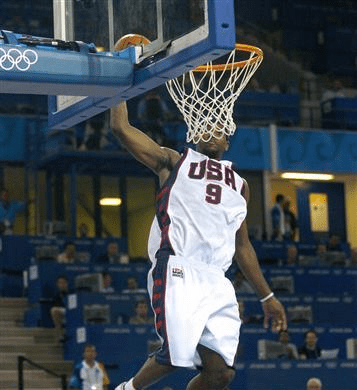
Once again, Tim Duncan would star for the USA, recording a game-high 18 points and 11 rebounds. Along with ‘The Big Fundamental’, Allan Iverson, Shawn Marion, and Dwyane Wade would also hit double figures for points. However, this group match would provide a platform for NBA Rookie of the Year LeBron James to show off his auspicious talents. In 18 minutes on the court, the 19-year-old James would score 4/8 field goal attempts (including two 3-pointers) and provide five assists in the United States’s victory.
USA vs Lithuania
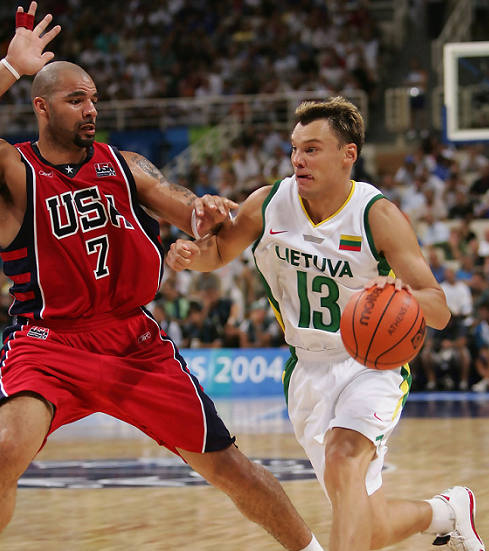
In Group B, Lithuania would provide the sternest test to the United States, having earned the bronze medal at the previous three Olympic Games. The team also entered the Olympics as the reigning EuroBasket champions. In the previous Olympic meeting between the two teams, the United States would edge out Lithuania 85-83 in the 2000 semi-finals in Sydney. In that match, Jason Kidd would hit a buzzer-beater free throw after a foul from Šarūnas Jasikevičius to advance the United States to their customary place in the Olympic final. In Athens, another tight game between the USA and Lithuania would end with the Eastern European team as the victors.
The USA would win the first two quarters 26-23 and 23-21, respectively, to lead by five points at the halfway stage (49-44). However, a 23-20 third quarter would see Lithuania cut the Olympic champions’ advantage to two points, and a 27-21 final period would see the European champions overhaul the Americans to win 94-90. Entering the competition without a defeat in three Olympic Games, the United States had now lost two out of their last three matches.
In the Lithuania match, shooting guard Richard Jefferson would recover from early shooting troubles to register 20 points against Lithuania, becoming the first US player to hit such a mark during the competition thus far. Tim Duncan would also continue his comparatively impressive form, providing 20 rebounds and 16 points in a 32-minute display, the most minutes of any American player. He would share this stat with Stephon Marbury, who would provide three assists and eight points, despite only managing to land two of his fourteen attempted field goals in the net.
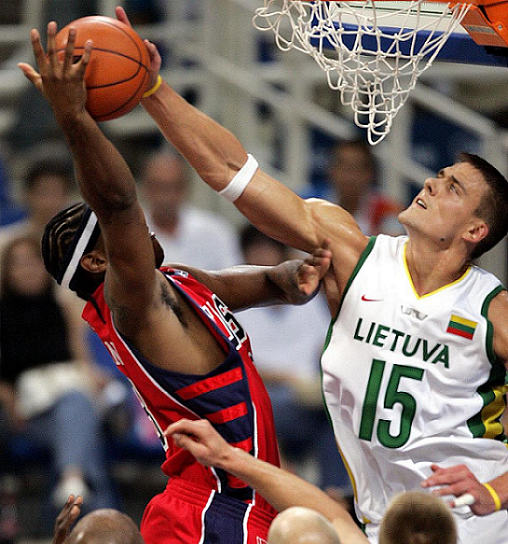
However, the day would belong to Šarūnas Jasikevičius, the man whose foul had led to Jason Kidd’s buzzer-beater free throw in Sydney. In this match, Jasikevičius would exorcise those demons from four years earlier by producing a standout display. The 28-year-old point guard would score a tournament-high 28 points against Larry Brown’s men while also providing a game-high four assists to condemn the USA to their second defeat of the 2004 Olympic campaign. Now, Larry Brown and his team would need to defeat minnows Angola in their final match and hope that results going their way would guarantee them a spot in the knockout stages and as high a finish as possible in Group B.
USA vs Angola
Before facing the United States, Angola had lost all four group matches and conceded 332 points while only scoring 268. Even though the African side had run both Lithuania (73-78) and Puerto Rico (80-83) close, they had also lost more convincingly to Australia (59-83) and Greece (56-88). However, very few people expected Angola to break their winless streak against the USA on 23rd August 2004.
In their final Group B match, the United States would earn their most convincing victory thus far, defeating Angola 89-53. In this game, Larry Brown would spread the playing minutes around his twelve-man squad, with only LeBron James (29) and Dwyane Wade (23) playing more than 20 minutes on the court. Brown’s rotation of his players would pay off, with the USA wrapping up a convincing victory by the end of the third quarter. The team would build the score and improve as the match progressed, winning the first three quarters by increasing seven (21-14), eleven (23-12) and sixteen-point (29-13) margins.
Despite playing just 13 minutes, Tim Duncan would continue as the leading light of this USA team, scoring 6/10 field goal attempts and 3/4 free throws to finish with 15 points. Carlos Boozer would also impress with nine rebounds in an 11-point display, as would LeBron James. Playing a team-high 29 minutes, James would again show the talents that saw himself selected 1st in the most recent NBA draft, providing four rebounds, four turnovers, five assists and hitting all five of his attempted field goals (including one three-pointer) to finish with 11 points.
After small victories over Greece (77-71) and Australia (89-79), the 89-53 victory over Angola was the closest thing to a traditional USA Olympic performance that the 2004 team had managed to achieve by this point in the tournament. With expectations understandably running high considering the country’s Olympic basketball history, a comfortable win over Angola in their final group game was just what the doctor ordered after an underwhelming group stage performance. With three wins and two defeats from five matches, the United States would end Group B in fourth place, occupying the final qualifying spot after losing out on a points-per-game tiebreaker to Greece (2nd) and Puerto Rico (3rd). Due to the layout of the knockout stage brackets, the USA would now face Group A winners Spain in the quarter-finals.
2004 Olympics Men’s Basketball Group B Table
| Country | Wins | Losses | Points For | Points Against | PD | Points |
|---|---|---|---|---|---|---|
| Lithuania | 5 | 0 | 468 | 414 | +54 | 10 |
| Greece | 3 | 2 | 389 | 343 | +46 | 8 |
| Puerto Rico | 3 | 2 | 410 | 411 | -1 | 8 |
| USA | 3 | 2 | 418 | 389 | +29 | 8 |
| Australia | 1 | 4 | 383 | 411 | -28 | 2 |
| Angola | 0 | 5 | 321 | 421 | -100 | 0 |
Quarter-Final: USA vs Spain
In their entire Olympic history before 2004, the Spanish Olympic men’s basketball team had only achieved one medal in nine appearances: a silver medal behind college students Michael Jordan and Patrick Ewing in 1984. Apart from this, Spain did not have the best record in the competition, reaching the knockout stages on just two other occasions in 1980 (4th place) and 1988 (Quarter-finals). However, the team would enter the 2004 Olympics in good form, earning a silver medal behind Lithuania in the 2003 EuroBasket. They would carry this good form into Group A, winning all five preliminary matches against China (83-58), Argentina (87-76), Italy (71-63), Serbia and Montenegro (76-68) and New Zealand (88-84). Coached by Mario Pesquera, Spain now looked strong favourites to add to their singular Olympic medal. However, they would still need to get past the defending champions USA in the quarter-finals.
Spain had never beaten the USA in the Olympics, and the USA had never lost an Olympic quarter-final. In their last Olympic meeting, John Thompson’s United States’ team would defeat Antonio Diaz-Miguel’s Spanish side 97-53 in the 1988 group stages. The most recent meeting between these two sides would also occur in Athens, as a US team coached by Rudy Tomjanovich would edge a 75-73 contest with Spain in the second group stage of the 1998 FIBA World Cup. History may have been against Spain heading into the 2004 quarter-final. Still, they were about to face a United States team that had stuttered their way through the preliminary round without ever really showing their true quality. Spain also had Memphis Grizzlies power forward Pau Gasol at their disposal. The 24-year-old had seriously impressed in the group stages, scoring 20+ points on two occasions, against China (21) and Argentina (26), a statistic which none of the United States players had managed.
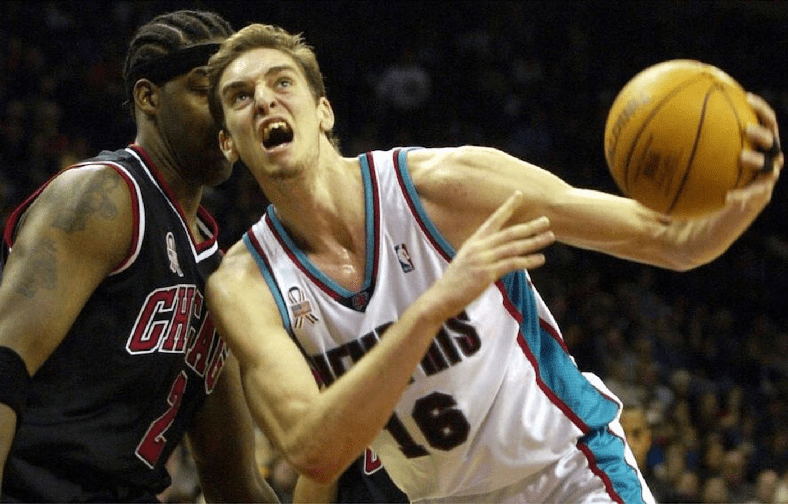
In the Olympic Indoor Hall on 26th August 2004, 14,500 spectators would witness a classic match. In all but one quarter, both teams would score over 20 points, and all but one quarter would be decided by or point or fewer. One quarter would even end in a draw. However, the third quarter would ultimately decide the fate of this Olympic quarter-final. After a 25-25 tie in the first quarter and edging the second period 19-18, the United States would win the third quarter 30-24 to take a seven-point margin into the final 12 minutes of action. The USA would not relinquish their lead in the final quarter, beating Spain 102-94 to progress to another Olympic semi-final.
Despite ending up on the losing side, Pau Gasol would leave his best performance for last, scoring 29 points against the defending Olympic champions to end his tournament with an average of 22.3 points per game. However, Stephon Marbury would outshine the Memphis Grizzlies forward by becoming the only second US player in Olympic history, after Charles Barkley in 1992, to score 30 points in a single match. In addition, only China’s Yao Ming (39 against New Zealand) had scored more points than the 31 points scored by Stephon Marbury against Spain. Marbury would land 10 out of 15 field goals, including six three-pointers, and successfully add five out of six free throws to end at this high score. Marbury would also top the assist charts with four, along with Allen Iverson, who would also hit three 3-pointers in a 16-point display. Meanwhile, Shawn Marion and Lamar Odom would provide six rebounds (including four offensive rebounds from Odom), and every US team member (except for LeBron James) would end up on the scoreboard.
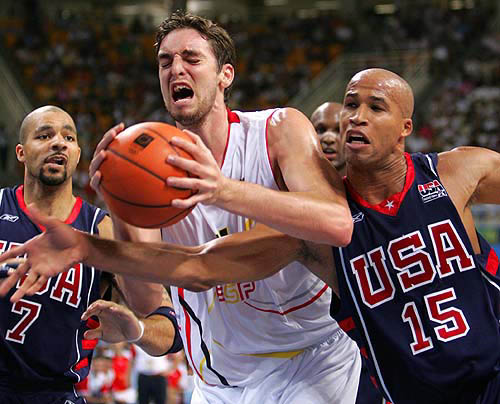
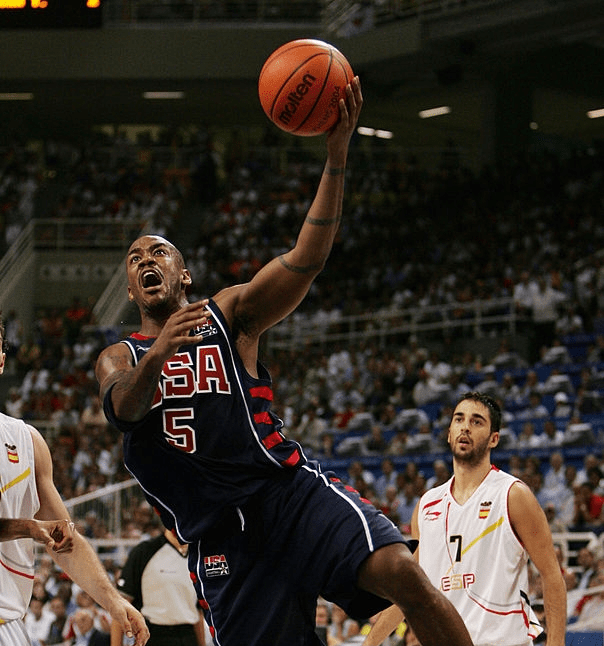
After a less-than-impressive group stage, Larry Brown’s team had finally arrived at the 2004 Olympics. Even though this was not a vintage USA team, they had done enough to avoid a shock quarter-final exit and beat a talented Spain team to reach another Olympic semi-final. Once again, the USA were one step away from another Olympic final and a shot at gold. However, the preceding semi-final match would be anything but easy.
Semi-Final: United States vs Argentina
In their 15th Olympic semi-final, the USA would face Argentina, the country they had defeated by 33 points to win the 2003 Tournament of the Americas. Only three members (Allan Iverson, Tim Duncan, Richard Jefferson) of the twelve-man USA squad that beat Argentina in that final would return to face Rubén Magnano’s side twelve months later. On the other side, seven members of the Argentina team that lost in that gold medal match in San Juan would return for this semi-final rematch, including San Antonio Spurs shooting guard Manu Ginóbili. The winner of this encounter would face either Italy or Lithuania in the gold medal match. The USA had only ever lost one Olympic semi-final (in 1988). At the same time, Argentina had never won one, coincidentally losing 85-76 to the USA in their previous semi-final appearance at Helsinki 1952. With history against them, Argentina would look to break new ground on 27th August 2004.
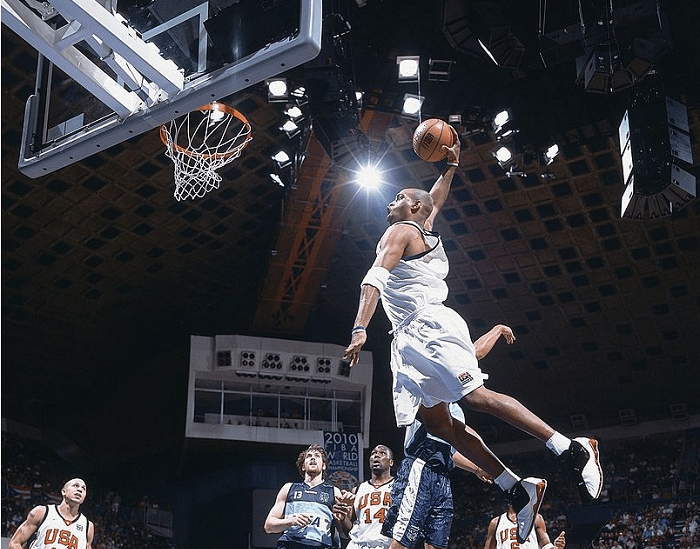
Despite possessing less experience at this stage than their seasoned US opponents, Argentina would win the first quarter of the semi-final 24-20. A closer second period would also end in Argentina’s favour (19-18), with Rubén Magnano’s team holding a five-point 43-38 advantage at the halfway point of the match. With Argentina turning over the ball more than the USA and landing a greater proportion of their shots, the Argentine players enjoyed themselves in this semi-final without becoming too complacent. After besting the defending champions in the first half, the Argentines would win the third quarter 27-19 to extend their advantage out to 13 points (70-57) ahead of the final 12 minutes. Knowing their chance of another Olympic gold medal now hung in the balance and predicting the potential response back home if the worst occurred, the USA would launch a response in the final quarter. However, despite winning the final period 24-19, this US reaction would come too little, too late. Despite more than halving Argentina’s lead in this final quarter, El Alma Argentina would hold on to win this semi-final 89-81, defeating the USA and guaranteeing a new Olympic men’s basketball champion.
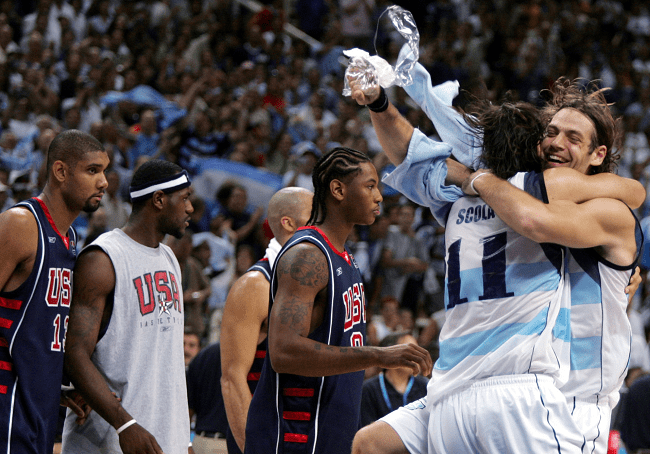
As had been their problem in their other defeats during this Olympic competition, poor shooting accuracy would partially be the USA’s undoing in this semi-final defeat to Argentina. The USA and Argentina would score the same amount of shots throughout the game (32), but the USA would attempt 77 shots to Argentina’s 59. On the day, Stephon Marbury would be the only American player to land more than 50% of his shots, hitting 8 out of 15 field-goal attempts (53%) plus two free throws to top score for the USA with 18 points. On the other end of the scale, Lamar Odom (6/12), Shawn Marion (4/10), Allen Iverson (3/12), Dwyane Wade (1/8) and even the normally-reliable Tim Duncan (4/8) were all wasteful in their shot-taking through the 48 minutes. At the same time, LeBron James (3 points, 3 minutes) and Amar’e Stoudemire (0 points, 2 minutes) could only watch from the bench as their teammates continually failed to find the inside of the basket. However, Tim Duncan’s San Antonio Spurs teammate Manu Ginóbili would shine for Argentina, hitting 29 points, four 3-pointers (more than all the USA players combined) and seven free throws in a 32-minute display on the court.
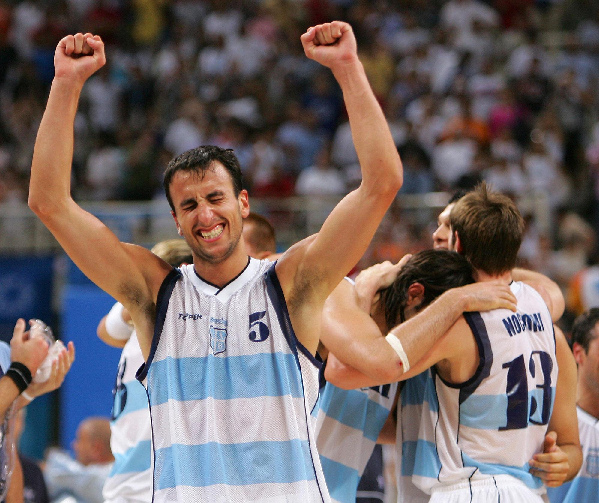
The USA would attempt more total (37) and offensive (17) rebounds than Argentina, with Carlos Boozer and Lamar Odom providing nine and eight. The Americans would even steal the ball on thirteen occasions compared to Argentina’s nine. However, they could not turn their superiority in these statistics into the points that mattered, and Argentina’s 20 ball turnovers and 18 assists showed a more complete side that would better the US in defence and attack to reach a first-ever Olympic basketball final and earn the country’s first medal in the sport.
After the match, Manu Ginóbili would say about Argentina’s victory: “In 1992, the USA had the best players ever. Here they are great players, too, but they are young, and they never played internationally, so with different rules, it’s a whole different thing. The rest of the world is getting better, and the States isn’t bringing their best players.”
A post-match LA Times article would mirror Ginóbili’s comments, stating: “The United States was not only beaten by Argentina, 89-81, but outplayed so thoroughly that the game is likely to serve as a focal point for those who believe the rest of the world has caught up in basketball.” (Bill Dwyre, ‘The Cradle of Basketball Gets Rocked at Olympics’, Los Angeles Times, 28th August 2004)
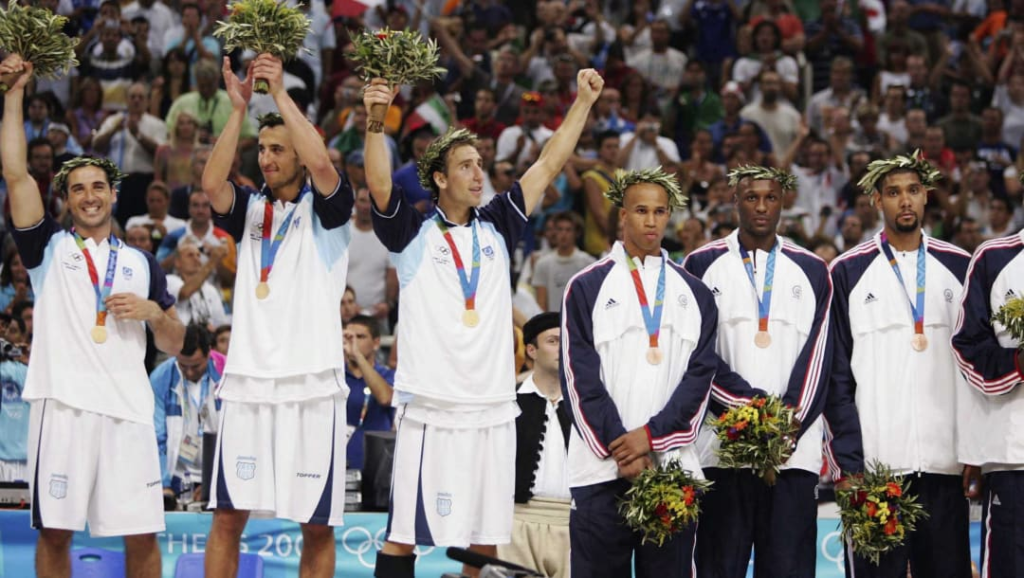
For the second time in their history, the USA would compete in the bronze medal match instead of their usual appearance in the Olympic final. More notably, for the first time since the birth of the ‘Dream Team’, the USA would not be the Olympic men’s basketball champions.
Bronze Medal Match: USA vs Lithuania
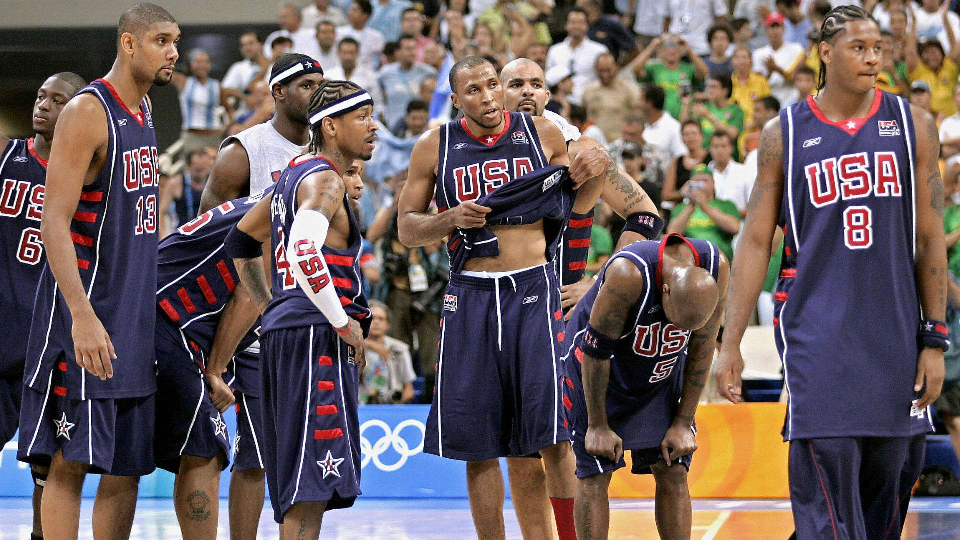
After their shocking exit at the hands of Argentina, the USA would face Lithuania in the bronze medal match at Athens 2004. While Larry Brown’s team were upset by Argentina in one semi-final, reigning EuroBasket champions Lithuania would lose 100-91 to Italy, with the Italians thus reaching their first Olympic final since 1980. This bronze-medal match would see the second meeting between the USA and Lithuania in this competition, with the Eastern European country triumphing 94-90 in the group stage encounter. The USA would now need to go through Antanas Sireika and his team to earn the minor medal. If the USA managed to avenge their earlier defeat to win the bronze, they would continue their 100% record of winning a medal in every Olympic men’s basketball competition they had competed in. However, a second loss to the Baltic giants would constitute the worst Olympic performance in the history of the USA men’s basketball team.
The first quarter would end in a 24-24 draw, showing the closeness in quality between these two countries. However, the USA would edge the next 12 minutes 25-20 to take a five-point lead at the halfway point. Lithuania would come back to narrow the US’s advantage to three points with just one quarter remaining. However, the Americans would shoot 30 points in this final quarter to beat Lithuania 104-96 and claim the bronze medal. Every member of the USA squad would hit the target during this game, with even LeBron James and Carmelo Anthony hitting six and three points during their seven minutes of play. Four US players would hit double figures, with Shawn Marion hitting 22 points for his best return of the competition. However, even in defeat, Lithuania would still land 21 three-pointers, with these three-point shots accounting for one-third of their overall field goals (63). Arvydas Macijauskas would hit seven of these in a 24-point display.
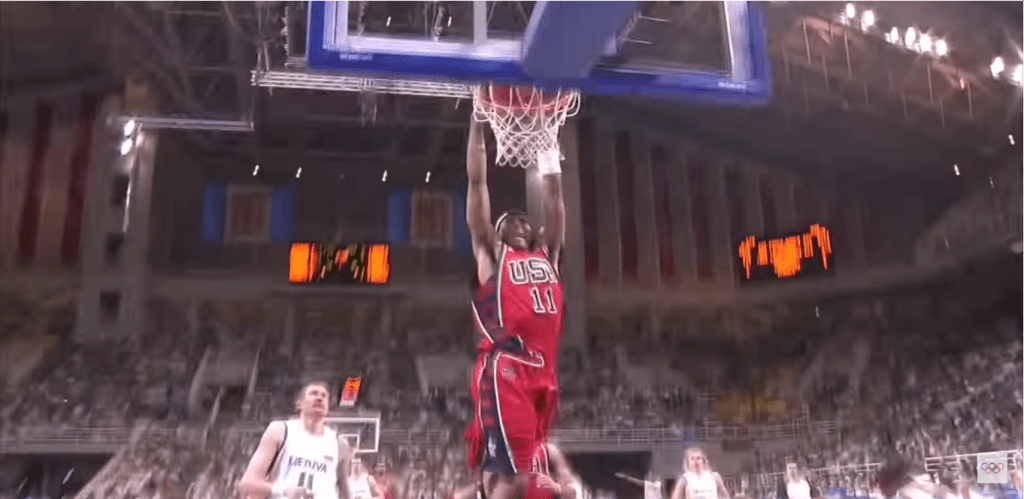
Crucially, the USA would win the bronze medal match in several key statistics. As well scoring more points than Lithuania, Larry Brown’s team would also register more successful field goals (36 to 32), successful free throws (24 to 11), offensive rebounds (20 to 7), assists (19 to 13), ball steals (13 to 4) and defensive blocks (4 to 2). Four American players would win more than five rebounds, with Carlos Boozer and Tim Duncan registering eight. Dwyane Wade and Lamar Odom would top the assists charts, making six and five, respectively. However, a lack of accuracy in front of the basket still partially remained, with the USA scoring 45.5% of their attempted 79 field goals compared to Lithuania’s 50.7% success rate from 63 shots. Therefore, even in victory, the team’s performance still left something to be desired. However, the now-former Olympic champions had done enough when it mattered and had still come away from an Olympic Games with a medal in men’s basketball, even if it wasn’t the one they and their fans were expecting.
In the 2004 Olympic men’s basketball final, Argentina would defeat Italy 84-69 to win their first-ever basketball gold medal. Luis Scola would score 25 points, landing 10/13 field goals, hitting 5/5 free throws and rebounding the ball eleven times. Manu Ginóbili would also end an impressive tournament with six rebounds, six assists and 16 points. At the time of writing, Argentina has won two more major tournaments since the 2004 Olympics: the 2011 FIBA AmeriCup (Tournament of the Americas) and the 2019 Pan American Games. However, they have not reached another Olympic men’s basketball final since winning the big one in Athens.
Aftermath
After the semi-final defeat to Argentina, ESPN would begin their match report with the following statement: ‘Bronze is the best the American men can do in basketball, and the reason is simple: A hastily assembled assortment of NBA stars couldn’t beat a better team — Argentina.
‘Their 19-point loss to Puerto Rico in the opener was shocking, and their second defeat, to Lithuania, finally hammered home a message to the team’s young players that the level of competition was a whole lot better than they had imagined.’
The Americans gave Argentina credit, but the fact remained that a big part of the U.S. team’s loss was its fundamental weaknesses: a lack of familiarity with each other, poor defense and abysmal outside shooting. It showed that the quarterfinal victory over Spain was an aberration, not an awakening.’ (AP, ESPN, 27th August 2004)
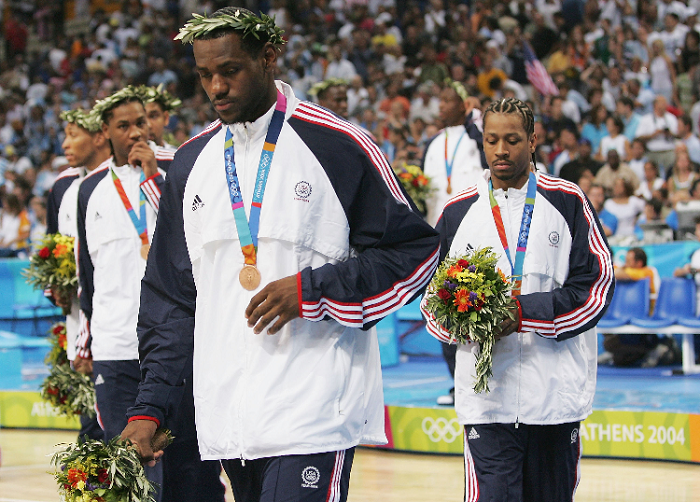
However, despite a disappointing tournament, many USA players would feature highly in the end-of-tournament statistics tables. Four would make the top 10 for rebounds per game, with Tim Duncan (4th, 9.1), Carlos Boozer (8th, 6.1), Shawn Marion (9th, 5.9) and Lamar Odom (10th, 5.8) all making the list. Stephon Marbury would rank 6th for assists, providing 3.4 per game. Dwyane Wade (2.1) and Lamar Odom (2.0) would finish 3rd and 4th for steals, and Tim Duncan would place 2nd for blocks with 1.4 per game. In another feather in Duncan’s cap, the power forward would rank No.1 for offensive rebounds, capping off an impressive tournament by the standards of the USA team. Larry Brown’s squad would also rank highly in a number of per-game statistics, ranking 2nd overall for points scored (88.1 per game) and topping the charts in rebounds (38.9 pg), assists (15.13 pg), blocks (3.45 pg) and steals (10.13 pg).
However, despite all their success in numerous statistical categories, two stats would suitably serve as emblems of the USA’s fortunes in Athens. The team would end the tournament finishing 7th (out of 12 teams) for shooting, having successfully shot just 45.9% of their field goals, and the team would also finish with the lowest amount of three-pointers made per game, scoring 5.5. In this Olympic men’s basketball competition, the USA were the Big Bad Wolf, a much-feared team who, despite their best efforts, would often end up huffing and puffing their way through matches with little reward. Despite creating plenty of attacking opportunities, the United States could not convert these shots into points, the things that really mattered at the end of the day.
USA Men’s Basketball Tournament Stats- 2004 Olympic Games
| Stat | Highest (Tournament ranking) |
|---|---|
| Minutes played | Allen Iverson 217 (10th) |
| Points | Allen Iverson 110 (12th) |
| Points per game | Allen Iverson 13.9 (12th) |
| Field goals made | Tim Duncan 38/67 (8th) |
| Field goal % | Lamar Odom 56.9% (29/51) (11th) |
| 3-pointers made | Allen Iverson 15/41 (=12th) |
| 3-point % (More than 10 attempts) | Allen Iverson 36.6% (27th) |
| Rebounds made | Tim Duncan 73 (1st) |
| Offensive Rebounds | Tim Duncan 36 (1st) |
| Assists | Stephon Marbury 27 (4th) |
| Blocks | Tim Duncan 10 (2nd) |
| Steals | Dwyane Wade 17 (2nd) |
If you thought that achieving the country’s joint-worst performance in an Olympic basketball tournament would lead to a response from selectors, executives, coaches and players alike and an immediate return to winning ways, you would be incorrect. One year after their Olympic disappointment, a USA team featuring just one active NBA player (Milwaukee Bucks guard Charlie Bell) would fail to successfully defend their Tournament of the Americas Championship, finishing 4th at the 2005 Championship. A 93-75 semi-final defeat to Brazil and a 93-83 bronze medal play-off defeat to Venezuela would see Morris McHone’s team leave the Dominican Republic without a medal.
Another year later, another semi-final defeat for the USA at a major basketball tournament. At the 2006 FIBA World Championship, a more star-studded United States team featuring the returning LeBron James, Dwyane Wade and Carmelo Anthony and talented rookies Chris Paul (NBA Rookie of the Year), Chris Bosh and Dwight Howard would win Group D with an unbeaten record. Impressive knockout victories over Australia (113-73) and Germany (85-65) would lead to a semi-final clash with reigning EuroBasket champions Greece. However, despite 25 points from Carmelo Anthony, 22 from Dwyane Wade and 15 from LeBron James, a great defence would see Greece knock out Mike Krzyzewski’s team in a 101-95 upset win. In the bronze medal match, the USA would avenge their Olympic semi-final defeat by defeating Argentina 96-81 in Saitama.
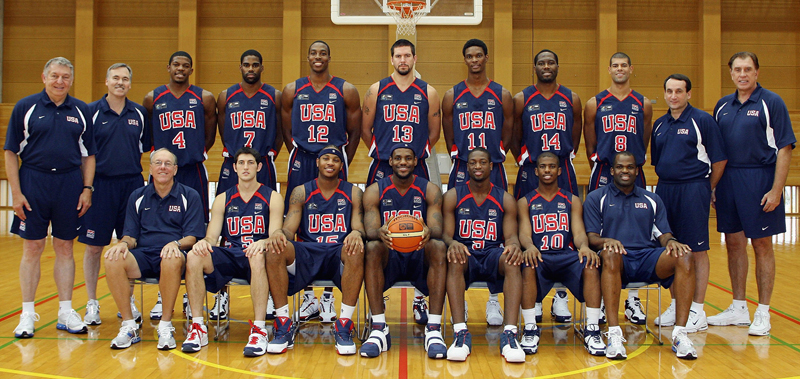
Now needing to qualify for the 2008 Beijing Olympics through the FIBA Americas Championship, many of the top NBA stars who had neglected the USA basketball team for years would turn out for the national side in Las Vegas. Along with LeBron James, Carmelo Anthony, Dwight Howard and Amar’e Stoudemire, multiple time NBA All-Stars Jason Kidd, Chauncey Billups and, biggest of all, Kobe Bryant would all join up to help the USA qualify for another Olympic Games. With their best team since the 2000 Olympics, Mike Krzyzewski’s team would blow away Venezuela (112-69), the Virgin Islands (123-59), Canada (113-63) and Brazil (113-76) to win Group D at a canter before doing the same to Mexico (127-100), Puerto Rico (117-78), Uruguay (118-79) and Argentina (91-76) in the quarter-finals. After beating Puerto Rico by 39 points in the quarter-final group, the USA would beat them by 44 points in the semi-finals to set up a rematch with Argentina in the final. Inside the Thomas & Mack Center, the USA would defeat Argentina 118-81 to reclaim the Americas Championship in style in a match that saw Kobe Bryant score 31 points and provide 14 assists.
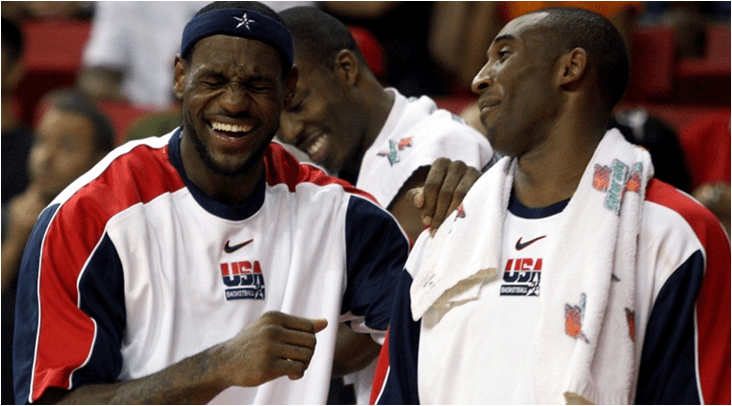
One year later, an American team now christened ‘The Redeem Team’ would travel to Beijing for the 2008 Olympic Games to win back the Olympic basketball gold medal and make amends for underwhelming performances at Athens 2004 and the 2006 FIBA World Championship. In Beijing, eight team members from the Americas Championship plus Dwyane Wade, Carlos Boozer, Chris Bosh and Chris Paul would top a preliminary group containing China, Angola, Greece, Spain and Germany with a 100% winning record. Next, the USA would easily defeat Australia 116-85 in the quarter-finals with James and Bryant starring. Then, Jason Kidd, Chris Bosh and Carmelo Anthony would step up in a 101-81 semi-final win over Argentina, avenging the defeat from Athens and delivering the USA to another Olympic men’s basketball final.
Finally, Mike Krzyzewski’s team would face Spain for the gold medal. In their closest match of the entire Olympic tournament, the USA would get off to a great start, winning the first two quarters to lead 69-61 at the halfway point. However, Spain would manage to keep their opponents within their sights, with three of the four 12-minute periods decided by two points or less. At one point in the final quarter, the Spanish would even cut the lead to two points and would later cut the US’s advantage to four with 2 minutes remaining. However, a late flurry from Dwyane Wade and Kobe Bryant would ensure a final score of 118-107 and another Olympic men’s basketball gold medal for the United States.
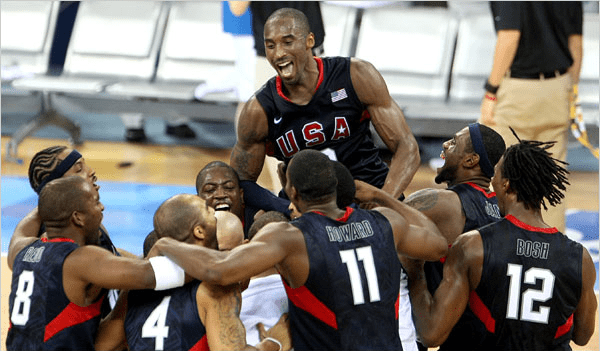
After Beijing, the USA national men’s basketball team would not fall into complacency, winning the next four major basketball tournaments. In addition to retaining their Olympic title at London 2012 and Rio 2016, the team would also win the 2010 FIBA World Championship, their first victory since 1994. They would also retain this title in 2014, assuring their spot atop the men’s international basketball summit.
After poor performances at the start of the 21st century, including the 2002 and 2006 FIBA World Championships and the 2004 Olympics, many of the NBA’s top homegrown stars would get serious and show the same desire about competing for the national team that the ‘Dream Team’ originally had back in the 1990s.
Conclusion
The 2004 Olympic Games would serve as the US basketball team hitting their version of ‘rock bottom’. During the worst period in the team’s history, including poor performances in both the 2002 and 2006 editions of the FIBA World Championships, a bronze-medal finish at the Olympics with a team full of NBA stars really brought the team’s misfortunes home to the widest possible audience. If there was one banker that the USA Olympic Team depended upon more than any other at this time, it was an expected gold medal in men’s basketball. However, a mix of injuries and apathy would prevent the USA from selecting the best team possible out of the largest player pool, meaning that coach Larry Brown had to rely upon a couple of All-Stars and a few inexperienced rookies to carry his team to glory.
A failure to win the gold medal in Athens would force the players and selectors to change how they viewed the national side. Instead of believing that any 12-man squad comprised of active NBA players would result in a gold medal, the 2004 Olympic Games showed that since the ‘Dream Team’ sides of 1992 and 1996, the rest of the basketball world had caught up to the sport’s market leaders and were now able to go toe-to-toe with them at the highest level.
After failing to win gold in Athens, USA Basketball would change how they selected players for the national side at major tournaments. In 2006, the organisation would choose former Phoenix Suns general manager and coach Jerry Colangelo as a director. In his new role, Colangelo would become the sole selector for the USA men’s national basketball team. He would manage to get Kobe Bryant and 2004 squad players Dwyane Wade, Carmelo Anthony and LeBron James to commit to the team for an extended period. These players would form the core of the USA’s gold medal-winning teams at both Beijing 2008 and London 2012. After a time when most of the big-name players would eschew representing the USA at the Olympics, now the biggest names in sport were willing to turn out at multiple Games and lead the United States to gold-medal glory. A notable sea change in attitudes between Olympic Games.
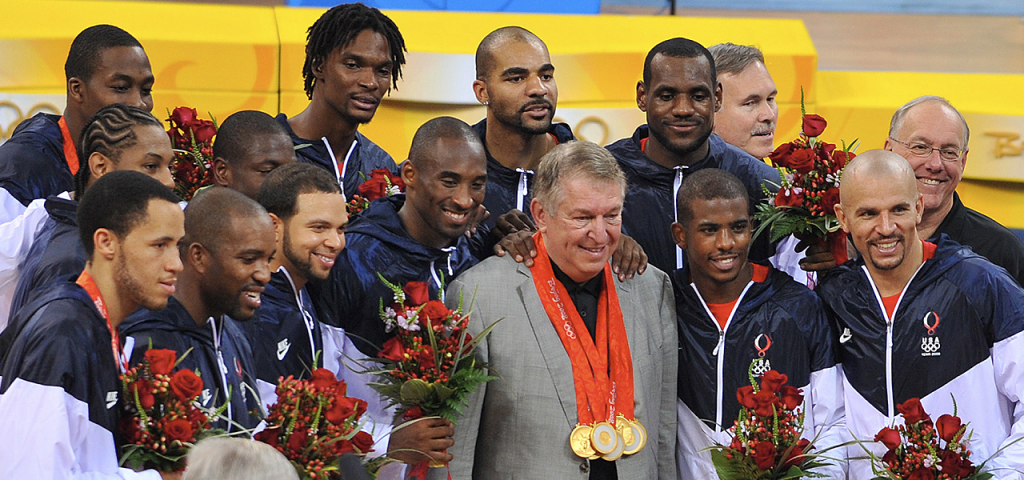
As had been the case with the formation of the original ‘Dream Team’, one of the main factors required to bring the best players in the country together was an underperformance by the US basketball team at a Summer Olympics. A bronze medal at the 1988 Olympics birthed the ‘Dream Team’ in 1992. A bronze medal at the 2004 Olympics would lead to the ‘Redeem Team’ in 2008.
The USA had lost just two matches in their Olympic basketball history prior to the 2004 Games. In Athens, they would lose three out of eight matches, bringing their overall Olympic record to 114 wins and five defeats. After the 2004 Olympics, the USA would not lose another game in the men’s competition until their opening group stage match of the 2020 Games in Tokyo, a sign of their dominance post-Athens.
 the-score-board.co.uk