
Gatlin, Greene and Crawford are no match for note-perfect Brits in Athens…
The 4x100m relay is usually one of the highlights of any Olympic Games. On the penultimate night of the Games, the finals of the men’s and women’s sprint relays serve to close out the athletics meet in a truly compelling fashion. It is a chance to see world-class sprinters who share a nationality team up and try to lead their country to victory over one lap of an athletics track. The relay also presents the opportunity of seeing 100m and 200m runners interact as the sprinters over the longer distance are required to tackle the two perilous bends situated around the track. Finally, the 4x100m relay is an easy way to witness the breaking of a world record. The last three Olympic Games (2008, 2012, 2016) all saw a new world record set in either the men’s or women’s 4x100m relay. Typically, the winners of either relay come down to a select number of countries like the USA or Jamaica, which are known to produce the vast majority of the world’s elite sprinting talent. However, like any Olympic event, the 4x100m relay has served up a surprise result or two since its inception at the 1912 Olympics in Stockholm.
The subject of today’s article is an example of this, a time where an underdog team prevailed to defeat the over-arching event favourites. The latest instalment in The Scoreboard’s ‘The Perfect Run’ series takes us back to the last night of athletics at the 2004 Olympics in Athens and the final of the men’s 4x100m relay. The USA enter the final as the overwhelming favourites to win the gold medal, entering a team where all four members have run sub-10 second times in the individual 100m this same year. The American quartet also contains two newly-minted Olympic sprint champions and a former world and Olympic champion in the 100m. However, on this night in Athens, a team from Great Britain, a country without an Olympic medal in the 4x100m relay since 1988, will upset the Americans and produce one of the biggest shocks of the entire 2004 Olympic Games.
Before the 2004 Olympics, the Games had played host to 20 men’s 4x100m relay finals. By this point, the USA had emerged victorious in 15 of these finals, with Great Britain (1912), the United Team of Germany (1960), the Soviet Union (1980, 1988) and Canada (1996) also earning gold medals along the way. Heading into Athens, the US men were the defending champions in this event. Four years earlier, Jon Drummond, Bernard Williams, Brian Lewis and Maurice Greene would defeat Brazil and Cuba to earn their fifteenth crown in Sydney. Four years later, a more talented relay quartet would attempt to defend this title in Athens.
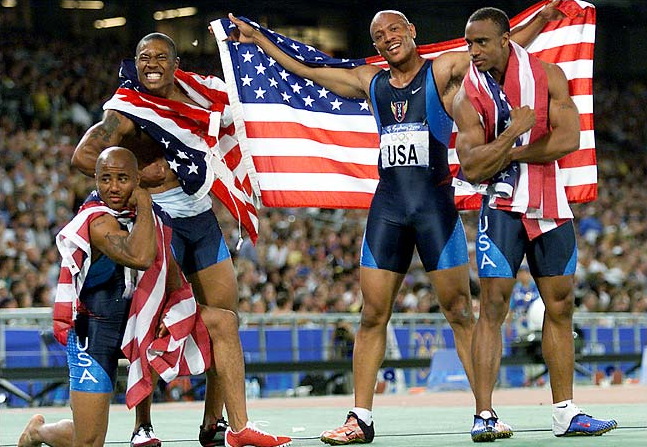
Only Maurice Greene would return from the gold medal-winning quartet from Sydney. In Athens, the former world record holder and three-time 100m world champion (1997, 1999, 2001) would fail to defend his individual Olympic 100m title from 2000, instead claiming the bronze on this occasion. Along with the returning Maurice Greene, newcomers Darvis Patton, Coby Miller, Shawn Crawford, and Justin Gatlin would fill out the rest of the USA 4x100m relay squad for Athens 2004.
28-year-old Coby Miller was the only member of the relay team to not compete in an individual event at the 2004 Olympics. He was the unlucky loser in the 100m race at the United States Olympic Trials, finishing in 4th behind Gatlin, Greene and Crawford. However in this race, Miller would become the only man in the history of the trials to clock a sub-10 second time (9.99) in the 100m and not qualify for the Olympics. Miller’s sole previous Olympic experience came from a 7th -placed finish in the 200m final in Sydney. However, he had experienced relay success with his country, being part of the US team that won the 4x100m at the 2002 IAAF World Cup in a championship record time of 37.95 seconds.
Shawn Crawford was a triple threat in Athens, competing in the 100m, 200m and the 4x100m relay. Despite the 100m being his weaker event, Crawford would impressively finish 4th in the 100m final behind Maurice Greene, Francis Obikwelu and one other. A talented but erratic 200m runner with a world indoor gold and a world outdoor bronze in his past (2001), the 26-year-old Crawford would finally achieve his potential by becoming the Olympic 200m champion on 26th August 2004.
Justin Gatlin would serve as the brightest star of this American relay team. The 22-year-old would make his Olympic debut in Athens but would head into the Games already with a world indoor gold medal to his name. A controversial sprinter, who already spent two years banned by the IAAF for testing positive for amphetamines, Gatlin would become one of the breakout stars of the 2004 Olympics. He would first win the 100m with a personal best time of 9.85 before getting a bronze medal as part of an American 1-2-3 in the 200m with Shawn Crawford (gold) and Bernard Williams (silver).
Finally, Darvis Patton (who would only run in the 4x100m heats in Athens) was the reigning World Championships silver medallist in the 200m. However, he did not carry not same level of prestige in 100m as his faster teammates In Athens, the USA would enter an all-star team that many expected could win this relay gold by some distance.
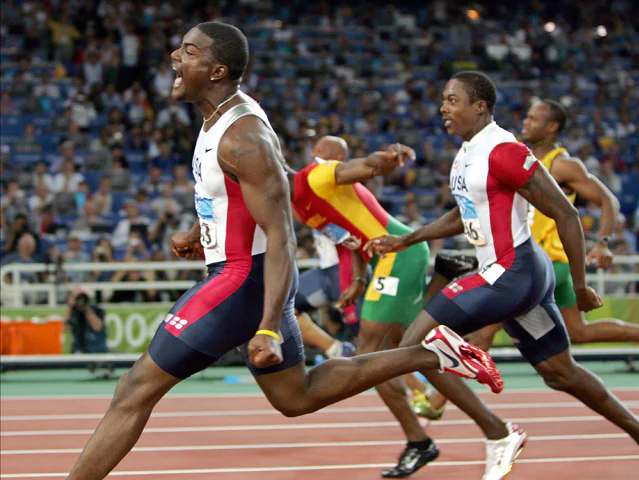
In the heats, the line-up of Crawford, Patton, Miller and Greene would help the United States qualify fastest for the final with a time of 38.02. The Great Britain relay team would finish 2nd in the heat (38.53), while Brazil would take the final automatic spot in 3rd place (38.64). In the other heat for the men’s 4x100m relay, Nigeria would win in 38.27 seconds, with Poland (38.47) and Australia (38.49) also qualifying for the final automatically. With the first heat being faster than the second heat, 4th and 5th-placed teams from Trinidad and Tobago (38.53) and Japan (38.53) would qualify for the final as fastest losers.
The USA team would start the event as overwhelming favourites to take the gold medal. Their heat performance, in which they ran two-tenths of a second quicker than anybody else while not even running at full speed, would back up this prediction. While the USA team contained three Olympic medallists (and two newly-crowned Olympic champions), none of the Great Britain team, for example, had even made the finals of the individual 100m and 200m events. However, the British quartet of Jason Gardener, Darren Campbell, Marlon Devonish and Mark Lewis-Francis were all talented sprinters in their own right who had the times and achievements to back it up.
Jason Gardener was one of the best indoor sprinters in the world heading into the 2004 Olympics. The 29-year-old Gardener would fly to Athens as the reigning European and World Indoor champion at 60m. For the latter title, he would defeat Shawn Crawford at the World Indoor Championships in March 2004. 32-year-old Darren Campbell was the only member of the British relay squad who had earned significant achievements at an outdoor level. One of the best sprint athletes in Europe across 100m and 200m, Campbell would sometimes prove himself as one of the best sprinters in the world. At the Sydney Olympics, Campbell would complete a European 1-2 in the 200m, earning the silver medal behind Greek athlete Konstantinos Kenteris. Three years later, Campbell would earn a bronze medal in the 100m at the 2003 Outdoor World Championships. In the final, Campbell would surprising finish ahead of notable sprinters like Bernard Williams, Tim Montgomery and Dwain Chambers, all of whom had faster 100m personal bests heading into the race.
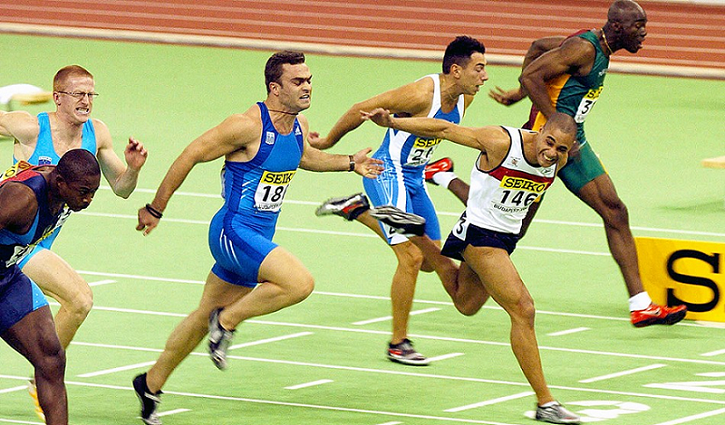
Jason Gardener (c) Athletics Weekly 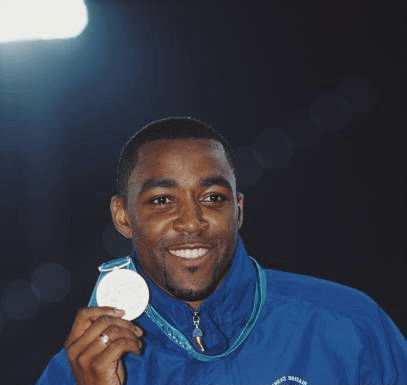
Darren Campbell (c) BBC 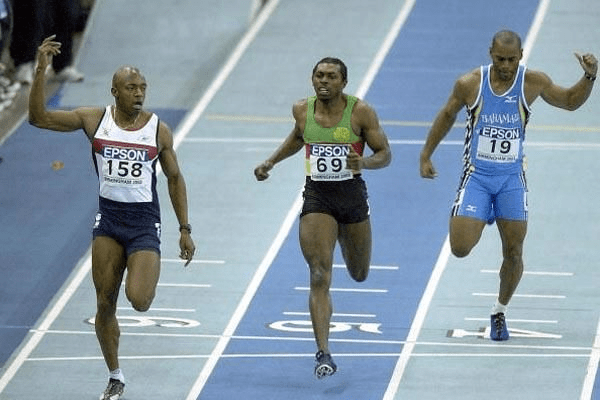
Marlon Devonish (c) Sporting-heroes.net 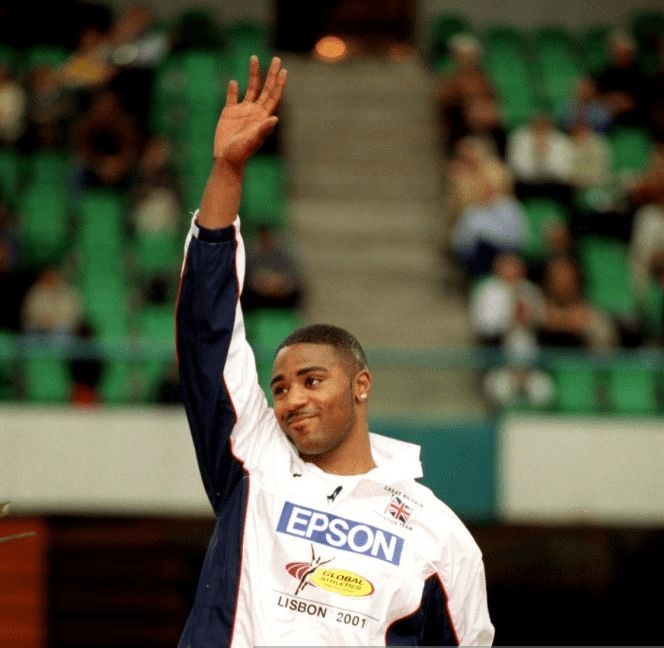
Mark Lewis-Francis (c) Image of Sport
28-year-old Marlon Devonish would not have the same level of achievements as Gardener or Campbell, but he did have a World Indoor 200m gold medal to his name dating back to 2003. Finally, 21-year-old Mark Lewis-Francis would anchor the British relay squad. A former World Indoor bronze medallist (2001) at 60m, Lewis-Francis would fill the place usually occupied by Dwain Chambers, who would miss the Olympics due to serving a two-year ban for steroids.
Gardener, Campbell and Devonish had previously served as three-quarters of the Great Britain team that earned a silver medal behind the USA at the 1999 World Athletic Championships in Seville. However, since that race, Great Britain’s men’s 4x100m relay team had been found wanting at the world level, failing to make the final at either the 2000 Olympics and the 2001 World Championships. At the 2003 World Championships in Paris, Great Britain would actually win a silver medal, with the USA’s JJ Johnson successfully chasing down Britain’s anchor leg Dwain Chambers and pipping him for gold on the finish line. However, Dwain Chambers’ subsequent positive drugs test and ban for steroids would lead to the IAAF stripping Britain of their relay silver medal and awarding it to original bronze medallist Brazil. Now without a single success in the relay for five years, a medal of any colour in Athens would be a success for this Great Britain team.
However, for any team to deny the Americans from claiming the men’s 4x100m relay gold medal in Athens, they would need to have a note-perfect race while hoping that the USA either made a mistake or failed to finish.
2004 Olympics Men’s 4x100m Relay Final Start List
| Lane | Country | Competitors | Qualifying Time |
|---|---|---|---|
| 1 | Australia | Adam Basil, Paul di Bella, Patrick Johnson, Josh Ross | 38.47 |
| 2 | Brazil | Cláudio Roberto Souza, Édson Ribeiro, André da Silva, Vicente de Lima | 38.64 |
| 3 | Great Britain | Jason Gardener, Darren Campbell, Marlon Devonish, Mark Lewis-Francis | 38.53 |
| 4 | Nigeria | Olusoji Fasuba, Uchenna Emedolu, Aaron Egbele, Deji Aliu | 38.27 |
| 5 | USA | Shawn Crawford, Justin Gatlin, Coby Miller, Maurice Greene | 38.02 |
| 6 | Poland | Zbigniew Tulin, Łukasz Chyła, Marcin Jędrusiński, Marcin Urbaś | 38.47 |
| 7 | Japan | Hiroyasu Tsuchie, Shingo Suetsugu, Shinji Takahira, Nobuharu Asahara | 38.53 |
| 8 | Trinidad and Tobago | Nicconnor Alexander, Marc Burns, Ato Boldon, Darrel Brown | 38.53 |
All the teams would get away cleanly from the gun, and brand-new 200m Olympic champion Shawn Crawford would have the best opening leg. He quickly began to chase down Polish athlete Zbigniew Tulin in the lane outside while creating a distance to Olusoji Fasuba, Jason Gardener and Adam Basil on his inside. After a 10.1 second-split, Shawn Crawford would pass the baton to Justin Gatlin with a half a second lead. The new 100m champion would stretch his legs down the back straight, almost drawing level with his Polish equivalent while also reeling in Japan’s Shingo Suetsugu in lane 7. Meanwhile, Darren Campbell and Nigeria’s Uchenna Emedolu would close the gap opened by Shawn Crawford’s incredible opening leg.
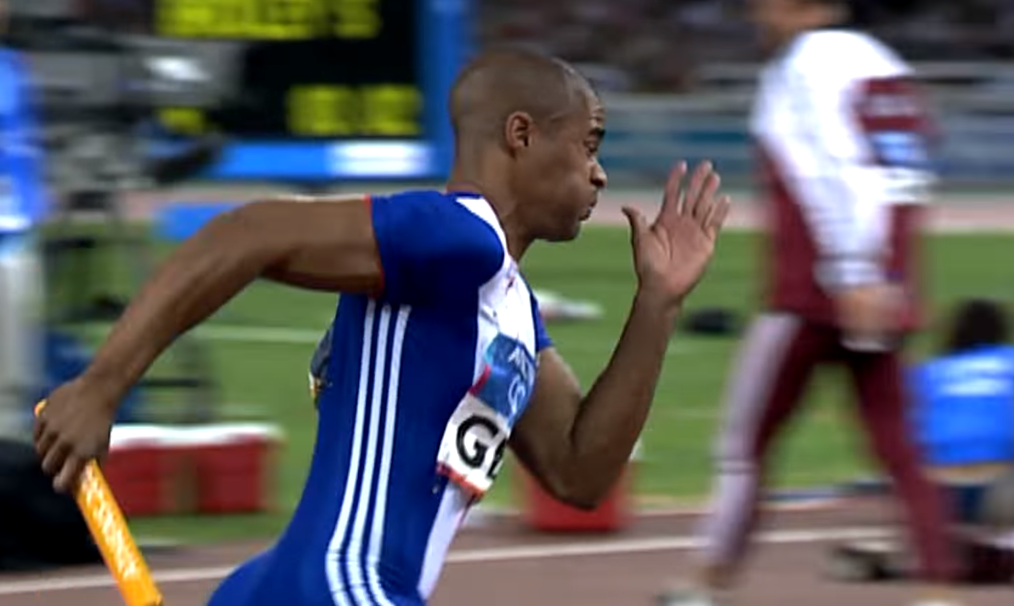
Campbell and Emedolu would safely pass their batons on to Marlon Devonish and Aaron Egbele to begin the third leg. However, the USA would experience some trouble when Gatlin tried to place it into the hands of their third runner Coby Miller. After a lack of coordination between the two men, Miller would rip the baton out of Gatlin’s hands and begin his leg. This delay in changing the baton would allow both Nigeria and Great Britain to close the gap to the United States going into the final bend. Nigeria’s third leg Aaron Egbele would then overtake Miller to take the race lead before the 200m runner could get up to speed. Around the final bend, Nigeria would lead the United States with Great Britain following close behind.
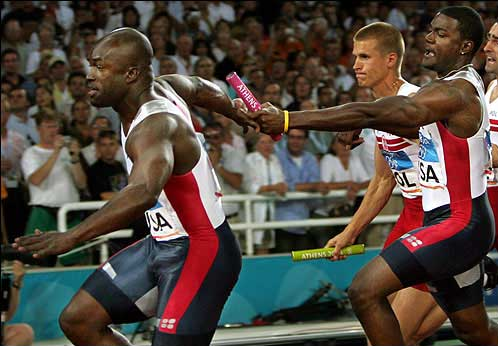
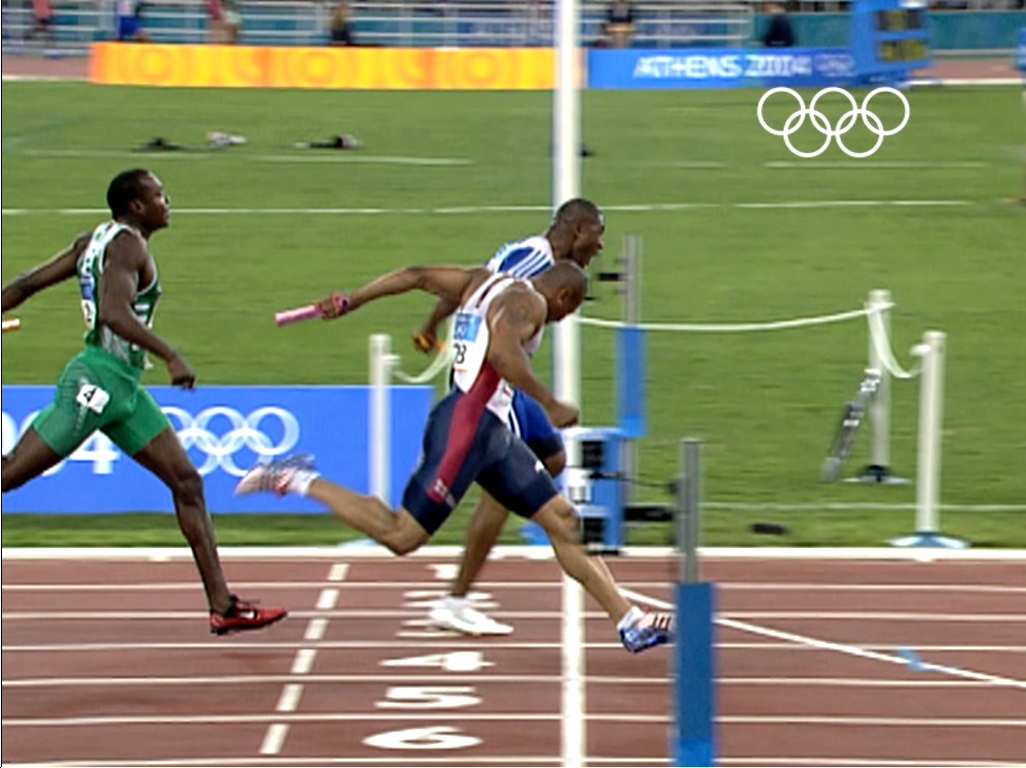
However, after an excellent final bend by Marlon Devonish and a cleaner baton change for Britain compared to their American and Nigerian counterparts, anchor leg Mark Lewis-Francis would receive the baton in the lead ahead of Nigeria’s Deji Aliu and the USA’s Maurice Greene. Lewis-Francis would get up to speed quicker than his rivals to extend his lead further, but soon the 21-year-old Birchfield Harrier would find himself quickly chased down by one of the greatest sprinters of his generation. As the three leaders hurtled down the home straight, the hugely experienced Greene would start to eat away at Lewis-Francis’s advantage, finding more gears that the young Briton didn’t have. With the speed at which Maurice Greene was closing down Mark Lewis-Francis, it looked like the three-time 100m world champion would repeat the feat of JJ Johnson from one year earlier and overtake the Olympic debutant before the finish line. However, whether this situation occurred or not, the finish to this men’s 4x100m relay would be a tight one.
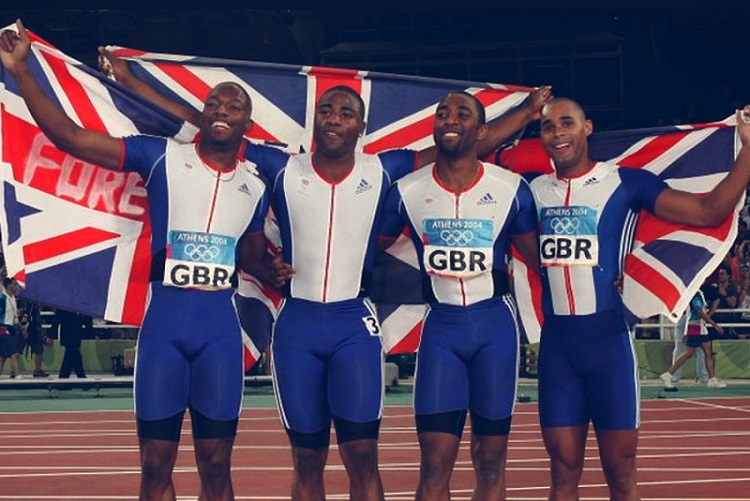
Twenty metres from the line, Mark Lewis-Francis might have seen Maurice Greene enter his peripheral vision as the two were now almost neck-and-neck. As the two athletes reached the finish line, the gap was almost minimal. Both men would cross the finish line so close together that an action replay was required to decide the winner. This replay would show that even though Greene’s mid-air foot had seemingly crossed the line first, and the two athlete’s bodies were almost in line with each other, the outstretched head and chest of Lewis-Francis would see Great Britain win a surprise gold by less than a metre. If the track had been five metres longer, Maurice Greene would likely have won gold for the USA. However, Great Britain’s flawless performance on the night would ultimately win them the top prize.
2004 Olympics Men’s 4x100m Final Result
| Position | Country | Time (seconds) |
|---|---|---|
| 1st | Great Britain | 38.07 |
| 2nd | USA | 38.08 |
| 3rd | Nigeria | 38.23 |
| 4th | Japan | 38.49 |
| 5th | Poland | 38.54 |
| 6th | Australia | 38.56 |
| 7th | Trinidad and Tobago | 38.60 |
| 8th | Brazil | 38.67 |
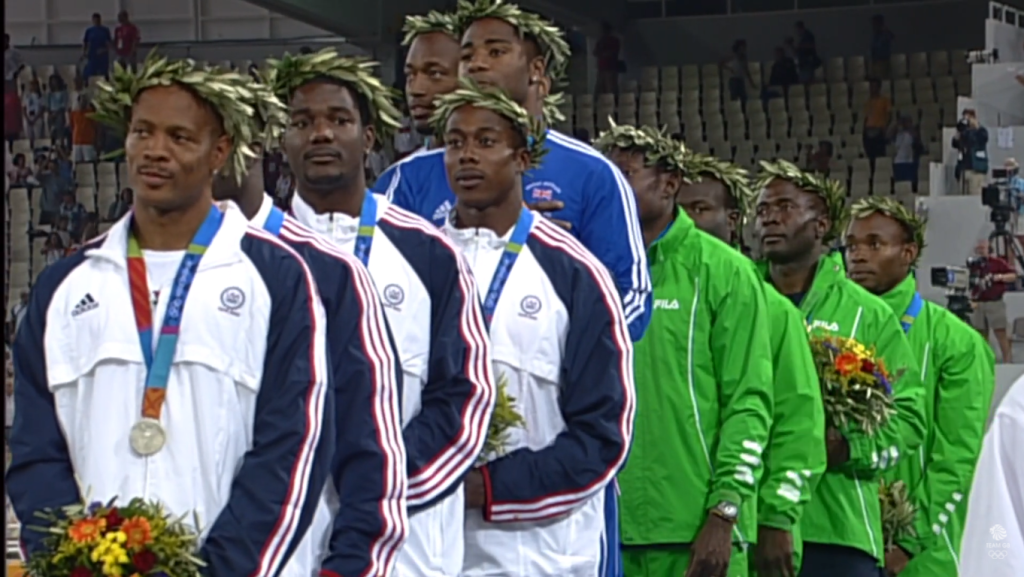
In the end, one botched baton exchange would ultimately cost the USA the gold medal. If Justin Gatlin had successfully managed to stick the baton in Coby Miller’s hands at the first attempt, then Maurice Greene would have had little trouble running clear of the field to win the race. Greene ran a faster time split in his anchor leg than Mark Lewis-Francis, recording an 8.9-second split compared to the Briton’s 9.1 seconds. However, the extra six or seven-tenths of a second caused by the delay in passing the baton would allow Nigeria and Great Britain to close the gap on the United States, making for a thrilling climax to this relay. Meanwhile, Jason Gardener, Darren Campbell, Marlon Devonish and Mark Lewis-Francis would execute a perfect 4x100m relay race, knowing when to make safe and risky baton changes depending on the situation. This men’s 4x100m relay gold would serve as Great Britain’s third athletics gold medal and ninth gold overall at the 2004 Athens Olympics, with Britain’s other two wins on the track coming from Kelly Holmes’ women’s 800m-1500m double.
It is a testament to the performance of Gardener, Campbell, Devonish and Lewis-Francis in 2004 that since this quartet won the gold in Athens, Britain has failed to win a medal of any colour in each of the following three Olympic Games. In Beijing 2008 and London 2012, a baton mix-up would lead to the British quartet bowing out in the heats with a disqualification. In 2016, Britain would reach the final, but Richard Kilty, Harry Aikines-Aryeetey, James Ellington and Adam Gemili would only manage a 5th-place finish.
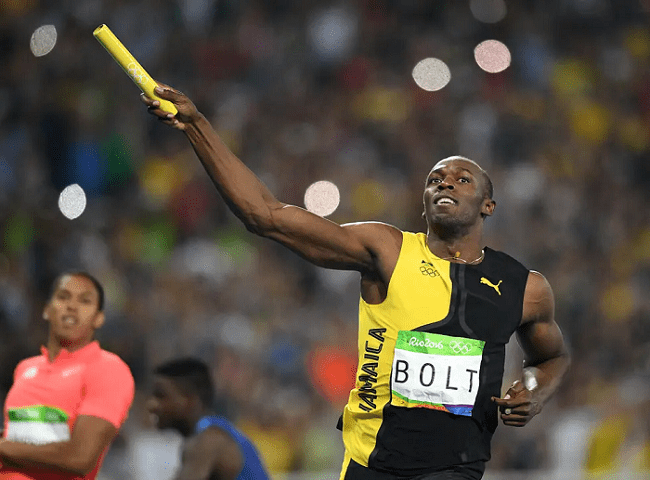
In that same race in Rio, the United States team of Mike Rodgers, Justin Gatlin, Tyson Gay and Trayvon Bromell would finish in 3rd only to be disqualified later for passing the baton outside of the takeover zone. As of 2021, the USA has not won the men’s 4x100m relay since the Sydney Olympics in 2000, earning two silver medals in 2004 and 2012. Since 2004, the great generation of Jamaican sprinters led by Usain Bolt has dominated the 4x100m relay, winning three successive gold medals in Beijing (2008), London (2012), and Rio de Janeiro (2016).
Since Great Britain’s victory in Athens, it has again become unlikely for a men’s relay team without household names to beat the established elite. You often see countries like Japan, China and Trinidad and Tobago among the medals in major athletics championships. However, if Japan or Brazil or France did manage to beat Jamaica and the USA to the men’s 4x100m relay gold at the upcoming Tokyo Olympics, it would come as a complete surprise, much like Great Britain’s victory in 2004. Once again, the team featuring the most famous and talented sprinters more often than not defeats a well-functioning relay quartet featuring a bunch of names not recognised outside of their own country.
However, on a late August night in 2004, a capacity crowd inside the Athens Olympic Stadium would witness an unfancied quartet of British sprinters upset the heavily-favoured American team to win an unlikely Olympic gold medal and produce perhaps the most famous athletics relay victory in the history of the Olympic Games.
 the-score-board.co.uk