
This is the reason why the French people didn’t expect to win the 1998 FIFA World Cup…
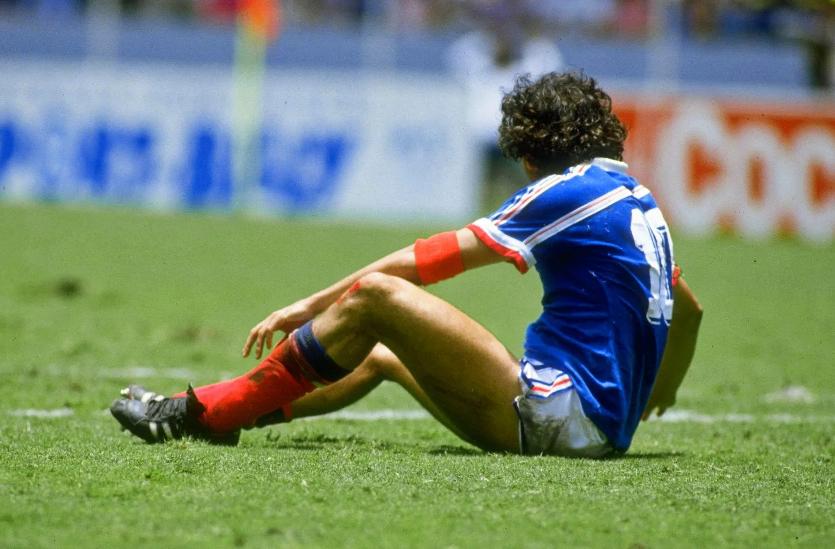
25th June 1986. Estadio Jalisco. Guadalajara, Mexico. The local time currently reads around 1:45 in the afternoon, while 5,826 miles to the east, Parisian clocks read 8:45 in the evening. On the field of play, the curly-haired substitute Rudi Voller, No.9 on his back, runs away after scoring a 90th-minute goal in the FIFA World Cup semi-final. Franz Beckenbauer’s West Germany side is about to beat France 2-0 and reach a second consecutive FIFA World Cup final. Meanwhile, Michel Platini and his reigning European champion French teammates, including Patrick Battiston, Alain Giresse and Jean Tigana, ponder a second consecutive FIFA World Cup semi-final exit at the hands of Die Mannschaft. While not as controversial or as heart-breaking as the penalty shoot-out loss four years earlier, the pain is no less easy to bear. So while West Germany looks forward to facing Diego Maradona and Argentina four days later, Les Bleus can only consider the small prospect of a third-place playoff match against Belgium before returning home trophyless.
Three days later, a Platini-lite French team defeated Belgium 4-2 in Puebla after extra time, with Jean-Marc Ferreri, Jean-Pierre Papin, Bernard Genghini, and Manuel Amoros providing the goals. After the match, the players receive their bronze medals, a slightly duller colour than what they were expecting. However, all Henri Michel’s side can do now is look forward. First, the 1988 European Championship held in West Germany, where the French would enter as one of the favourites to defend their crown. Secondly, the 1990 World Cup in Italy, surely a tournament too far for Platini (30), Tigana (30) and Giresse (33), but instead one for Papin (22), Ferreri (23) and Amoros (24). Considering the French eye for spotting talent for the national side, it would not be out of the question to consider France as a contender at Italia ’90. You can never really write off France ahead of a major tournament.
Fast forward to 1998. France is about to host the 16th FIFA World Cup. Aimé Jacquet’s 22-man tournament squad contains a mix of experience (Laurent Blanc, Didier Deschamps, Marcel Desailly, Youri Djorkaeff) and relative youth (Zinedine Zidane, Robert Pires, Thierry Henry, Patrick Vieira) either playing in France or for big clubs around Europe. This squad could go deep into the competition, quarter-finals or further. The Times newspaper gives the hosts 11/2 odds to win the tournament, making them the second-favourites behind reigning champions Brazil. However, if you ask the locals whether they believe their national side could become world champions, the majority answer is a resounding no. Can you never truthfully write off France ahead of a major tournament? Perhaps you can.
Looking back, it seems an absurd notion to believe that anyone could doubt this French squad’s chances of winning the World Cup, considering what happens later. However, these French ‘vox pops’ in the street? These fans have experienced too much hurt. They have borne witness to twelve years of national embarrassment that has brought morale in the national football team down to its lowest point. They witnessed ‘The Cursed Generation’ first-hand.
Who are ‘The Cursed Generation’? From 1986 to 1996, France would qualify for two out of a possible five major tournaments, missing out on consecutive FIFA World Cups and one UEFA European Championship. Four national managers. Six national team captains. The country’s outstanding player who would choose to retire at his peak, a maverick twice barred from representing the team never to return, a national squad that contains the best player in European football struggling to make an impact on the international stage. All these elements represent France between 1986 and 1996, and the following article will let you understand how hope in 1986 turned to a lack of belief in 1998.
Part 1: The End of An Era
The 1986 World Cup would mark the final involvements of Maxime Bossis (76), Dominique Rocheteau (49), Alain Giresse (47), Thierry Tusseau (22), Michel Bibard (6), Philippe Bergeroo (3) and Albert Rust (1) with the French national side. These players were all aged 27 years or older, and post-World Cup, manager Henri Michel would begin to focus on the younger players in the national set-up. Thus, for example, the team’s first match after the World Cup, a friendly with Switzerland on 19th August 1986, would see 19-year-old Auxerre centre-back Basile Boli make his international debut. France’s starting line-up for this match would also be notable for the absences of midfield lynchpin Jean Tigana and, more notably, captain and talisman Michel Platini. On this night, a different-looking France, featuring international journeymen Jean Christophe Thouvenel, Dominique Bijotat and Fabrice Poullain, would lose 2-0 to a Switzerland team that did not qualify for the World Cup.
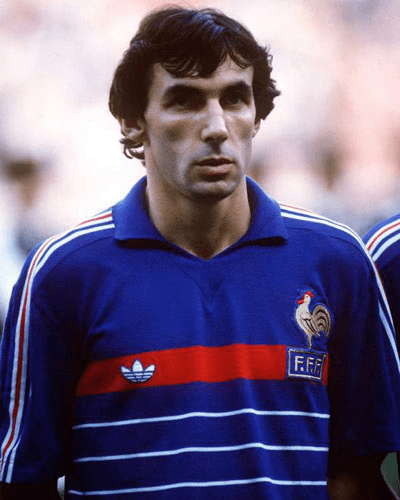
Maxime Bossis 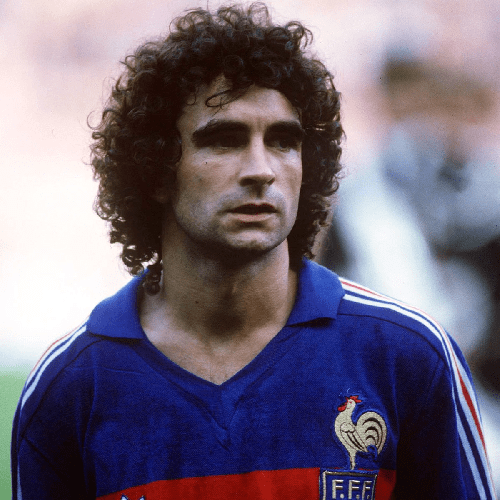
Dominique Rocheteau 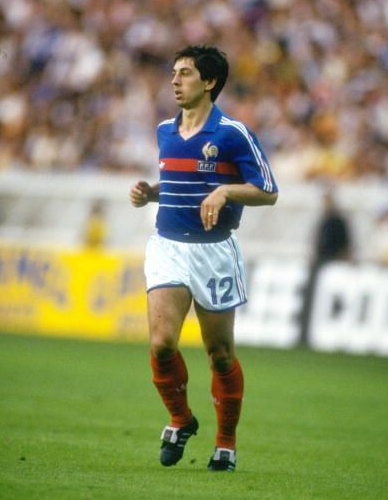
Alain Giresse 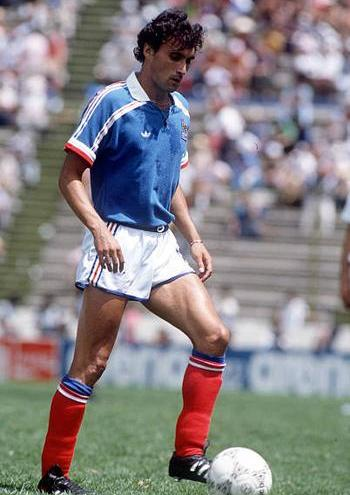
Thierry Tusseau 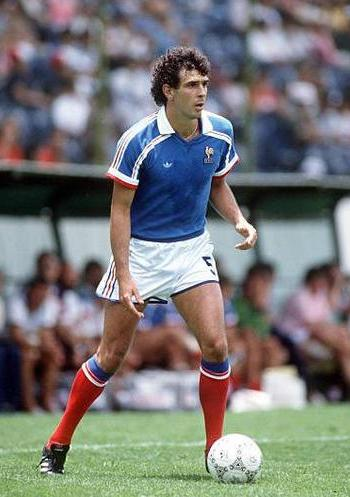
Michel Bibard 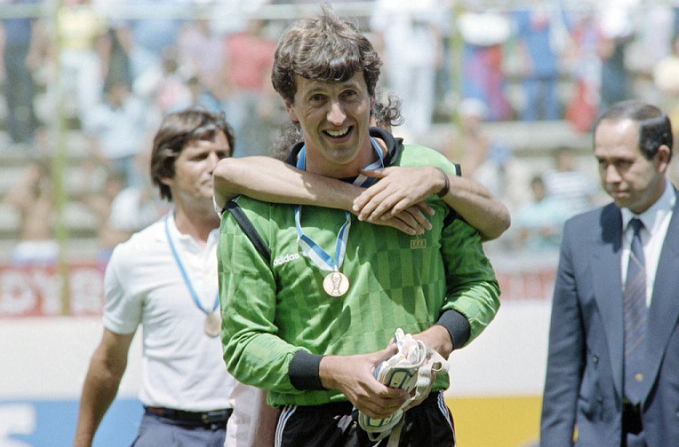
Philippe Bergeroo 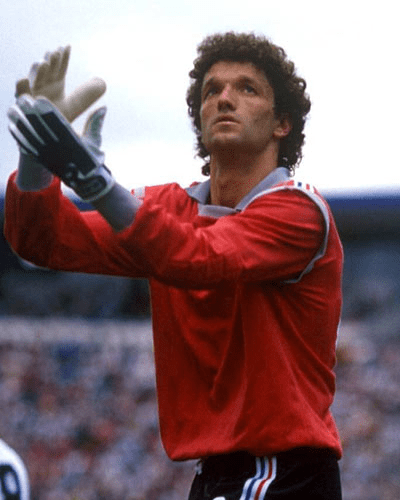
Albert Rust
After this friendly defeat, France would begin their qualification campaign for the 1988 European Championships. The UEFA draw would place the French in Group 3 with East Germany, Iceland, Norway and the Soviet Union. Only the USSR participated at the recent World Cup, exiting after a 4-3 extra-time defeat to Belgium in the second round. As the defending European champions and recent World Cup bronze medallists, France would begin Group 3 as the top seed. With their reputation, many would expect Henri Michel’s team to end the qualification campaign as one of seven group winners who would travel to West Germany for the finals 18 months later. However, it is fair to say that France did not get off to the best start in qualifying for Euro ’88.
On 9th October 1986, a still Platini-less France would travel to Reykjavik to face Iceland in their first Euro ’88 qualification match. With Jean Tigana returning to the starting line-up, seven of the eleven who started the World Cup semi-final defeat against Germany would also begin against Strákarnir okkar. Despite the talent on display, France would struggle to score against the Scandinavian side. At the end of 90 minutes, the match would end in a goalless stalemate. Not the ideal start that French fans would have hoped for, especially against a team featuring several players from the Icelandic league who had never previously qualified for a major international tournament.
France’s second qualifying match against the USSR on 11th October would see the return of Michel Platini to the starting line-up for the first time since the World Cup semi-final. The USSR were always a tricky prospect, even for the best teams. However, France would have an advantage on this night, playing in front of home fans in Paris for the first time since March. At half-time, the match remained goalless. However, in the 66th minute, forward Igor Belanov would break the deadlock for the USSR. Eleven minutes later, midfielder Vasyl Rats would double the Soviet lead. Despite France’s attempts to respond, including replacing defender Basile Boli with midfielder Philippe Vercruysse, the USSR would claim a 2-0 away victory inside the Parc Des Princes. One month later, France’s post-World Cup goalscoring drought and winless streak would continue with another goalless draw, this time against East Germany. After three matches, France sat 4th in Group 3 with one point and zero goals to their name. Only Norway’s 4-0 defeat to the Soviet Union kept Henri Michel’s side off the bottom of the group at this stage.
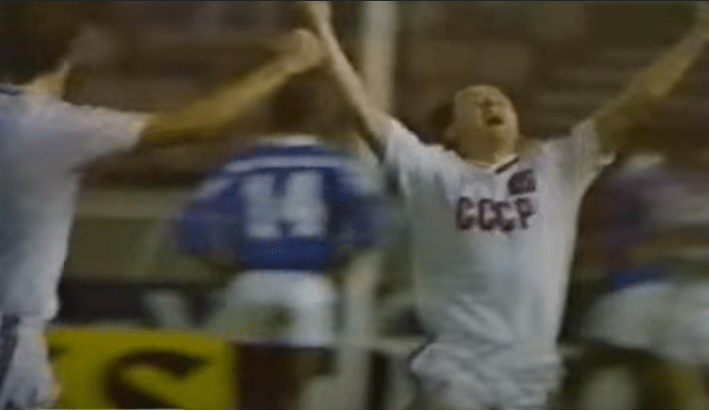
Round 4 would finally see France get the first win of their Euro ’88 qualifying campaign. On 29th April 1987, Iceland would travel southeast to the Parc Des Princes for their reverse fixture against Les Bleus. After a goalless draw in the first match, Siegfried Held would hope for another draw or even a famous victory over the reigning European champions. If he thought this, he was sadly mistaken. After 307 minutes without a goal, Michel Platini would set up striker Carmelo Micciche to give France the 1-0 lead in the 37th minute of play. Halfway through the second half, the scorer would turn provider as Micciche provided the assist for strike partner Yannick Stopyra to double France’s lead. Finally, France would win their first match in five attempts. The 2-0 victory would move France above Iceland, into third place in the group, level on points with East Germany.
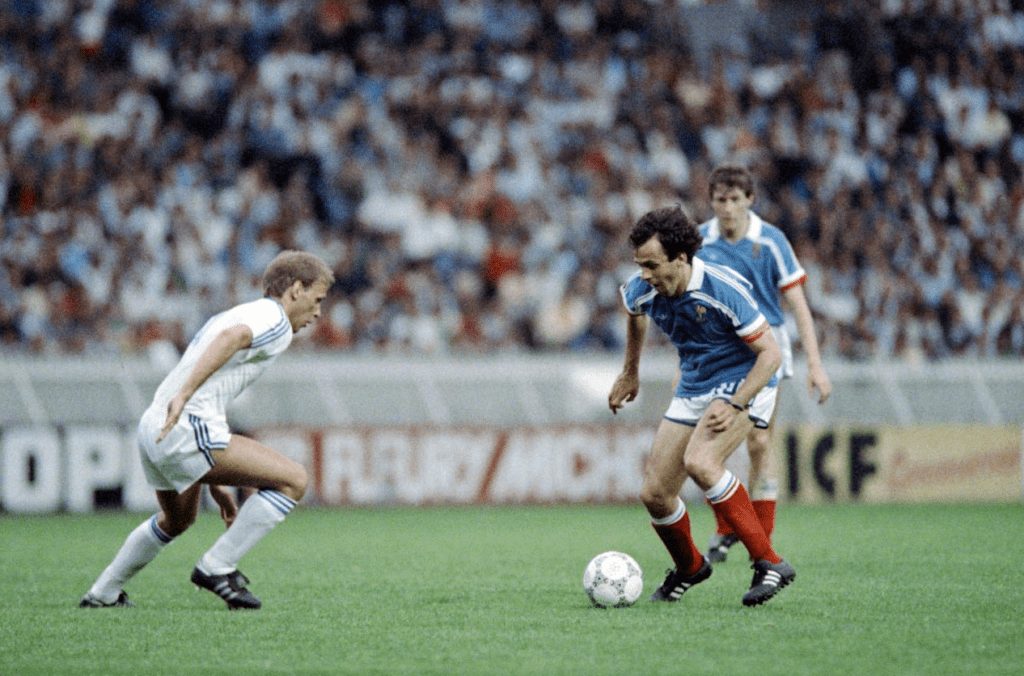
Two months would pass before France’s next qualifier against Norway on 16th June 1987. Norway was without a win before facing France, losing twice to the USSR (4-0, 2-0) and drawing with East Germany (0-0). Now, they would hope to break that duck against a French team stripped of their talisman for good. At the end of the 1986-87 football season, Michel Platini would announce his retirement from all forms of football at the age of 31, simultaneously ending his careers with Juventus and the French national team. The 2-0 win over Iceland in April would serve as the 72nd and final cap of Platini’s France career. This eleven-year international career would produce 41 goals, two World Cup semi-finals and a European Championship victory. For the match against Norway, midfielder Luis Fernandez would take the captain’s armband. His first time as French captain would not end positively. Two second-half goals from Per Mordt (73′) and Jorn Andersen (80′) would see the Norwegian Lions claim a famous victory over Henri Michel’s team. Four weeks later, France’s poor form would continue with a 2-0 friendly defeat against West Germany, a match that saw Eric Cantona’s international debut.
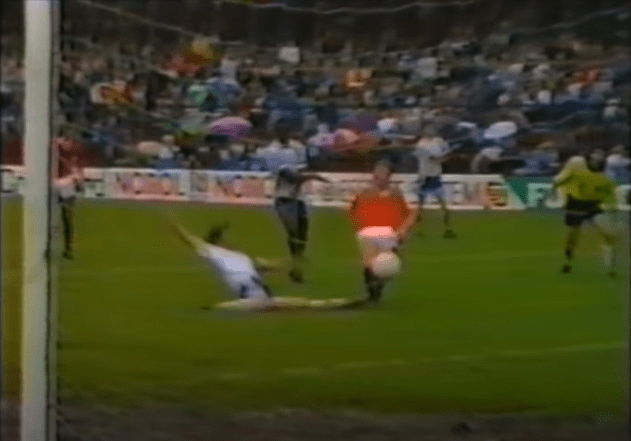
With three qualifying matches left, France sat 3rd in Group 3, three points adrift of the Soviet Union in 1st. With only the group winners qualifying for the European Championships, Henri Michel’s men would need to win their final three matches against the USSR, Norway and East Germany, hoping that the Soviets and East Germans dropped points against Norway and Iceland. On 9th September, France would earn a 1-1 draw away in Moscow. Luis Touré would score first for the away side after 13 minutes, but Oleksiy Mykhaylychenko would cancel out this goal thirteen minutes from time, in another missed opportunity for the French. One month later, East Germany and the USSR would play out a 1-1 draw. Even though this draw did nothing more than hold the respective positions of these two sides in the standings, the result would effectively rule France out of qualification for the 1988 European Championships, with a five-point gap now opened between 1st and 3rd.
With qualification now out of the question, France would head into their final two matches fighting for pride, bragging rights and 2nd place in the Group 3 table. Only one point would separate Les Bleus and East Germany with two games left. If France could not make the Euros, 2nd place would manage to limit the damage to an extent. However, a 1-1 draw with Norway on 14th October twinned with a 3-1 win for East Germany over the same team two weeks later would secure second place for the latter side. On 18th November, a last-minute Rainer Ernst goal at the Parc Des Princes would round off France’s qualification campaign with a miserable 1-0 home defeat.

Despite entering UEFA Euro 88 Qualifying Group 3 as the defending European champions, France would deliver an embarrassing campaign, finishing with one win, four draws and three defeats from eight matches. As a result, Henri Michel’s team would finish seven points adrift of the 1st-placed Soviet Union and five points short of second-placed East Germany, finishing in 3rd place, with only goal difference separating Les Bleus and 4th-placed Iceland. Now, for the first time since 1980, France would spend the following summer at home, watching Ruud Gullit, Marco van Basten and the Netherlands take their title by defeating the impressive Soviet Union in the final to win Euro 1988.
UEFA Euro 1988 Qualifying Group 3
| Position | Team | Played | Won | Drawn | Lost | GF | GA | GD | Points |
|---|---|---|---|---|---|---|---|---|---|
| 1 | Soviet Union | 8 | 5 | 3 | 0 | 14 | 3 | +11 | 13 |
| 2 | East Germany | 8 | 4 | 3 | 1 | 13 | 4 | +9 | 11 |
| 3 | France | 8 | 1 | 4 | 3 | 4 | 7 | -3 | 6 |
| 4 | Iceland | 8 | 2 | 2 | 4 | 4 | 14 | -10 | 6 |
| 5 | Norway | 8 | 1 | 2 | 5 | 5 | 12 | -7 | 4 |
Part 2: The Rot Sets In, And A Legend Returns
With the 1990 World Cup campaign set to begin in the autumn, France would begin 1988 with five friendly matches in four months against Israel, Switzerland, Morocco, Spain and Northern Ireland. On 27th January, a 1-1 draw in Tel Aviv would continue France’s eight-match winless streak in all competitions. However, France would finally win their first match since Michel Platini’s retirement by defeating Switzerland 2-1 in Toulouse five days later. Two early goals from Gérald Passi and Philippe Fargeon would give French football fans a positive result for the first time since April 1987. Three days later, a 2-1 win over Morocco would see France register back-to-back victories for the first since the 1986 FIFA World Cup knockout stages.
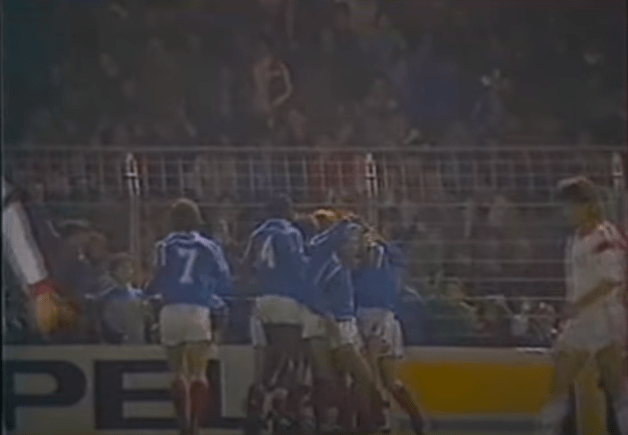
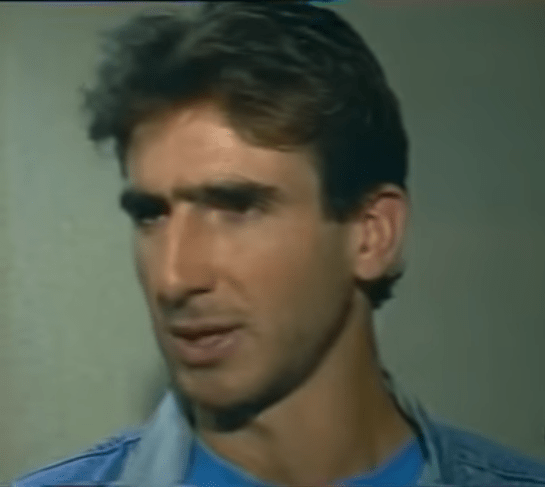
At the end of March, a third consecutive 2-1 win over Spain in Bordeaux would give France their biggest win since 1986, and Henri Michel’s side was starting to build some momentum heading into the World Cup qualification campaign later in the year. A goalless draw with Northern Ireland in April would halt the team’s three-match winning streak but maintain France’s unbeaten start to 1988. Four months later, France would draw 1-1 with Czechoslovakia in their final friendly before the 1990 World Cup qualifiers. However, in the days after the match, another story would soon emerge. On 21st August 1988, in a post-match interview for his club Auxerre, striker Eric Cantona would call Henri Michel “a bag of s**t” for leaving him out of recent France squads. Michel had given Cantona his international debut against West Germany the previous August. By October 1988, Cantona had earned six international caps. However, Cantona’s most recent cap had come in the 2-1 win over Spain on 23rd March, with Michel choosing not to select the 21-year-old for the following three squads. For Cantona’s improper language, Henri Michel would indefinitely ban the enigmatic striker from international football.
Despite their poor performance during Euro ’88 qualification, France would enter the draw for UEFA’s part of the 1990 FIFA World Cup qualifiers as one of the top seeds with West Germany, England, Spain, Belgium, Denmark, and the Soviet Union. From UEFA, seven group winners and four runners-up would qualify for the World Cup in Italy. The qualifying draw would put France in Group 5 with Scotland, Yugoslavia, Norway and Cyprus. Of the five teams, Scotland and Yugoslavia would pose the most significant threats with six and seven previous World Cup appearances to their names. At the same time, Norway hadn’t qualified for a World Cup since 1938, and Cyprus hadn’t even come close. Henri Michel’s team would begin their campaign with a home game against Norway on 29th September 1988. After twice failing to beat the Scandinavian side during the Euro 88 qualifiers, Jean-Pierre Papin’s 84th-minute penalty would ensure that France ended the victors on this occasion. However, Les Bleus’ newfound positivity and seven-match unbeaten streak would not last for much longer.
On 22nd October, France would draw 1-1 with Cyprus in Nicosia. Daniel Xuereb would open the scoring for Les Bleus one minute before half-time, but Charalambos Pittas would equalise from the penalty spot in the 78th minute to earn an unlikely draw for the Cypriots. However, for the three-time World Cup semi-finalists to draw with a team who had lost 34 out of 36 World Cup qualifying matches to that point would constitute an embarrassing result for Les Bleus and, unfortunately, one too far for Henri Michel. After four years and 36 games in charge, the French Football Federation (FFF) would sack Henri Michel as manager of the national team. In his place, the FFF would hire a national legend. Seventeen months after his international retirement as a player, Michel Platini would return to the French national team as the manager.
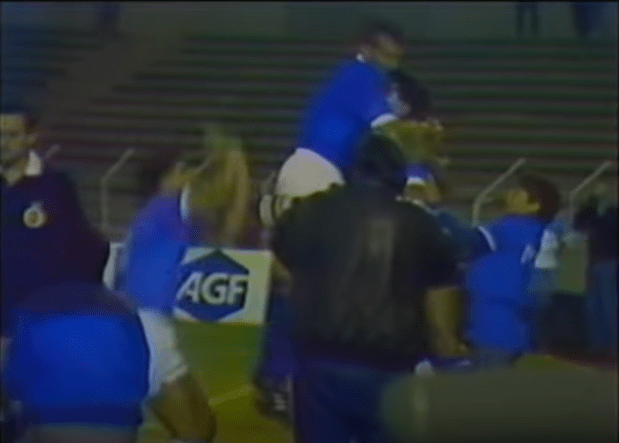
Michel Platini’s first match in charge would come away at Yugoslavia on 19th November 1988. For this game, Jean Tigana would earn his first France cap since June 1987. Platini’s first match would have the perfect start, with the returning Tigana assisting Christian Perez for the opening goal within three minutes. However, Yugoslavia would respond through Predrag Spasic’s effort eight minutes later. Following this early start, the score would remain 1-1 at half-time before kicking into life again midway through the second period. In the 68th minute, Christian Perez would turn provider for Franck Sauzée to put France 2-1 ahead. However, Les Bleus’ lead would last eight minutes as Dejan Savićević set up Safet Susic for Yugoslavia’s second equaliser. Substitute Savićević would continue to impact the match, providing another assist for Dragan Stojković in the 82nd minute to give the home side the lead. Yugoslavia would eventually run out 3-2 winners, ending Michel Platini’s first match as France manager with a defeat. Jean Tigana would not play for France again after this match, eventually retiring from football in 1991.
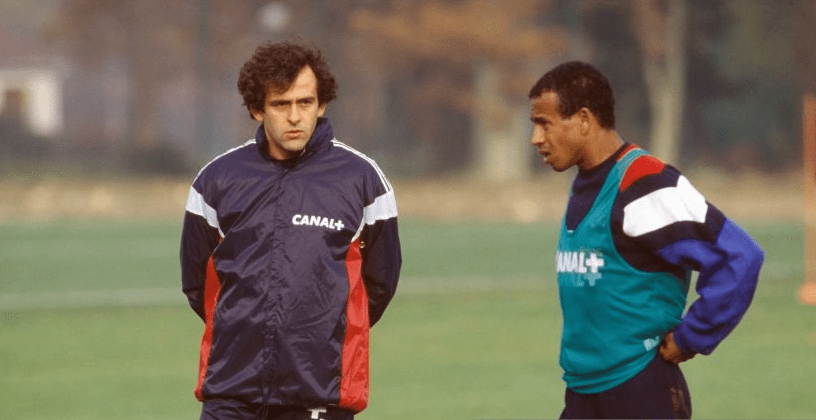
France’s next qualifying match against Scotland would occur on 8th March 1989. In between the Yugoslavia and Scotland games, France would play out a goalless draw with Jack Charlton’s Republic of Ireland team, a match notable for the return of Patrick Battiston for the first time since August 1987. Scotland had begun their 1990 World Cup qualification campaign unbeaten, beating Cyprus (2-3) and Norway (1-2) and drawing with Yugoslavia (1-1). However, at Hampden Park, a brace from Mo Johnston would see Andy Roxburgh’s team defeat the former European champions. Therefore at the halfway point of the qualifying campaign, France had one win, one draw and two defeats from four matches, putting them 3rd behind Scotland (7) and Yugoslavia (5) in Group 5 with three points. Without a win in his first three matches as France’s manager, Michel Platini would need to turn his team’s form around to qualify for the 1990 World Cup.
Three days after Scotland’s 2-0 win over Cyprus, France would draw 0-0 with Yugoslavia in Paris to continue Michel Platini’s underwhelming start as the national team’s manager. Later victories for Norway over Cyprus (3-1) and Yugoslavia over Norway (2-1) would drop France down to 4th place in the table, only depressing the national mood. An impressive 4-2 friendly win over Sweden featuring braces from Jean-Pierre Papin and the returning Eric Cantona would give French fans hope for a late run towards qualification. However, a 1-1 draw with Norway on 5th September would continue France’s competitive slump. However, Yugoslavia’s 3-1 win over Scotland one night later would present France with a slight opportunity with two matches remaining. With a four-point gap between 2nd-placed Scotland and 4th-placed France, two wins for the French and two defeats for the Scots could see France qualify for the World Cup on goal difference. But, first, France would need to beat Scotland in a must-win match inside the Parc Des Princes on 11th October 1989. Anything but a win would end France’s qualification hopes immediately.
In Paris, France would produce their best performance since defeating Brazil in the 1986 World Cup quarter-finals. Didier Deschamps would score his first France goal on his fourth cap to put Les Bleus ahead at half-time. Eric Cantona would double the score with his third goal in three matches after 63 minutes before a Steve Nicol own-goal would confirm France’s 3-0 victory late on. With Yugoslavia beating Cyprus 2-1 to top Group 5 and book their place in the 1990 World Cup in late October, Scotland would face Norway and France host Cyprus in November 1989. With Scotland’s match taking place three days before France’s Les Bleus would know their fate before taking on the Cypriots inside the Parc Des Princes. For France to qualify, a win for Norway over Scotland in Glasgow, plus a French win over Cyprus three days later, would see Michel Platini’s side qualify for the 1990 World Cup on goal difference. Did this scenario play out? No, it did not.

In Glasgow, Scotland would take the lead one minute before half-time through Ally McCoist’s effort. As the match continued, Scotland would retain their 1-0 lead, putting France’s World Cup hopes at risk. However, in the 89th minute, Erland Johnsen would equalise for Norway, giving French fans hope. However, the grandstand finish that Gallic fans were hoping for would not happen. The match would end 1-1, putting Andy Roxburgh’s Scotland side three points ahead of France, qualifying the Scots for their fifth successive FIFA World Cup tournament and knocking the French out of contention with one match remaining. Three days later, a France team with nothing to play for would defeat Cyprus 2-0, with Didier Deschamps and Laurent Blanc providing the goals. Les Bleus would finish their 1990 FIFA World Cup qualifying group in 3rd place, registering three wins, three draws and two losses to finish on nine points, one point shy of Scotland in second place.
Despite the installation of Michel Platini as manager, France had failed to qualify for a second successive tournament and would miss out on their first World Cup since 1974. Placed in a more challenging group than their Euro 1988 qualifying group, France would perform better overall. However, draws with Cyprus and Norway would give the team too much to do to earn qualification. Despite the win over Scotland in October, it was a case of ‘too little, too late’ for Michel Platini’s men. The following year, France would watch another international tournament from the sidelines before beginning their qualification campaign for Euro ’92 in the autumn of 1990.
1990 FIFA World Cup qualification – UEFA Group 5
| Position | Team | Played | Won | Drawn | Lost | GF | GA | GD | Points |
|---|---|---|---|---|---|---|---|---|---|
| 1 | Yugoslavia | 8 | 6 | 2 | 0 | 16 | 6 | +10 | 14 |
| 2 | Scotland | 8 | 4 | 2 | 2 | 12 | 12 | 0 | 10 |
| 3 | France | 8 | 3 | 3 | 2 | 10 | 7 | +3 | 9 |
| 4 | Norway | 8 | 2 | 2 | 4 | 10 | 9 | +1 | 6 |
| 5 | Cyprus | 8 | 0 | 1 | 7 | 6 | 20 | -14 | 1 |
Part 3: May Plaudits Come Their Way
Without a World Cup to look forward to, France would spend three-quarters of 1990 playing nothing but friendly matches. France would begin the year with a 1-0 win over Kuwait, with Laurent Blanc’s header securing the win. Three days later, Eric Cantona would score a brace in a 3-0 victory over East Germany. Then, moving up through the gears, Michel Platini’s side would earn an impressive 2-1 win over West Germany in Montpellier on 27th February, four months before the World Cup. The front two, Cantona and Jean-Pierre Papin, would help France recover from Andreas Moller’s opener to earn some bragging rights over one of the World Cup’s pre-tournament favourites. Another brace from Cantona, plus a third from Franck Sauzée, would continue France’s good form against Hungary on 28th March. After a five-month break, however, France’s six-match winning run would end with a goalless draw against Poland on 15th August. However, the friendly wins earlier in the year would stand Michel Platini’s team in good stead heading into the UEFA Euro 1992 qualifying campaign beginning in September 1990.

After two unimpressive qualifying campaigns, France would find themselves in Pot Three ahead of the Euro 1992 qualifiers. As a result, the draw would place the French in Group 1 with Spain, World Cup quarter-finalists Czechoslovakia, Iceland and Albania. With only the group winners qualifying for the finals, Michel Platini would face a difficult job leading his team back to the European Championships ahead of their two fellow former competition winners Spain and Czechoslovakia.
France would open their Euro 1992 qualifying campaign in the same way that they had begun their Euro 1988 group, with a trip to Reykjavik to face Iceland. However, this French team would improve on the 0-0 draw achieved by Henri Michel’s team four years earlier. After finding their form the previous spring, the strike partnership of Marseille’s Eric Cantona and Jean-Pierre Papin would fire on all cylinders once more, with both men scoring in a 2-1 France win. Five weeks later, France would host Czechoslovakia inside the Parc Des Princes. The in-form Papin, who had scored 38 goals for Marseille the previous year, would score a brace of goals in another 2-1 France victory. In round three, a changed French side lacking the presence of either Cantona and Papin would earn a narrow 1-0 win over minnows Albania when Basile Boli headed in Christian Perez’s corner kick. The win over Albania would mean that France would go through the entirety of 1990 without losing, quite an achievement for a team that hadn’t made the previous two major tournaments.
The win over Albania would also mean France carried a thirteen-match unbeaten streak heading into their match with Spain on 20th February 1991. While France had laboured to a 1-0 win over Albania the previous November, the Spanish would defeat the same side by a 9-0 scoreline one month later, with Emilio Butragueño scoring four. Luis Suárez’s team would continue their scoring habit when José Mari Bakero shot past goalkeeper Bruno Martini after 10 minutes in Paris. However, France would not take long to respond as Franck Sauzée equalised with a header four minutes later. Michel Platini’s team would take the advantage in the second half, and Jean-Pierre Papin would continue his prolific form in front of goal, putting France ahead with a right-footed shot in the 58th minute. Later, France would receive a free-kick, and Pascal Vahirua would find Laurent Blanc to head home the third goal for Les Bleus and continue his team’s perfect record in Group 1. One month later, France would take a leaf out of Spain’s book, dispatching Albania 5-0 in Paris. Braces from Sauzée and Papin and an own goal would make it five wins from five matches for the French.
With three qualifying matches left, France stood atop Group 1 with 10 points from 10. Four wins and eight points for Czechoslovakia would now place them as Les Bleus’ nearest challengers in the fight for Euros qualification. On 14th August, France would put five goals past Poland in a friendly match, with five different players (Sauzée, Papin, Amara Simba, Blanc, Christian Perez) getting on the scoresheet in a 5-1 away win. On 4th September 1991, France would travel to Prague to face Czechoslovakia. A victory for France would bring them one step away from European qualification. However, Vaclav Němeček’s 19th-minute opener would give Michel Platini food for thought during the half-time break. At half-time, Christian Perez would replace centre forward Christophe Cocard as France reverted to a 5-3-2 formation. The subbing-on of Perez would work wonders, as the PSG midfielder’s 53rd-minute cross would result in Jean-Pierre Papin volleying home France’s equaliser. With the match set to end in a 1-1 draw, Perez’s through-ball would set up Papin to score a last-minute breakaway winner for Les Bleus, protecting their winning record.
After the win over Czechoslovakia, an away victory over Spain on 12th October would confirm France’s qualification for Euro 1992. The match would see Luis Fernandez and Eric Cantona return to the starting line-up for the first time since the 5-0 win over Albania. At the same time, Christian Perez would start after his heroics as a substitute against Czechoslovakia. In a match where the final score was decided after 32 minutes, Luis Fernandez’s individual effort would give the away side the lead after 13 minutes. The opening goal was Fernandez’s first international goal since March 1988, when he would score in a 2-1 win over Spain. After opening the scoring, Laurent Blanc’s pass would set up Jean-Pierre Papin for his ninth goal of the qualifying campaign three minutes later. France had stunned Spain with two goals in three minutes and was now on their way towards victory.
Spain would pull back a goal back through centre-back Abelardo’s header after 31 minutes, making things interesting going into half-time. However, despite both team’s best efforts, the score would remain 2-1 until full-time. With a third consecutive 2-1 win over Spain, Michel Platini’s France had qualified for UEFA Euro 1992, ending their five-year exile from a major tournament. Les Bleus would achieve qualification one month before anybody else, topping Group 1 on 12th October 1991 with one game to spare. Now, France would finish the campaign they had begun with a match against Iceland. In Paris on 19th November, France would end the qualifying group stage with a 3-1 win as Eric Cantona (x2) and Amara Simba would ensure that Michel Platini’s team would finish with eight wins from eight and a maximum of 16 points. The Iceland win would also mean that, for the second successive year, France would go through 1991 without losing a single match. In addition, Les Bleus now held a nineteen-match, two-year unbeaten streak tracing back to a 0-0 draw with Yugoslavia on 29th April 1989.
After such a strong year, France would rightly earn plaudits for their unbeaten performances during 1991. For his performances for the national team and for his club Marseille, Jean-Pierre Papin would win the Ballon D’or, the Onze D’or (given by French magazine Onze Mondial) and World Soccer Magazine’s Men’s World Player of the Year awards. In addition, World Soccer would name Michel Platini as the Men’s World Manager of the Year and France the World Team of the Year. Now, France would need to carry these plaudits and their form into Euro 1992.
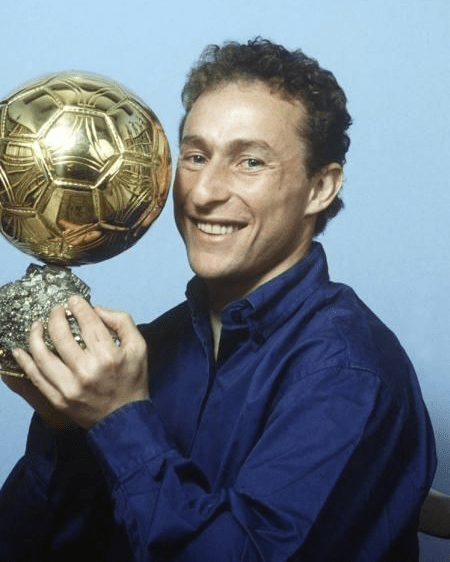
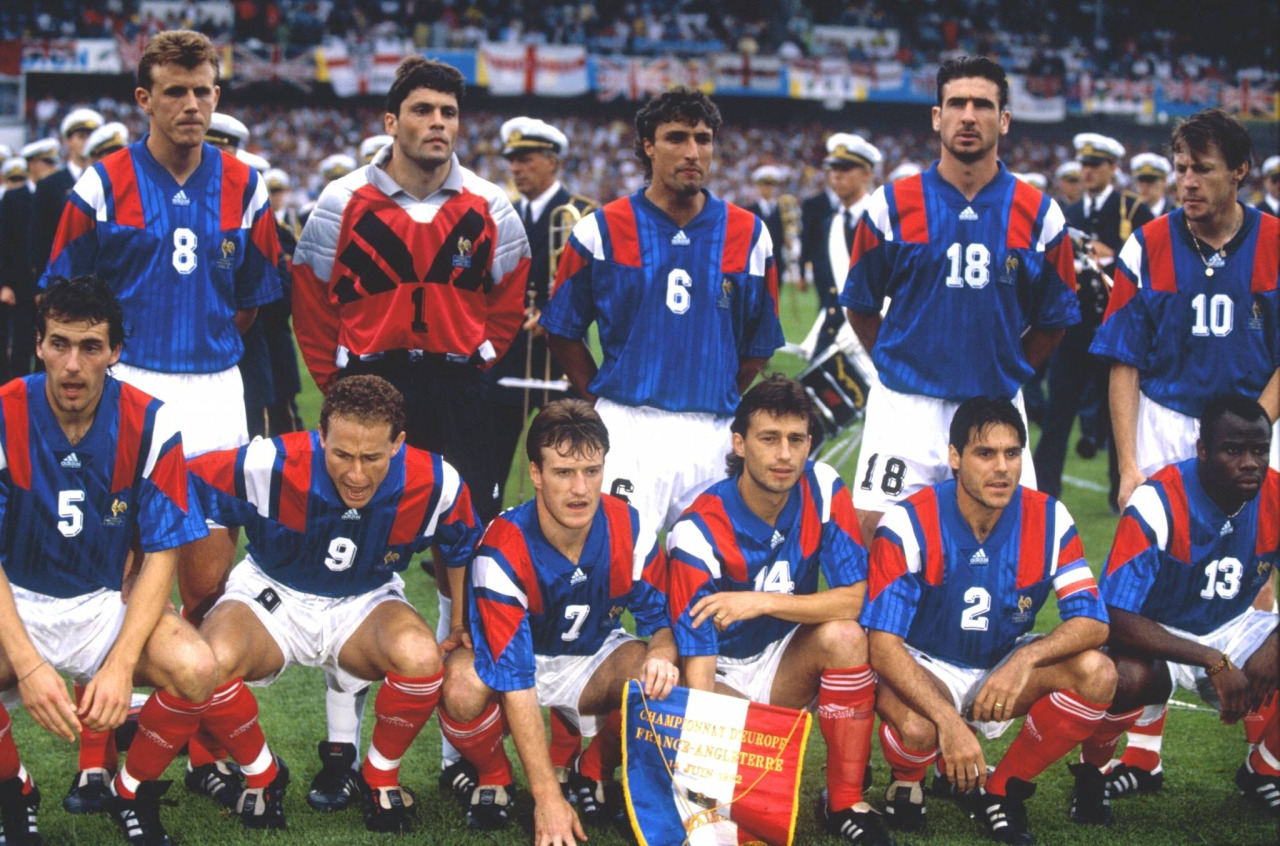
(c) Pinterest 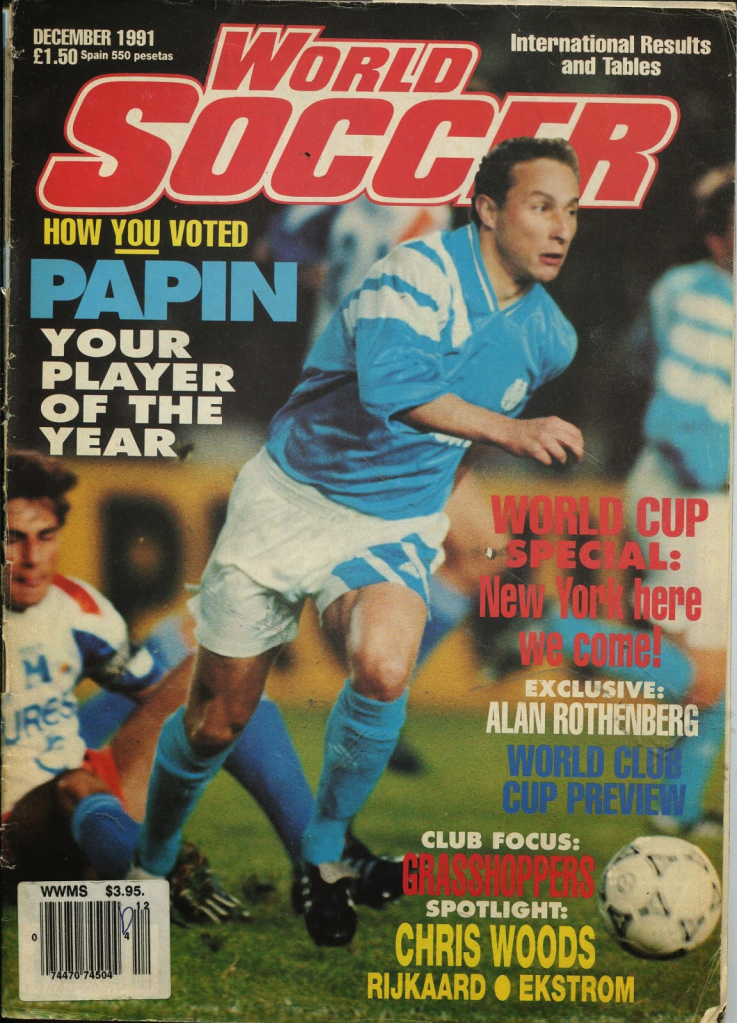
(c) Soccer Nostalgia
UEFA Euro 1992 qualifying Group 1
| Position | Team | Played | Won | Drawn | Lost | GF | GA | GD | Points |
|---|---|---|---|---|---|---|---|---|---|
| 1 | France | 8 | 8 | 0 | 0 | 20 | 6 | +14 | 16 |
| 2 | Czechoslovakia | 8 | 5 | 0 | 3 | 12 | 9 | +3 | 10 |
| 3 | Spain | 7 | 3 | 0 | 5 | 17 | 12 | +5 | 6 |
| 4 | Iceland | 8 | 2 | 0 | 6 | 7 | 10 | -3 | 4 |
| 5 | Albania | 7 | 1 | 0 | 7 | 2 | 21 | -19 | 3 |
Part 4: Down To Earth With A Bump
Despite not even qualifying for the two previous major tournaments, Michel Platini’s France would head into UEFA Euro 1992 as one of the pre-tournament favourites alongside defending European champions the Netherlands, world champions Germany and World Cup semi-finalists England. In qualifying, Les Bleus were the only team to win eight out of eight matches, and only Yugoslavia (who would later withdraw from Euro 1992 pre-tournament) would score more goals than France’s 20. The pre-tournament draw would place France in Group 1 with England, hosts Sweden and Denmark (who would replace Yugoslavia for political reasons). Early predictions would place France as potential group winners, setting up a potential semi-final with Germany or the Netherlands.
Before Euro 1992, France would play four friendly matches against England, Belgium, Switzerland. At Wembley on 19th February 1992, France’s 19-match unbeaten streak would end at the hands of Graham Taylor’s England. Goals from strike partners Alan Shearer and captain Gary Lineker would see England claim a 2-0 home victory. The following month, Michel Platini’s side would play out a classic with Belgium in Paris. The Belgians would take the lead through Philippe Albert’s 27th-minute effort. In the 40th minute, a foul on Pascal Vahirua would result in a France penalty, from which Jean-Pierre Papin would score an equaliser. However, Belgium would earn their own penalty kick in the 44th minute after a foul on Luc Nilis. Captain Enzo Scifo would step up and convert to put the visitors 2-1 up. With Belgium seemingly heading into the break leading, Papin would set up Vahirua to score France’s second equaliser in first-half stoppage time. Two minutes into the second half, Marc Wilmots would capitalise on a Marc Degryse header to re-establish Belgium’s lead once more at 3-2. However, with five minutes remaining, Papin would score a spectacular overhead kick from a Basile Boli cross to end the six-goal thriller in a 3-3 draw. In May, Switzerland would beat France 2-1 to continue Les Bleus’ less-than-ideal Euro preparations.

On 31st May 1992, Michel Platini would select a 20-man squad to compete for France at Euro 1992. Of the 20 men chosen, only defender Laurent Blanc played his football outside of the French top division Ligue 1. Eight squad members, including Manuel Amoros, Basile Boli, Didier Deschamps and Jean-Pierre Papin, represented French champions Marseille at club level. Marseille defender Manuel Amoros would captain the squad, having occupied the role during Michel Platini’s managerial tenure.
With an average player age of 26 and an average number of 23 caps, Platini would choose a mix of youth and experience for his Euros squad, ranging from 21-year-old Emmanuel Petit to 32-year-old Luis Fernández. For most of the team, Euro 1992 would serve as their major tournament debut. Meanwhile, Manuel Amoros, Luis Fernández and Jean-Pierre Papin were part of the squad that reached the 1986 FIFA World Cup semi-finals, and the former two were European Championship winners back in 1984. With Euro 1992 likely to be the final tournament for Amoros and Fernández, France would need their experience to win a second European Championship trophy. After the squad selection, France would draw 1-1 with the Netherlands in their final game before Euro 1992.
| Position | No. | Player | Age | Caps | Club | Position | No. | Player | Age | Caps | Club |
| GK | 1 | Bruno Martini | 30 | 22 | Auxerre | MF | 4 | Emmanuel Petit | 21 | 4 | Monaco |
| GK | 19 | Gilles Rousset | 28 | 2 | Lyon | MF | 7 | Didier Deschamps | 23 | 21 | Marseille |
| DF | 2 | Manuel Amoros (capt.) | 30 | 79 | Marseille | MF | 8 | Franck Sauzée | 26 | 25 | Marseille |
| DF | 3 | Franck Silvestre | 25 | 11 | Sochaux | MF | 10 | Luis Fernández | 32 | 57 | Cannes |
| DF | 5 | Laurent Blanc | 26 | 22 | Napoli | MF | 12 | Christophe Cocard | 24 | 4 | Auxerre |
| DF | 6 | Bernard Casoni | 30 | 24 | Marseille | MF | 14 | Jean-Philippe Durand | 31 | 20 | Marseille |
| DF | 13 | Basile Boli | 25 | 35 | Marseille | MF | 16 | Pascal Vahirua | 26 | 13 | Auxerre |
| DF | 17 | Rémi Garde | 26 | 6 | Lyon | FW | 9 | Jean-Pierre Papin | 28 | 35 | Marseille |
| DF | 20 | Jocelyn Angloma | 26 | 10 | Marseille | FW | 11 | Christian Perez | 29 | 19 | PSG |
| FW | 15 | Fabrice Divert | 24 | 3 | Montpellier | ||||||
| FW | 18 | Eric Cantona | 26 | 24 | Leeds United |
Appearing in their first major tournament since the 1986 FIFA World Cup, France would help kick off UEFA Euro 1992 by facing hosts Sweden in the opening match on 10th June. Michel Platini would line up his team in a defensive 3-4-3 formation. In front of goalkeeper Bruno Martini, Laurent Blanc would act as a sweeper behind Basile Boli and Bernard Casoni in a defensive back three. Captain Manuel Amoros and Jocelyn Angloma would play as wing-backs on either side of Didier Deschamps and Franck Sauzée in midfield. Up top, Eric Cantona and Pascal Vahirua would flank Jean-Pierre Papin in an attacking front three.
In the first match of Euro 1992, the host nation would score the first goal after 24 minutes. Arsenal’s Anders Limpar would swing in a corner, and centre-back Jan Eriksson would head the ball past Bruno Martini to put Sweden ahead. Swede would maintain their 1-0 lead into the half-time break, and Michel Platini would choose to make a substitution. He would bring on Christian Perez for Vahirua in the front three, hoping to replicate the qualifying match against Czechoslovakia, where Perez assisted two second-half goals for Jean-Pierre Papin after coming off the bench. Like Prague, Perez would provide the assist for Papin to find a 58th-minute equaliser for France. Despite manager Tommy Svensson bringing on striker Martin Dahlin to score a winner for Sweden in the 74th minute, the first match of Euro 1992 would end in a 1-1 draw. A safe result for both teams, but a game that France might have won a year earlier.
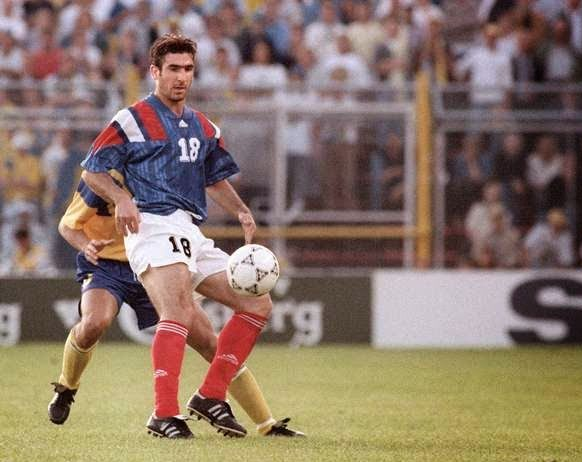
Four days later, France would face England in Malmö. Like France, England would begin their Euro 1992 campaign with a draw, a 0-0 stalemate with late arrivals Denmark. For this second match, Michel Platini would bring in Jean-Philippe Durand and Luis Fernández to replace Jocelyn Angloma and Pascal Vahirua as part of a more familiar 3-5-2 formation. Fernández would join Didier Deschamps and Franck Sauzée in central midfield, while Durand would play as the left wing-back opposite Manuel Amoros.
In front of nearly 27,000 spectators, the two giants of world football would play out a goalless draw. In two halves of few goalscoring chances, Alan Shearer’s diving header that just missed the right-hand post of Martini’s goal and a Basile Boli header that forced Chris Woods into a point-blank save would stand out. However, England would come closest when a 30-yard Stuart Pearce free-kick would hit the crossbar with Bruno Martini left flailing in the France goal. However, the most memorable moment of the game would happen off the ball. Following an England corner, France centre-back Basile Boli would decide to deliver a headbutt to England left-back Stuart ‘Psycho’ Pearce. The force of the headbutt would send Pearce to the ground, and the Nottingham Forest hardman would sport a cut on his right cheek for the rest of the match. However, the game would end honours even, with Group 1’s two big hitters needing to win their final matches to reach the semi-finals stage.
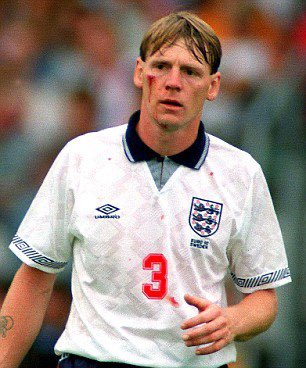
After a 1-0 win for Sweden over Denmark, all of Group 1 would head into their final matches, knowing that a win would see them through to the last four. To book their place, France would need to beat Denmark, a team that had been on their holidays a month earlier before receiving the call to replace Yugoslavia in the competition. For the final group game, Pascal Vahirua would return to the starting line-up in place of Franck Sauzée. Vahirua would start as the left wing-back while Jean-Philippe Durand would move into midfield. Meanwhile, Christian Perez would start ahead of Luis Fernández in the midfield three in the other change to the side.
With both sides entering the match knowing only a win would suffice, Denmark would take a surprise 8th-minute lead against Michel Platini’s side. A knock-down header from Flemming Povlsen in the France penalty area would find its way to midfielder Henrik Larsen (not that one), who would swing a left-footed shot into the French net. The Danes would enjoy the better of the first half, missing a couple more chances to go 2-0 up. Meanwhile, Eric Cantona would find space just outside the Danish box only to blaze his shot wide of Peter Schmeichel’s net, meaning Denmark would remain 1-0 leaders at half-time. With their Euros future in jeopardy, Michel Platini would bring on the experienced Luis Fernández for Pascal Vahirua at the start of the second period.
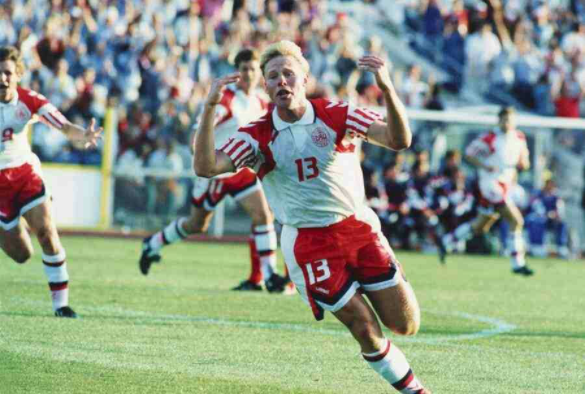
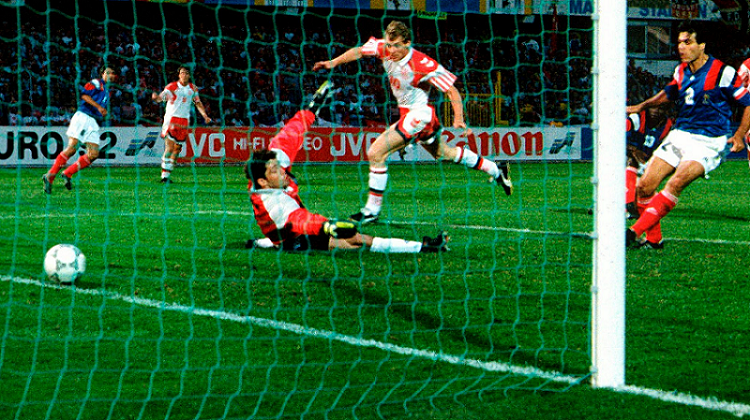
In the early stages of the second half, France would call Denmark goalkeeper Peter Schmeichel into action, with the Manchester United man equal to anything shot at him. At the other end, a Denmark freekick would clear the goal, Bruno Martini leaping to his right to attempt the save. However, France would equalise on the hour mark, with scoring duty going to the one and only Jean-Pierre Papin. Collecting a pass from Jean-Philippe Durand, the Marseille striker would fire a shot across Schmeichel into the far corner of the net. With Papin’s goal, France would move 2nd in the provisional Group 1 table. If France could hold on for a draw and England failed to beat Sweden, France would progress to the semi-finals by the skin of their teeth along with Tommy Svensson’s side. However, Denmark was not ready to go home just yet.
In the 78th minute, Flemming Povlsen would deliver a low cross across the French box and substitute Lars Elstrup would poke the ball home for Denmark’s second goal. Immediately after the goal, Platini would sub on Christophe Cocard for Christian Perez, searching for a quick response. However, Laurent Blanc would blaze a volley over the bar from a France corner, and that was all she wrote. In an underdog win, Denmark would beat France 2-1, progressing to the Euro 1992 semi-finals while knocking out the former European champions. At the same time, hosts Sweden had just completed doing the same to Graham Taylor’s England. Thus, in one night, the two strongest teams in the group on paper would fall at the first hurdle, while the pair of spirited Scandinavian sides would move on to face Germany and the Netherlands in the final four.
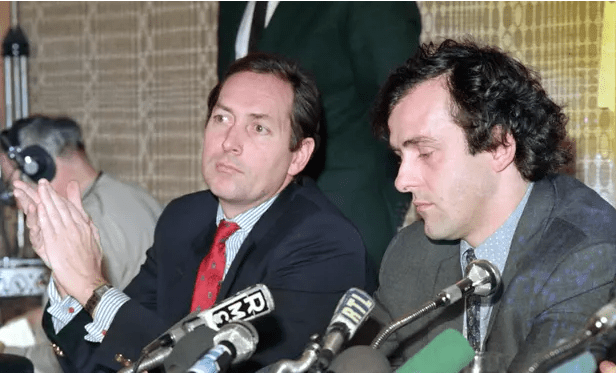
After a perfect qualifying campaign and two consecutive unbeaten years in 1990 and 1991, France would fail to win a single match at Euro 1992 against Sweden, England or Denmark, scoring two goals in three games. Thus, France would fail to progress beyond the first stage in their return to a major international tournament. Following Euro 1992, Michel Platini would resign as national coach. However, the FFF would not look too far for his replacement, hiring his assistant manager Gerard Houllier to lead France to the USA-based 1994 FIFA World Cup. On the playing side, veterans Manuel Amoros and Luis Fernández would call time on their international careers shortly after the tournament. Also, Euros squad members Bernard Casoni, Franck Silvestre, Christian Perez, Jean-Philippe Durand, Fabrice Divert, Rémi Garde and Gilles Rousset would not play for France after 1992.
UEFA Euro 1992 Group 1
| Position | Team | Played | Won | Drawn | Lost | GF | GA | GD | Points |
|---|---|---|---|---|---|---|---|---|---|
| 1 | Sweden | 3 | 2 | 1 | 0 | 4 | 2 | +2 | 5 |
| 2 | Denmark | 3 | 1 | 2 | 0 | 2 | 2 | 0 | 3 |
| 3 | France | 3 | 0 | 2 | 1 | 2 | 3 | -1 | 2 |
| 4 | England | 3 | 0 | 2 | 1 | 1 | 2 | -1 | 2 |
Part 5: Snatching Defeat From The Jaws Of Victory
Following the Euros disappointment, France would host Brazil in a friendly on 28th August 1992. Goalkeeper Bruno Martini would hand the visitors the lead just before half-time, diverting a Raí header into his own net. In the 52nd minute, winger Luiz Henrique would head home Jorginho’s cross to double Brazil’s advantage, which the team would hold until the final whistle. Thus, Gerard Houllier’s first match in charge would end in a 2-0 defeat. In another blow, the Brazil defeat would also mark the final appearances of Euro 1984 winners Manuel Amoros and Luis Fernández wearing their national colours.
The 1994 FIFA World Cup would mark the beginning of six-team qualifying groups in the UEFA sector. Following the dissolution of the Soviet Union, newly independent countries could now try to book their place in the USA in 1994. Beginning the qualifying group draw in Pot 1 alongside England, Italy, Russia, Belgium and Spain, France would end up in Group 6 with Austria, Sweden, Bulgaria, Finland and Israel. With all teams now playing ten qualifying matches instead of eight, the task of making the World Cup would become slightly more complicated. However, France would hope to finish in the top two of Group 6 and qualify as one of 12 European teams for the tournament finals.
France’s first World Cup qualifying match would see them travel to Bulgaria on 8th September 1992. The Lions had five previous FIFA World Cup appearances, but only once (in 1986) had they progressed beyond the group stages. However, they would have Barcelona’s Hristo Stoichkov leading the line, with the 26-year-old forward scoring 31 goals in 56 appearances over the previous two Spanish league seasons. Stoichkov would prove his ability against France by scoring the opening goal in Sofia. In the 21st minute, a foul on Krasimir Balakov would result in a Bulgaria penalty, which Stoichkov would convert to put the hosts ahead. Eight minutes later, Balakov would pick himself up to score a superb individual goal and double the Bulgarian’s lead. Despite possessing a front three of David Ginola, Pascal Vahirua, and Jean-Pierre Papin, France could not place the ball past Boris Mihaylov. At the end of 90 minutes, Bulgaria would doom Gerard Houllier to defeat in his first competitive match as France manager.
After the Bulgaria defeat, France would respond with a brace of two-goal victories in their next two qualifiers to round off 1992 in a more positive fashion. Against both Austria and Finland, Jean-Pierre Papin would open the scoring with his strike partner Eric Cantona adding a second that would ultimately prove crucial.
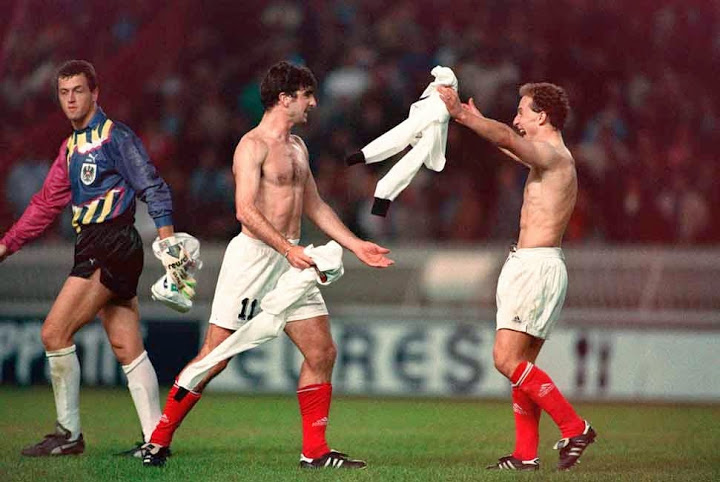
After a three-month break, France would open their 1993 account with a 4-0 away triumph over Israel on 17th February. Goals from Eric Cantona, Alain Roche and two from Laurent Blanc would help France earn a resounding win in the city of Ramat Gan, home to the world’s largest diamond exchange. The following month, a Jean-Pierre Papin goal would see France win the reverse fixture over Austria 1-0, earning France their fourth victory in five World Cup qualifiers. Halfway through qualifying, Gerard Houllier’s side would sit top of Group 6, two points ahead of Bulgaria and Sweden (with the latter having played one game fewer). In Sweden’s next match, two Eric Cantona goals would extend France’s record to five wins in six with a 2-1 win in Paris. At this point, it seemed like France had rediscovered the form that had carried them to Euro 1992, with it now being a case of when, not if, Les Bleus would qualify for the World Cup.
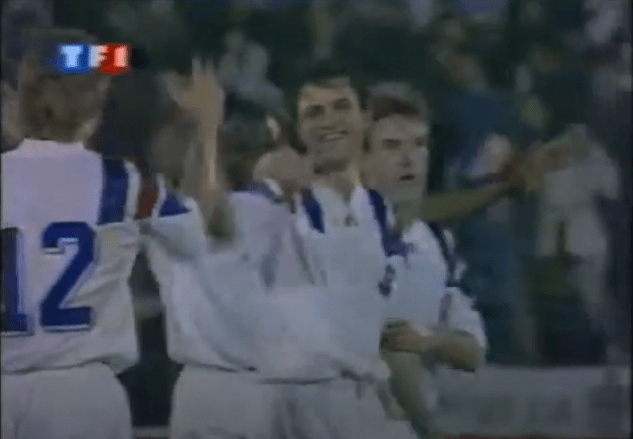
In July, a 3-1 friendly win over Russia would extend France’s winning run to six matches and give the team confidence heading into their final four 1994 FIFA World Cup qualifying matches, beginning with Sweden on 22nd August 1993. After France’s 2-1 win in April, Sweden would recover with back-to-back victories over Austria (1-0) and Israel (5-0) to draw level on points with Gerard’s Houllier men at the top of Group 6. In this top-of-the-table clash, Sweden and France would cancel each other out in a 1-1 draw, with both goals coming in the final twenty minutes. Franck Sauzée would break the deadlock in the 77th minute, collecting a Didier Deschamps pass before firing a long-range shot past Thomas Ravelli. However, Tomas Dahlin would pop up with an 88th-minute equaliser to halt France’s winning streak and earn a point for Tommy Svensson’s side.
Two weeks later, France would return to winning form in Finland, with Laurent Blanc and Jean-Pierre Papin scoring in a 2-0 win. On the same night, Bulgaria and Sweden’s 1-1 draw meant that France would head into the final two qualifying matches in pole position to qualify for the 1994 FIFA World Cup. Holding a three-point gap to third-placed Bulgaria, a win from either of their last two games against Israel or Hristo Stoichkov and Co would be enough for France to book their tickets to America.
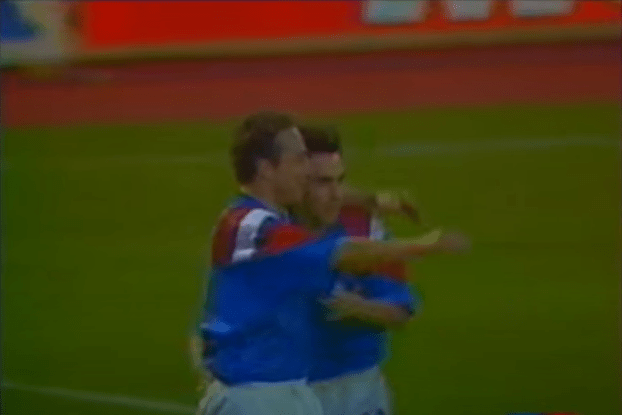
On 13th October 1993, France would invite Israel to the French capital. The French had triumphed 5-0 in the reverse fixture back in January, and another comfortable victory was expected by the 32,700 spectators inside the Parc Des Princes. Fielding a team featuring Laurent Blanc and Marcel Desailly in a back three, Didier Deschamps and Emmanuel Petit anchoring the midfield and a front three of Jean-Pierre Papin, David Ginola and Eric Cantona, France would fall behind in the 21st minute. From a flicked-on header, striker Ronen Harazi would fire past French goalkeeper Bernard Lama to put the visitors ahead. However, France would equalise through Franck Sauzée and later take the lead through David Ginola to head into half-time with a 2-1 advantage.
From this point, many would expect France to win the match 2-1 or even extend their lead to earn a more comfortable victory. World Cup qualification was on its way. However, Israel had not read the script. In the 83rd minute, Eyal Berkovic’s goal would put Shlomo Scharf’s team level at 2-2. Set to attain their fourth draw in nine qualifying matches, Israel would quickly attempt one better. In the 90th minute, Liverpool striker Ronny Rosenthal would send in a cross, and Reuven Atar would shoot past Lama to inexplicably give Israel the lead. With no time to respond, the Blue and Whites would earn a shocking 3-2 victory over group leaders France. On the same night, Bulgaria and Sweden would defeat Austria and Finland to drop France down to 2nd in the group. Now, France would need to avoid defeat against Bulgaria at home to claim World Cup qualification.
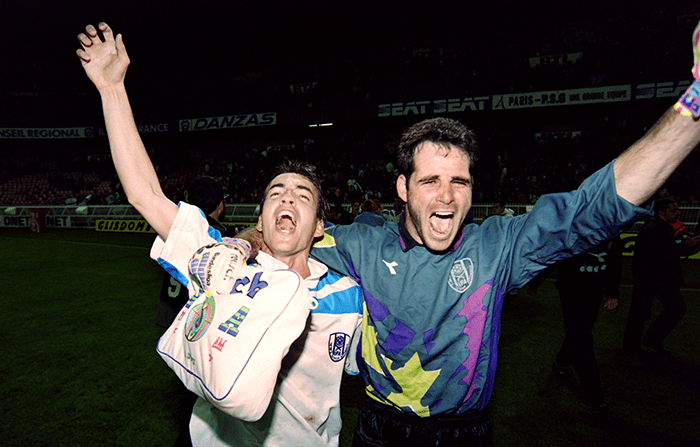
Before France’s final match, Sweden would draw with Austria to book their place in the 1994 FIFA World Cup as Group 6 winners. Now, attention would turn to Paris on 17th November as France and Bulgaria would battle for the second qualifying spot. French manager Gerard Houllier would make one change from the Israel turnaround, replacing David Ginola with 22-year-old attacking midfielder Reynald Pedros, with the Nantes man making his first start in his fourth international cap. Knowing the stakes and backed by a vociferous home crowd, the match would remain goalless throughout the first half-hour of football. However, Jean-Pierre Papin would knock the ball in the direction of strike partner Eric Cantona to score the opening goal after 32 minutes. Five minutes later, Bulgaria would earn a corner. From Krasimir Balakov’s delivery, striker Emil Kostadinov’s headed effort would draw Dimitar Penev’s side level. With a half-time score of 1-1, France was set to qualify ahead of Bulgaria. However, Bulgaria, like France, had missed the previous World Cup in Italy and would not take that result lying down.
As the minutes ticked down, the pendulum was swinging further towards France, with Les Bleus set to make their World Cup return. Gerard Houllier would even take off captain Papin after 69 minutes, replacing him with David Ginola. However, the game and the group would soon turn on its head. From a French cross into the Bulgarian penalty area, the Lions would launch a counter-attack. Just inside the French half, Lyuboslav Penev would launch the ball forwards towards Kostadinov. Running into the penalty area, Kostadinov would bring the ball down, smashing it high into the roof of the net from a tight angle with one second remaining.
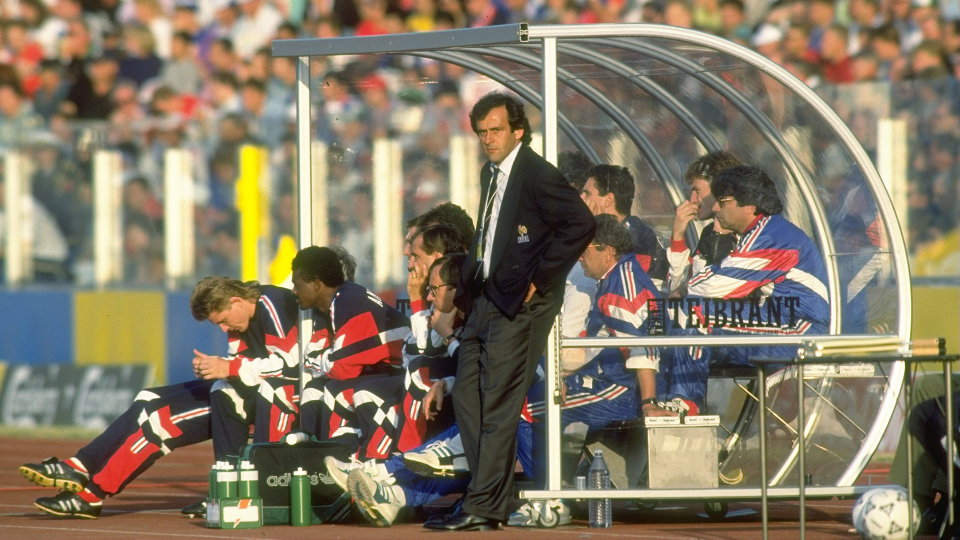
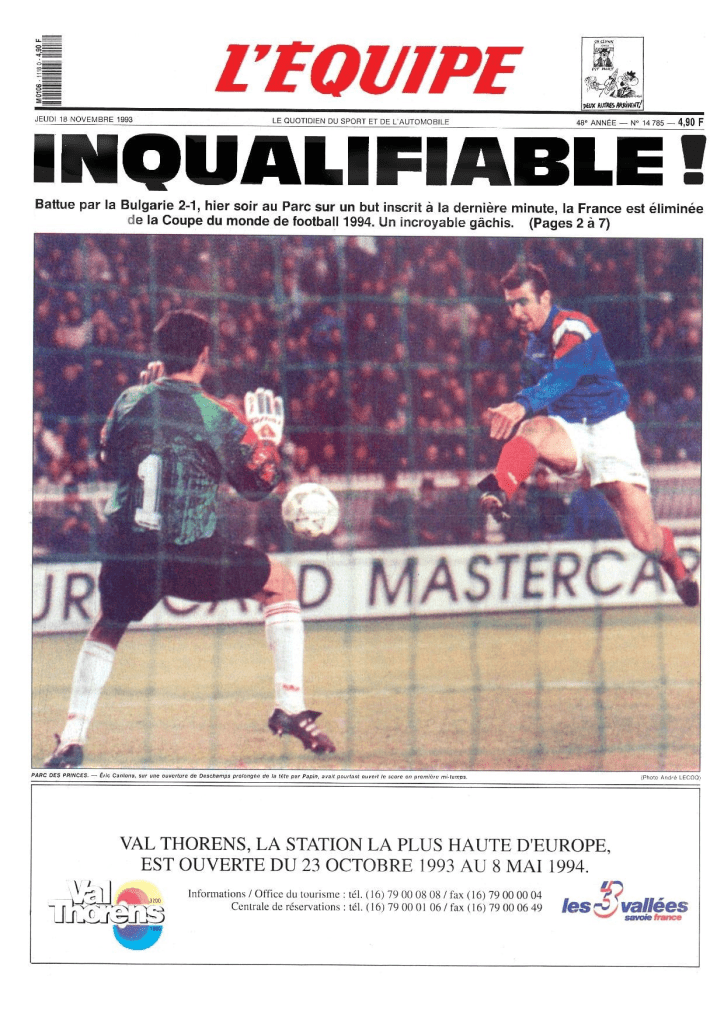
As Kostadinov wheeled away to celebrate with his teammates, even the French commentators for TV channel TF1 would acknowledge that the Bulgarian striker had just scored a ‘décent goal’. At the same time, the French coaching staff on the bench and players on the field would walk away with their hands on their heads, wondering what had just transpired. The camera would even find former manager Michel Platini on the touchline, with the former talisman turning away with his arms folded. Thirty seconds after the restart, the referee would blow the final whistle to confirm that Bulgaria had qualified for the 1994 FIFA World Cup, while France would miss out on the tournament once more. Again, the French players would fall to their haunches or walk away with their heads held low. Meanwhile, Gerard Houllier would retreat inside the stadium’s bowels as the home fans voiced their disapproval over more French failure. The following day, L’Equipe’s headline would read ‘Inqualifiable!’, before going on to call the defeat ‘an incredible waste’.
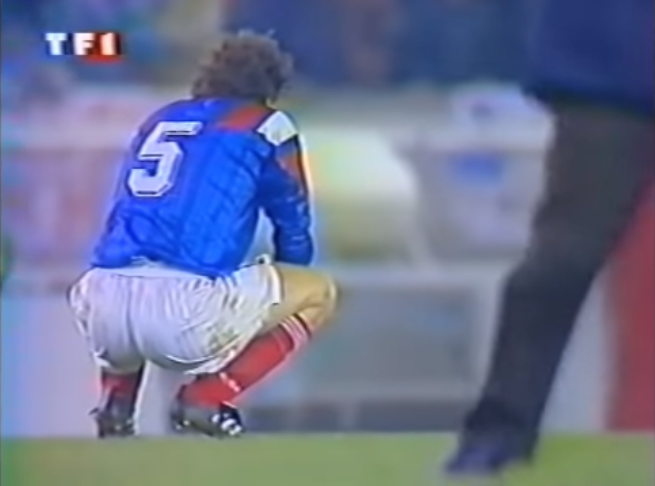
For the second time in succession, France would fail to qualify for the FIFA World Cup. However, this one would hurt more compared to four years earlier. With two matches left, France was leading Group 6 after six wins from eight games. One more win would have been enough to ensure qualification. However, two last-minute goals would cost France consecutive matches against Israel and Bulgaria. If France had drawn these matches 2-2 and 1-1, they would have qualified for the World Cup. The odds were stacked heavily in France’s favour heading into these two matches, but Gérard Houllier’s men would manage to snatch defeat from the almost inevitable jaws of victory. For this embarrassment, Houllier would resign his position as manager.
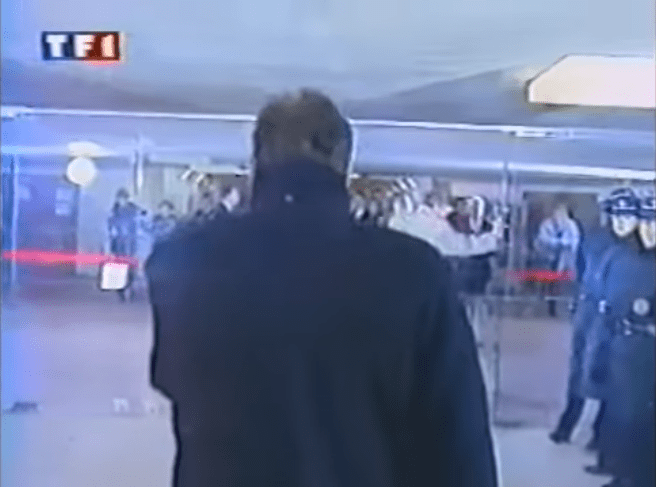
In less than five years, France would host the 1998 FIFA World Cup. At this point, fans of the national team could not conceive of a French victory in this tournament, following years of failure dating back to the 1986 FIFA World Cup semi-final defeat to Germany. Something would have to happen to ensure that France went into that competition with any chance of doing well. Otherwise, French fans could only see complete and utter embarrassment coming up on the horizon.
1994 FIFA World Cup qualification – UEFA Group 6
| Position | Team | Played | Won | Drawn | Lost | GF | GA | GD | Points |
|---|---|---|---|---|---|---|---|---|---|
| 1 | Sweden | 10 | 6 | 3 | 1 | 19 | 8 | +11 | 15 |
| 2 | Bulgaria | 10 | 6 | 2 | 2 | 19 | 10 | +9 | 14 |
| 3 | France | 10 | 6 | 1 | 3 | 17 | 10 | +7 | 13 |
| 4 | Austria | 10 | 3 | 2 | 5 | 15 | 16 | -1 | 8 |
| 5 | Finland | 10 | 2 | 1 | 7 | 9 | 18 | -9 | 5 |
| 6 | Israel | 10 | 1 | 3 | 6 | 10 | 27 | -17 | 5 |
Part 6: 6th-best runner-up
For the third time in six years, France would begin 1994 with a new manager and no major tournament to look forward towards. As had been the case when the French Football Federation (FFF) would choose to replace Michel Platini with his assistant manager Gérard Houllier, the same rules would apply when selecting Houllier’s successor 17 months later.
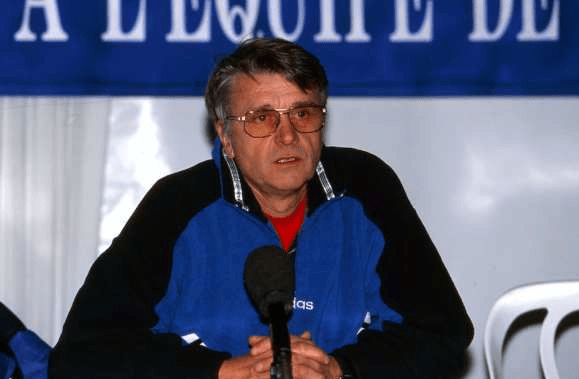
For the past year, Aimé Jacquet, a former two-time Ligue 1 and French Manager of the Year winner when the manager of Bordeaux, had sat on the bench next to Gérard Houllier watching the bubble slowly burst on his boss’s tenure as France manager. Now, Jacquet would accept the task of qualifying France for UEFA Euro 1996 and, potentially, leading the team into a home World Cup in 1998. However, his first match in charge would come on 16th February 1994, where France would face Italy in a friendly. On this day, six players who had started the final World Cup qualifier against Bulgaria three months earlier would retain their places for this match. Along with the retained Bernard Lama, Marcel Desailly, Alain Roche, Didier Deschamps, Paul Le Guen and Eric Cantona, new additions Christian Karembeu, Éric Di Meco, Youri Djorkaeff, Jérôme Gnako and David Ginola would fill up the rest of the starting line-up. In Napoli, France would get off to the perfect start under Aimé Jacquet, as a Djorkaeff goal would see Les Bleus upset the Azzurri 1-0.
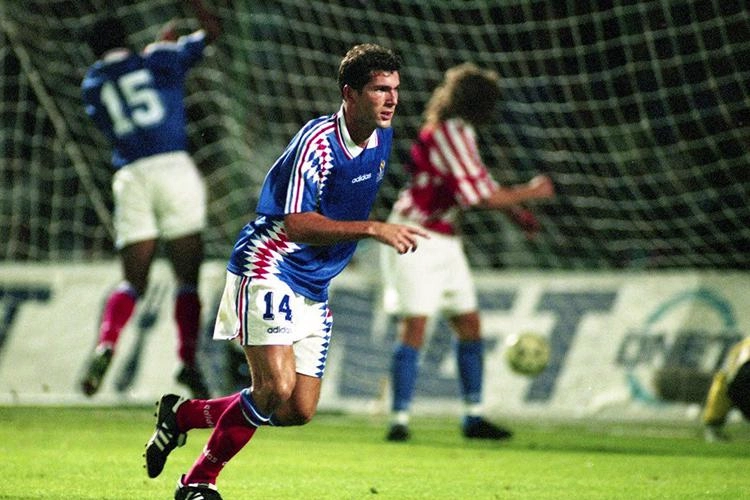
Following this victory, Jean-Pierre Papin, Youri Djorkaeff and Corentin Martins would help France defeat Chile 3-1 in Lyon before travelling to Japan for the Kirin Cup in May 1994. On 26th May, Les Bleus would beat Australia 1-0 thanks to an Eric Cantona goal before thrashing Japan 4-1 three days later. In their final friendly before beginning their Euro ’96 qualification campaign, France would draw 2-2 with the Czech Republic in August 1994, a match more notable for the international debut of 22-year-old Bordeaux midfielder Zinedine Zidane from the substitutes bench. After coming off the bench with France 2-0 down, the Bordeaux midfielder would score two goals in the 85th and 87th minutes to earn France a draw.
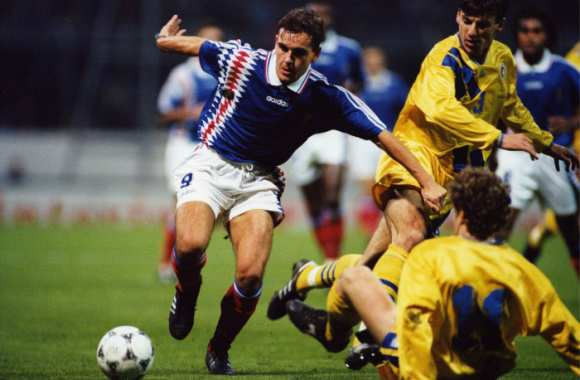
Despite failing to make the previous World Cup, France would begin the Euro ’96 qualifying group draw as a top seed. Aimé Jacquet’s team would end up in Group 1 with World Cup quarter-finalists Romania, Poland, Israel, Slovakia and Azerbaijan. Of the teams in this group, only Romania had featured in the 1994 World Cup and would pose the biggest threat to France during the qualifiers. However, with Euro ’96 becoming the first European Championships to feature 16 teams, the process for France to make the tournament would become slightly more accessible. Along with eight group winners, the six best performing group runners-up would also qualify automatically. The two worst-performing second-placed teams would then face one another in a play-off to decide the final qualifier. However, Les Bleus would first have to finish in the top two of Group 1 following ten rounds of matches to give themselves a chance of reaching Euro 96.
France would begin their Euro ’96 qualification campaign with a goalless draw away to newly-minted national team Slovakia. With David Ginola and new national captain Eric Cantona starting up front and Christophe Dugarry coming off the bench, the French could not find a way through the Slovak back five. One month later, France would play out another goalless draw with Romania in Saint-Etienne, a somewhat positive result against a team that reached the World Cup quarter-finals. However, by the time France produced a third consecutive 0-0 draw against Poland, fans started to get restless. While the back five of Jocelyn Angloma, Laurent Blanc, Marcel Desailly, Alain Roche and Eric Di Meco had kept another clean sheet, the team’s main striker and captain Eric Cantona was now without a goal in five international matches. Cantona’s strike partner Nicolas Ouédec failed to find the net in his last four international appearances. On 12th December 1994, France would finally earn their first qualifying victory, with a 2-0 win over group minnows Azerbaijan to end the year on a slightly positive note.
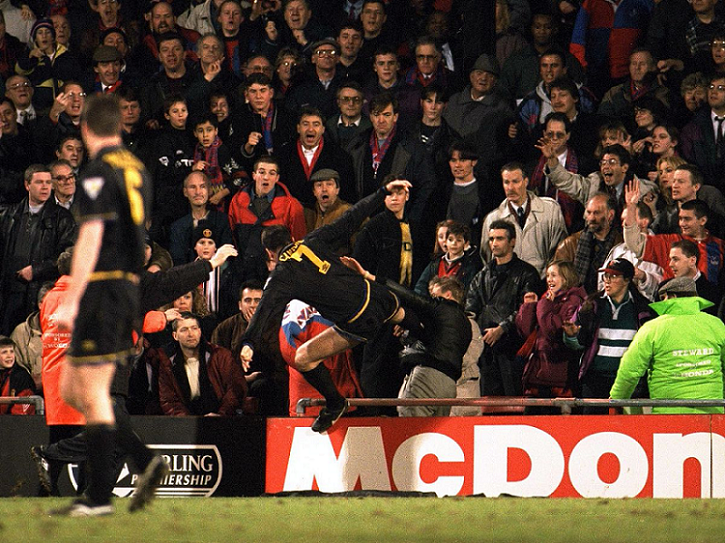
After a 1-0 friendly win over the Netherlands to begin 1995, France would soon lose their captain Eric Cantona to a disciplinary ban. On 25th January, during a match between Cantona’s Manchester United and Crystal Palace, the French forward would receive a red card for kicking an opposition defender. While walking off the pitch, a fan in the crowd would hurl abuse at Cantona. Seeing the red mist, Cantona would launch at the fan with a ‘kung-fu’ kick before landing punches on the man. For the attack, Eric Cantona would earn an eight-month worldwide ban from all forms of football, accept a criminal charge and undertake 120 hours of community service. In addition, Aimé Jacquet would strip Cantona of the national team captaincy, giving the armband to Didier Deschamps for the foreseeable future. Following his ban, Eric Cantona would never add to his 45 France caps before his retirement in 1997.
On 29th March 1995, France would draw 0-0 with Israel, registering their fourth goalless draw in five Euro 96 qualifiers. The stalemate with Israel put France 3rd in Group 1 with seven points behind leaders Romania (10) and second-placed Israel (9). In five matches, France had not conceded once but had only scored two at the other end. France would need to start scoring goals and winning matches to qualify for Euro 96. On 26th April, France would finally deliver a dominant performance, defeating Slovakia 4-0 in Nantes. An own goal by midfielder Ondrej Kristofik would give France a 27th-minute lead, and further goals from David Ginola, Laurent Blanc and Vincent Guérin would complete the rout.
In July, France and Norway would deliver a 0-0 draw in a friendly match. The match would see the international debut of 22-year-old Nantes defensive midfielder Claude Makélélé. Returning to competitive action one month later, France would host Poland in Paris. After a mixed start, a 4-3 win over Israel and a 5-0 thrashing of Slovakia had moved Poland into 2nd place in Group 1, level on points with France but ahead on goal difference. Inside the Parc Des Princes on 16th August, the game between the two teams would end in a 1-1 draw. Poland would lead at the half-time break through Andrzej Juskowiak’s 35th-minute opener, but France would earn a draw through Youri Djorkaeff’s 87th-minute equaliser. Five points behind group leaders Romania, Poland would now be the biggest threat to France’s Euro ’96 qualification hopes.
Behind Poland on goal difference heading into their eighth qualifying match, Aimé Jacquet’s side would rectify that statistic by producing the biggest win in the 91-year competitive history of the France national football team against poor, unfortunate Azerbaijan at the Stade de l’Abbé-Deschamps in Auxerre. Les Bleus would open the scoring through Marcel Desailly’s header after 13 minutes. Five minutes later, a header from Youri Djorkaeff would double the French lead, and midfielder Vincent Guérin would give France a 3-0 half-time advantage following an individual effort in the 33rd minute.
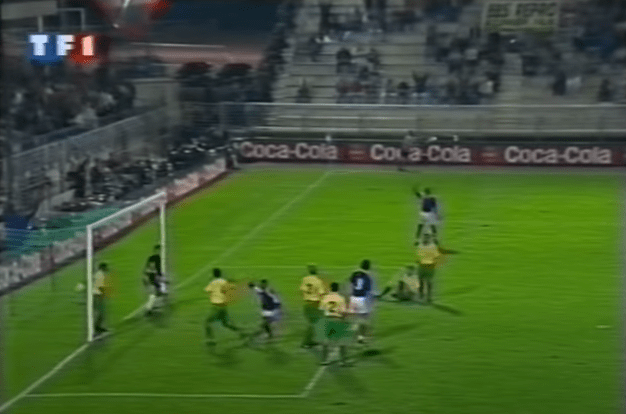
1-0 Desailly 13′ 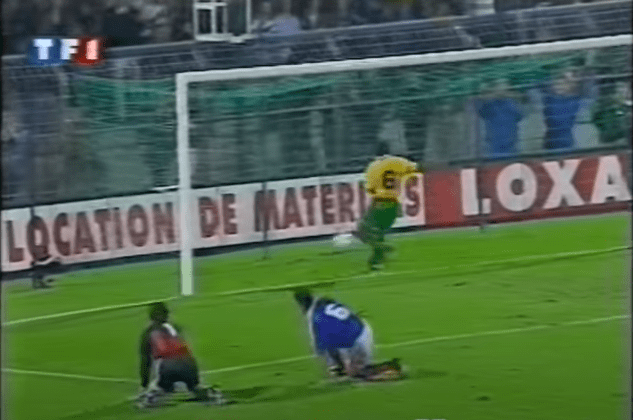
2-0 Djorkaeff 18′ 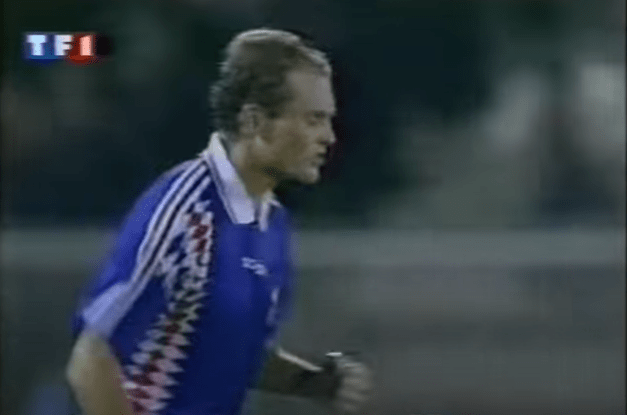
3-0 Guérin 33′
If France were using the first half to warm themselves up, they would run riot in the second period. In the 49th minute, Reynald Pedros would score France’s fourth goal of the evening. Next, centre-back Frank LeBoeuf and striker Christophe Dugarry would register their first international goals to rack up goals number five and six, then France would score three goals in six second-half minutes. In the 72nd minute, Zinedine Zidane would put his team in seventh heaven before LeBoeuf and Djorkaeff would notch up their second goals of the night to make it 9-0. Finally, in the 90th minute, substitute forward Christophe Cocard would bring France in double figures to complete a 10-0 win. With this win, France would move into 2nd place in Group 1, three points behind leaders Romania.
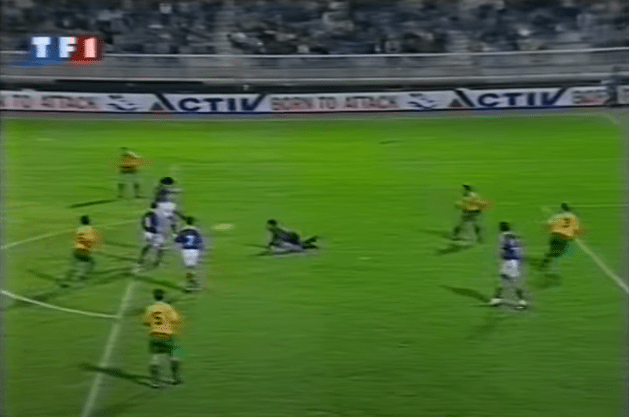
4-0 Pedros 49′ 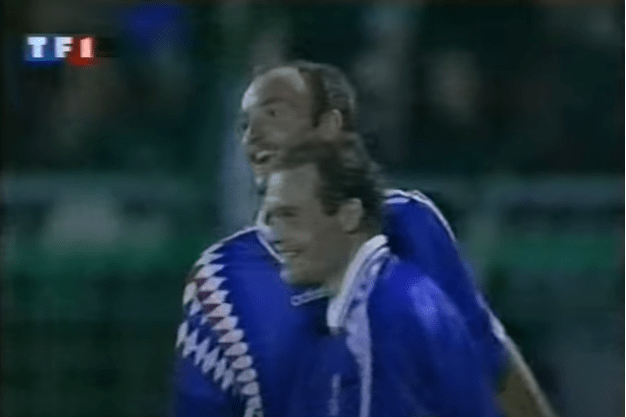
5-0 Leboeuf 54′ 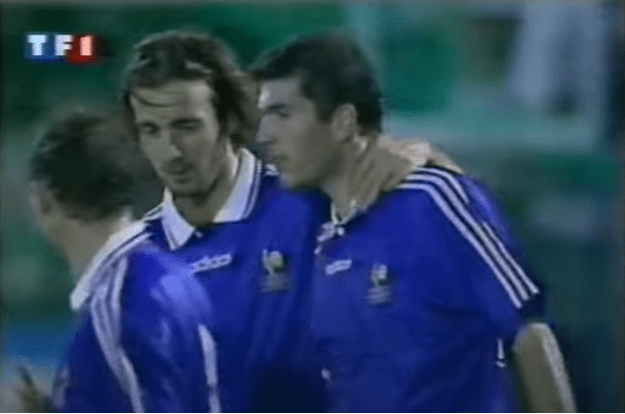
6-0 Dugarry 66′ 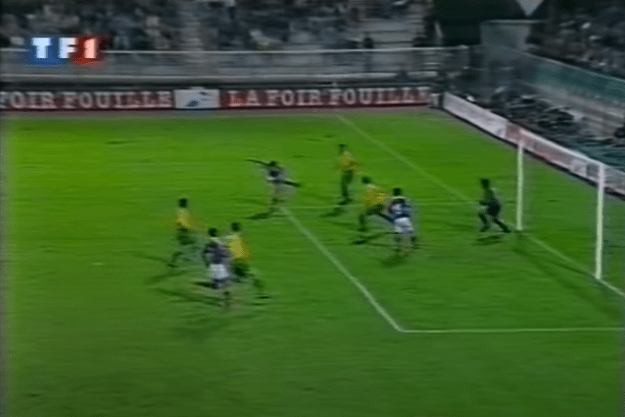
7-0 Zidane 72′ 
8-0 Leboeuf (x2) 74′ 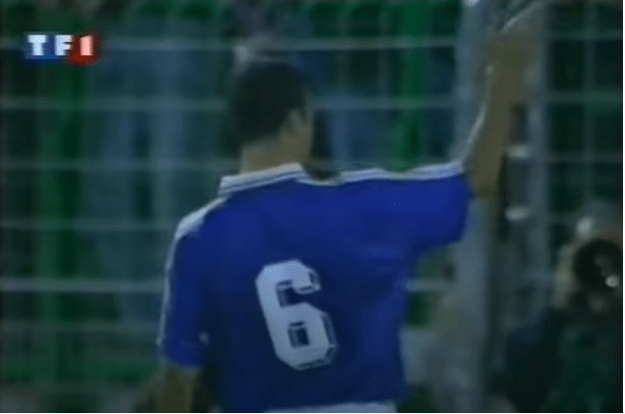
9-0 Djorkaeff (x2) 78′ 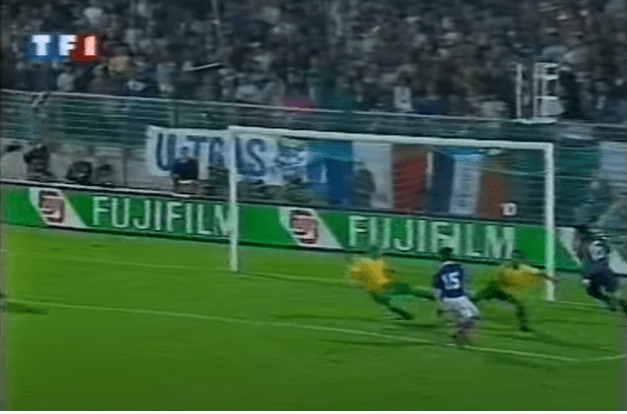
10-0 Cocard 90′
With two qualifying matches remaining, France would need to earn maximum points against Romania and Israel to secure their spot at Euro ’96. First up, a trip to Bucharest. Inside the Stadionul Steaua, France would carry a 2-0 lead into half-time. Christian Karembeu would score from a Zinedine Zidane cross to put his team ahead after 29 minutes, and Youri Djorkaeff would score a rebound for his fourth goal of the qualifying campaign. Romania would pull one back six minutes into the second half through Marius Lăcătuș’ effort, but Zidane would accept a Karembeu pass to score France’s third goal and seal a big win.
With Poland losing 4-1 to Slovakia, France could head into their final match against Israel knowing that a win would likely earn them a place at Euro ’96 as one of the best group runners-up. However, if Romania failed to beat a resurgent Slovakia, France could qualify for the Euros as Group 1 winners. In Caen on 15th November 1995, France beat Israel 2-0 through second-half goals from Youri Djorkaeff and Bixente Lizarazu. Romania’s 2-0 win over Slovakia in Košice would see them top the group and qualify for their first European Championships. Now France would have to hope that their qualifying record was enough to take them to the finals in England.
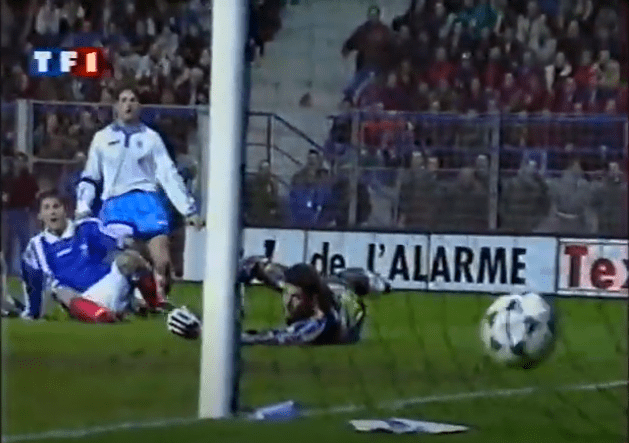
At the end of qualifying, Spain, Switzerland, Croatia, Czech Republic, Portugal, Germany and Russia would join Romania as group winners. Meanwhile, the eight group runners-up would be ranked based on their results against the teams that finished 1st, 2nd and 4th in their respective groups. Italy would top these ranks with 13 points, followed by Bulgaria (12), Turkey, Scotland and Denmark (all 11) and finally, France with 10 points. In the end, two wins over Romania and Slovakia plus four draws with the former two and Poland (x2) would see France edge out the Netherlands and the Republic of Ireland to take the final automatic qualifying place for Euro 96 as the 6th-best group runner-up.
UEFA Euro 1996 Qualifying Group 1
| Position | Team | Played | Won | Drawn | Lost | GF | GA | GD | Points |
|---|---|---|---|---|---|---|---|---|---|
| 1 | Romania | 10 | 6 | 3 | 1 | 18 | 9 | +9 | 21 |
| 2 | France | 10 | 5 | 5 | 0 | 22 | 2 | +20 | 20 |
| 3 | Slovakia | 10 | 4 | 2 | 4 | 14 | 18 | -4 | 14 |
| 4 | Poland | 10 | 3 | 4 | 3 | 14 | 12 | +2 | 13 |
| 5 | Israel | 10 | 3 | 3 | 4 | 13 | 13 | 0 | 12 |
| 6 | Azerbaijan | 10 | 0 | 1 | 9 | 2 | 29 | -27 | 1 |
Part 7: Forget The Past
One month after qualifying, France would learn their group for UEFA Euro 1996. With hosts England, holders Denmark, Germany and Spain as the seeded teams in the draw, the French fans and players would hope for a group involving the defending champions. However, in the draw, France would end up in Group B with Bulgaria, Romania and top seeds Spain. Having finished behind Romania in qualifying Group 1 and with Spain earning more points than any other team in qualifying (26), Aimé Jacquet and his backroom team would have a task on their hands to get through Group B and qualify for the knockout stages of a European Championship for the first time since 1984. With the right squad, the correct tactics and a little bit of luck, that fate could come their way.
France would play six friendly matches before travelling to England for the Euro ’96 finals in June. To begin 1996, Les Bleus would win a five-goal thriller against fellow qualifiers Portugal. In the 22nd minute, a Rui Costa free-kick would find the head of captain Fernando Couto to put Os Navegadores ahead. France would respond quickly, with Zinedine Zidane setting up Youri Djorkaeff to equalise two minutes later. After setting up the night’s first goal, Rui Costa would score Portugal’s second goal after 34 minutes to help his side lead 2-1 at the break. After subbing on Reynald Pedros and debutant Sabri Lamouchi for Vincent Guérin and Jocelyn Angloma, France would take 30 minutes of the second half to equalise once more. In a near carbon copy of the first goal, Zidane’s pass would lead to another goal for Djorkaeff. However, France would not stop there, as Sabri Lamouchi would assist Reynald Pedros for France’s third, and ultimately, winning goal.
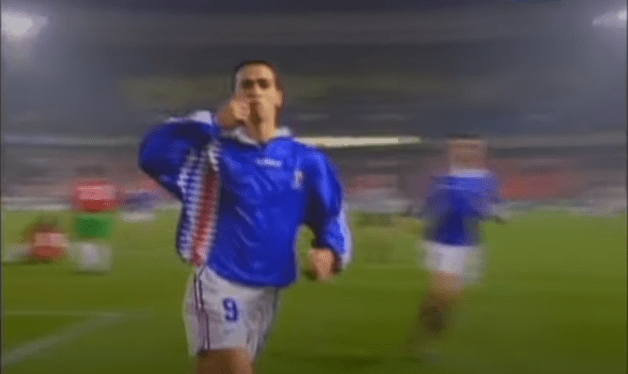
France would continue their march towards the Euros with a 3-1 win over Greece in February, with a Patrice Loko brace and another from Zinedine Zidane producing the desired result. One month later, Les Bleus would defeat regional rivals Belgium 2-0 away in Brussels. An unfortunate own goal from Philippe Albert would break the deadlock in the 66th minute, and Sabri Lamouchi would score his first international goal to seal the victory five minutes later.
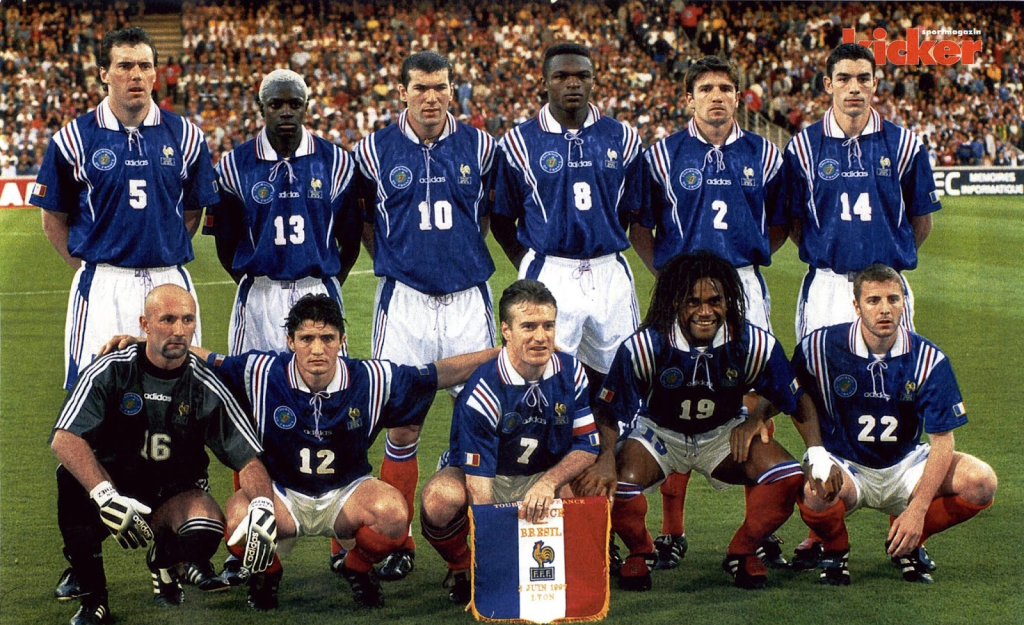
On 28th May 1996, Aimé Jacquet would announce his 22-man squad for the 1996 European Championships, selecting three goalkeepers, seven defenders, nine midfielders, and three forwards. Of the twenty-two players selected by Jacquet, eighteen would make their major tournament debuts at Euro ’96. At the same time, Euro ’92 squad members Bruno Martini, defenders Jocelyn Angloma and Laurent Blanc and midfielder Didier Deschamps would hope to improve upon the group stage failure of four years earlier.
However, two notable omissions would see strikers Jean-Pierre Papin and Eric Cantona, starters in 1992, miss out on the 1996 squad. France would begin their Euro ’96 qualifying campaign with the duo continuing their prolific partnership together. However, France’s 1-0 friendly win over the Netherlands in January 1995 would mark the final appearance for either striker. Notably, Cantona would serve an eight-month ban during 1995 for his infamous ‘Kung fu’ kick, while the 33-year-old Papin’s high-profile move from AC Milan to Bayern Munich in 1994 had turned disastrous, with the forward scoring 6 goals in 40 appearances up to this point. In addition, Newcastle United’s David Ginola would miss out despite featuring heavily in the Magpie’s Premier League title challenge the previous season. Instead, manager Aimé Jacquet would trust PSG’s Patrice Loko, Bordeaux’s Christophe Dugarry and Monaco’s Mickaël Madar to find the net for Les Bleus.
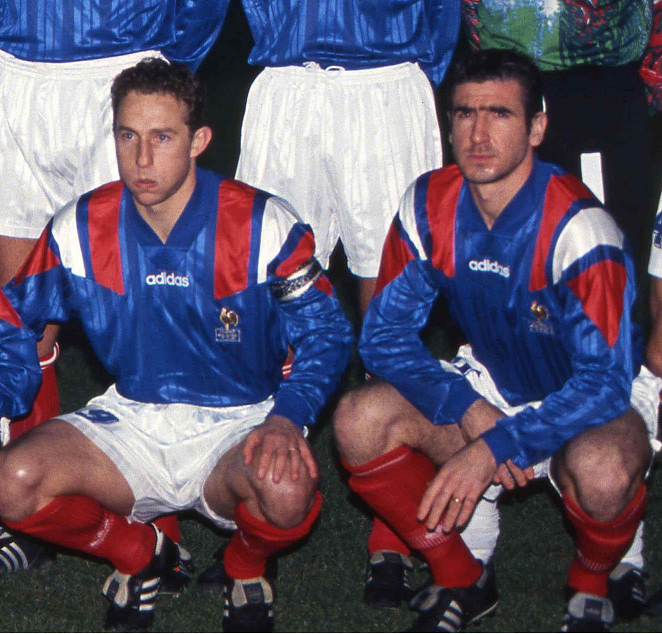
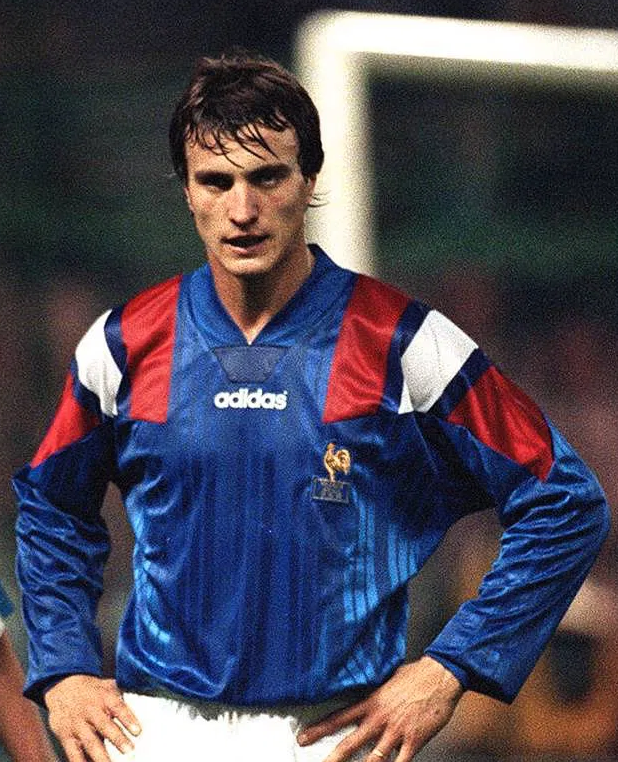
The Euro ’96 squad would enter the competition with a similar age (27.3 to 26.8) and caps profile (20 to 23) compared to the 20 men who travelled to Sweden in 1992. In 1992, Laurent Blanc was the only squad member to play his football outside of France. However, four players could stake this claim ahead of Euro 1996, with Jocelyn Angloma (Torino), Christian Karembeu (Sampdoria), Marcel Desailly (AC Milan) and captain Didier Deschamps (Juventus) all plying their trade in Italian football. Of the eighteen domestic-based players, Aimé Jacquet would pick three members (Blanc, Sabri Lamouchi, Corentin Martins) of Auxerre’s league title-winning side from the previous season and five players (Bernard Lama, Alain Roche, Vincent Guérin, Youri Djorkaeff, Patrice Loko) from runners-up PSG. In another intriguing selection choice, Jacquet would choose Bordeaux players Bixente Lizarazu, Zinedine Zidane and Christophe Dugarry despite Les Girondins finishing 16th in the French First Division that year.
| Position | No. | Name | Age | Caps | Club | Position | No. | Name | Age | Caps | Club |
| GK | 1 | Bernard Lama | 33 | 29 | PSG | MF | 6 | Vincent Guérin | 30 | 14 | PSG |
| GK | 16 | Fabien Barthez | 24 | 4 | Monaco | MF | 7 | Didier Deschamps | 27 | 53 | Juventus |
| GK | 22 | Bruno Martini | 34 | 31 | Montpellier | MF | 8 | Marcel Desailly | 27 | 25 | AC Milan |
| DF | 2 | Jocelyn Angloma | 30 | 35 | Torino | MF | 9 | Youri Djorkaeff | 28 | 20 | PSG |
| DF | 3 | Éric Di Meco | 32 | 22 | Monaco | MF | 10 | Zinedine Zidane | 23 | 15 | Bordeaux |
| DF | 4 | Frank Leboeuf | 28 | 9 | Strasbourg | MF | 14 | Sabri Lamouchi | 24 | 8 | Auxerre |
| DF | 5 | Laurent Blanc | 30 | 51 | Auxerre | MF | 18 | Reynald Pedros | 24 | 22 | Nantes |
| DF | 12 | Bixente Lizarazu | 26 | 21 | Bordeaux | MF | 19 | Christian Karembeu | 25 | 20 | Sampdoria |
| DF | 15 | Lilian Thuram | 24 | 14 | Monaco | MF | 21 | Corentin Martins | 26 | 14 | Auxerre |
| DF | 20 | Alain Roche | 28 | 22 | PSG | FW | 11 | Patrice Loko | 26 | 17 | PSG |
| FW | 13 | Christophe Dugarry | 24 | 11 | Bordeaux | ||||||
| FW | 17 | Mickaël Madar | 28 | 3 | Monaco |
After the squad announcements, France would play three more pre-tournament friendlies. First, the French would beat Finland 2-0 in Paris on 28th May, before a Laurent Blanc header was enough to defeat Germany in Stuttgart three days later. Finally, five days before the team’s first Euros match, Jocelyn Angloma and Mickaël Madar scored their first international goals in a 2-0 win over Armenia in Lille to send the team off the right way. Unbeaten since the start of the year, France would head into Euro ’96 in ideal form.
France would play their first match of UEFA Euro 1996 against Romania in Newcastle on 10th June. In qualifying, the two teams had played out a 0-0 in Saint Etienne in September 1994, before France would win 3-0 in Bucharest in October 1995. For this first European Championship game, the French would line up in a ‘Christmas Tree’ 4-3-2-1 formation. Ahead of goalkeeper Bernard Lama, Aimé Jacquet would play a defensive back four with full-backs Lilian Thuram and Éric Di Meco flanking the centre-back pairing of Marcel Desailly and Laurent Blanc. Further upfield, Christian Karembeu, Vincent Guérin and captain Didier Deschamps would start in a midfield three. Zinedine Zidane and Youri Djorkaeff would play as attacking midfielders behind lone striker Christophe Dugarry. Dugarry would end up scoring the only goal of the contest.
In the 25th minute, a misplaced pass by defender Gheorghe Mihali would fall to Youri Djorkaeff, who would cross the ball into the Romania penalty area. In a case of miscommunication, Romanian goalkeeper Bogdan Stelea would come out to claim the ball only to find himself in ‘no man’s land’, allowing Dugarry to head the ball past him into the empty net. After going behind, Romania would attempt a response, only for their attacks to fizzle on more than one occasion. In their most clear-cut chance, substitute Viorel Moldovan would find himself through on goal, only for Laurent Blanc to deny him with a last-ditch tackle. At the other end, Dugarry’s replacement Patrice Loko would almost get his name on the scoresheet only to miss the target after navigating his way through the opposition defence. However, one goal was enough, and France would claim their first major tournament victory in 10 years. Next up for Aimé Jacquet’s team: a tough match against group favourites Spain in Leeds five days later.
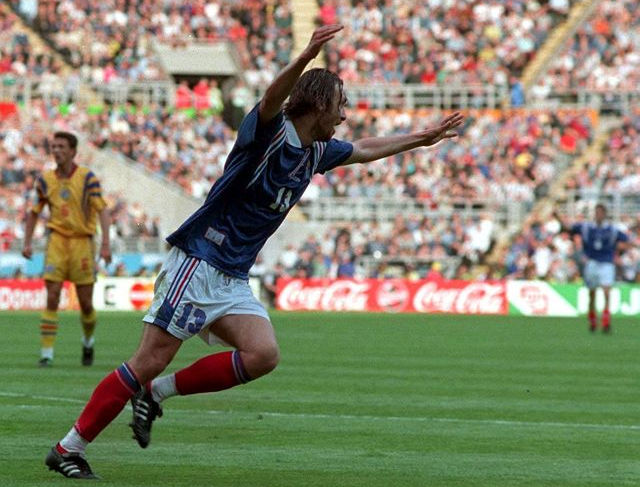
For France’s second Group B match, Aimé Jacquet would make three changes to the team that beat Romania. First, he would swap both full-backs, bringing in Jocelyn Angloma and Bixente Lizarazu for Lilian Thuram and Éric Di Meco. Second, Jacquet would replace the Romania match-winner Christophe Dugarry with Patrice Loko up top. Thus, the game at Elland Road would not only see the meeting between the two highest-profile teams in Group B, but it would also see two teams who went unbeaten during the qualification campaign face one another. However, while France would scrap for their second place in Qualifying Group 1 with five wins and five draws in ten matches, Spain would easily top Group 2, gaining eight wins and two draws to finish with 26 points out of a possible 30.
For two teams with unbeaten qualification records for Euro ’96, it was not surprising that the France and Spain match would end in a draw. Early on, Spain would appeal for a penalty following alleged contact between Laurent Blanc and Spanish midfielder José Luis Caminero. However, referee Vadim Zhuk would ignore the protests and wave play on. France’s first real chance would see great passing from Youri Djorkaeff, Christian Karembeu, and Patrice Loko set up Vincent Guérin for a shot that would need the attention of Andoni Zubizarreta to turn the ball around his near post. However, three minutes after the break, France would break the deadlock through Youri Djorkaeff. Didier Deschamps would intercept a Rafael Alkorta pass near the halfway line before passing the ball to Christian Karembeu. Karembeu would spot the forward run of Djorkaeff and find his man with a beautifully lifted ball into the penalty area. The PSG midfielder would take the ball in his stride before prodding it past Zubizarreta with his right foot.
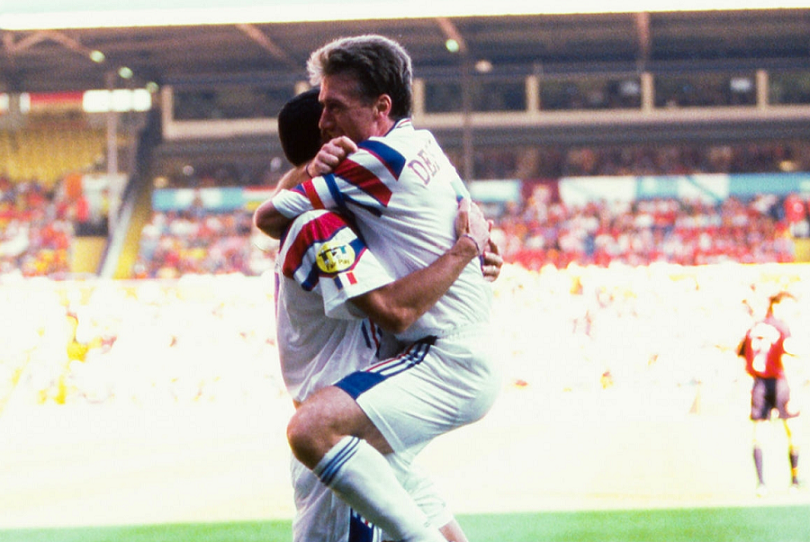
At first, the closest Spain would come to an equaliser would be a José Amavisca shot that would fall right into the hands of an upright Bernard Lama. Later, a ball from Caminero would find substitute Kiko for a sliding shot that would cross the face of the goal missing the far corner by a whisker. Later, France would almost score again, with Djorkaeff turning provider for Christophe Dugarry. However, Dugarry’s header would both miss the target and fail to find Zinedine Zidane’s run towards the far post. Finally, Spain’s equaliser would arrive in the 85th minute. The French would twice fail to clear their lines, and José Luis Caminero would pop up to scuff a seven-yard shot past Bernard Lama. Lama would get a left hand on the ball but could not stop it ultimately ending up in the net. France had enjoyed more possession and created better chances but would allow the win to slip through their fingers with Caminero’s equaliser.

With one final group game left to play, France would share the lead in Group B with Bulgaria, and the two teams would face each other in Newcastle on 18th June to potentially decide the winner of the group. For the Bulgaria match, Lilian Thuram and Christophe Dugarry would return to the starting XI, with Jocelyn Angloma and Patrice Loko dropping to the bench as a result.
On this Tuesday afternoon, France would produce their best performance so far, comfortably beating Dimitar Penev’s World Cup quarter-finalists to top Group B and make the last eight of Euro ’96. However, Penev’s nephew Lyuboslav would almost put Bulgaria ahead, sliding in at the back post only to send his shot high and wide. At the other end, a Youri Djorkaeff free kick would force a diving save out of opposition keeper Borislav Mihaylov. Laurent Blanc would head home Djorkaeff’s cross from the resulting corner to give France the lead after 21 minutes.
France would almost double their lead before half-time, as Christophe Dugarry would block the attempted pass of sweeper Petar Hubchev and try to chip Mihaylov. However, the Reading goalkeeper would manage to tip the ball behind for a France corner. Aimé Jacquet’s team would head into half-time in complete control of the match, leading Bulgaria 1-0 at the break.
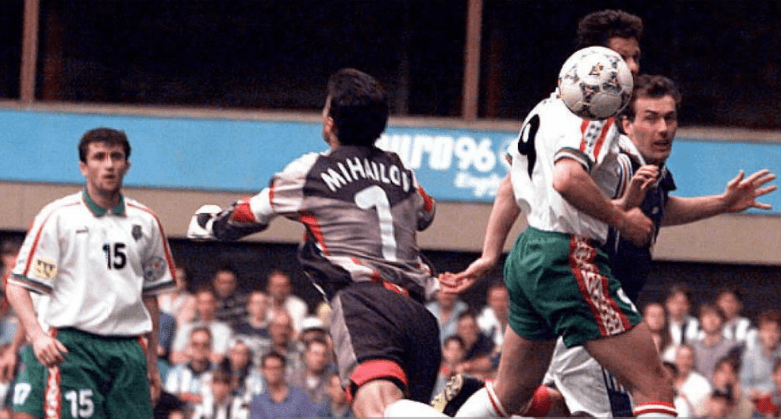
Halfway through the second half, France would score a second goal. From a Djorkaeff free-kick high out on the left flank, the threat of Laurent Blanc at the near post would force Lyuboslav Penev to glance a header past Mihaylov and score an own goal. After nearly opening the scoring in the first half, Penev had now successfully given France a 2-0 lead. However, with Spain and Romania currently drawing 1-1 at Elland Road, Bulgaria was still heading through to the quarter-finals despite losing to France. Four minutes after Penev’s mishap, Hristo Stoichkov would find the top corner with an excellent 25-yard free-kick to give his team hope in this match.
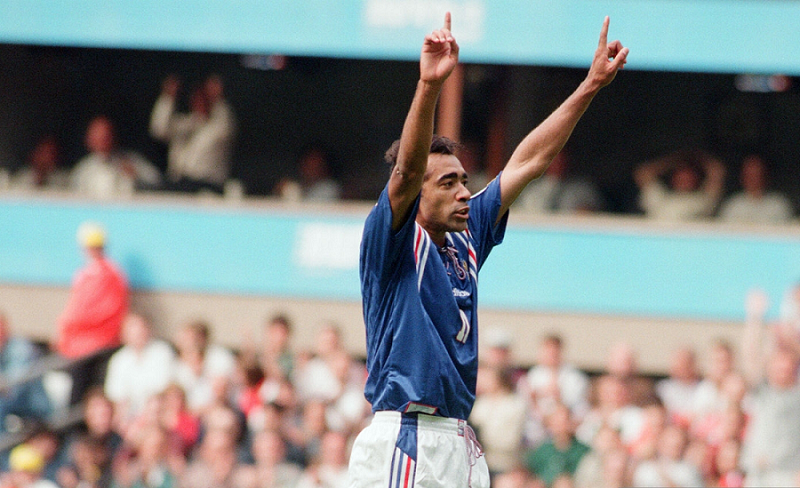
In the 81st minute in Leeds, Spain would take a 2-1 lead against Romania through Guillermo Amor’s finish. Now, Bulgaria would be heading home unless they could somehow find a way to snatch an unbelievable victory with less than ten minutes remaining in Newcastle. However, France would have the last word in the northeast. In the 90th minute, Christian Karembeu would flick the ball through a gap in the Bulgarian defence to substitute Patrice Loko. On-side, the PSG forward would run into the opposition box unopposed, flick the ball to the left of Borislav Mihaylov and keep his balance before firing the ball past the recovering defenders into the net. With this classy finish, France would beat Bulgaria 3-1 to top Group B and progress to their first knockout match in a major tournament since 1986.
UEFA Euro 1996 Group B
| Position | Team | Played | Won | Drawn | Lost | GF | GA | GD | Points |
|---|---|---|---|---|---|---|---|---|---|
| 1 | France | 3 | 2 | 1 | 0 | 5 | 2 | +3 | 7 |
| 2 | Spain | 3 | 1 | 2 | 0 | 4 | 3 | +1 | 5 |
| 3 | Bulgaria | 3 | 1 | 1 | 1 | 3 | 4 | -1 | 4 |
| 4 | Romania | 3 | 0 | 0 | 3 | 1 | 4 | -1 | 0 |
On 22nd June, France would take on the Netherlands at Anfield in the second of four UEFA Euro 1996 quarter-finals. The Netherlands had qualified for the last eight by finishing runners-up to hosts England in Group A. However, the Dutch would only finish second ahead of Scotland by scoring one more goal in their three matches. Also, Guus Hiddink’s side would suffer a 4-1 defeat to England in their final group game, scraping their way through to the knockout stages. However, the Netherlands team that stepped on the Anfield turf that Saturday evening would still boast such talents as Edwin van der Sar, Dennis Bergkamp and Patrick Kluivert. For the quarter-final, France manager Aimé Jacquet would reward Patrice Loko for his Bulgaria goal by starting him ahead of Christophe Dugarry in the only change to the French starting XI.
From a corner, the Netherlands would register the first threatening attempt on goal. Richard Witschge would swing the ball into the area, and an unmarked Ronald de Boer would head the ball down and wide with goalkeeper Bernard Lama out of his goal. As a potential counter-punch, France would move the ball up the field quickly, as Bixente Lizarazu’s flick would return the ball to Didier Deschamps in space. This attacking move would eventually end with Christian Karembeu finding striker Patrice Loko in the box, who would turn and shoot across the face of Edwin van der Sar’s goal. Down the other end of the field, Dennis Bergkamp would receive the ball on the left flank and find Philip Cocu, who managed to get a shot away despite a French tackle. However, Cocu’s quickly-taken effort would end up in Row I of the Anfield Road stand. After these opportunities, the two teams would head into half-time with the deadlock intact after an even first 45 minutes.

The first major highlight of the second half would see the Netherlands have grounds for a penalty. After a cross into the area, the ball would appear to hit the leading left arm of Marcel Desailly as he went to jostle with Patrick Kluivert near the edge of the box. However, to the Dutch striker’s dismay, referee Antonio López Nieto would award his team a free kick on the edge of the France 18-yard box. From the free-kick, Philip Cocu’s shot would deflect off the leg of the airborne Laurent Blanc and hit the outside of the near post.
Just past the hour mark, both Aimé Jacquet and Guus Hiddink would call upon substitutes for the first time. Hiddink would replace Dennis Bergkamp with Clarence Seedorf to inject more dynamism into the Dutch midfield, while Jacquet would make his customary striker swap of Christophe Dugarry for Patrice Loko. However, Dugarry would last just 19 minutes on the field before an injury saw Reynald Pedros become France’s second substitution around the 80-minute mark. Around this same time, Clarence Seedorf would run onto the end of a Youri Mulder pass at pace before attempting to dink the ball past Bernard Lama. However, the ball would hit Lama’s leg and deflect over the crossbar. Nothing could separate Les Bleus and the Oranje during regulation time, meaning 30 minutes of golden goal extra time would now potentially decide the winner between these two teams.
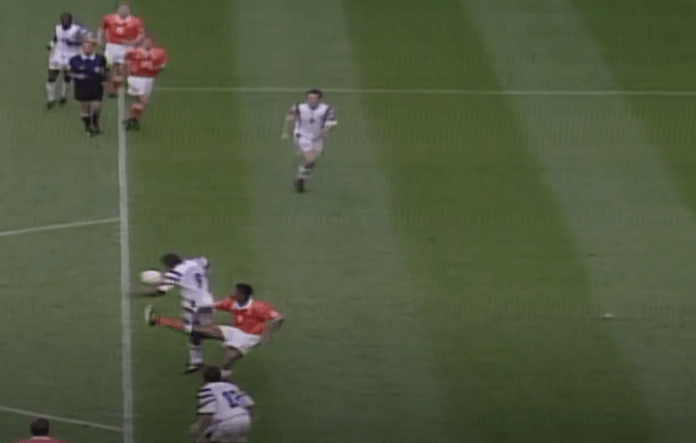
The first period of extra time would pass without a golden goal. However, a France attack with seconds remaining would end with the ball finding Zinedine Zidane in the Dutch penalty area. Jostling with Michael Reiziger all the way, the Bordeaux man could only produce a weak shot that would luckily fall into the path of Youri Djorkaeff, whose subsequent attempt would be smothered by both Edwin van der Sar and the tackle of Philip Cocu. In the second extra-time period, France would again come closer to the crucial golden goal. A handful of yards from his own box, Christian Karembeu would intercept Patrick Kluivert’s layoff and find Zidane near the centre circle. Zidane would play the ball out to Reynald Pedros on the right flank, who would deliver a long ball over to Youri Djorkaeff on the opposite side. Fancying himself, Djorkaeff would attempt a shot from outside the area, which van der Sar would claim quite easily.
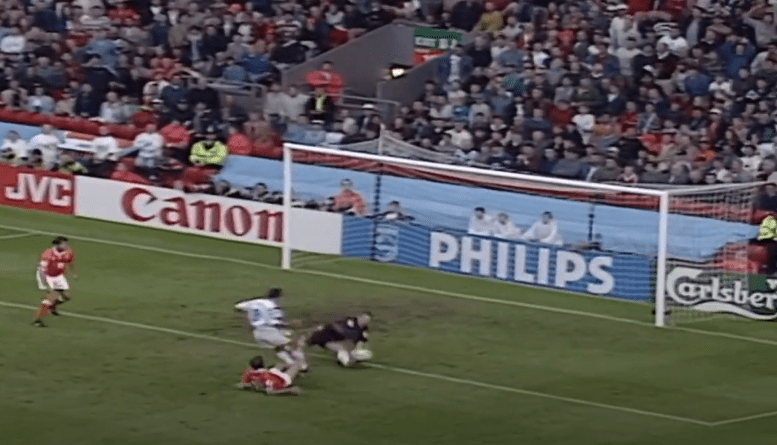
France was frequently managing to transition from defence into attack quickly. They would launch another counter-attack from their own penalty area through a Laurent Blanc interception and subsequent passes with Christian Karembeu and Didier Deschamps. Deschamps would run into space before passing to Vincent Guérin, who would soon find Djorkaeff down the right-hand side. After receiving the ball, Djorkaeff would cut inside, evading the Dutch tackles. Exchanging passes with Zidane on the edge of the box, Djorkaeff would win a free-kick from the foul of Winston Bogarde. With the free-kick, Djorkaeff would only send the ball over the top of the Dutch goal. A highlight of a poor 120 minutes of football, sparsely punctuated by excellent pieces of skill or elegant movement from a few choice players. With extra time now over, only a penalty shoot-out could decide the winner between these two teams.
The Netherlands would shoot first in the shoot-out, with centre-back Johan de Kock taking the first spot-kick. In front of the Kop, the Roda JC defender would strike the ball centrally, hitting the ball with power into the roof of the net via the crossbar, with Bernard Lama left looking up at it. Now, Zinedine Zidane would attempt to get France on the board at 1-1. Later becoming known as a penalty kick specialist, the 23-year-old would side-foot the ball deep into the bottom-left corner, out of the reach of Edwin van der Sar. Next up for the Dutch: Ronald de Boer. With his twin brother Frank a regular penalty taker for Ajax, Ronald would show the same assuredness from 12 yards, prodding the ball into the bottom corner while sending Lama the wrong way. 2-1. Youri Djorkaeff would take France’s second penalty, sending van der Sar the wrong way to level the score once more. 2-2.
Dutch striker Patrick Kluivert would continue the spot-kick success, echoing Zidane’s penalty with a side-footed shot to the goalkeeper’s right, evading Bernard Lama’s dive. 3-2. Left-back Bixente Lizarazu would tie everything up again, powerfully sending the ball into the bottom-right corner, as van der Sar would come within centimetres of providing the first save of the shoot-out. 3-3. That honour would instead go to his opposite number. Bernard Lama would guess correctly, diving low to his left to keep out Clarence Seedorf’s effort and keep the score at 3-3. Vincent Guérin would step up next and would give France the advantage, just squeezing his penalty above the dive of Edwin van der Sar. 3-4 France. Now, Dutch captain Dany Blind would need to score to keep his team in the shoot-out. He would score, hitting the ball to Lama’s right. 4-4.
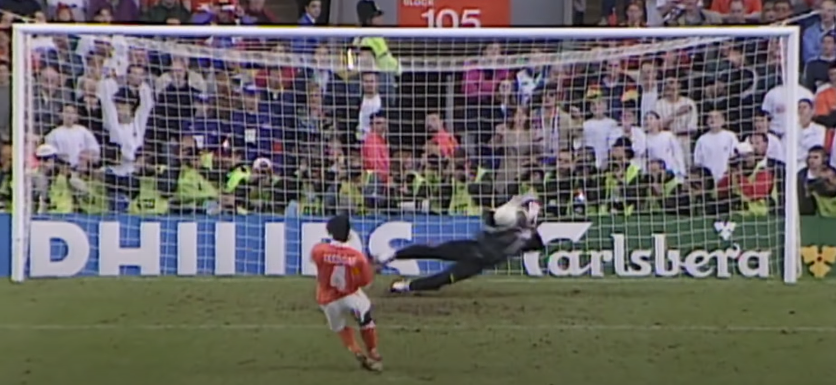
Now, the attention would turn to French centre-back Laurent Blanc. A survivor of Euro ’92, the 55-cap defender could send his side through to a first major semi-final since the 1986 World Cup. Blanc would hit the Adidas Questra ball into the bottom-right corner of Edwin van der Sar’s net, slipping as he did so, while the Ajax keeper guessed incorrectly. Blanc would wheel away in celebration, accepting the congratulations of his teammates, knowing he had just sent France to a third European Championship semi-final and their first appearance in the last four since 1984.
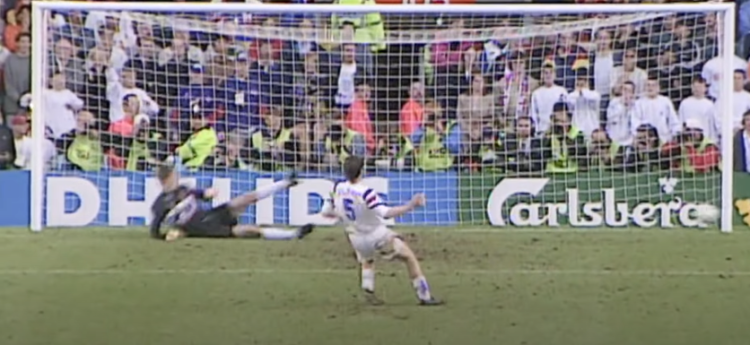
At Old Trafford on 26th June, France would take on the tournament’s surprise package, the Czech Republic. In their first tournament following the dissolution of Czechoslovakia, Dušan Uhrin’s team would defeat the 1994 World Cup finalists Italy 2-1 and draw 3-3 with Russia to finish 2nd in Group D behind Germany. Then, in the quarter-final, Karel Poborský’s famous scooped lob over Vítor Baía would knock out Luís Figo and the rest of Portugal’s burgeoning ‘golden generation’ and set up a semi-final with Aimé Jacquet’s men. Against the Czechs, injuries to Christian Karembeu and captain Didier Deschamps would see Sabri Lamouchi and Marcel Desailly come into the midfield, with Alain Roche taking Desailly’s place alongside Laurent Blanc in the heart of the French defence. On the other side, suspensions would force four changes in the Czech Republic XI, but the side would still feature Pavel Nedvěd, Vladimir Šmicer and quarter-final hero Karel Poborský in their attacking ranks. With these midfield talents taking on the likes of Zinedine Zidane and Youri Djorkaeff on the opposite side, it was a surprise that the first semi-final would end in another goalless draw for France.
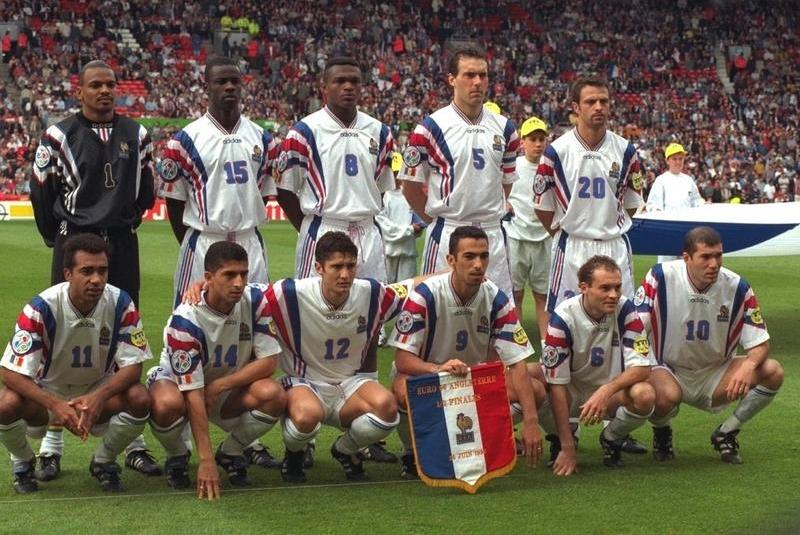
In a match filled with missed chances, the Czechs would provide the first clear-cut attempt on Bernard Lama’s goal. Dribbling down the left channel, striker Radek Drulák would cut inside Laurent Blanc into the French penalty area before unleashing a shot that cleared the top-right corner of the net. At the other end, Sabri Lamouchi would send a 30-yard shot that had the power but not the accuracy to trouble Czech goalkeeper Petr Kouba. Later in the first half, Patrice Loko would do better, turning and hitting a shot that Kouba would stretch himself to keep out at the far post. Apart from Loko’s effort, both teams would struggle to find a path through tight defensive lines, eventually resorting to shots from range. Unsurprisingly, the half-time score would read 0-0.
One minute into the second half, a clash of heads with Lilian Thuram would force Vladimir Šmicer off the field on a stretcher, and future Liverpool teammate Patrik Berger would replace him on the right wing. Soon, Radek Drulák would find more space in the channels, firing a shot from the right that Bernard Lama would catch despite the ball heading away from the PSG shot-stopper. France not long afterwards. Cutting inside to open up his right foot, Djorkaeff would let fly from the edge of the Czech Republic box, his shot hitting the crossbar before going over. Two minutes later, a cross into the box would see the French midfielder attempt a jumping volley that would just graze the top of the net. This pair of close calls would spark the Czech Republic into life. The speed and skill of Patrik Berger would see the winger run down the by-line and work his way into the French box before delivering a shot that Marcel Desailly would manage to block. Later, a slight deflection would take Jiří Němec’s side-footed effort away from goal. After a few more chances, referee Leslie Mottram would blow the whistle for full-time. Another 30 minutes of golden goal extra time would soon await Aimé Jacquet’s side.
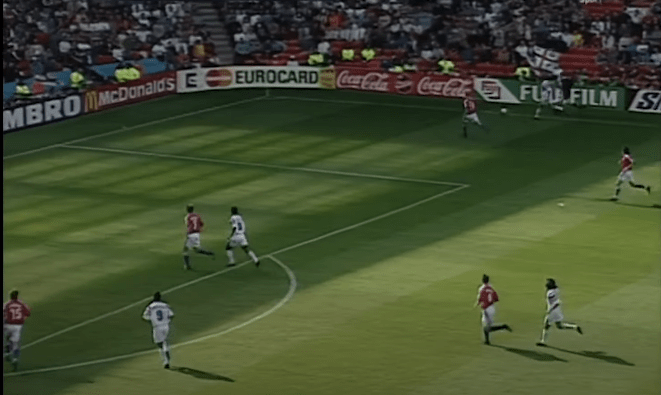
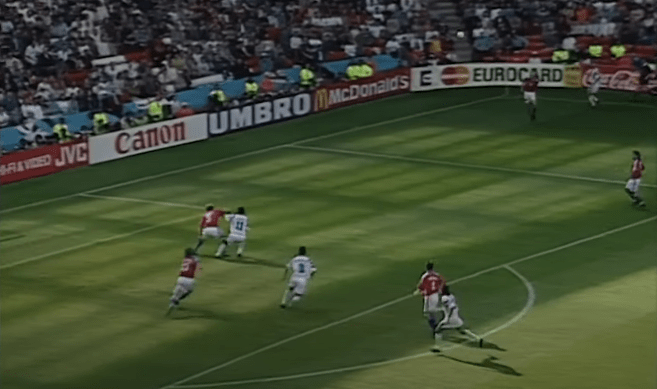
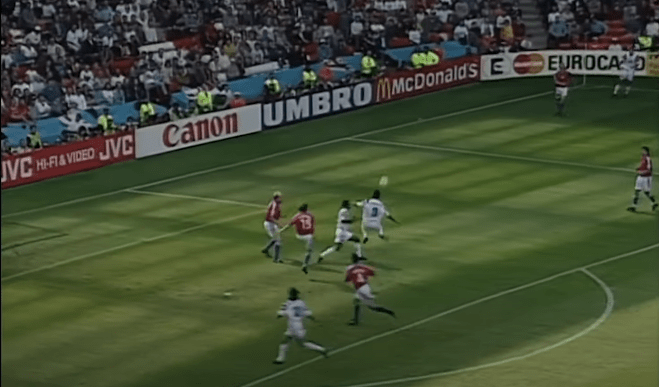
In extra time, Zinedine Zidane would trade passes with Youri Djorkaeff before firing a low shot towards the bottom-right corner that Petr Kouba would save. Laurent Blanc would mistime his run towards the ball from a Djorkaeff free-kick, missing it entirely as the ball went behind for a goal kick. At the other end, a Czech free-kick from Miroslav Kadlec would send Bernard Lama scampering to his left even though the ball would miss the target completely. Later in the first period, long-haired midfielders Patrik Berger and Karel Poborský would use their dribbling skills to run deep into French territory only for the defence to recover in time. In the second period, the quality of play would worsen as the player’s fitness levels decreased, with poor shooting quickly becoming the norm. With the game still goalless, this first UEFA Euro 1996 semi-final would go to penalties.
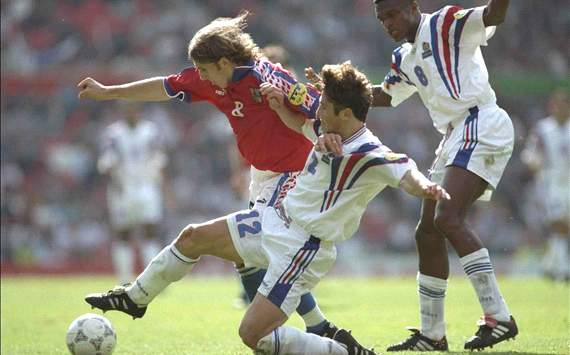
Aimé Jacquet would keep the same penalty takers that had proven successful during the quarter-final win over the Netherlands in this shoot-out. Zinedine Zidane would take the first penalty, sliding the ball into the bottom-left corner past Petr Kouba. 1-0. Substitute midfielder Luboš Kubík would shoot first for the Czechs, driving the ball down the middle into the gap left by Bernard Lama diving to his left. 1-1. Youri Djorkaeff would send the ball into the bottom-right corner, despite the Czech goalkeeper again guessing the correct location of Djorkaeff’s shot. 2-1. 24-year-old Pavel Nedvěd would quickly level the scores with a pin-pointed effort that would send Lama the wrong way. 2-2. Bixente Lizarazu would take a long run-up before sliding the ball inside the near post (3-2) before Patrik Berger, an excellent penalty taker on his best day, would do his reputation no harm by smashing his spot-kick to Lama’s left. 3-3. Vincent Guérin would continue the streak of successful penalty kicks, sending the ball high into the top-left corner. 3-3. Then, the Czech Republic’s quarter-final hero Karel Poborský would send the keeper the wrong way keep his side’s perfect record. 4-4.
The last of the pre-approved penalty takers for each side would be Laurent Blanc for France and Karel Rada for the Czech Republic. Knowing a miss could signal his team’s elimination, Blanc would again successfully find the net, but the ball would only just manage to squirm its way under the dive of Petr Kouba. 5-4. Now, Rada would need to respond, putting the ball into the bottom-right corner to level the score at 5-5. With all the assigned penalty takers scoring their spot-kicks, the penalty shoot-out would now head to sudden death, with the less confident players stepping up to the spot.
French substitute Reynald Pedros would put the ball on the spot. After completing his run-up, the 24-year-old Nantes midfielder would deliver a weak penalty that Petr Kouba would save with his legs. 5-5 Now, Miroslav Kadlec would have the chance to take the Czech Republic into the Euro 96 final. The 32-year-old sweeper would send his shot high above the dive of Bernard Lama into the goal. As players and backroom staff would rush into the arms of their penalty hero, the Czech fans inside Old Trafford would go crazy, with some even weeping. In their first major tournament as a new country, the Czech Republic had made the 1996 European Championship final. The team could now look to make history again inside Wembley Stadium four days later. Despite the Czech’s previous exploits in the tournament, experts would still consider their victory over France as an upset win. For France, a semi-final exit at Euro ’96 was a huge step forward for Aimé Jacquet’s team, considering their performances on the international stage in recent years. However, some fans of a Gallic persuasion would view defeat to the Czech Republic two years before a home World Cup with more negative eyes.
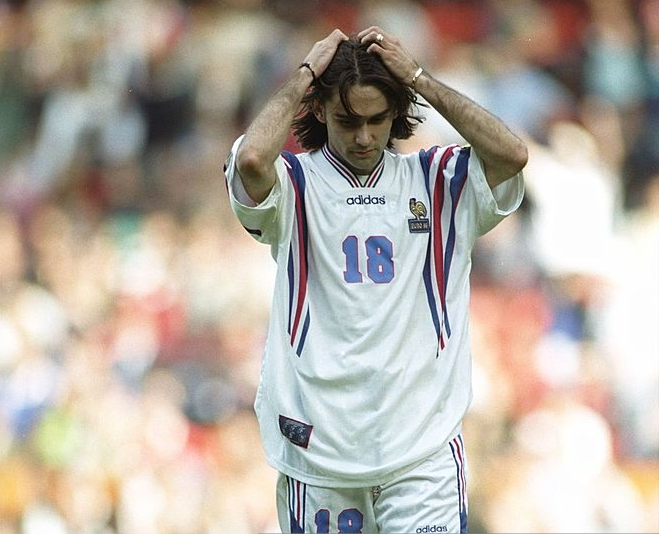
After his penalty miss, Reynald Pedros’s career would never recover. After Euro ’96, the French press would heap criticism on the Nantes midfielder, blaming him for France’s failure. Nevertheless, he would earn three more caps for the national side, with the last coming in a friendly defeat to Denmark on 9th November 1996. However, in the thirteen seasons following Euro 96, Reynald Pedros would turn out for eleven different clubs in five countries, including France, Italy, Israel, Qatar and Switzerland. After leaving Nantes for Marseille in August 1996 for £1.8m, Pedros would transfer to Parma for £2.97 million the following February. Unsuccessful loan spells at Napoli and Lyon would then dominate a frustrating time for Pedros in northern Italy. In July 1999, Pedros would leave Parma for Montpellier, but La Paillade would release him the following summer after six appearances. Toulouse would pick up the unattached Pedros in December 2000 before selling him to fellow Ligue 1 club SC Bastia in July 2001. After 16 appearances, Bastia would release the now 31-year-old Reynald Pedros in January 2003, after which the former 25-cap French international would fade into obscurity until his retirement in July 2009.
Aside from the eventual fate of Reynald Pedros, Aimé Jacquet and his staff could judge Euro ’96 as a successful tournament. Les Bleus had held their own against the likes of Spain and the Netherlands in addition to defeating Romania and Bulgaria, two teams that had got the better of France in previous years. Jacquet could also count upon a solid core to his side, with long-time stalwarts Laurent Blanc (30) and Didier Deschamps (27) mixing well with younger talents like Lilian Thuram (24), Zinedine Zidane (23) and Christophe Dugarry (24). Moreover, the squad would not need a significant overhaul in the two years leading up to the World Cup. The players who turned out in England were young enough to build and improve together and arrive at the 1998 World Cup as a more experienced bunch.
The same year as France’s trek to the Euro ’96 semi-finals, the country’s youth teams would also impress. In the spring, Raymond Domenech’s France would finish third in the 1996 UEFA U-21 European Championships and qualify for the 1996 Olympic Games, with AC Milan’s Patrick Vieira (19), Metz’s Robert Pires (22) and Lyon’s Florian Maurice (21) impressing. A month after France’s exit to the Czech Republic, the national team’s under-18 squad would triumph at the U-18 European Championship held in France and Luxembourg. On 30th July, Monaco’s Thierry Henry would score the only goal as Les Bleus would defeat Spain at the Stade Léo Lagrange in Besançon to win the trophy for the first time since 1983. If they continued to develop, Henry and his cohorts could earn international recognition before the end of the decade.
Thus, even though fans of the national team were down on France’s chances of winning a trophy any time soon, France had reason to hope that the team’s performances following Euro ’96 would better those seen in the ten years after the 1986 FIFA World Cup.
Epilogue: A Home World Cup
Between the autumn of 1996 and the spring of 1998, France did not have to worry about the ardours of facing a group of teams like Austria, Azerbaijan, Bulgaria, Belgium and Finland as part of a gruelling qualification campaign for the 1998 FIFA World Cup. With the French nation playing host to the next World Cup, the French Football Federation would need to fill the 23 months between Euro ’96 and France ’98 with friendly matches that could challenge and test Aimé Jacquet’s team in the absence of a World Cup qualification campaign. Between 31st August 1996 and 5th June 1998, the France national football team would play eighteen consecutive friendly matches. During this run, France would play Mexico, Turkey, Denmark, Portugal, Netherlands, Sweden (x2), Brazil, England, Italy, South Africa, Scotland, Spain, Norway, Russia, Belgium, Morocco and Finland. Of these eighteen matches, France would win ten, draw four, and lose four.
Over eight days in June 1997, France would invite three of the world’s top sides Brazil, Italy and England, for a World Cup test event named the Tournoi de France. In an invitational which the Three Lions would win as part of a four-team group stage format, France would earn an impressive 1-1 draw with reigning world champions Brazil in Lyon, before losing 1-0 to England in Montpellier, and finally drawing 2-2 with Italy inside the Parc Des Princes. One month before the World Cup, France, England and Belgium would travel to Morocco for the King Hassan II International Cup. France would win the tournament on goal difference ahead of England after earning four points from two matches in the same format as the Tournoi. A Zinedine Zidane goal would make a 1-0 win over Belgium, and Laurent Blanc and Youri Djorkaeff would score in a 2-2 draw with the hosts, after which Morocco would win 6-5 on penalties.
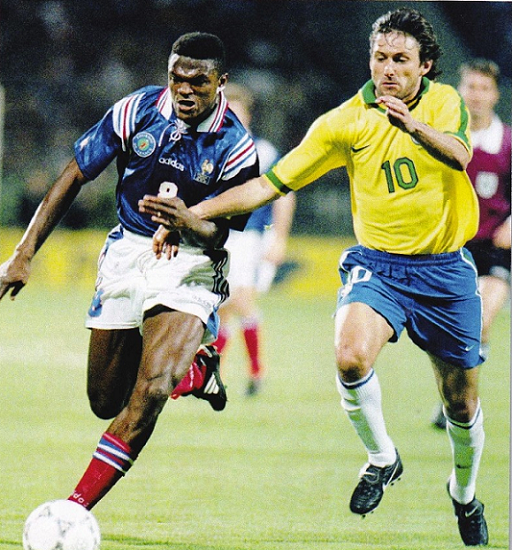
In the two-year gap between tournaments, Aimé Jacquet would hand debuts to eighteen players including two goalkeepers (Lionel Charbonnier, Lionel Létizi), four defenders (Alain Goma, Vincent Candela, Martin Djetou, Patrick Blondeau), six midfielders (Robert Pires, Franck Gava, Ibrahim Bá, Patrick Vieira, Alain Boghossian, Bernard Diomède) and six strikers (Florian Maurice, Stéphane Guivarc’h, Lilian Laslandes, David Trezeguet, Nicolas Anelka, Thierry Henry). Jacquet would eventually select nine of these players (Charbonnier, Candela, Pires, Vieira, Boghossian, Diomède, Guivarc’h, Trezeguet, Henry) for the 1998 FIFA World Cup squad, alongside twelve players retained from Euro ’96 and Emmanuel Petit. As a result, the group may have been slightly younger than their 1996 equivalents (26.7 to 27.3). However, with an average cap number of 22.7, the overall squad contained slightly more international experience compared to two years previously (20.9). In fact, nine players (Didier Deschamps, Laurent Blanc, Marcel Desailly, Bernard Lama, Youri Djorkaeff, Zinedine Zidane, Bixente Lizarazu, Lilian Thuram, Christian Karembeu) would go into the World Cup with 30 or more caps to their name.
Fast-forward to 12th July 1998. After victories over South Africa, Saudi Arabia, Denmark, Paraguay, Italy and Croatia, the French team, from whom their own supporters were not expecting much due to 12 years of overall disappointment, is now set to take on Brazil in the World Cup Final. With the pre-match discussion dominated by the surprise omission and then re-inclusion of Ronaldo in Brazil’s starting line-up, France takes the lead after 27 minutes through Zinedine Zidane’s header from an Emmanuel Petit corner. In first-half stoppage time, Youri Djorkaeff swings a corner from the opposite side, and Zidane heads home France’s second goal. The half-time reads 2-0 to France, and Les Bleus are comfortable in their lead.
In the 68th minute, Marcel Desailly’s red card checks France’s momentum. However, despite having Ronaldo as their central striker, Brazil rarely offers any considerable threat to the depleted French backline. Finally, to add insult to injury, France counter-attack from a Brazil corner in second-half stoppage time and Christophe Dugarry and Patrick Vieira combine to set up Emmanuel Petit. Petit, a defensive midfielder by trade, collects the ball and runs into the Brazil box before sliding the ball past Claudio Taffarel into the Brazil net. Thus, France wins the 1998 FIFA World Cup final 3-0, and captain Didier Deschamps lifts the FIFA World Cup trophy to declare France as world champions.
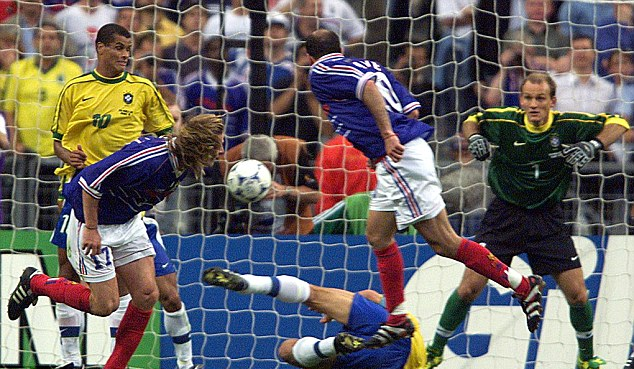
1. Zidane 27′ (c) Weebly 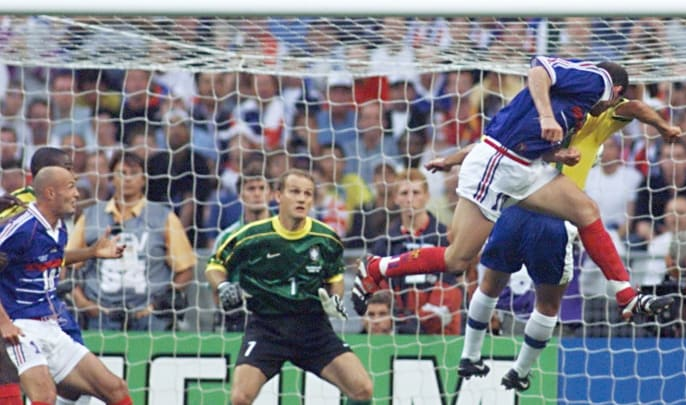
2. Zidane 45+1 (c) Lathansport 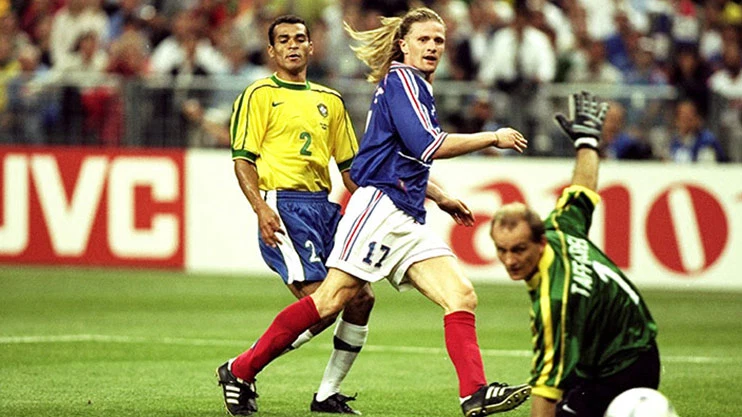
3. Petit 90+3 (c) Dream Team
Two years after the World Cup win, France would win their second UEFA European Championship trophy, beating Italy in the Euro 2000 final to become both World and European champions at the same time. For many a French fan, such a feat was unthinkable for a team that had, at one point, failed to qualify for three out of four major tournaments between 1988 and 1994. However, by winning the World Cup in 1998 and the Euros in 2000, France would crown a golden generation of players. This generation would include Laurent Blanc and Didier Deschamps, members of the previous ‘Cursed Generation’. Blanc and Deschamps, who both made their international debuts in 1989, had seen the France national team at its lowest. However, the duo had since played key roles for Aimé Jacquet to lead the team to glory and a place at the top of world football.
Aimé Jacquet, who in 1993 had sat on the bench next to Gerard Houllier as France missed out on the 1994 FIFA World Cup, had turned the downtrodden team around, leading them to the semi-final of Euro ’96 and victory in a home World Cup in 1998. When he would hand the reins over to his assistant Roger Lemerre following the World Cup Final, he would know that his task to restore dignity to the national team and establish France as a member of the footballing elite had been a success.
The French national team had been through some bad times before hosting their own World Cup. From Michel Platini’s retirement in 1987 and later unsuccessful return as manager, the solitary win in Euro 1988 qualifying, the two bans handed out to Eric Cantona in 1988 and 1995, the group-stage exit at Euro 1992 following two unbeaten years, the disastrous end to the 1994 World Cup qualification campaign and Reynald Pedros’s penalty miss, France had endured a severe storm between 1986 and 1996. However, in 1998, Les Bleus would win when it mattered most, putting the dark past to bed and proving the doubters wrong to win at the top level of football once again. The French national team has gone on to have ups and downs during the 21st century. However, nothing has come close to the decade-long period of French football known as ‘The Cursed Generation’.
 the-score-board.co.uk