
Six tries, 55 points, one virtuoso fly-half performance and an unforeseen comeback contribute to one of the best rugby matches of the 2010s…
The European Cup in rugby union, whether it be the Heineken Cup that lasted from 1996 to 2014, or the similarly titled and slightly different Heineken Champions Cup that exists today, offers fans of the sport the chance to see the best teams in northern hemisphere club rugby battle it out across the course of a single season, in between league encounters. Aside from the domestic leagues of the English Premiership, the French Top 14 or the Pro14, the European Cup can serve as the pinnacle of a team’s season. It is the battleground where the best teams and the best players from European rugby face each other in hard-fought competitive action.
Over the years, the Heineken Cup/Heineken Champions Cup has served as a representation of the dominance of a certain team across one or even multiple seasons. Across 25 seasons of European competition, twelve teams have earned the name ‘European champions. Seven of the twelve have won on more than one occasion, and many of these multiple victories have arrived close to one another. These victories have aided in establishing rugby dynasties, of which this article and two other provides examples. However, it seems that to truly establish these rugby dynasties, a victory in a close-fought high-scoring highly-entertaining 80 minutes of rugby is required to prove the superiority of the victors.
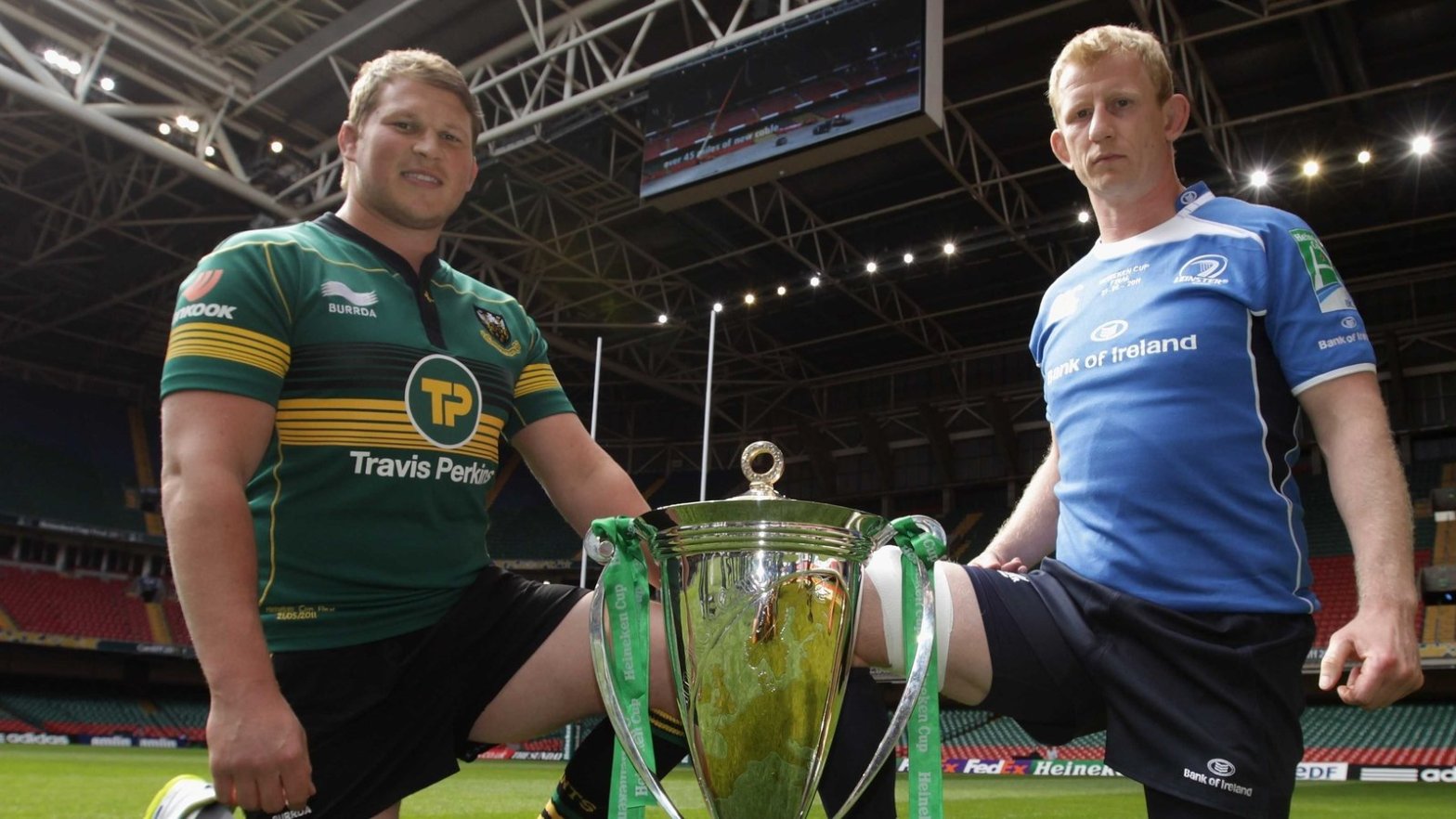
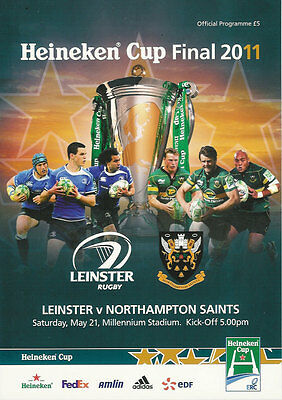
In 2011, in front of 72,000 spectators at Cardiff’s Millennium Stadium, Leinster would try to win a second Heineken Cup in three seasons to add to their win in 2009. To achieve this success, Joe Schmidt’s side would have to defeat Northampton Saints, a team also looking for a second Heineken Cup victory following their last win in 2000. In this final, Northampton was also looking to become only the third team in competition history and the first since Brive in 1997 to go the entire tournament unbeaten. With these factors at play, Leinster and Northampton would together produce 80 minutes of unforgettable club rugby.
The build-up
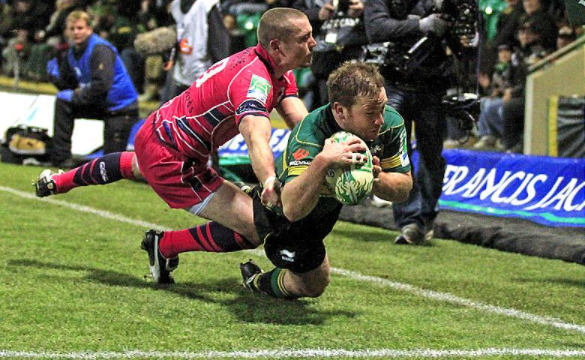
Northampton Saints would begin their Heineken Cup campaign in Pool 1 alongside the previous season’s European Challenge Cup winners Cardiff Blues, Edinburgh and Top 14 side Castres. As referenced earlier, Saints would go through the entire pool stage unbeaten. In fact, Jim Mallinder’s side would become the only team in the entire pool stages to win six out of six preliminary matches. However, as shown by the table below, Northampton would earn just one bonus point from these six matches. This bonus point would easily arrive in a 37-0 five-try home drubbing of Edinburgh in round five. On that day, an early try for prop Brian Mujati followed by a quartet of touchdowns for winger Paul Diggin saw the Saints put on a show for the home fans at Franklin’s Gardens.
However, the 37-0 victory over Edinburgh is the only one of Northampton’s pool stage wins that can be considered a truly dominant one. Matches against Castres (18-14), Cardiff (19-23) and the reverse fixture away at Edinburgh (27-31) all saw Northampton winning tight games, with the losing side ending the match with a bonus point. Even the home fixture against Cardiff would see Jim Mallinder’s side enter half-time 12-10 behind before a converted Chris Ashton try and two penalties from the boot of Stephen Myler helped the Saints win the match 23-15. Therefore, despite appearing to win Pool 1 with the simplest of ease, Northampton would need to work hard to earn all six victories. However, these six victories would see Northampton Saints enter the 2011 Heineken Cup quarter-finals as the top seed.
Pool 1
| Club | Played | Wins | Draws | Losses | Points For | Points Against | Bonus Points | Total Points |
|---|---|---|---|---|---|---|---|---|
| Northampton Saints | 6 | 6 | 0 | 0 | 155 | 87 | 1 | 25 |
| Cardiff Blues | 6 | 3 | 0 | 3 | 107 | 113 | 2 | 14 |
| Castres | 6 | 2 | 0 | 4 | 105 | 115 | 3 | 11 |
| Edinburgh | 6 | 1 | 0 | 5 | 98 | 150 | 4 | 8 |
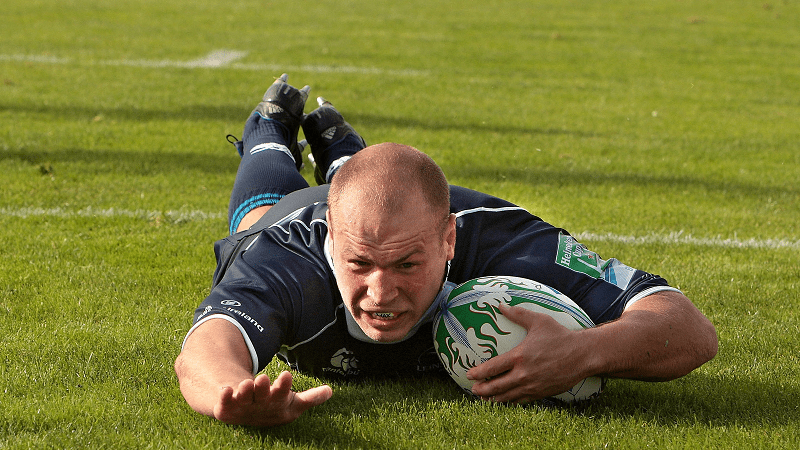
Compared to Northampton, Leinster would receive a more difficult group stage draw with reigning French Top 14 champions Clermont Auvergne, English Premiership runners-up Saracens, and Clermont’s league rivals Racing Metro also featuring in Pool 2. Despite this draw, Leinster would begin their competition with a comfortable six-try 38-22 home win over Racing, with Sean O’Brien, Rob Kearney, Richardt Strauss, Jamie Heaslip and Fergus McFadden providing the five-pointers. One week later, fly-half Jonathan Sexton would score all 25 of his team’s points, providing a try, conversion and six penalties in a tight 25-23 victory over Saracens.
In Round 3, Joe Schmidt’s team would come undone in central France, earning a losing point in a 20-13 defeat to Clermont Auvergne. However, another try for Sean O’Brien and a brace from loose-head prop Cian Healy would see the Dublin-based side return the favour with a 24-8 win at the RDS Arena six days later. The final two reverse fixtures would see Leinster pick up try bonus points in heavy victories over Saracens (43-20) and Racing Metro (11-36) to finish first in Pool 2 with 24 points, qualifying as the second seed for the knockout rounds.
Pool 2
| Club | Played | Wins | Draws | Losses | Points For | Points Against | Bonus Points | Total Points |
|---|---|---|---|---|---|---|---|---|
| Leinster | 6 | 5 | 0 | 1 | 179 | 104 | 4 | 24 |
| Clermont Auvergne | 6 | 4 | 0 | 2 | 114 | 94 | 3 | 19 |
| Racing Metro | 6 | 2 | 0 | 4 | 104 | 151 | 1 | 9 |
| Saracens | 6 | 1 | 0 | 5 | 107 | 155 | 2 | 6 |
The quarter-finals would draw Northampton Saints and Leinster with pool runners-up Ulster and Leicester Tigers. On 9th April, Leinster would host the reigning English champions and two-time Heineken Cup winners Leicester at Dublin’s 51,700-seater Aviva Stadium in the second of four quarter-final matches. The last meeting between Leinster and Leicester had come in the 2009 Heineken Cup Final. On that day, a Jamie Heaslip try, an early drop goal from Brian O’Driscoll and a further 10 points from Jonathan Sexton had been enough for the Dubliners to edge a close final 19-16. In this 2011 quarter-final, the margin of victory would be slightly bigger, in that a seven-point margin is more comfortable than a three-point margin.
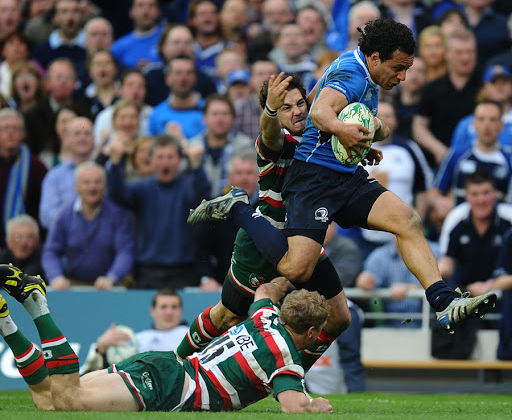
The first five minutes would see Sexton and opposite number Toby Flood exchange penalties at 3-3 before the Irishman rattled off two further kicks through the posts to give Leinster a 9-3 half-time lead. Three minutes into the second half, Leicester wing Alesana Tuilagi would think he had scored the first try of the match, only for the TMO to adjudge that Sean O’Brien had successfully tackled the Samoan back into touch. Five minutes later, Leinster’s Fijian full-back Isa Nacewa would collect a Ben Youngs kick, and exchange passes with wing Shane Horgan before evading three tackles to reach for the white line and score the game’s first try. Sexton would miss the following conversion, but Leinster now led the Tigers 14-3 with 30 minutes remaining. In the 73rd minute, Sexton would land a fourth penalty to generate double figures for the day and extend the home side’s advantage to 14 points. However, replacement Tigers hooker Rob Hawkins would cross for the visitors in the 76th minute, with Flood converting to halve Leinster’s lead, sparking a nervy finish for Joe Schmidt’s men. Leicester would have further opportunities in the closing stages to force a draw and extra time, but the hosts would hold on to reach the semi-finals.
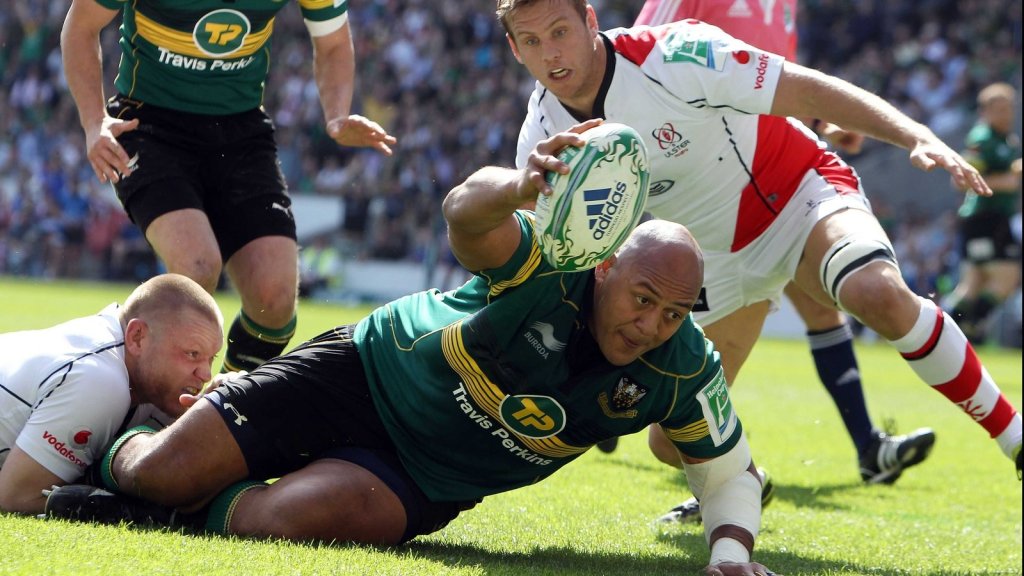
The following day, Northampton would play host to Ulster not at Franklin’s Gardens but at the much-larger Stadium.mk in Milton Keynes. Despite the unusual surroundings, the Saints would have the perfect start when prop Soane Tonga’uiha broke through the Ulster defence and planted the ball over the try-line in the second minute of the game. Stephen Myler would add the conversion to give Northampton a quick 7-0 lead. Ulster would get on the board five minutes later through Ian Humphreys’ penalty, and the Belfast-born fly-half would double his side’s points tally in the 14th minute. Despite an amazing start, Northampton was struggling to add to their converted try. Instead, Ulster would register their own seven-pointer in the 32nd minute when Andrew Trimble combined with fellow wing Simon Danielli to score a try for the away side. With Humphrey’s conversion, the Ulstermen had scored 13 unanswered points in the 30 minutes following Northampton’s early try.
(c) RTE.ie 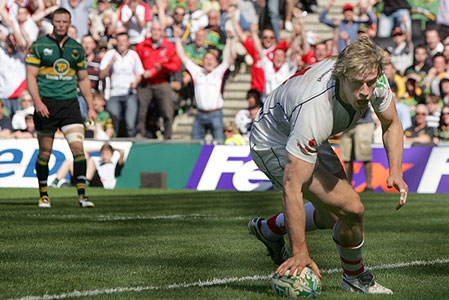
(c) Ulster Rugby
To break Northampton’s rut, Stephen Myler would score a penalty on the verge of half-time to bring his team back within three points at the break (10-13). Myler would later add another penalty in the 48th minute to draw the hosts level at 13-13. In the 55th minute, Saints would completely turn the game around. Scrum-half Lee Dickson would finish off an excellent team counter-attack to cross the whitewash, and Myler would add the conversion to put Northampton Saints ahead. In 15 second-half minutes, Northampton had come from 13-10 behind on the score-line to lead 20-13. Ulster would almost respond with their own try minutes later, only for full-back Adam D’Arcy to drop the ball with the try-line just metres away. This unforced error would provide Saints with the break they needed, and Myler would convert his fifth penalty in the 65th minute to extend Northampton’s lead to 10 points. With no further points scored for the rest of the match, Northampton would defeat Ulster 23-13 to progress to a third Heineken Cup semi-final, following previous visits in 2000 and 2007.
At the semi-final stage, both Leinster and Northampton would face difficult opponents in defending European champions Toulouse and Perpignan. In two all-French quarter-finals, Perpignan would defeat star-studded Toulon 29-25, while Toulouse would require extra time to eliminate Biarritz 27-20 in a rematch of the previous season’s final.
In a meeting of the two previous Heineken Cup champions Leinster and Toulouse, the 2010 winners would draw first blood after four minutes. When a David Skrela penalty kick would rebound off the posts, centre Florian Fritz would rise above the rest to collect the dropping ball and touch it down. Skrela would have no problem adding a conversion to give the champions an early 7-0 lead. Johnny Sexton would put Leinster on the board with two penalties in the 10th and 14th minutes, but a successful Skrela drop goal would give Toulouse a 10-6 advantage after 16 minutes. Leinster No.8 Jamie Heaslip would give the home crowd something to cheer on the half-hour mark, placing the ball on the try-line after sneaking unnoticed through a close-range ruck. Sexton would convert to give Leinster the lead, only for Skrela to tie the game at 13-13 in the 37th minute. However, Ireland’s No.10 would hold his nerve to send the ball through the uprights in the 41st minute to send Leinster into half-time with a 16-13 advantage.
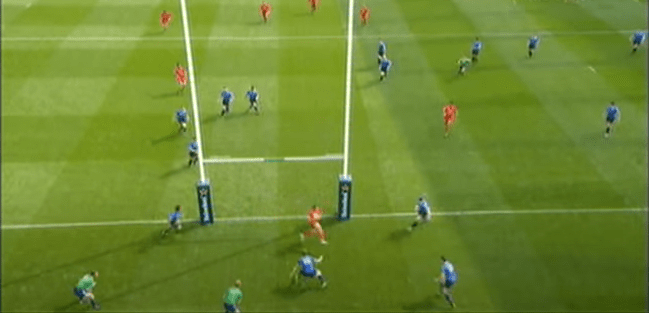
In a similar fashion to the first half, Toulouse would score early in the second half to take the lead once more. In the 43rd minute, red-and-black No.8 Louis Picamoles would finish off a Toulouse maul, and David Skrela would add the extras, putting the champions 20-16 ahead. Sexton would respond with a 47th-minute penalty to reduce the deficit to one point, and Joe Schmidt’s team would soon produce two scores that would see the lead switch sides once more. First, Sexton would land another penalty in the 54th minute to make the score read 22-20 to Leinster before Brian O’Driscoll’s try five minutes later would extend the Irish team’s winning margin to nine points. The score-line would remain at 29-20 before scrum-half Nicolas Bezy’s kick at goal would bring Toulouse back within a converted try with five minutes remaining. However, the last word would go to Sexton, with the 25-year-old sending one more kick through the posts to end his personal tally at 22 points and send Leinster through to a second Heineken Cup Final in three years with a 32-23 victory.
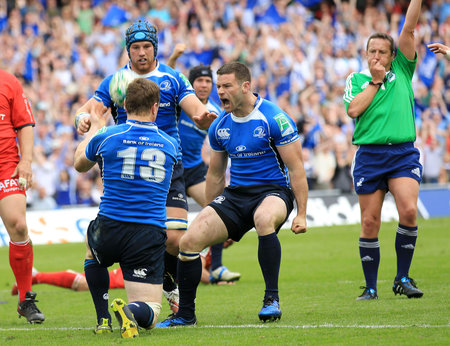
If Leinster had been made to work for their victory over Toulouse, Northampton would make much easier work of Perpignan in the second semi-final. In an excellent 80 minute performance, the Saints would match and dominate the Pays-Basque side in every department, effectively winning the match before half-time. The match would begin with both fly-halves fluffing their lines. First, Perpignan Nicolas Laharrague would attempt an early drop goal, only for his long-range effort to miss the target, before Stephen Myler would miss a more standard kick at goal. However, Northampton would not miss the mark when they took the lead in the 14th minute. Centre James Downey would set up a line break for Phil Dowson, with the French defence stopping the 17-stone flanker short of the line, only for full-back Ben Foden to score from the resulting passage of play. Myler would kick successfully on this occasion, and the ‘home’ side was first to register points on the board. Ten minutes later, Myler would extend Northampton’s lead to 10-0 following a Perpignan infringement.
Myler would later miss another penalty from the halfway line, but Northampton’s lead would increase further in the 30th minute. Following a line-out drive, centre Jon Clarke (a Saint since 2003) would skilfully cruise over the try-line from 25 metres without a visiting hand touching him. Myler’s conversion would increase the points gap to 17 points. Things would get even worse for Perpignan from the resulting kick-off as winger Julien Candelon would take out Lee Dickson in mid-air, causing the scrum-half to land on his head and shoulder. Candelon would earn 10 minutes in the sin-bin for his punishment. Three minutes before half-time, another Myler penalty would take Northampton over the 20-point mark before Perpignan finally got on the scoreboard. One minute before half-time, hooker Guilhem Guirado would finish off a line-out drive, and Nicolas Laharrague would break his points duck to send his team in 20-7 behind.

In the 49th minute of the match, Stephen Myler would score his third penalty kick. These three points from the English fly-half would be the last points that either team would score for the remaining 31 minutes of action. To have any hope of facing Leinster in Cardiff, Perpignan would need to score a minimum of two converted tries plus other points without a reply from Northampton. Despite launching a series of attacks on the Northampton 22 throughout the second period, the Top 14 side could not ultimately find a breakthrough. The East Midlands club would eventually prevail 23-7 to join Leinster in Cardiff on 21st May 2011.
The Match
Here’s how the two teams lined up on the day:
| Northampton Saints | Leinster | |
|---|---|---|
| Ben Foden | 15 | Isa Nacewa |
| Chris Ashton | 14 | Shane Horgan |
| Jon Clarke | 13 | Brian O’Driscoll |
| James Downey | 12 | Gordon D’Arcy |
| Paul Diggin | 11 | Luke Fitzgerald |
| Stephen Myler | 10 | Jonathan Sexton |
| Lee Dickson | 9 | Eoin Reddan |
| Soane Tonga’uiha | 1 | Cian Healy |
| Dylan Hartley | 2 | Richardt Strauss |
| Brian Mujati | 3 | Mike Ross |
| Courtney Lawes | 4 | Leo Cullen |
| Christian Day | 5 | Nathan Hines |
| Calum Clark | 6 | Kevin McLaughlin |
| Phil Dowson | 7 | Seán O’Brien |
| Roger Wilson | 8 | Jamie Heaslip |
| Replacements | ||
| Brett Sharman | 16 | Jason Harris-Wright |
| Alex Waller | 17 | Heinke van der Merwe |
| Tom Mercey | 18 | Stan Wright |
| Mark Sorenson | 19 | Devin Toner |
| Mark Easter | 20 | Shane Jennings |
| Stuart Commins | 21 | Isaac Boss |
| Shane Geraghty | 22 | Ian Madigan |
| Joe Ansbro | 23 | Fergus McFadden |
| Jim Mallinder | Coach | Joe Schmidt |
Following the kick-off, Northampton would enjoy much of the early possession, spending the early minutes of the match inside the Leinster half. Even when Jonathan Sexton attempted a clearing kick to give his team some breathing room, his kick from the Leinster 22 would travel into the Northampton in-goal area and out of play, leading to a Northampton scrum from where Sexton cleared the ball. From the resulting scrum, Saints No.8 Roger Wilson would peel off the back of the scrum and pass to winger Paul Diggin, who would evade a couple of tackles to make ground. Northampton would quickly recycle the ball in the ruck with scrum-half Lee Dickson feeding flanker Calum Clark. Clark would initially move to his left before readjusting and powerfully running through a gap vacated by Leinster scrum-half Eoin Reddan. Despite Reddan tackling the blindside flanker, Clark would offload the ball to openside flanker Phil Dowson, who would manage to score a try from close range despite the attentions of two Leinster tackles. Stephen Myler would add the following conversion, and Northampton would lead Leinster 7-0 after 8 minutes.
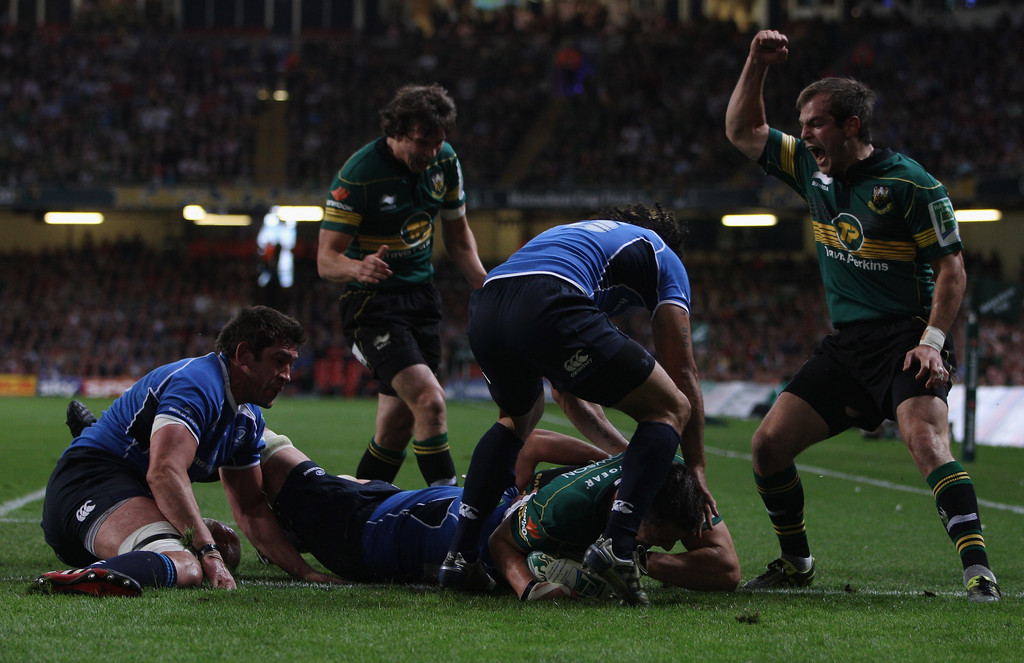
After conceding an early try, it would take Leinster until the 13th minute of play to form a response. From a Northampton scrum in their own 22, Roger Wilson would break through the Leinster defence, pumping his legs to get the Saints 7 metres from the halfway line. Leinster would manage to recover from this break and turnover possession of the ball, eventually earning a penalty. Jonathan Sexton would successfully convert the penalty kick to put Leinster on the board at 7-3. In the 20th minute, Northampton would earn their first kickable penalty the Saints pack would dominate their opposite numbers in the scrum. Myler would land a successful 43m kick to re-establish Northampton’s seven-point lead.
One minute later, Leinster would almost score their first try of the Heineken Cup final. Collecting an offloaded pass near the halfway line, winger Shane Horgan would push down a would-be tackler, cantering forward with two teammates on his shoulder. Horgan would pass to openside flanker Sean O’Brien to continue the break before offloading the ball to Brian O’Driscoll. O’Driscoll would make it into the Northampton 22, running for the try-line, before fullback Ben Foden got across to tackle him. The speed and momentum of Foden’s tackle would spin the Ireland captain along the turf, knocking the ball free from his grasp just metres from the try-line. Saints would win a penalty from the resulting scrum, clearing the ball downfield to safety.
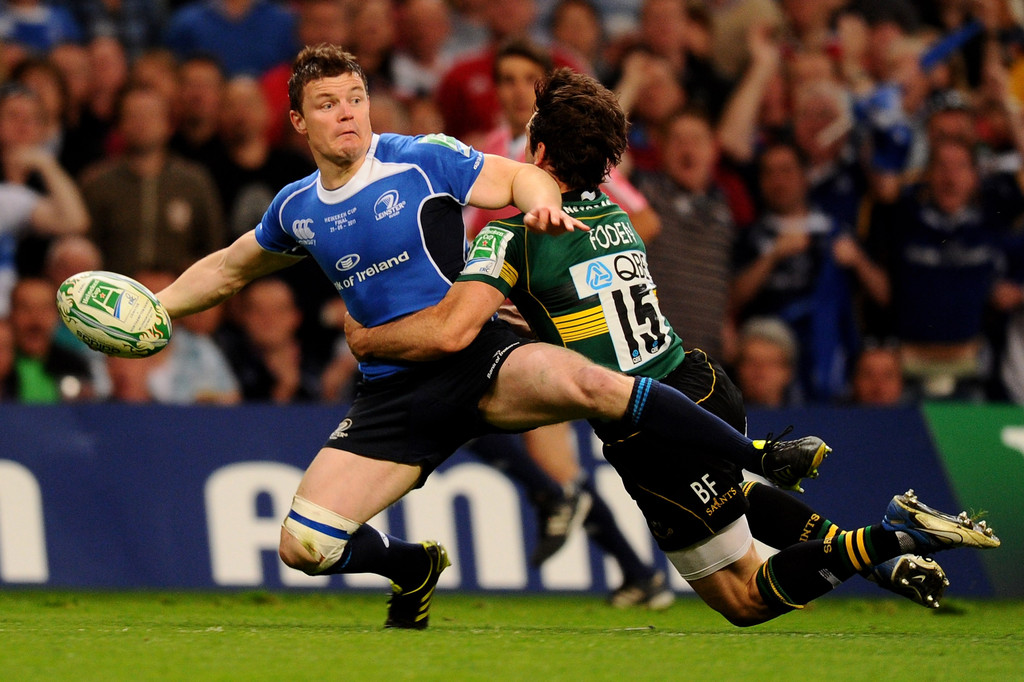
In the 25th minute, Northampton would find themselves down to 14 men. Referee Romain Poite would send Brian Mujati to the sin bin for tugging the shirt of fellow prop Cian Healy, stopping him from receiving the ball when Leinster was set to launch another line break. Despite the man disadvantage, Northampton would again dominate Leinster in the scrum, earning a penalty and knocking the ball into the opposition 22. Six minutes after Mujati’s sin-binning, the Saints would score the next points of the final. Inside the Leinster 22, Stephen Myler would sprint through a gap between two forwards, making ground before Brian O’Driscoll pulled him down five metres from the try-line. Lee Dickson would fling out a pass, with the ball eventually finding Ben Foden. Foden would break through an attempted tackle and feign passing the ball before reaching the Leinster line and touching down for Northampton’s second try. Myler would add the extra two points to make the score 17-3 to the Saints.
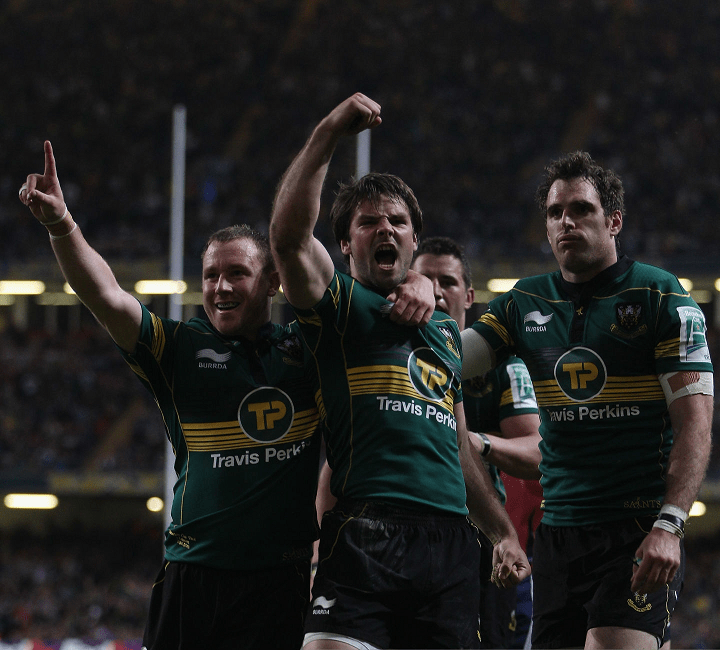
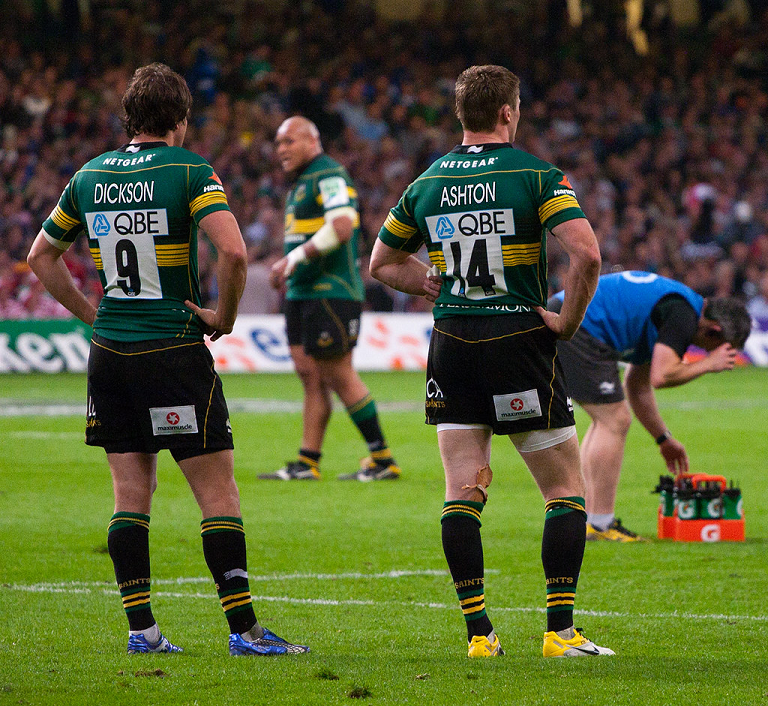
Four minutes before half-time, Jonathan Sexton would kick another penalty to double Leinster’s points total to 6. However, Northampton would have the last word of the first half to move further away from Joe Schmidt’s side. After Sexton’s penalty, Leinster would knock the ball on from the next restart, giving Northampton immediate territory inside the opposition 22. Brian Mujati would soon return to the field following his 10 minutes in the sin bin, restoring Northampton’s full complement of 15 players ahead of a Saints scrum. Northampton would break quickly from the scrum, spreading the ball wide, where Jon Clarke would spin out of a two-man tackle before finally being stopped four metres short of the Leinster in-goal area. Carries from lock Courtney Lawes and winger Chris Ashton would consolidate the team’s position close to the line.
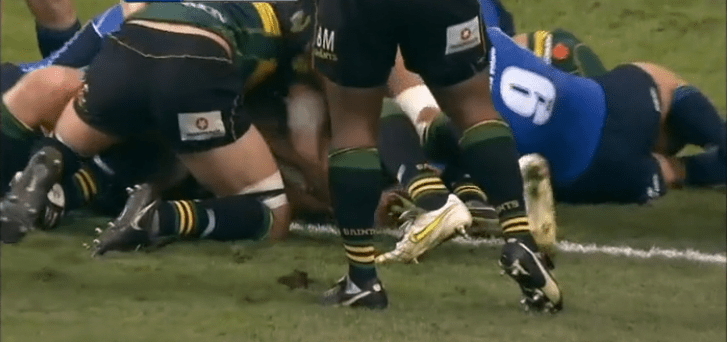
Further close-range ball-carrying was forcing Leinster into last-ditch defending, trying to prevent a third Northampton try. With the help of fellow forwards Calum Clark and Courtney Lawes, Saints captain Dylan Hartley would muscle his way over the line, but Romain Poite would need to check whether the hooker had managed to ground the ball. Following a check with the video referee, Poite would award the try. With the last kick of the first half, Stephen Myler’s conversion attempt would bounce off the post, leaving Northampton with a 22-6 half-time lead. At this point, the Heineken Cup was heading back to the East Midlands.
Jonathan Sexton would kick off the second half of the 2011 Heineken Cup final knowing that he and his Leinster teammates would need to deliver an excellent performance to even have a hope of winning the trophy. However, based on Northampton’s first-half showing, that did not seem too likely. Soon after the kick-off, Leinster would turn over possession in the Northampton 22. In the 10th phase of Leinster possession, Sexton would exchange the ball with Shane Horgan before passing to Isa Nacewa, who would make ground deeper inside the 22. After two phases more, Northampton would manage to reclaim the ball and momentarily clear their lines.
Less than a minute later, Brian O’Driscoll would catch the Saints defence off-guard by picking the ball up from a ruck and running into the 22 before passing to Jamie Heaslip, who would reach the five-metre line. In the next phase, Eoin Reddan would find Isa Nacewa, who would run from deep to make a couple metres more. Then, after further carries by the Leinster forwards, Reddan would play a long pass towards Sexton, who would run between Soane Tonga’uiha and Chris Ashton to score Leinster’s first try. The fly-half would quickly dust himself off to add the conversion, making the score 22-13 after just six minutes of the second half.
With some hope, Leinster would start to force the issue, earning two penalties in quick succession to kick themselves back into the Northampton 22. Once in the 22, the Leinster players were starting to fall through a series of Northampton tackles, making ground with each carry of the rugby ball. In particular, two significant carries from Jamie Heaslip and Shane Horgan would place the Irish side within mere metres of the Northampton Saints try-line. Then, spreading the ball out to the right flank, the ball would find Gordon D’Arcy, who would seemingly score Leinster’s second try. However, the video referee would show that Saints winger Paul Diggin had managed to get his arm under the ball, preventing D’Arcy from scoring the try.
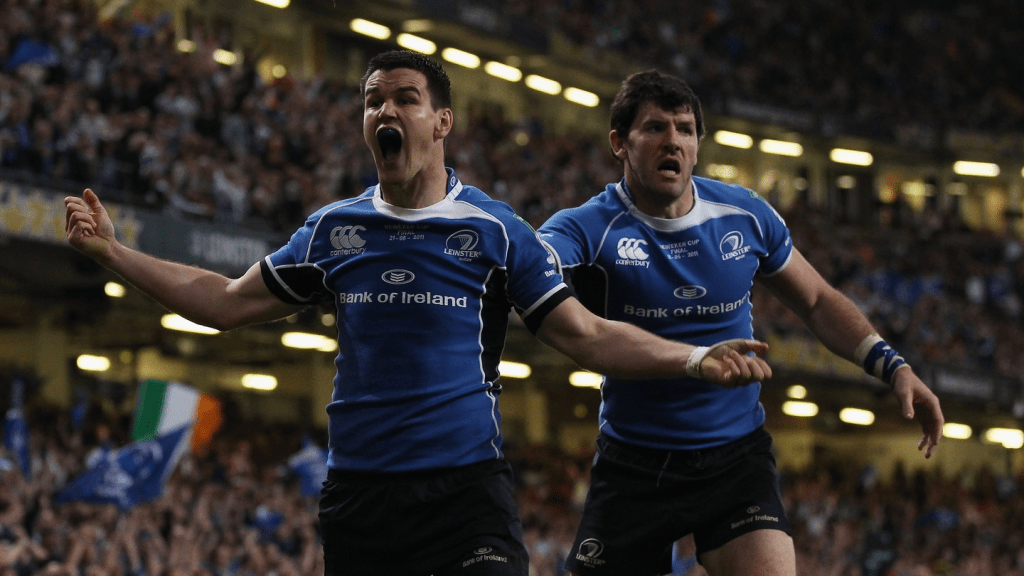
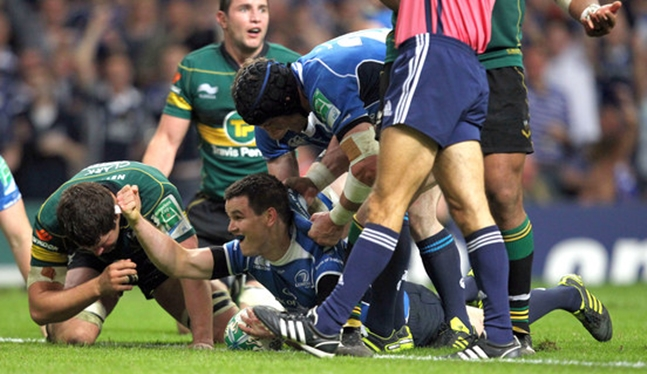
Following this reprieve, Leinster would go again, scoring two minutes later. Johnny Sexton would receive the ball from Eoin Reddan and exchange the ball with Jamie Heaslip before throwing a dummy, running through a gap in the Saints defence and escaping a shirt-tugging to score his second try of the half. Once again, Sexton would successfully convert his own score. Thus, in thirteen second-half minutes, two Leinster tries had reduced Northampton’s lead from 16 points at 22-6 to two points at 22-20.
After being behind for the whole match, Leinster now had their tails up, and the team were now looking to take the lead for the first time. They would achieve this feat in the 57th minute. After a Northampton knock-on, the Leinster pack would earn a penalty from the following scrum. Thirty-four metres from goal, Sexton would step up and land another successful kick to put Joe Schmidt’s team 23-22 ahead on the scoreboard.
After a short spell of Northampton possession following the restart, Cian Healy would receive a pass on his own 10-metre line and shrug off three tackles before the Saints players could bring him down on their 10-metre line. The next phase would see Sean O’Brien break the gain line, stepping through holes and dragging Stephen Myler with him 10 metres short of the Northampton try-line. Leinster were anxious to score more points as quickly as possible, and Sexton and Brian O’Driscoll would advance the team within three metres of the in-goal area. Northampton would recover only to get penalised for a deliberate knock-on. From this penalty call, Phil Dowson, the man who scored the first try of the final after seven minutes, would become the second Northampton Saints player to receive a yellow card and a stay in the sin bin. Meanwhile, Sexton would kick the easy penalty to extend Leinster’s lead to four points.
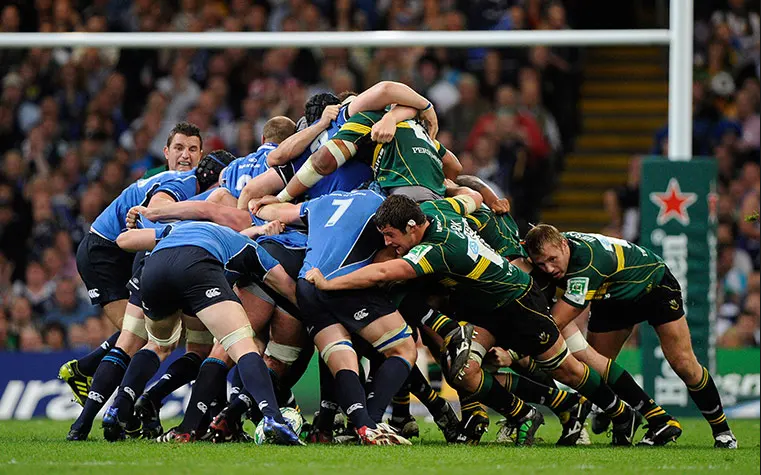
If you think Leinster’s spell of complete dominance would soon end, you would be wrong. Every time a man wearing blue and white would receive the ball, he would make ground. In the 64th minute, Jamie Heaslip would peel off a scrum, and it would require two Saints players to tackle him. In the next phase, Sean O’Brien would break through two tackles before offloading the ball to hooker Richardt Strauss. Strauss would carry the ball into the Northampton 22 before himself offloading to captain Leo Cullen, with the second row catching the ball with his fingertips before being tackled.
At each ruck, scrum-half Eoin Reddan would switch the ball left and right, not giving either side of the Northampton defence a moment of comfort. One switch of play saw Shane Horgan carry the ball before attempting an offload to an on-rushing Johnny Sexton. Sexton would miss the offload, only for Isa Nacewa to pick up the loose ball and make more metres. Horgan would carry again to make another metre. O’Brien would get another inch. From the next ruck, second row Nathan Hines would roll over the prone Ben Foden to score Leinster’s third try. For the third time in 20 minutes, Sexton would add the conversion. In 25 second-half minutes, Leinster had scored 27 unanswered points. Northampton had not even been given the opportunity to score points in the second half thus far.
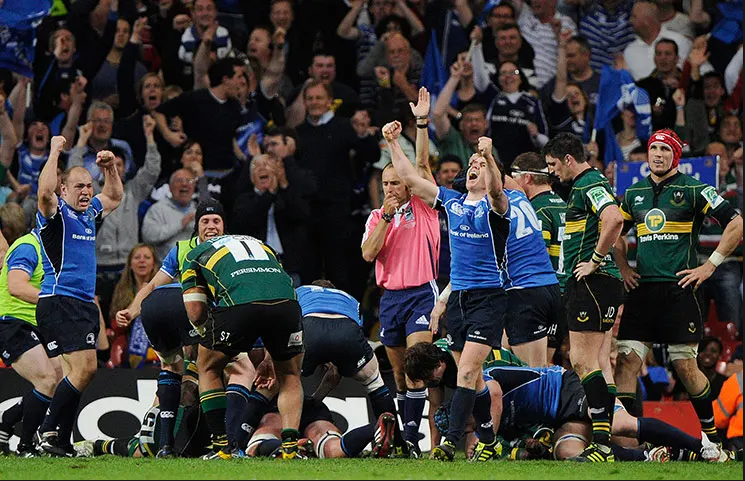
With 15 minutes remaining, Saints coach Jim Mallinder would ring the changes, knowing that his side needed to produce something to stop the relentless Leinster onslaught. By the 68th minute, Leinster had enjoyed 76% of ball possession in the second half compared to Northampton’s 24%. Mallinder would even sacrifice captain Dylan Hartley just to spark something in his beleaguered troops. To win the Heineken Cup, Northampton would require at least two converted tries without reply. However, to achieve that would require the team managing to get the upper hand over Leinster for the first time in the entirety of the second period. Luckily for Northampton, Sexton would miss his first penalty of the game in the 68th minute, a kick that would have extended Leinster’s lead to 14 points, equivalent to two converted tries.
In the 70th minute, Northampton would begin to spark into life. From a scrum, the ball would find its way to Ben Foden, who would collect the ball in his own 22 before side-stepping through a tackle and running over the halfway line before passing to Chris Ashton on his outside shoulder. Ashton would continue in a straight line before cutting inside and running infield, reaching the 22-metre line before the Leinster players could bring him down. Unfortunately for Northampton, Leinster would reclaim the ball from the ruck, with Eoin Reddan passing to Johnny Sexton, who would clear the ball. Another foray forwards a minute later would also end with the referee awarding a penalty to Leinster. Try as they might, Northampton could not penetrate a well-disciplined Leinster defence.
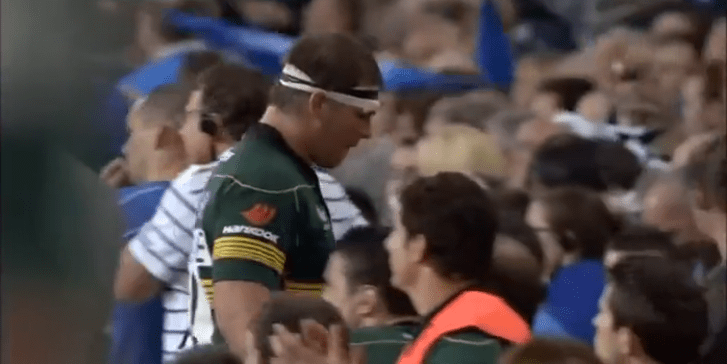
In the 78th minute, Ian Madigan would come on to replace Jonathan Sexton. The Irish fly-half would receive a standing ovation as he clapped hands and hugged his teammates on the touchline. Later, when Sexton was announced as the man-of-the-match, a huge cheer would erupt from the stands. Then, when Isaac Boss would kick the ball out when the clock hit 80 minutes, a more considerable reaction would come.
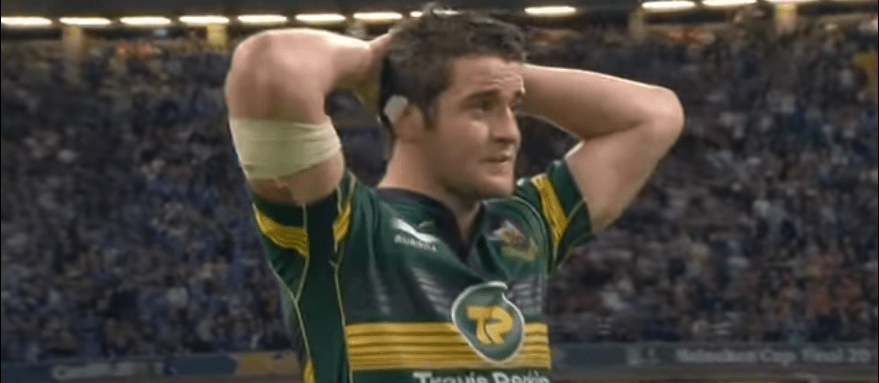
For the second time in three years, Leinster were the Heineken Cup winners and champions of Europe. Leo Cullen and his team had pulled off one of the most remarkable comebacks in rugby history to reach that mark. From losing 22-6 at half-time, two tries from Jonathan Sexton, a third from Nathan Hines and 12 points from the former meant that Joe Schmidt’s side would end the match as 33-22 winners. Northampton Saints had built up a 16-point halftime lead by scoring three tries of their own, including a try in the last minute of the first half. However, in the second half, the Saints would not register one single point. At no point during the second half would Northampton earn a penalty that Stephen Myler could attempt a kick at goal. Northampton would not even manage to carry the ball into the opposition 22 once during the second half. Instead, Leinster would return from the half-time break and carry out a 25-minute non-stop onslaught on the Northampton try-line, returning with points on almost every occasion.
In the years, a rumour has persisted, stating that at half-time, Johnny Sexton delivered a passionate speech to his Leinster teammates referencing the 2005 UEFA Champions League and the famous ‘Miracle of Istanbul’. In the ‘Miracle of Istanbul’, Liverpool went into the half-time changing rooms losing 3-0 to AC Milan. Following the half-time break, Liverpool, led commandingly by Steven Gerrard, would score three goals in the first 15 minutes of the second half to level the final at 3-3. The score would remain at 3-3 after both normal and extra time, and Liverpool would eventually beat AC Milan in a penalty shoot-out to become Champions League winners. If we were to compare the ‘Miracle of Istanbul’ to the events that transpired in the 2011 Heineken Cup final, Northampton Saints would take the role of AC Milan in this scenario while Leinster would assume the role of Liverpool. On both occasions, one side builds an almost unassailable half-time lead only for the losing team to stage a remarkable second-half comeback to win the match and the trophy.
On 25th May 2005, Liverpool had become football’s European champions for the fifth time. On 21st May 2011, Leinster would become rugby’s European champions for the second time. However, while Liverpool would have Steven Gerrard to inspire their comeback in Istanbul, Leinster would have a similarly inspiring figure in Jonathan Sexton to lead their remarkable recovery in Cardiff, ensuring this Leinster team became a rugby union dynasty.
Final Score: Leinster 33 Northampton Saints 22

 the-score-board.co.uk