
Because calling it the ‘next goal wins’ rule would be too on the nose…
Whenever football introduces a new rule change, it is bound to have its supporters and detractors in equal measure. In recent times, this has never been more obvious than with VAR. Since being written into the Laws of the Game in 2018, and following a mostly successful trial in the 2018 World Cup in Russia, the Video Assistant Referee is currently being utilised in Europe’s Big 5 Leagues (Premier League, Serie A, Ligue 1, Bundesliga, La Liga). As an avid viewer of the Premier League, barely a week has gone by where VAR hasn’t been the main topic of conversation amongst fans and ex-players alike. Extremely marginal offsides made using a series of coloured lines on a screen, penalty decisions and defining what constitutes as a handball in the modern game has led to many calling for an abrupt end to the VAR experiment.
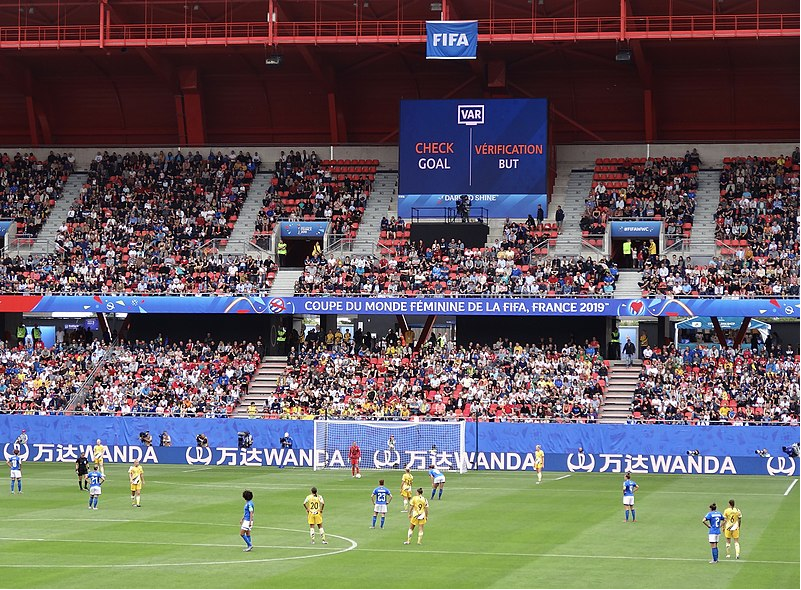
If VAR manages to last at least 10 years, then it can only be deemed as a success. If it lasts beyond 11 years, then it will have outlasted the ‘golden goal’ rule. Between 1993 and 2004, the ‘golden goal’ rule was used in two World Cups and two European Championships and produced a series of memorable moments that many football fans still remember to this day. This article will discuss the entire history of the ‘golden goal’ rule from beginning to end, from why it was implemented to why it was removed and everything that happened in between. This article will discuss the entire history of the ‘golden goal’ rule from its original implementation to its eventual abolition and everything that happened in the intervening years.
Creation of the rule
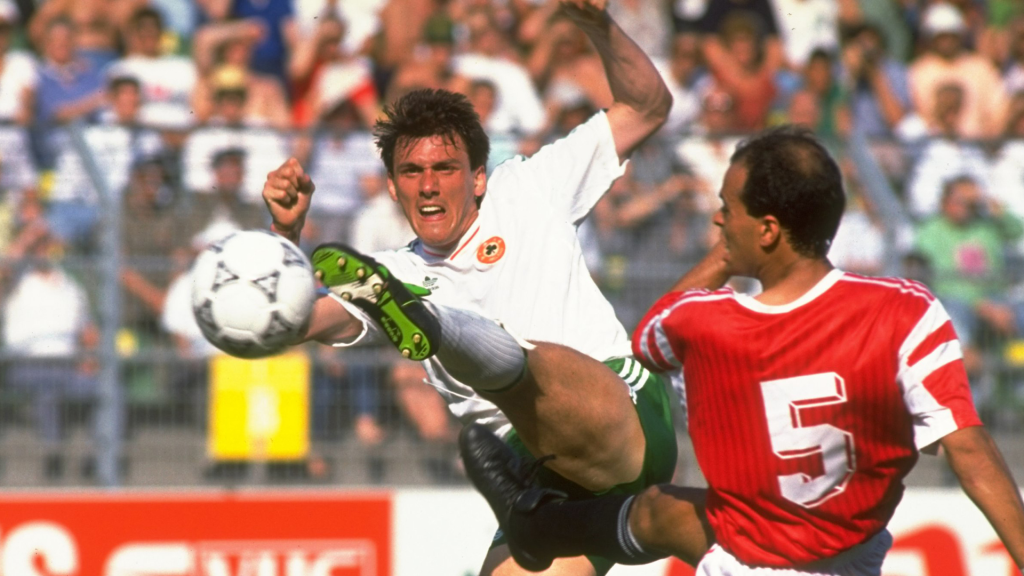
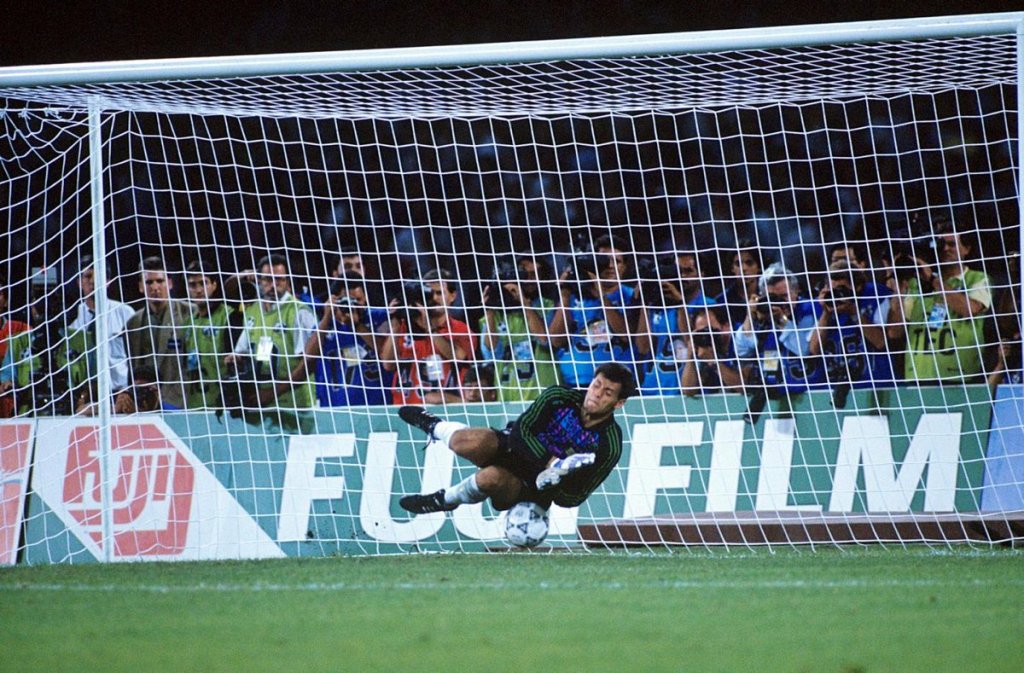
While the 1990 World Cup has since gone down in history as one of the most celebrated World Cups of all time, the reaction from FIFA at the time was one of negativity. The tournament produced three notable and worrying statistics for the governing body. First, referees handed out a record 16 red cards, a record that would only be beaten by the 28 red cards handed out in 2006. Italia ’90 would also produce two more statistics which are more relevant to the following article. First, teams would score a record low average of 2.21 goals in each match. This record still stands to this day. In the knockout stages, 8 out of 16 games would go to extra time, including two out of four quarter-finals and both semi-finals. Four of these eight matches would end in penalty shoot-outs. A penalty kick would even decide the World Cup Final.
FIFA put all three of these statistics down to negative tactics employed by different sides throughout the tournament. In a tactic that is arguably still seen today, teams in the knockout stages played not to lose, choosing to risk their chances in a penalty shoot-out rather than fight for the win. For example, debutants Republic of Ireland made it to the quarter-finals despite not winning a single match. At the time, a win was still worth two points and a draw worth 1 point. Through this method of points scoring, Ireland would finish 2nd behind England in Group F after three draws before defeating Romania via a penalty shoot-out in the second round. Defending champions Argentina required back-to-back penalty shoot-out wins over Yugoslavia and Italy to reach a second successive World Cup final. Reacting to these negative tactics, FIFA would introduce the back-pass rule to reduce defensive time-wasting and three points for a win to encourage more teams to attack.
The perceived solution to the extra-time problem would finally arrive in 1993. In 1993, FIFA would introduce the ‘Golden Goal’ rule to the Laws of the Game. In knockout matches in major tournaments, if a match ended in a draw after 90 minutes, the match would head to ‘sudden death extra time’. In theory, extra time would be mostly the same, with two fifteen-minute periods followed by a penalty shoot-out if such was needed. However, if one team managed to score a goal at any point during either period of extra time, the match would immediately end, with the team that scored the ‘golden goal’ being declared the winner. Their opponents would not have a chance to respond.
By introducing this rule, FIFA hoped to encourage teams to produce more attacking play in extra time, ultimately reducing the number of penalty shoot-outs that took place. The introduction of the ‘golden goal’ would be a soft launch, with no significant announcement tying the new rule to any upcoming competitions. For example, the 1994 World Cup would choose not to use the ‘golden goal’ rule, with the tournament not adopting the rule until the 1998 edition. The first notable tournament to use ‘golden goals’ would be the 1993 FIFA World Youth Championship (now the FIFA U-20 World Cup).
Early Implementations
1993 World Youth Championship– The first notable usage of the ‘golden goal’ deciding a match came in the year FIFA first implemented the rule. This first usage came during the quarter-finals of the 1993 FIFA World Youth Championship in a match-up between Uruguay and Australia on 13th March 1993. After 90 minutes of regulation time, the match was level at 1-1 after goals from Sergio Sena Lamela (21′) for Uruguay and Paul Agostino (59′) for Australia. With the game drawn after 90 minutes, the match went to golden goal extra time. Nine minutes into the first period, forward Jim Tsekinis would cross the ball into the Uruguay box, where midfielder Anthony Carbone would head the ball home to end the match and send Australia through to the tournament semi-finals to face Brazil.
1994 Caribbean Cup– After Anthony Carbone delivered the first golden goal to be scored on an international scale, another of the early examples would prove to be one of the craziest. The 1994 Caribbean Cup would feature a qualifying tournament to decide the six teams that would join cup holders Martinique and host country Trinidad and Tobago in the actual tournament. The qualifying tournament comprised six groups of three teams, with each group winner advancing to the Caribbean Cup. One of the strange rules of the qualifying tournament was the requirement that every match must have a winner. If any game ended in a draw, the game would progress to golden goal extra time, and potentially a penalty shootout. If a team scored a golden goal during extra time, the golden goal alone would count as two goals. Of the 21 matches played during this qualifying tournament, golden goals would decide five of them.
The most infamous example of this rule being used to decide a match came a Group 1 encounter between Barbados and Grenada. In this match, Grenada just had to win to progress to the finals tournament. On the other side, Barbados had to beat Grenada by a two-goal margin to progress at their opponent’s expense. In the match, Barbados went 2-0 ahead to establish the two-goal advantage they need to win the qualifying group. In the 83rd minute, Grenada pulled a goal back to make the score 2-1, a score that would take Grenada to win the group.
As the clock ticked towards 90, Barbados panicked to keep their qualification hopes alive. In the 87th minute, Barbados defender Terry Sealey deliberately scored an own goal to make the score 2-2 to force the match into golden goal extra time. If the game went to golden goal extra time, a golden goal for Barbados would give them the two-goal margin they needed to qualify for the Caribbean Cup. Realising Barbados’ tactical plan, Grenada started to panic. The final three minutes of regular time saw Grenada trying to score in either net and Barbados trying to defend both goals, all to decide whether this group stage decider progressed to ‘golden goal’ extra time.
At the end of 90 minutes, the match ended in a 2-2 draw and progressed to extra time. In extra time, Trevor Thorne would score the golden goal, and the game would end in a 4-2 victory for Barbados. With this win, Barbados would win their qualifying group and progress to the finals tournament of the 1994 Caribbean Cup, where they would exit at the group stage. After this qualifying tournament, the Caribbean Cup organisers scrapped the unusual golden goal rule, using it in the more conventional sense in later competitions.
1995 Football League Trophy– The first notable usage of the golden goal in English football would occur at the country’s national stadium, Wembley. The Football League Trophy, the competition for teams who play in the third and fourth divisions of English football, would be the tournament to provide this historic moment. A golden goal would decide the 1995 final between Birmingham City and Carlisle United. With the game goalless after 90 minutes, the two teams would play 13 minutes of extra time before Birmingham’s Paul Tait’s header would give the club their second Football League Trophy in five seasons.
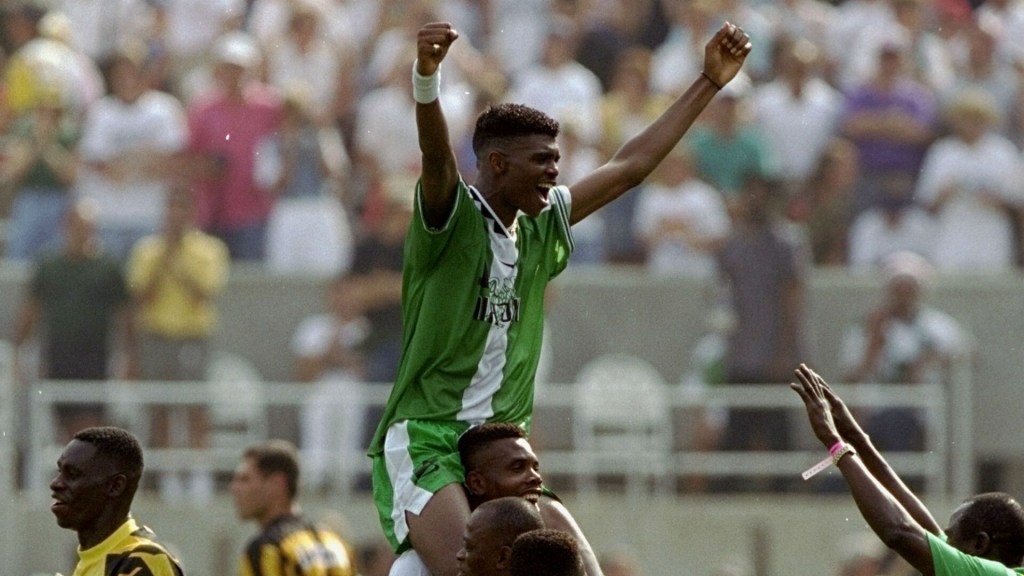
1996 Olympic Games– The 1996 Olympics Games in Atlanta were the first of two Olympics to feature the ‘golden goal’ as part of the rules of both the men’s and women’s football tournaments. The men’s competition would see two notable ‘golden goals’. In the round of 16, Portugal would defeat France 2-1 after Jose Calado scored a 105th-minute penalty.. The second would decide a seven-goal thriller of a semi-final between favourites Brazil and Nigeria. Recovering from 2-0 and 3-1 down, Nigeria took the match to extra time after a goal from Nwankwo Kanu in the 90th minute of play. In the 4th minute of extra time, Kanu would score again to take the Super Eagles to the gold medal match with Argentina.
The 1996 Olympics would see the addition of women’s football to the events lists. In a tournament that would eventually, and inevitably, be won by the United States, the Americans would require a golden goal even to make the gold medal match. In the semi-final clash between the United States and Norway, a 14th-minute opener from Norway’s Linda Medalen would be cancelled out by a Michelle Akers penalty after 76 minutes. Ten minutes into extra time, Shannon Macmillan would score the ‘golden goal’ to take the U.S. to a gold medal clash with China.
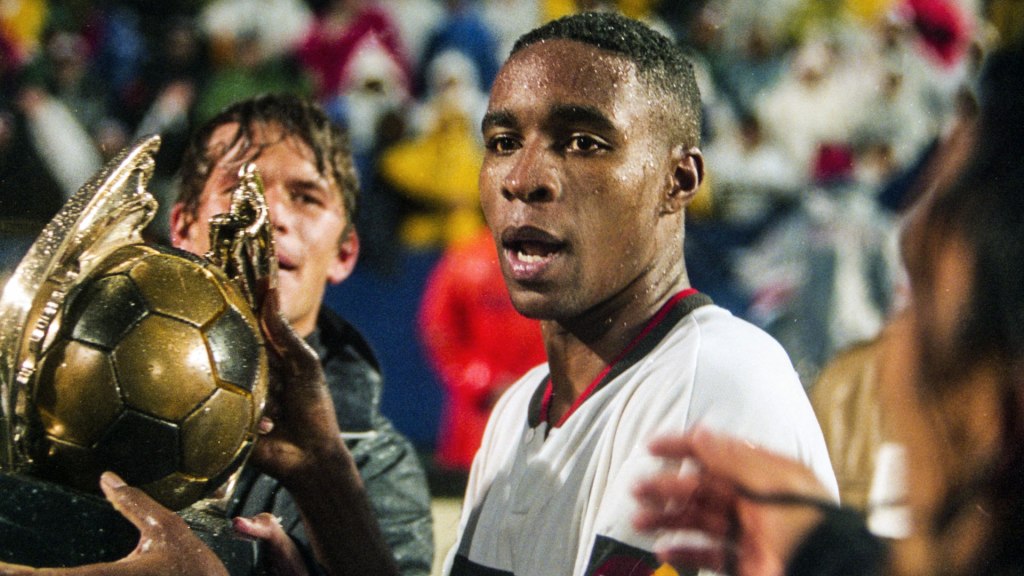
1996 MLS Cup-D.C. United vs LA Galaxy, 20th October 1996– The last of the early examples that may not have received much media attention outside of the home country came in the 1996 MLS Cup, the play-off final used to decide the first-ever Major League Soccer Champion. Taking place in Foxborough, Massachusetts on 20th October 1996, the final saw the Eastern Conference champions D.C. United meet the Western Conference champions Los Angeles Galaxy. In this example, the golden goal served to cap off an exciting contest. L.A. Galaxy had taken the lead after 5 minutes through striker Eduardo Hurtado before midfielder Chris Armas doubled their lead after 56 minutes. However, D.C. United would refuse to lie down, and goals from substitutes Anthony Sanneh (73′) and Shawn Medved (81′) would complete an 8-minute comeback. The 90 minutes would end with the final tied at 2-2. Four minutes into extra time, centre-back Eddie Pope would complete D.C. United’s comeback, scoring the golden goal to make his team the first-ever Major League Soccer champions.
Famous examples
1996 UEFA European Championships Final-Germany v Czech Republic, 30th June 1996
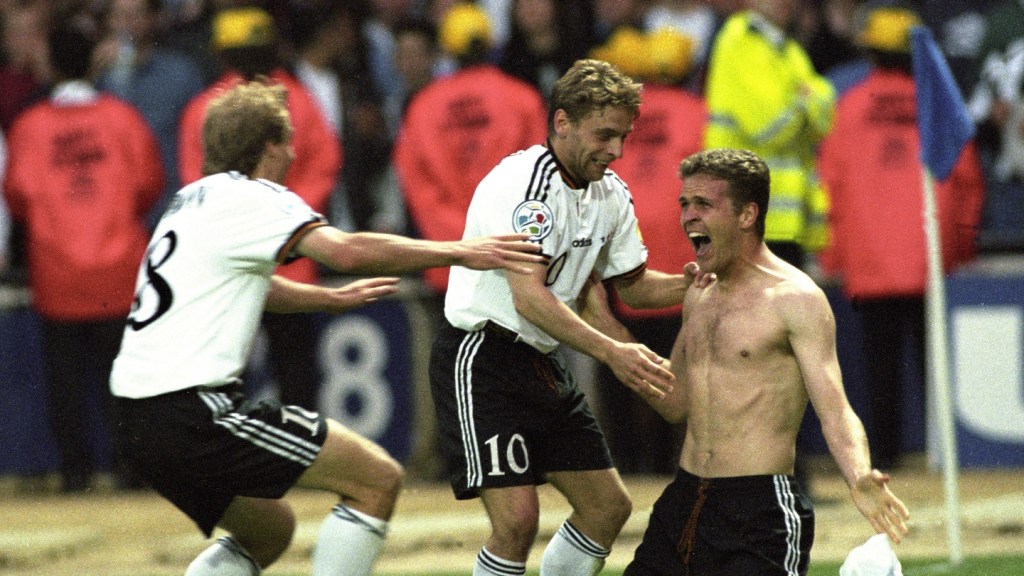
After those early golden goal examples, the first golden goal to receive a large amount of media attention and occur at a major football competition occurred in 1996. The earliest golden goal that the majority of football fans would be able to recall is Oliver Bierhoff’s golden goal from the final of the 1996 European Football Championships AKA ‘Euro 96’. Euro 96 is notable for the reason that six of the competition’s eight knockout matches went to extra time. Five of these six matches saw no golden goal and were eventually settled in penalty shoot-outs. Both of the sides that reached the final of Euro 96 had won their semi-finals on penalties. Both of these semi-finals even occurred on the same day. First, the Czech Republic would play out a 120-minute goalless draw with France before winning the penalty shoot-out 6-5, with Miroslav Kadlec scoring the winning spot-kick. Later that day, Germany would draw 1-1 with England before winning the resulting shoot-out 6-5 after Andreas Moller capitalised on Gareth Southgate’s miss. The final between these two teams would not finish in similarly tense circumstances.
In the final, the Czech Republic would take the lead in controversial circumstances. In the 59th minute, Matthias Sammer would tackle Matthias Sammer tackled mulleted midfielder Karel Poborsky, and referee Pierluigi Pairetto would award a penalty to the Czech Republic. Later replays would show that Poborsky had ‘dived’ to win the penalty and had even removed a piece of the Wembley turf after scraping his boot across it. Patrik Berger would score the resulting penalty, putting the Czech Republic 1-0 ahead. In the 69th minute, Germany would bring on forward Oliver Bierhoff to replace midfielder Mehmet Scholl. Four minutes later, Bierhoff would score Germany’s equaliser after heading home from Christian Ziege’s free-kick. After further chances to score, the final would reach 90 minutes still at 1-1, leading to extra time. The Euro 96 final would be the first European Championship Final to be decided after 90 minutes since Czechoslovakia defeated West Germany on penalties in 1976, the site of the famous ‘Panenka’ penalty.
After all the penalty shoot-outs early in the tournament, the Euro 96 final would be decided five minutes into extra time. Bierhoff would flick a long ball from the German defence forward to Jurgen Klinsmann. Klinsmann would turn on his heel and cross the ball back to his strike partner. Bierhoff would collect the ball with his back to goal, turn around his marker and fire a shot at goal. The shot would take a deflection off Czech defender Michal Hornak, confusing Czech goalkeeper Petr Kouba who would fumble the ball as it slipped out of his grasp and bounced into his goal. As commentators took a moment to recognise that someone had actually scored a ‘golden goal’ and that the game was now over, Bierhoff celebrated wildly, removing his shirt as his teammates congratulated him. With Bierhoff’s golden goal, Germany had won the match and were now European champions for the third time. From that day on, history would always read that that a ‘golden goal’ decided the final of Euro 96.
1998 FIFA World Cup Round of 16- France vs Paraguay, 29th June 1998
The 1998 FIFA World Cup in France was the first edition of the World Cup to include the ‘golden goal’ as part of its set of rules. With the World Cup taking place in France, it would therefore be poetic if would therefore be poetic if a French player scored the first ‘golden goal’ in World Cup history. On 28th June 1998, the hosts took on Paraguay in the 3rd of eight Round of 16 matches. Despite muted pre-tournament expectations from home fans, France had swept through the group stage in style, securing three wins from three in games against South Africa (3-0), Saudi Arabia (4-0), and Denmark (2-1). Their opponents Paraguay managed to progress from a more competitive group that eventually saw the top seed Spain eliminated at the opening stage. After goalless draws with Bulgaria and Spain, a 3-1 win over Nigeria saw them finish 2nd in the group behind The Super Eagles.
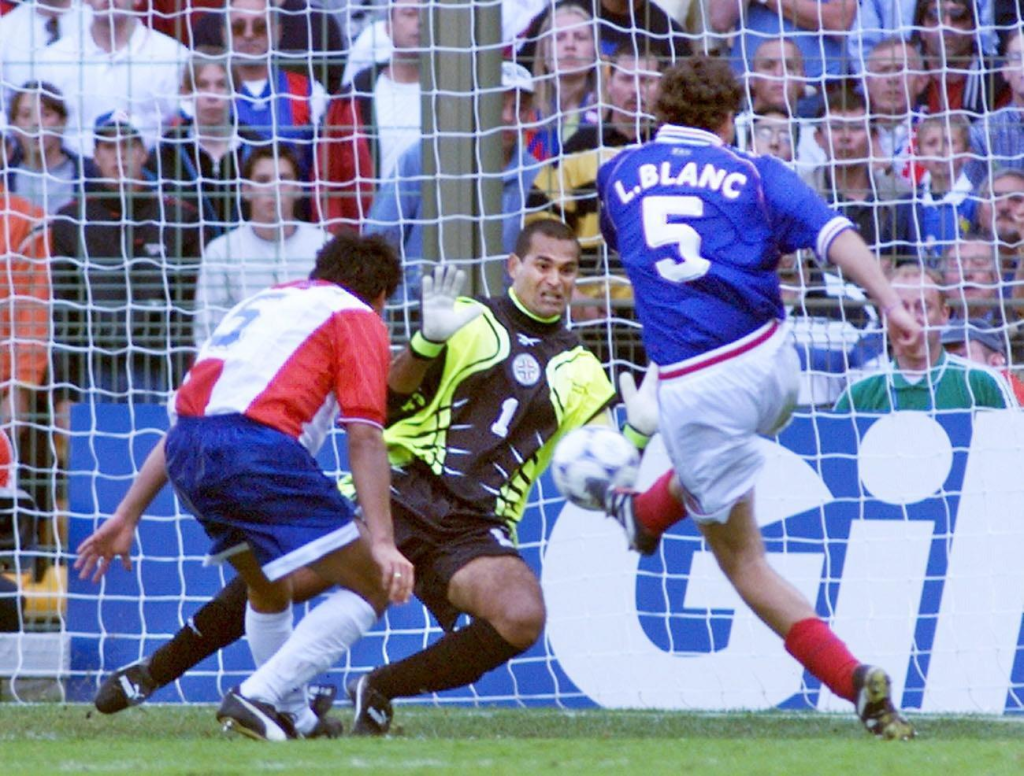
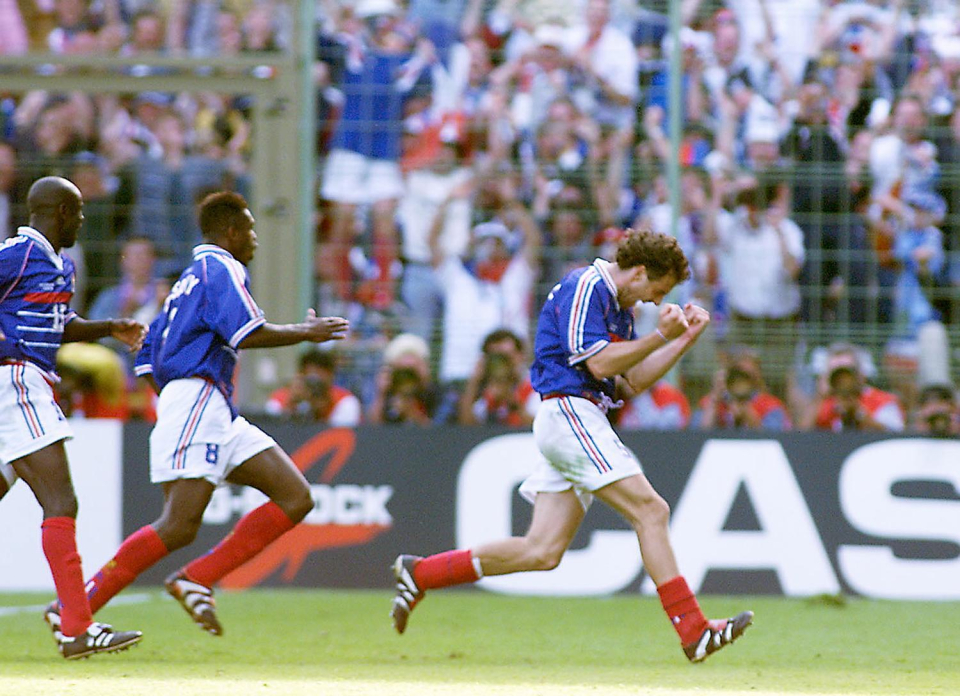
France entered the match without talented playmaker Zinedine Zidane, who received a red card during the 4-0 win over Saudi Arabia for stamping on an opposition player. Without the influence of Zidane coupled with a stubborn Paraguayan defence that had only conceded once in the group stages, France struggled to score past goalkeeper Jose Luis Chilavert. On the other hand, Paraguay failed to shoot past Fabien Barthez, looking like a team that had been unable to score in two of their three group stage matches. The match would end goalless after 90 minutes. Despite possessing the attacking talents of young strikers David Trezeguet and Thierry Henry, France would need a centre back to help them dispatch the White and Red. The goal would arrive in the 114th minute of play. A Robert Pires cross into the penalty area would be knocked down by Trezeguet for Laurent Blanc to a hit a low volley past Chilavert.
2000 UEFA European Championships
2000 UEFA European Championships semi-final- France vs Portugal, 28th June 2000
This isn’t the one you’re thinking of. That is coming next. I wonder how many people remember that France needed a ‘golden goal’ to get to the final of Euro 2000. To face Italy in Rotterdam on 2nd July, France first had to find their way past a Portugal team featuring a golden generation of players in their prime led by Luis Figo, Rui Costa and Nuno Gomes. Portugal had made the semi-finals after topping a group featuring England, Germany and Romania and defeating Turkey in the quarter-finals.
Portugal would take the lead after 19 minutes after a flick-on from Sergio Conceicao bounced towards Nuno Gomes, who quickly delivered a first-time shot past Fabien Barthez from 20 yards out. Os Navegadores would maintain their lead until the 51st minute when France would respond through Thierry Henry. Henry would collect a cut-back from Nicolas Anelka before firing through the legs of Fernando Couto into the Portuguese goal. With no further goals in regular time, the crowd in the King Baudouin would have to wait until the 117th minute to find the winning goal.
In the dying minutes of extra time, a Sylvain Wiltord shot would touch the hand of defender Abel Xavier, and France were given a penalty with three minutes remaining. The talismanic Zidane would send goalkeeper Victor Baia the wrong way, firing the ball with assurance and power into the top-left corner of the net, sending France into the Euro 2000 final.
2000 UEFA European Championships Final- France vs Italy, 2nd July 2000
This goal is perhaps the most famous golden goal of all, the golden goal that completed one of the greatest comebacks in football history. A recovery equivalent to that achieved by Manchester United’s treble-winning side in Paris one year previously.
With 90+3 minutes on the clock in Rotterdam, the Italian coaching staff and substitutes were lined up arm-in-arm on the touchline, ready to run onto the field a celebrate Italy winning their second European Football Championships. The Italians had taken the lead after 55 minutes when a cross across the France 18-yard box from Gianluca Pessotto was tapped home by striker Marco Delvecchio. Now, the Azzurri was set to upset the reigning world champions to become European champions. However, in the 93rd minute, a long ball forward from Fabien Barthez was headed on by David Trezeguet to Sylvain Wiltord, who would fire home a last-minute equaliser from a tight angle. This Italian victory had now been taken to extra time and was once again all to play for.
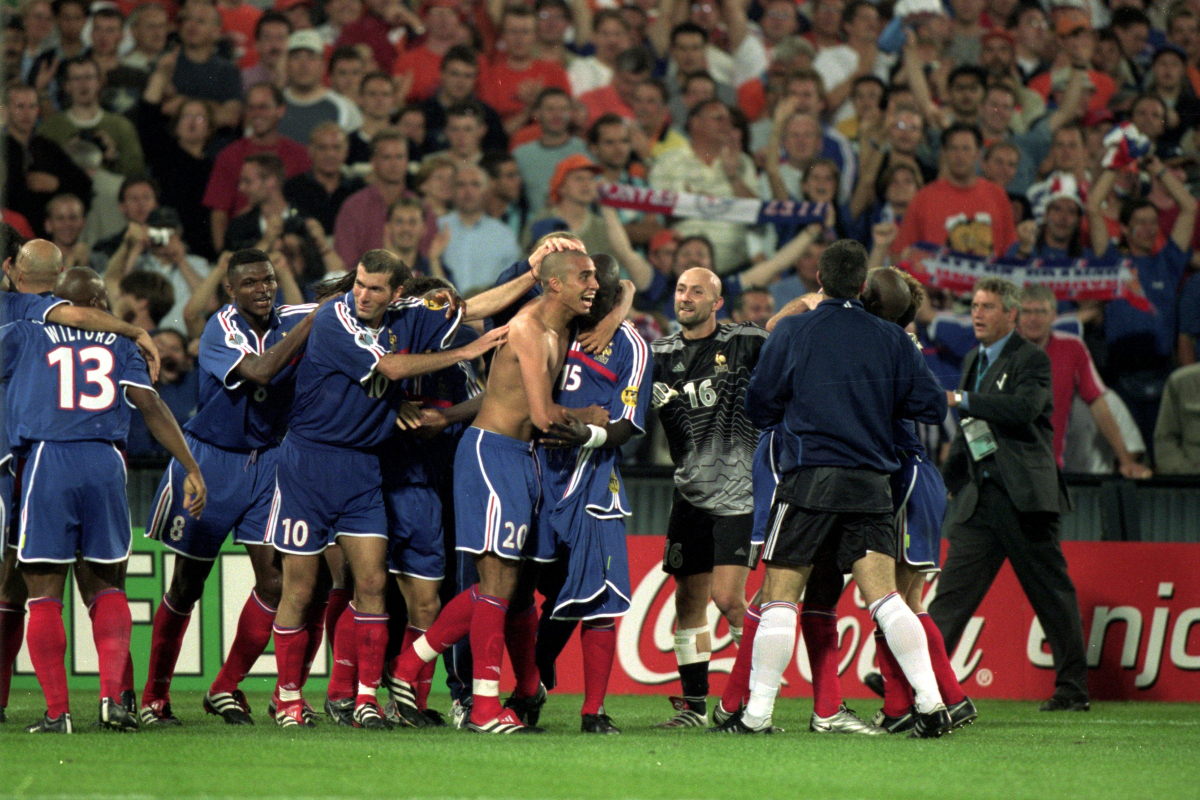
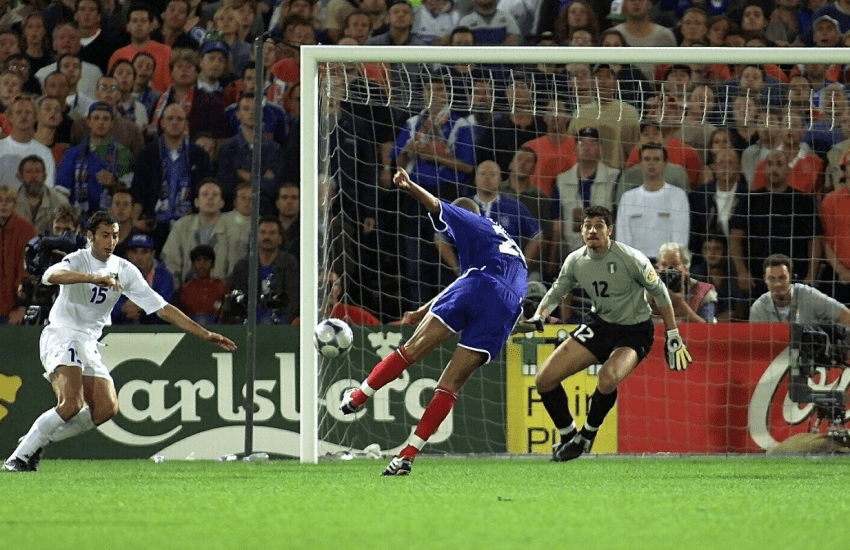
Instead of Italy going again and taking the lead once more, France would go on to complete their comeback 13 minutes into extra time. Robert Pires would run toward the touchline before cutting the ball back to David Trezeguet in the penalty area. Trezeguet would immediately fire the ball into the roof of Francesco Toldo’s net. In the space of 13 minutes, France had gone from the verge of defeat to European champions, adding the title to their World Cup victory from two years earlier.
2001 UEFA Cup Final- Liverpool vs Deportivo Alaves- 16th May 2001
The 2001 UEFA Cup Final saw 3rd in the FA Premier League face 10th in La Liga. Both teams had progressed through six rounds of knockout football to reach this final. Of note, Liverpool had defeated Olympiakos, Roma, Porto and Barcelona while Alaves had dispatched Norwegian champions Rosenborg, 1998 Bundesliga champions Kaiserslautern and Inter Milan. The finals of knockout competitions are usually close affairs, with one team winning by as much as a two-goal margin. If the two teams draw, the score often reads 0-0, 1-1, 2-2 (or even 3-3). Not many people would expect a final to end in a 4-4 score-line after 90 minutes.
Liverpool would score the first goal inside three minutes. A Gary McAllister free-kick would be headed home by centre-back Markus Babbel to put the Reds ahead. In the 16th minute, the Reds would double their lead as passes from Dietmar Hamann and Michael Owen would find Steven Gerrard, who would strike the ball home. After adjusting their tactics, Alaves would respond in the 26th minute as a cross into the Liverpool penalty area would be met by the head of striker Ivan Alonso. Alonso had been on the field for four minutes, coming on as a substitute for defender Dan Eggen as Alaves switched to an attacking formation. Five minutes before half-time, Liverpool would re-establish their two-goal advantage. Gary McAllister would score from the penalty spot after Michael Owen had been brought down in the area by goalkeeper Martin Herrera.
In a complete reverse to the first half, Alaves would strike first in the second half. Two goals from striker Javi Moreno in three second-half minutes (47′, 49′) would eliminate Liverpool’s two-goal lead and level the match at 3-3 after 49 minutes played. A full 22 minutes would pass before either team would score again. In the 72nd minute of the game, replacement striker Robbie Fowler would put Liverpool ahead once again. It seemed like that would be the last goal of the final, that is until Jordi Cruyff headed home from an Alaves corner with two minutes remaining. Two minutes later, the match would head to extra time. With eight goals already on the board, one team would need a ninth to emerge victorious.
Three minutes into extra time, Alaves had put the ball in the Liverpool net, but Ivan Alonso’s goal would be ruled out for offside. In the last minute of the first period, it would be Robbie Fowler’s turn to see a golden goal chalked off for an offside decision. Alaves would be reduced to nine men in extra time, and their bad luck on the night would get worse. In the 116th minute, Alaves defender Carlos Karmona would bring down Vladimir Smicer, giving away a free-kick and receiving a second yellow card for his troubles. From the resulting Gary McAllister free-kick, Alaves left-back Delfi Geli would try to head the ball away. Unfortunately, he would only succeed in heading the ball into his own goal. As the Liverpool players celebrated, Geli now knew that he had become part of football history. In this classic match, Delfi Geli had become part of a select few to score a ‘golden ‘own’ goal’.
UEFA Women’s Euro 2001 Final- Germany vs Sweden-7th July 2001
The first significant ‘golden goal’ to occur in the women’s side of the sport would also happen in the final of a European Championships. Similar to Euro 96 five before it, one of the participants in this historic moment would be Germany. Germany headed into the final, looking to successfully defend the crown that they had won for the fourth time in 1997. To win their fifth Women’s Euro, Germany would have to defeat Sweden, who had won the first edition of the competition back in 1984. Germany had previously beaten Sweden 3-2 in the final of Euro 1995, with the Swedes looking to avenge this defeat six years later.
The final of Euro 2001 would be the second meeting between the two in that year’s competition. The two teams had already faced each other in the opening match of the tournament. In their first meeting, a brace from Claudia Muller and a third from Maron Meinert had seen Germany emerge 3-1 winners. The second round of group matches would see both Germany and Sweden deliver comfortable victories over Russia (5-0) and England (4-0), respectively. In the final round, Germany would win the group after a 3-0 win over England, while Sweden would record a 1-0 win over Russia to finish as group runners-up. In the semi-finals, both Germany and Sweden would face Scandinavian opposition. A Sandra Smisek goal would be enough for Germany to knock out Norway with a 1-0 victory, while a Tina Nordlund finish would result in precisely the same score-line against Denmark.
Due to the result of their earlier encounter, Germany was the heavy favourite heading into the final in Ulm. However, despite the 3-1 score-line seen in the first match, together, the final of Euro 2001 would be a scoreless affair for the entire 90 minutes. The play on the field may not have been helped by the conditions, as torrential rain made sure that players on both sides had to check their footing on more than one occasion. As the match advanced, both sides would have their goalkeepers to thank for keeping the tie scoreless. The crucial goal would finally arrive eight minutes into extra time. Claudia Muller, who had scored twice in Germany’s group-stage victory, would run onto a through ball from Maren Meinert before slotting the ball past Hanna Marklund, giving German their third consecutive European Championship victory.
2002 FIFA World Cup
The 2002 World Cup held in Japan and South Korea was the World Cup for the underdog. A World Cup which saw France, Argentina and Portugal fail to qualify from the group stages while South Korea, Turkey and Senegal progress as far as the quarter-finals, the 2002 World Cup was a tournament full of teams that could be termed ‘surprise packages’. Three golden goals would occur in the 2002 World Cup. These three goals would come from Senegal, South Korea and Turkey to help them progress further in the tournament after producing extraordinary results.
(c) BBC 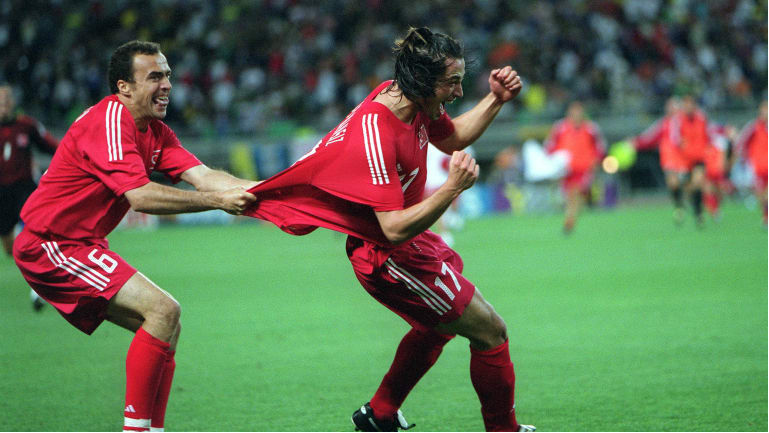
c) FIFA.com 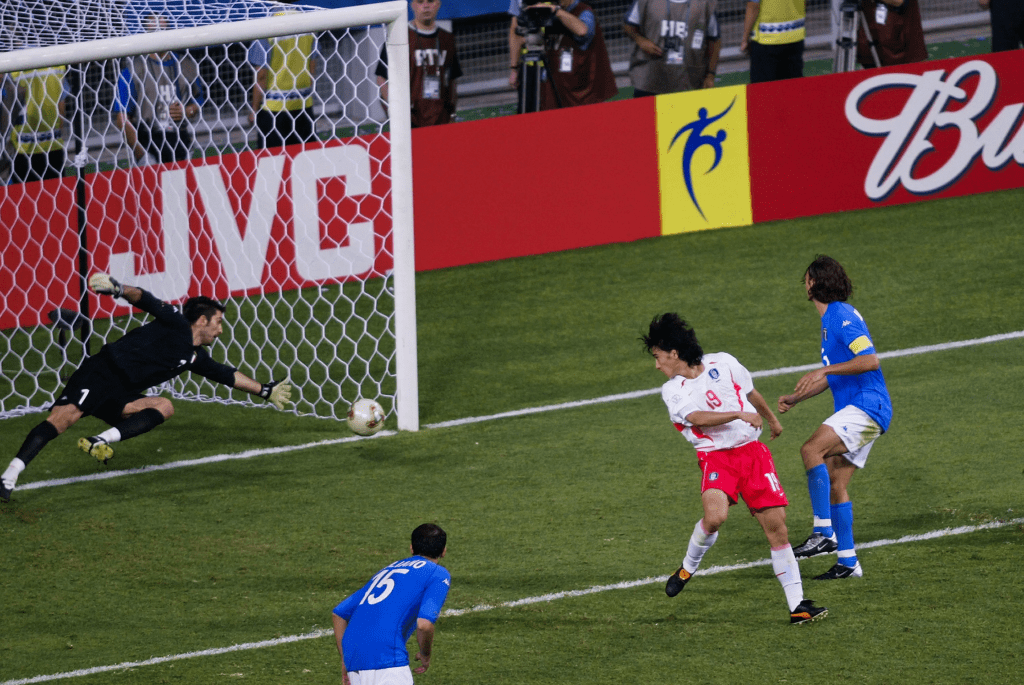
(c) These Football Times
2002 FIFA World Cup Round of 16- Sweden vs Senegal, 16th June 2002
The first golden goal of the 2002 World Cup would arrive in a Round of 16 match between Group F winners Sweden and Group A runners-up Senegal. Sweden had finished top of a ‘group of death’ also containing runners-up England, Argentina and Nigeria. Meanwhile, experts did not give World Cup debutants Senegal much of a chance of progressing from a group containing defending champions and favourites France, two-time World Cup winners Uruguay and one-time European champions Denmark. In their first-ever World Cup match, Senegal would shock the world by defeating France 1-0 in the opening match of the tournament. The African side would follow up this win with draws against Denmark and Uruguay to progress to the knockout stages.
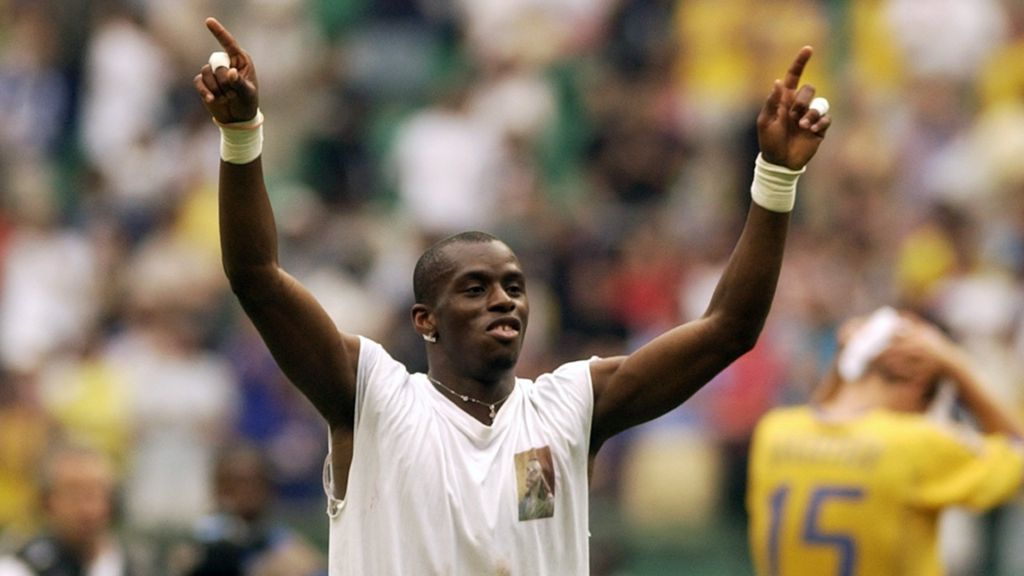
The more experienced side would take the lead after 11 minutes as Henrik Larsson would head home from a corner. The Lions of Teranga would respond in the 37th minute. El-Hadji Diouf would knock down a long ball to his strike partner Henri Camara. Camara would chest the ball down, beat his marker before firing home a low shot from 20 yards out. Sixty-seven minutes later, Camara would score from a similar position, but this goal would mean much more than his first effort.
In the 104th minute of play, Papa Bouba Diop would pass the ball forward to striker Pape Thiaw. Thiaw would run towards the right-hand side of the pitch before passing inside to Camara. Camara would drive through the Swedish defence before scuffing a shot past Magnus Hedman from just inside the Swedish box. With this goal, Henri Camara had ensured that Senegal had joined Cameroon in becoming the second African team to reach the quarter-finals of a FIFA World Cup.
2002 FIFA World Cup Round of 16- South Korea vs Italy, 18th June 2002
Two days later, a ‘golden goal’ would decide another Round of 16 match, albeit a much more controversial one. To give a slight indication how controversial South Korea vs Italy is in FIFA World Cup history, Byron Moreno, the Ecuadorian referee for this match, would later be suspended twice for refereeing errors, with one suspension lasting 20 matches. South Korea entered this match as the winners of Group D after wins against Poland (2-0) and Portugal (0-1) and a draw with the USA (1-1). Meanwhile, Italy had stumbled their way through Group G. They would open with a 2-0 win over Ecuador, before falling to a 2-1 defeat to Croatia and a 1-1 draw against Mexico, to finish in the runner-up spot.
It would take just 3 minutes for the controversy to start. When Song Chung-Gug swung a free-kick into the Italian penalty area, South Korean forward Seol Ki-Hyeon went down in the box. Referee Byron Moreno would award the home side a penalty. However, Italian players and fans were left looking bemused, as Seol had seemingly gone down under little or no contact with Italian defender Christian Panucci. The resulting penalty from striker Ahn Jung-Hwan would be saved to his right by Italy’s young goalkeeper Gianluigi Buffon. Despite this early call going against them, the three-time world champions would draw first blood inside 20 minutes. Striker Christian Vieri would head home at the near post from a Francesco Totti corner. The Italians would still lead at half-time, with both sides failing to create many shots on target.
Throughout the second half, Vieri would have further chances to extend Italy’s lead but would fail to take any of them, even kicking the ball into his foot on one occasion. However in the 88th minute, a South Korean ball into the Italian box would befuddle Christian Panucci. The ball would bounce off the defender into the path of Seol Ki-Hyeon, who would score an equaliser for the hosts. Two minutes later, the match would head to extra time.
In the 100th minute, South Korea would win a direct free-kick just outside the Italian 18-yard box. Substitute Hwang Sun-Hong would deliver a low shot underneath the defensive wall that would send goalkeeper Buffon scuttling to his left to push the ball away. Three minutes later, Totti would collect the ball outside the Korean box and turned his marker before falling to the turf. While Totti called for a penalty, referee Moreno would see something different, giving the Roma striker a second yellow card for diving, sending off one of Italy’s main attacking threats. However, later replays would show that Totti had been brought down by the trailing leg of Song Chong-Gug, meaning Italy should have been awarded a penalty. In the 110th minute, Italy seemed to have found the golden goal. However, the linesman would disallow midfielder Damiano Tommasi’s goal for a marginal offside call.
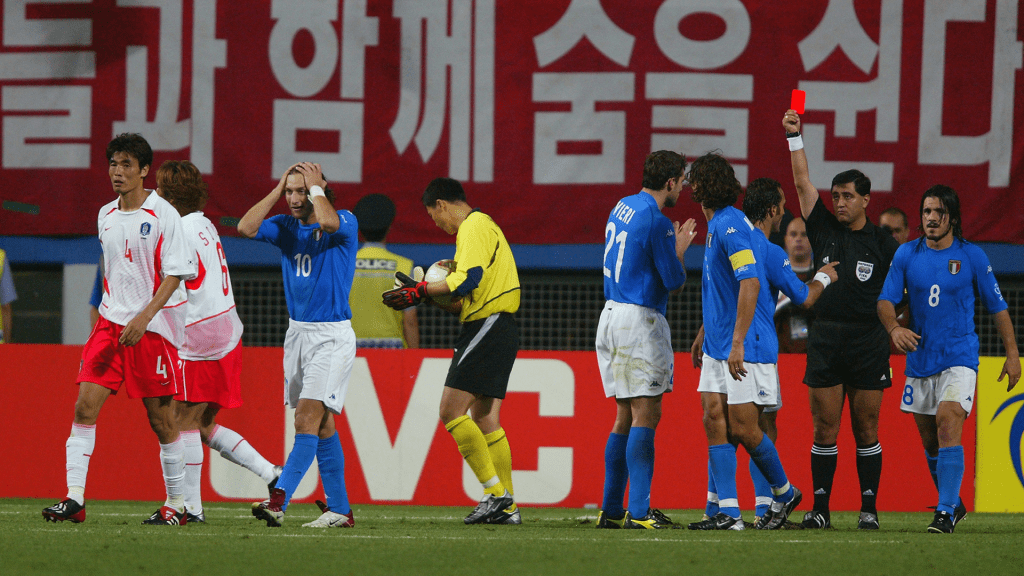
The golden goal would arrive in the 116th minute. Winger Lee Young-Pyo would deliver an in-swinging ball into the Italian penalty area. Striker Ahn Jung-Hwan would jump higher than his marker, flicking the ball of the top of his head past Gianluigi Buffon into the Italian net. Another big-name team dropped out of the 2002 World Cup as the hosts South Korea progressed to the quarter-finals thanks to a striker who spent his weekends playing for Italian Serie A side Perugia. Famously, Ahn would have his contract terminated by Perugia, seemingly for knocking the national team out of the World Cup. To this day, this match remains controversial.
2002 FIFA World Cup Quarter-Final- Senegal vs Turkey, 22nd June 2002
Just one round and six days after Henri Camara’s golden goal heroics against Sweden, Senegal would find themselves on the other end of a golden goal. After knocking the Scandinavians out of the World Cup, The Lions of Teranga would face fellow surprise package Turkey in the quarter-finals. To make the last eight, Turkey had scraped through the group stages on goal difference ahead of Costa Rica. In the second round, they managed to upset Group H winners and co-hosts Japan with a 1-0 victory, after a 12th-minute header from winger Umit Davala.
After a goalless 90 minutes in Osaka between the two shock quarter-finalists, extra time would last all of four minutes. In the 94th minute of play, Senegal left-back Omar Daf would bring down Turkey striker Arif Erdem. However, referee Oscar Ruiz would play the advantage, allowing second-round hero Umit Davala to continue attacking. Davala would deliver a cross into the near-side of the area. Substitute striker Ilhan Mansiz would run in front of his marker Lamine Diatta, firing a first-time shot into the far corner of goalkeeper Tony Sylva’s net. Just six days after a golden goal helped Senegal make football history, a golden goal would help Turkey make history by reaching the World Cup semi-finals in only their second appearance in the tournament finals.
2003 CONCACAF Gold Cup Final-Mexico vs Brazil-27th July 2003
In 2002, Brazil became the most successful side in FIFA World Cup history, beating Germany to winning their 5th World Cup victory. One year later, while trying to add another trophy into their cabinet, they would be on the end of a huge upset. In 2003, CONCACAF invited Brazil (along with Colombia) to take part in the CONCACAF Gold Cup. The tournament decides who is the best team in North and Central America and the Caribbean. Brazil would accept the invite but would send an under-23 squad to the 12-team tournament in Mexico and the United States. Squad members included players who would later start for Brazil in future World Cup tournaments such as Maicon, Kaka and Robinho.
Before their eventual meeting in the Gold Cup Final, Mexico and Brazil would be drawn in the same three-team group along with Honduras and meet in the opening match of the tournament. In their first meeting, the hosts Mexico would emerge victorious thanks to a 70th-minute goal from Jared Borgetti. After this match, Brazil would defeat Honduras 2-1 after goals from Maicon and Diego. The last game in the group would see Mexico play out a goalless draw with Honduras, a result which would be enough for El Tri finish as group winners.
In the quarter-finals, Mexico would put Jamaica to the sword with a 5-0 victory, with five goals from five different players. At the same stage, a brace from 21-year-old Kaka would knock out Colombia at the expense of their South American rivals. To reach the final, Brazil’s youngsters would come from behind to knockout the USA, the competition’s defending champions. Going behind to a goal from Carols Bocanegra, another goal from Kaka in the last minute of regulation time would take the match to extra time. Ten minutes into the first period of extra time, future Werder Bremen player Diego would score the golden goal from the penalty spot. One the other side of the draw, Mexico would have a much more straightforward path to the final, scoring a 2-0 win over Costa Rica after goals from Rafael Marquez and Jared Borgetti.
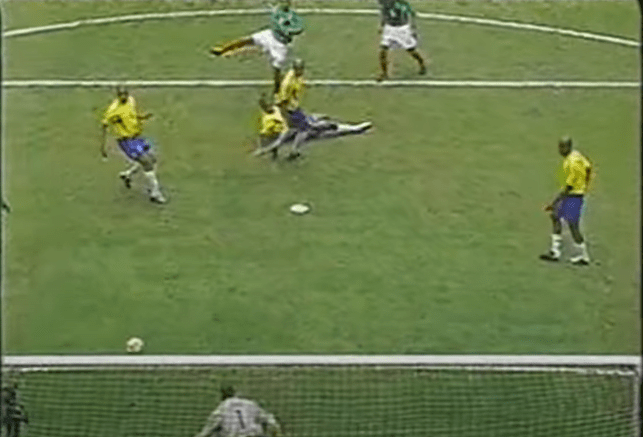
In front of 85,000 spectators at the famous Estadio Azteca, Brazil’s young team proved that despite their age and inexperience at international level they still possessed enough talent to trouble Mexico’s strongest XI. Kaka, Brazil’s captain for the day, would come close to scoring, side-footing the ball just past the post. At the other end, Mexico would a combination post and crossbar with future Tottenham goalkeeper Heurelho Gomes left flailing. In the second half, Gomes would have to be at his best to turn a Pavel Pardo free-kick just past the post. After these goal-scoring chances, the match would head to extra-time.
Seven minutes into extra time, Mario Mendez would find fellow substitute Daniel Osorno inside the Brazil penalty area. Osorno would create space for himself, running to the edge of the box before unleashing a low shot that zipped past Gomes into the net. Later, Mexico would lift their 4th CONCACAF Gold Cup title.
2003 FIFA Women’s World Cup Final- Germany vs Sweden, 12th October 2003
In a tournament which has had its fair share of dramatic finals over the years, it is not a surprise to say that a golden goal once decided FIFA Women’s World Cup Final. Four years after Brandi Chastain’s iconic winning penalty and celebration in front of 90,000 people in the Rose Bowl, another unique and iconic moment in women’s football would occur in 2003. In a rematch of the final of the 2001 Women’s European Championship, Germany and Sweden would meet again, this time for the chance to become world champions. Having emerged victorious in their previous encounter, Germany was looking to add the World Cup to their Euro triumph, while Sweden was looking to avenge the 1-0 defeat in the Donaustadion.
To make the final, Germany had progressed through the group stage with comfortable wins over Canada (4-1), Japan (3-0) and Argentina (6-1) and thrashed Russia 7-1 in the quarter-finals before meeting the USA in the semi-finals. A 15th-minute header from Kerstin Garefrekes and stoppage-time goals from Maren Meinert and Brigit Prinz saw the Germans upset the hosts and defending champions, handing them only their second-ever loss in Women’s World Cup history.
Sweden would be drawn in Group A with North Korea, Nigeria and the United States. A defeat to the USA (1-3) and wins over North Korea (1-0) and Nigeria saw the team finish as group runners-up. In the quarter-finals, Sweden would beat Group B winners Brazil 2-1 as goals from Victoria Svensson and Malin Andersson would cancel out Marta’s penalty kick. One round later, Sweden would match this scoreline to defeat Canada in the semi-finals and set up a final match with Germany.
The first goal of the final would arrive in the 41st minute. Sweden would overturn possession of the ball from a German throw-in before a through ball from Victoria Svensson would set free her strike partner Hanna Ljungberg. Ljungberg would run clear of the defence before side-footing the ball past the diving Silke Rottenberg in the German goal. Despite falling behind just minutes before half-time, Germany would equalise only 40 seconds after half-time. Intercepting a clearance from the Swedish defence, Kerstin Garefrekes would pass the ball to Birgit Prinz. Prinz would free herself from her marker to deliver a diagonal ball around the Swedish defence to Maren Meinert, who would finish from 12 yards out. Despite further goal scoring chances, the final would remain tied at the end of regulation time. Just like the Euro 2001 final, extra time would decide the winner between Germany and Sweden.
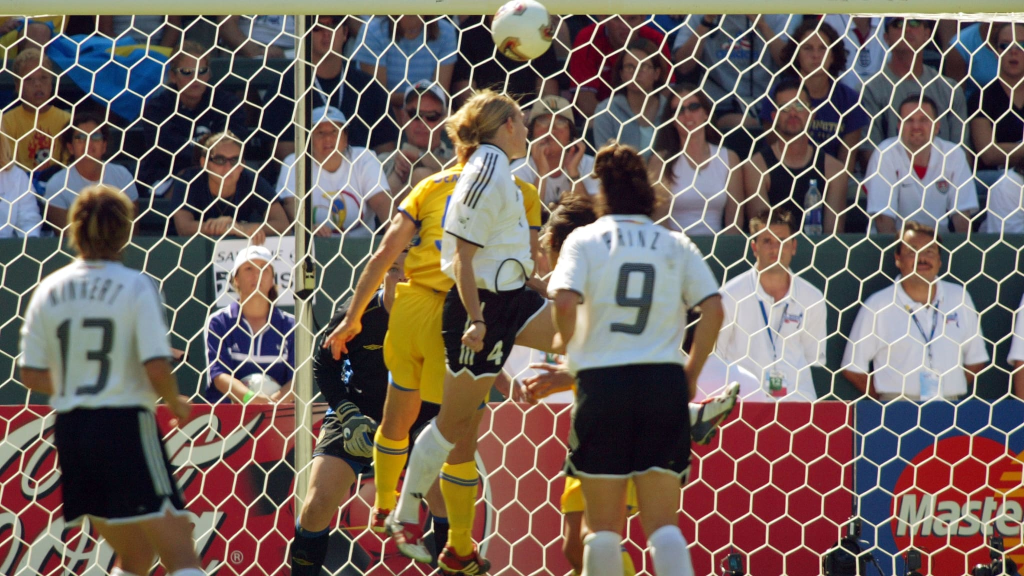
In the 98th minute, Victoria Svensson brought down German right-back Kersten Stegemann and Germany were awarded a free-kick 35 yards from goal. Renate Lingor would swing the ball into the area where defender Nia Kunzer would meet it. Kunzer would outjump her marker to head home from 8 yards out and deliver Germany their second Women’s World Cup Trophy. For the second time in three years, Germany had beaten Sweden in a major tournament by scoring a golden goal.
Other examples
1997 FIFA Confederations Cup Semi-Final- Uruguay vs Australia, 19th December 1997
Harry Kewell is not a name you would associate with ‘golden’ goals. However, in 1997, the then-Leeds United player etched his name into football history by scoring the first goal in the history of the FIFA Confederations Cup. Even if the Confederations Cup does not hold the same level of importance as the FIFA World Cup, Kewell’s golden goal still occurred at a major international football tournament overseen by FIFA. Harry Kewell and his Australian teammates entered the 1997 Confederations Cup as the champions of the Oceania Football Confederation (OFC). Being drawn in Group A, a win against Mexico (1-3), a draw with Brazil (0-0) and a defeat to hosts Saudi Arabia (1-0) was enough to see the Socceroos finish 2nd behind the reigning world champions to qualify for the semi-finals Their opponent would be the COMNEBOL champions Uruguay.
Managed by Terry Venables and featuring the likes of Mark Viduka, Mark Bosnich and Stan Lazaridis, the 19-year-old Kewell would be the team’s hero on the night. After a goalless 90 minutes, the man from Sydney would score just 2 minutes into extra-time to send his team into the Confederations Cup Final and a rematch with Brazil. Australia would ultimately lose that match 6-0 after hat-tricks for both Ronaldo and Romario.
1999 FIFA Confederations Cup Semi-Final- Mexico vs USA, 1st August 1999
Two years after Harry Kewell’s history-making goal in the 1997 FIFA Confederations Cup, the 1999 edition of the tournament would see a golden goal decide the winner of a high-profile football rivalry. The semi-finals of the 1999 Confederations Cup would see the hosts Mexico take on reigning CONCACAF Gold Cup champions the USA, the two biggest football powers in North and Central America. To reach the semi-finals, Mexico had beaten Saudi Arabia (5-1) and Bolivia (0-1) and drawn with Egypt (2-2) to win Group A. Meanwhile, the USA had finished second behind Brazil in Group B after losing 1-0 to the Selecao in between victories over Oceanic champions New Zealand (1-2) and European champions Germany (2-0).
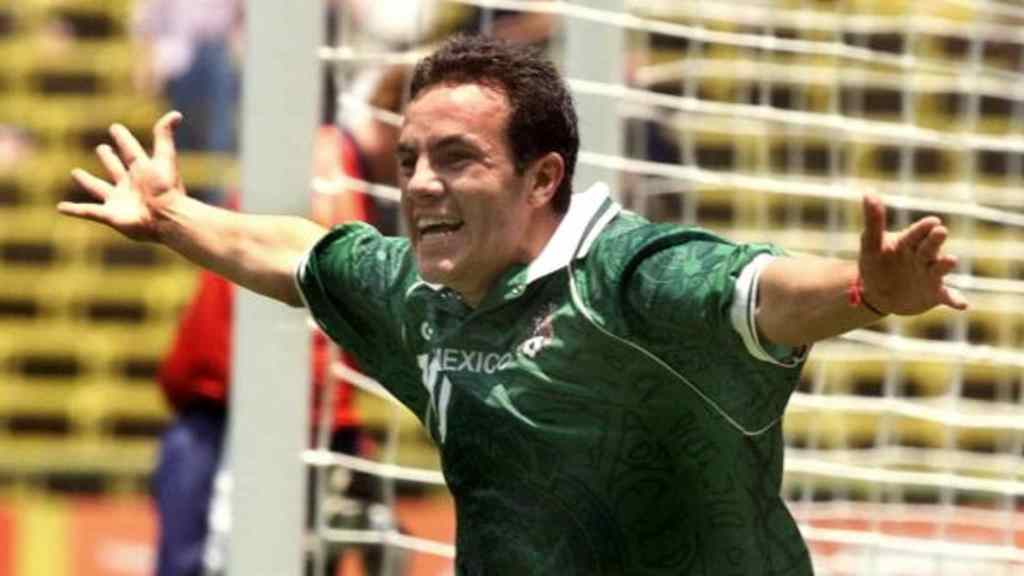
After a goalless 90 minutes, the deadlock would finally be broken in minute 97. Striker Cuauhtémoc Blanco, who had previously scored four goals in the group stages, would be the scorer. In a chaotic American penalty area, Blanco would scuff his first attempt with his left foot before scoring with his right foot to take Mexico to the Confederations Cup final where they would face Brazil. In said final, Mexico would win their first, and so far, only FIFA Confederations Cup, winning a 4-3 classic against a Brazilian side featuring a young Ronaldinho.
2000 UEFA Super Cup- Real Madrid vs Galatasaray- 25th August 2000
The primary purpose of the UEFA Super Cup is to serve as a tying up of loose ends. Despite not functioning as a pre-season tournament, the match’s location in late August suggests this fixture is used to end one season of European football before the new season of European football begins. Winning the UEFA Super Cup allows either Champions League holders or the Europa League holders to add a new trophy to their collection, earn some bragging rights and boldly claim that they were the best team in Europe the previous season.
In the year 2000, this showpiece match saw Champions League winners Real Madrid meet UEFA Cup winners Galatasaray. To reach this champion vs champion final, Real Madrid had beaten Spanish league rivals Valencia 3-0 in Paris, while Gala had defeated Arsenal 4-1 on penalties in a bad-tempered final in Copenhagen to become the first Turkish side to win a European football competition. As expected in elite-level football, both starting line-ups featured superstars. While Galatasaray possessed the talents of Claudio Taffarel in goal, Gheorghe Popescu in defence and Gheorghe Hagi in midfield, Real Madrid was in the early phases of the first ‘Galacticos’ era. Along with players like 19-year-old goalkeeper Iker Casillas and future Chelsea and Newcastle defender Geremi, Los Blancos could call upon Roberto Carlos, Luis Figo, Claude Makelele and their talismanic homegrown captain Raul.
Fans inside the Stade Louis II in Monaco would have to wait 41 minutes for the first goal to arrive. Galatasaray would be awarded a penalty after left-back Hakan Unsal’s impressive run from deep was ended by the foot of Ivan Campo. Gala’s central striker Mario Jardel would step to take the penalty, sending Casillas the wrong way. In the 79th minute, Real Madrid would be awarded of their own. A Savio cross into the box would hit the elbow of midfielder Suat Kaya, and referee Gunter Benko would point to the spot. Unlike his opposite number, Claudio Taffarel would dive the right way, but Raul would send his penalty high into the top corner, out of his reach.
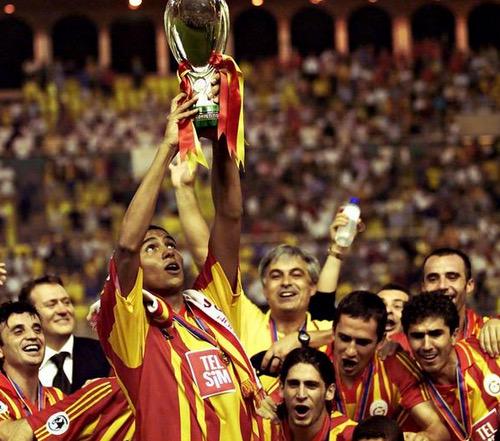
In a match low on clear-cut chances, it wasn’t a surprise to see this final head to extra time. The golden goal would arrive in the 103rd minute. A crossfield ball would find substitute defender Fatih Akyel. Akyel would jostle with Real striker Pedro Munitis, winning the physical battle before reaching the edge of the penalty area and delivering a precise and powerful pass straight to the foot of Mario Jardel. Jardel would finish first-time, stroking the ball home to hand Gala their first UEFA Super Cup and their 4th different trophy of the year 2000. In the first UEFA Super Cup to see the Champions League winners take on the UEFA Cup winners (instead of the winners of the UEFA Cup Winners’ Cup), the underdogs had upset the Galacticos.
2000 Olympics Games- Men’s and Women’s tournaments-15th-30th September 2000
The second and final Olympic Games to use the ‘golden goal’ as part of its men’s and women’s football tournaments would see two notable examples of the rule.
In the men’s tournament, Brazil would once again be eliminated by an African team by conceding a golden goal, further lengthening the wait for an eventual Brazilian football Olympic gold medal. This time, Cameroon would be the team to end Brazilian hopes. In the quarter-finals, Cameroon would take the lead after 17 minutes through a Patrick M’Boma free-kick. In the 4th minute of stoppage time, 20-year-old Ronaldinho would equalise for Brazil through a free-kick of his own, tasking the match to extra time. However, in the 113th minute of play, Modeste M’Bami would run past one Brazilian defender before firing a shot past Helton from the edge of the penalty area. After beating Brazil, Cameroon would follow the lead of Nigeria four years earlier by going on to win the gold medal by beating Spain in the final.
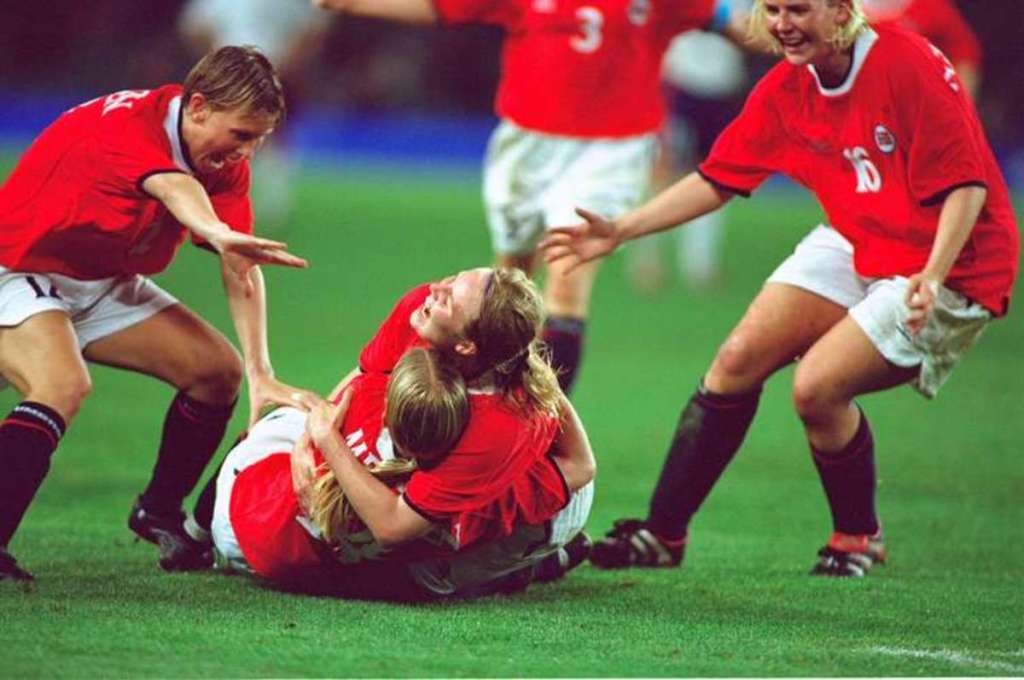
In the women’s competition, the ‘golden goal’ would decide the gold medal match between Norway and the defending champions the USA. The United States had taken the lead through a Tiffeny Milbrett tap-in after 5 minutes only for Norway to equalise on the verge of half-time through a header from Gro Espeseth. In the second half, Norway would take the lead through Ragnhild Øren Gulbrandsen, but Milbrett would equalise in the second minute of stoppage time to force extra time. Four minutes before the end of the first period, a long ball forward by Hege Riise would fall for Dagny Mellgren to score past Siri Mullinix and give Norway the second Olympic gold medal in Women’s football.
2003 FIFA Confederations Cup Final- France vs Cameroon, 29th June 2003
If you haven’t heard of this particular ‘golden goal’, the reasons may be twofold. As mentioned earlier, football fans do not treat the FIFA Confederations Cup with the same level of attention afforded to the World Cup or the individual continental competitions. Second of all, the 2003 Confederations Cup Final between hosts and European champions France and African champions Cameroon was played under a cloud, taking place just three days after a football tragedy. On 26th June 2003, in the 72nd minute of a semi-final between Cameroon and Colombia, Cameroonian defender Marc-Vivien Foe collapsed in the centre of the pitch with no players around him. After attempts at on-field resuscitation, a group of physios stretchered Foe off the field. After later attempts at resuscitation, Foe was pronounced dead later that night at the age of 28. An autopsy later found that Foe’s death was caused by hypertrophic cardiomyopathy, a hereditary heart condition.
The Confederations Cup Final would be dedicated to Foe’s memory. The Cameroon players would wear shirts adorned with Foe’s name and dates of birth and death. A large photo of Foe would also be carried onto the pitch by captains Marcel Desailly and Rigobert Song as the teams walked out.
The match would remain goalless for the entire 90 minutes, necessitating the need for extra time. 7 minutes into extra time, France would provide a golden goal of real quality. Lilian Thuram delivered a long ball into the penalty area. The ball would reach Thierry Henry (at the height of his powers), who would provide the deftest of touches to score with his shin past Carlos Kameni and help France retain the Confederations Cup. Once the match was over, thoughts again returned to Marc-Vivien Foe. His Cameroonian teammates hung a silver medal over the enlarged picture of Foe. Team captains Marcel Desailly and Rigobert Song would lift the Confederations Cup trophy together in a symbol of solidarity.
Gold Turns To Silver
Ahead of the 2002-03 European football season, UEFA introduced an alternative to the golden goal: the silver goal. In the case of the silver goal rule, a match would not immediately stop after one team scored a goal in extra time. Instead, the rest of the particular period of extra time would be played, giving the losing side a chance to respond. However, a silver goal would only be acknowledged if scored in the first period of extra time. Below, you will see two significant examples where a team would score a silver goal. However, in one instance, the silver goal would not register as one for reasons that will be explained later. UEFA would implement the ‘silver goal’ rule in the Champions League, UEFA Cup and at Euro 2004.
2003 UEFA Cup Final- Celtic vs FC Porto, 21st May 2003
The first example of a ‘silver goal’ deciding a high-profile football match came in the 2003 UEFA Cup Final between Celtic and FC Porto. Both of these teams had experienced previous European success in the form of the European Cup, with Celtic winning in 1967 and Porto triumphing 20 years later. However, no team from Scotland or Portugal had ever won the UEFA Cup up to this point. No matter what happened in the final or whichever team came out as the winner in Seville, one team would be making history. To make the final, Celtic had defeated Polonia Warsaw, Austria Wien, Lens, Denizlispor, Panathinaikos and Lazio. On the other side of the draw, Porto, managed by an unknown called Jose Mourinho, had swept aside Suduva, Blackburn Rovers, Celta Vigo, Stuttgart, Liverpool and league rivals Boavista.
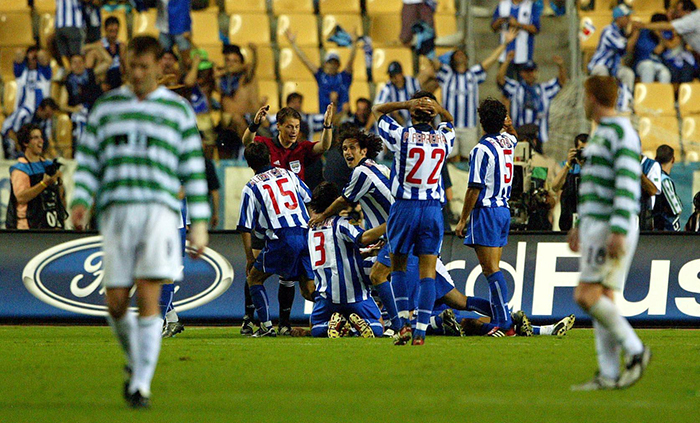
For a match that would eventually see five goals scored, the first goal would not arrive until first-half stoppage time. A chip into the Celtic penalty area would find Dmitri Alenichev. Alenichev’s volley would be parried by Celtic goalkeeper Rab Douglas, only for striker Derlei to fire home the rebound. You would think that going behind on the verge of half-time might have affected Celtic going into the second half, but Henrik Larsson’s equaliser would answer that question two minutes after half-time. The Swedish international would head home Didier Agathe’s cross from a tight angle to put the Bhoys back on level terms. Seven minutes later, Porto would take the lead once again. Excellent play from Deco set up Dmitri Alenichev, who would score under the onrushing Rab Douglas. However, Celtic would not take long to respond. From a Celtic corner, Larsson would head home to score his second goal of the night. After the two teams had combined for four goals in 12 minutes, neither side would score again for the remaining 33 minutes of regulation time.
Six minutes into extra time, Celtic defender Bobo Balde would be sent off for a second yellow card, reducing his team down to 10 men. Nineteen minutes later, Porto would take advantage. A long through ball would find striker Marco Ferreira, but an onrushing Rab Douglas would get to him first. Douglas would slide the ball away from Ferreira only for it to land at the feet of Derlei. Derlei would evade the Celtic tackles before firing home the winning goal. Three minutes plus added time later, Porto were UEFA Cup champions. Derlei’s extra-time winner is a silver goal according to the match scoresheet, but it technically isn’t counted as one, as Derlei scored his goal in the second period of extra time. Scoring in the second period of extra time nullified the silver goal rule, meaning that despite what the record books say, FC Porto did and also did not win the 2003 UEFA Cup thanks to a ‘silver goal’.
2004 UEFA European Championships Semi-Final- Greece vs Czech Republic, 1st July 2004
The match in which a ‘silver goal’ actually counted towards the match result would play a part in one football’s great underdog stories. On 1st July 2004 at the Estadio do Dragao in Porto, Greece defender Traianos Dellas would score the most high-profile silver goal in the history of football to help his team reach the final of Euro 2004. The victory was the latest in a series of shocking results that would officially end with Greece winning their only significant piece of silverware in international football. However, to make the Euro 2004 final in Lisbon on 4th July, Greece first had to defeat an impressive Czech Republic side in the competition’s semi-finals.
Many didn’t expect Greece to progress from a preliminary group containing hosts Portugal, Spain and Russia, having not competed in a major international football competition since a group stage exit at the 1994 FIFA World Cup. However, the Greek campaign would start with a bang, defeating the host nation 2-1 in the opening match of the tournament. Midfielders Giorgos Karagounis and Angelos Basinas would provide the goals that sparked the upset. However, Greece would not follow up this result in their next two Group A matches, drawing 1-1 with Spain and losing 2-1 to already eliminated Russia. After progressing to the quarter-finals on the tiebreaker of goals scored, Greece would face defending European champions France, who were heavily favoured to win the competition once again. However, Greece would defy pre-match expectations, as an Angelos Charisteas goal would knock out the champions and see Greece progress to the semi-finals to face the Czechs.
On the other side of the draw, the Czech Republic, led by captain and reigning Ballon D’or winner Pavel Nedved, were drawn in a group with one-time winners the Netherlands, three-time winners Germany and minnows Latvia. Despite this challenging draw, the Czechs would be the only side to gain maximum points from all three group matches, first defeating Latvia (2-1), then edging a win over the Netherlands (2-3) before beating an underwhelming Germany side 2-1 to top the group. In the quarter-finals, the Czech Republic would be drawn against Group C runners-up Denmark. The Czech would dispatch the Scandinavians with ease, winning 3-0 with a brace from Milan Baros and another from Jan Koller.
Before facing Greece, the Czech Republic had scored at least two goals in every game they had played at Euro 2004, as well as being the only unbeaten side left in the competition. However, the Czechs would struggle to score against the Greek defence. A powerful volley from Tomas Rosicky would hit the crossbar, with Antonios Nikopolidis beaten. Nikopolidis would also have to be smart to turn away a Marek Jankulovski shot from a tight angle. Another from Jankulovski would have the Greek goalkeeper backtracking only for the shot to just clear the bar. In the second half, a quick exchange of passes between Rosicky and Jan Koller would see the bald striker skew his effort wide of the target. Despite these many shooting chances, the match would remain goalless come 90 minutes and silver goal extra time would soon follow.
In extra time, it would be Greece creating the more clear-cut chances with substitute Stelios Giannakopoulos proving a threat to the Czech defence. However, the killer blow to the match would be struck in added time at the end of the first period of extra time, the latest possible moment for a silver goal to matter. Greece would have a corner, which midfield substitute Vassilios Tsiartas would swing into the area. Defender Traianos Dellas would head it in at the near post, ending the match right then and there. Greece had upset expectations once again, eliminating the unbeaten Czech Republic to make the Euro 2004 final, where they would also subvert pre-match predictions by winning it.
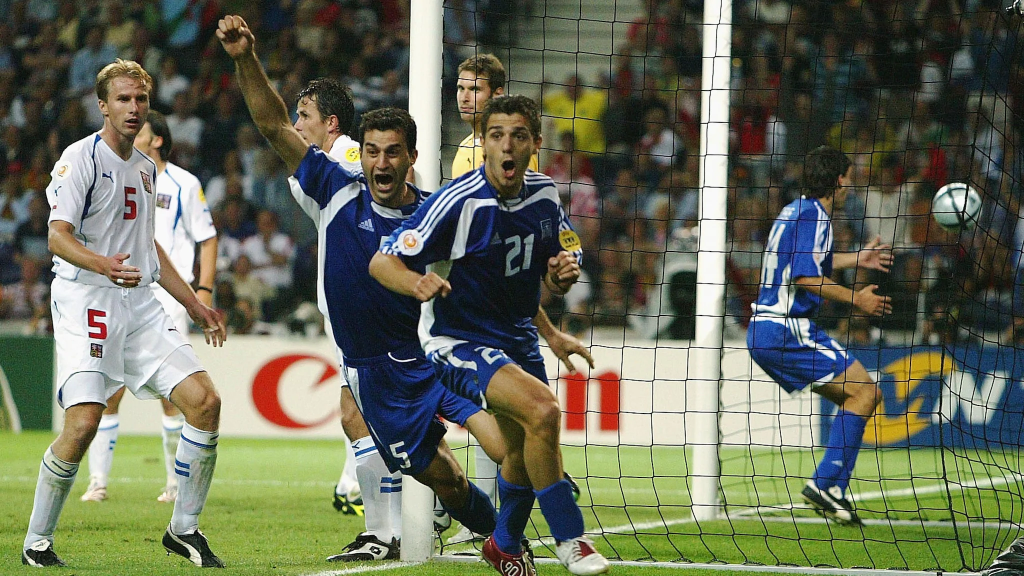
Traianos Dellas’s silver goal would be the last notable time a silver or golden goal would decide the result of a match before the higher-ups and football’s governing bodies decided on these two rules.
The rule is scrapped
Despite playing a significant part in football history as shown by the examples above, the golden goal and silver goal did not last long as part of FIFA’s Rules Of The Game. After first being implemented in 1993, the rule would be in place for 11 years before being abolished. In February 2004, the International Football Association Board would remove both the golden goal and silver goal from the Laws of the Game after Euro 2004. This ruling was later re-affirmed when FIFA announced that they would not be utilising either rule at the 2006 World Cup in Germany.
Critics believed that the golden goal had not solved the problem of teams playing defensive game plans in extra time, an issue that FIFA implemented the golden goal to solve. Another criticism of the golden goal struck right at the heart of the rule itself. With matches ending immediately after one team had scored a golden goal, players and coaches from losing sides were often annoyed that they were not given a chance to respond to said golden goal. In the Euro 96 final, Czech Republic players were left fuming as they believed that Oliver Bierhoff’s golden goal was offside. Similarly, if a controversial penalty decision immediately led to a ‘golden goal’, the penalised team would feel harshly treated.
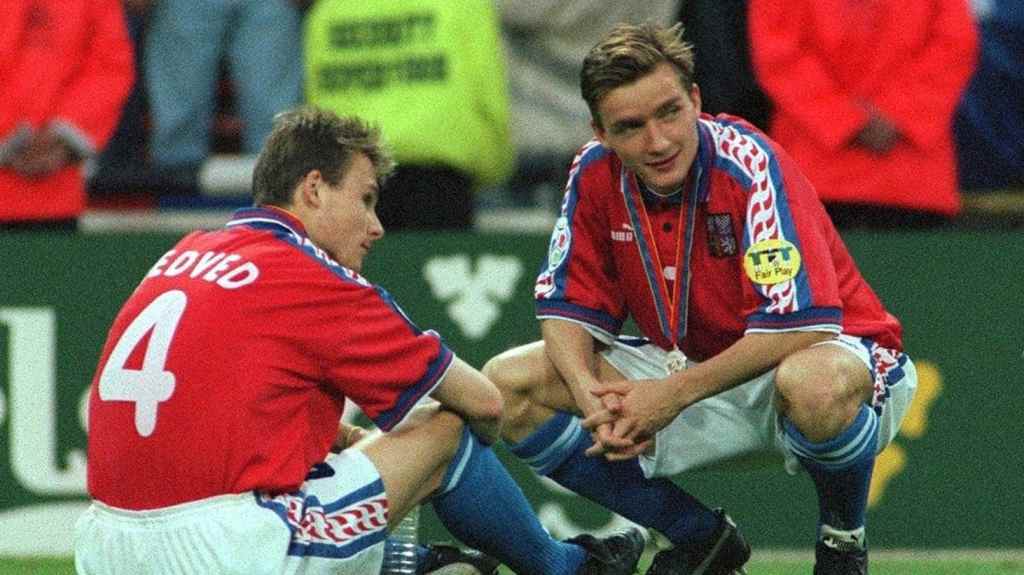
Some of the criticism of the golden goal led to the introduction of the ‘silver goal’ in 2003. However, as noted above, the silver goal only counted if somebody scored the goal in the first period of extra time. In the Euro 2004 semi-final, the Czech Republic (again) felt aggrieved when Greece won by scoring a silver goal in added time a the end of the first period of extra time. Instead of playing the second period, the silver goal ended the match, and the Czechs did not have a chance to register a response. Since 2004, extra time is once again two solid fifteen-minute halves of football followed by a penalty shoot-out if required.
In a nice bit of symmetry, the last international tournament to feature the golden goal as part of its rules would be the 2003 FIFA World Youth Championship, that would run from 29th November-13th December 2003. Ten years earlier, the 1993 edition of the same competition was the first to operate under these rules. In a fitting send-off to the controversial law, 5 of the 16 matches played in the knockout stages of the 2003 FIFA World Youth Championship would be decided by ‘golden goals’. However, people are less likely to recall the names Daisuke Sakata, Duda, Erwin Carrillo and Fernando Cavenaghi as golden goal scorers as they are to remember the names Bierhoff, Blanc and Trezeguet.
Conclusion
Comparisons can be drawn between the ‘golden goal’ rule and VAR. The golden goal was never as controversial in its eleven years of operation as VAR has been in its three years of operation. Also, ‘golden goals’ were only applied in extra time, while VAR is active for all 90-120 minutes of a football match. However, both rule changes have managed to create memorable moments, be they good or bad. Both rule changes have made moments that have caused joy and pain in equal measure, and criticism from those who have ended up on the wrong side of the law. After 11 years of operation, FIFA and IFAB felt that the ‘golden goal’ rule had failed to live up to its original purpose in making football matches more exciting. It is currently unknown how long VAR will last as part of the Laws of the Game, while it faces a constant barrage of negative criticism from players, managers and pundits every single week. However, the latter rule cannot call on the individual moments of magic created for players like Oliver Bierhoff and David Trezeguet and countries like South Korea and Senegal.
For 11 years, the ‘golden goal’ created moments in football history that fans still fondly remember to this day. In this writer’s opinion, something that would serve to make those long extra-time periods more exciting and reduce the number of nerves shredded by another penalty shoot-out would be a return of the ‘golden goal’ rule or a slightly adjusted version. At least losing a golden goal would be better to take than losing to an incorrect VAR decision.
 the-score-board.co.uk