
You never forget your country’s first Olympic gold medal…
To be the first to achieve anything is something that can never be taken away from somebody. In a sporting sense, to win your country’s first Olympic gold medal is something that will always belong to a select group of competitors. 97 countries have won an Olympic gold medal at either the Winter or Summer Olympics, meaning that 97 people can claim to be their nation’s first Olympic gold medallist. The first country to achieve this feat would be the USA, as Harvard student James Connolly would triumph in the triple jump to become the first modern Olympic champion on 6th April 1896. One day later, Australia would gain their first Olympic gold medallist when Edwin Flack won the 1500 metres in a time of 4:33:20. France and Great Britain would also gain their first Olympic champions on 7th April. First, Eugene-Henri Gravelotte would achieve the feat for France in fencing, winning the men’s foil final against fellow Frenchman Henri Callot. Second, weightlifter Launceston Elliot would triumph in the one-handed lift competition to become Britain’s first Olympic champion.
Outside of the predominant Olympic nations, India’s first of 9 gold medals would arrive at the 1928 Olympics in Amsterdam in the sport of field hockey. Canada’s first gold medal would come from George Orton’s success in the 2500m steeplechase. Jamaica, a nation known for its Olympic exploits on the track, would gain an Olympic gold medal in their Games debut, with 400m runner Arthur Wint winning at London 1948. Despite all these statistics, the real question of this article remains. What about Grenada? With a national population of 111,454 people (based on 2018 estimates), the Caribbean country of Grenada is one of the smallest countries to compete in the Olympics every four years.
Grenada would make its Olympic debut in Los Angeles in 1984, sending six athletes to compete in the Games, including four boxers, men’s 800m runner Samuel Shawny and women’s long jumper Jacinta Bartholomew. The team wouldn’t reach any Olympic finals and would return home with zero medals. Four years later, Grenada would again send 6 competitors to the Games in athletics and boxing, with the same results.
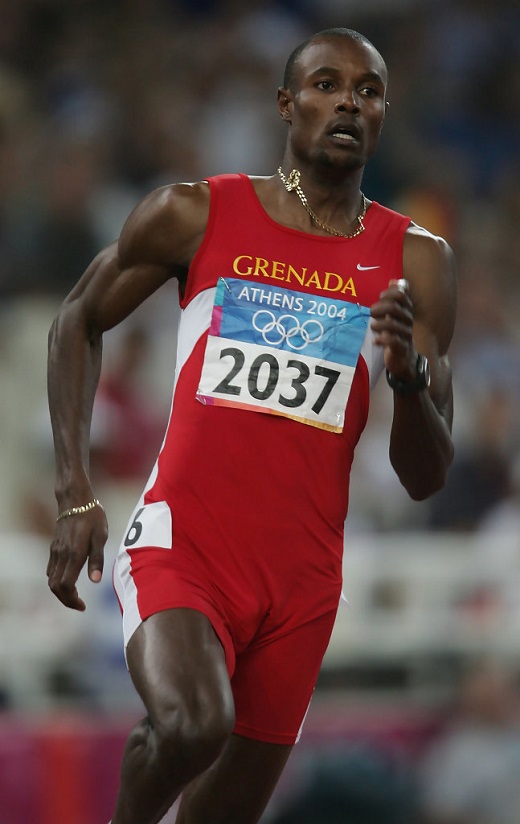
As the years went by, the numbers would steadily drop with 3 athletes travelling to the Sydney Olympics in 2000. The country’s main strength was found in athletics, although no Grenadian athlete had ever made it past the Olympic heats. This stat would improve at Athens 2004, as Hazel-Ann Regis would progress to the 400m semi-finals, finishing 7th in her semi-final heat. On the men’s side, flag bearer Alleyne Francique would do better, qualifying for the men’s 400m final. In the final, he would be the best non-US finisher, placing in 4th behind the all-American clean sweep of Jeremy Wariner, Otis Harris and Derrick Brew.
In 2008, 9 athletes would compete for Grenada, but only one would make it past the heats. In the women’s 800m, Neisha Bernard-Thomas would set a new national record of 2:00:09 to progress from her heat, but would bow out at the semi-final stage. At this point, no one would have predicted that Grenada would break their duck just 4 years later, thanks to a 6ft 3in 19-year-old from Gouyave from the parish of St John, lying on the country’s west coast.
In 2009, a 16-year-old Kirani James had just completed the rare 200m/400m double at the World Youth Championships. In an interview with the IAAF website after winning the 200m, he expressed that his main targets were the upcoming Pan American Junior Championships, followed by the 2010 World Junior Championships, while his coach Albert Joseph stated that “We are looking forward to the 2012 Olympics in London”. He would win the 400m at the 2009 Pan American Junior Championships before heading to the 2010 World Junior Championships in great form after an excellent American collegiate season at Alabama State. At the championships in New Brunswick, James would win the 400m with a time of 45.89 seconds. Despite winning gold, James would express his disappointment with his time, stating that “I don’t care about winning championships. I only care about running fast.” He would finish his season, winning the NCAA Outdoor Championship in his freshman year of college.
The 18-year-old would begin the following season by setting a new world junior record indoors at the Southeastern Conference Indoor Championships with a time of 44.80 seconds, beating the previous record held by reigning World and Olympic champion LaShawn Merritt. He would retain the NCAA title before setting a world leading time at the London Diamond League with a time of 44.61. Heading into his senior championship debut at the upcoming World Championships in Daegu, the 18-year-old would be seen as a favourite to win 400m gold alongside defending champion Merritt.
At the championships, his chief rival Merritt would set his own stall out early, setting his own world leading time, winning his heat in 44.35 seconds to qualify fastest for the semi-finals. Kirani James would win his heat, qualifying 5th overall with a time of 45.12. Merritt and James would both win their semi-finals, with the American once again running the faster of the two with a time of 44.76, to Kirani’s easy 45.20. Kirani would also be joined in the final by fellow Grenadian Rondell Bartholomew, who had qualified as a fastest loser after finishing 3rd in his semi-final. In the final, LaShawn Merritt would have his trademark fast start and would come into the home straight with a 3m lead. However, the young Grenadian to his right would noticeably power down the home stretch, closing down on the defending champion with every passing stride. His speed would bring him back to Merritt close to or on the finish line.
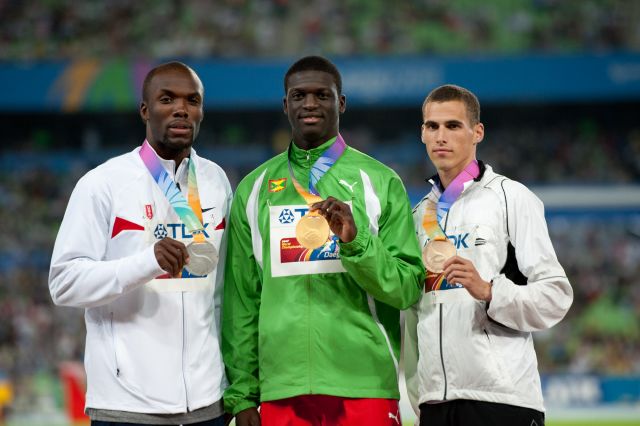
The gold medal would be decided on the line by 3/100ths of a second, and it would be Kirani James who would edge this incredibly close 400m final with a time of 44.60 ahead of Merritt’s 44.63. Not only had James claimed Grenada’s first world championship gold medal, he had also become the youngest 400m world champion, achieving the record two days before his 19th birthday. He had also joined a select group of athletes including Usain Bolt, Valerie Adams, Veronica Campbell-Brown and Yelena Isinbayaeva who had become world champion in the same event at youth, junior and senior level. Following Daegu, James would go on to win the 2011 Diamond League for the best performances over 400m. With an Olympic year on the horizon, the young Grenadian was in fine fettle to make history in London.
James finished his preparations for the 2012 Olympics by repeating his victory in the London leg of the Diamond League, winning in 44.85. Once again, his chief rival for Olympic gold would be defending champion LaShawn Merritt. Four years earlier in Beijing, Merritt had recorded a new personal best of 43.75 to defeat defending World and Olympic champion and teammate Jeremy Wariner by almost a second. Merritt had started the season in good form, winning the Diamond League events in Doha on 11th May and the Prefontaine Classic in Eugene on 2nd June. Merritt was also entering the Olympics as the fastest in the world that year, having stopped the clock at 44.19 to win in Qatar. He would lower this time to 44.12 to win the U.S. Olympic Trials. However, there were concerns about Merritt’s fitness heading into his Olympic defence, having picked up an injury following his early-season form. He had pulled up in the London Diamond League and had also failed to finish in Monaco just two weeks before the Games.
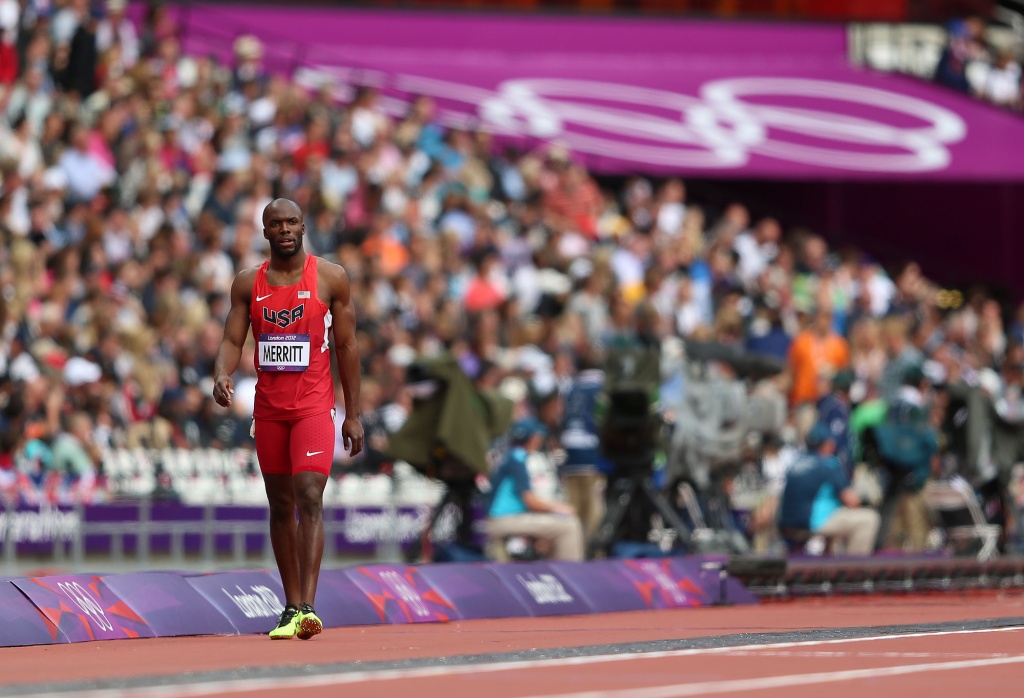
At the Olympics, Kirani James would find himself in the second of seven 400m heats. Starting in a favourable lane 6, James would easily qualify for the semi-finals in 45.23, followed by Commonwealth bronze medallist Ramon Miller of the Bahamas and Liemarvin Bonevacia, an Independent Olympic Athlete. After heats 3,4 and 5 were won by Belgian record holder Jonathan Borlee, world indoor silver medallist Demetrius Pinder, and 2010 world indoor champion Chris Brown, defending champion LaShawn Merritt would go in heat 6. His main threats would come from World Junior bronze medallist Steven Solomon of Australia and Trinidadian champion Lalonde Gordon, but nothing that Merritt couldn’t handle if he was fit. After the gun sounded, Merritt did not have his traditional fast start. Going down the home stretch, he would find himself last, even being overtaken by Britain’s Conrad Williams in the inside lane. Less than 200m in, Merritt would pull up clearly injured, bringing his Olympic title defence to a brief and unsatisfying ending.
Now with his chief rival out of the Olympics, Kirani James was now the overwhelming favourite to turn World Championship gold into Olympic gold. In his semi-final, he would set a season’s best of 44.59 to win ahead of Chris Brown and Jonathan Borlee. The other semi-finals would be won by Lalonder Gordon in a personal best 44.58 and Lugelin Santos of the Dominican Republic in 44.78. The final on 6th August 2012 would see 6 countries represented. The line-up would see Belgium’s Jonathan Borlee in lane 2, Australia’s Steven Solomon in lane 3, Lalonde Gordon of Trinidad and Tobago in lane 4, Kirani James in lane 5, Chris Brown of the Bahamas in lane 6, Liguelin Santos in lane 7, Demetrius Pinder of the Bahamas in lane 8 and Kevin Borlee of Belgium in lane 9.
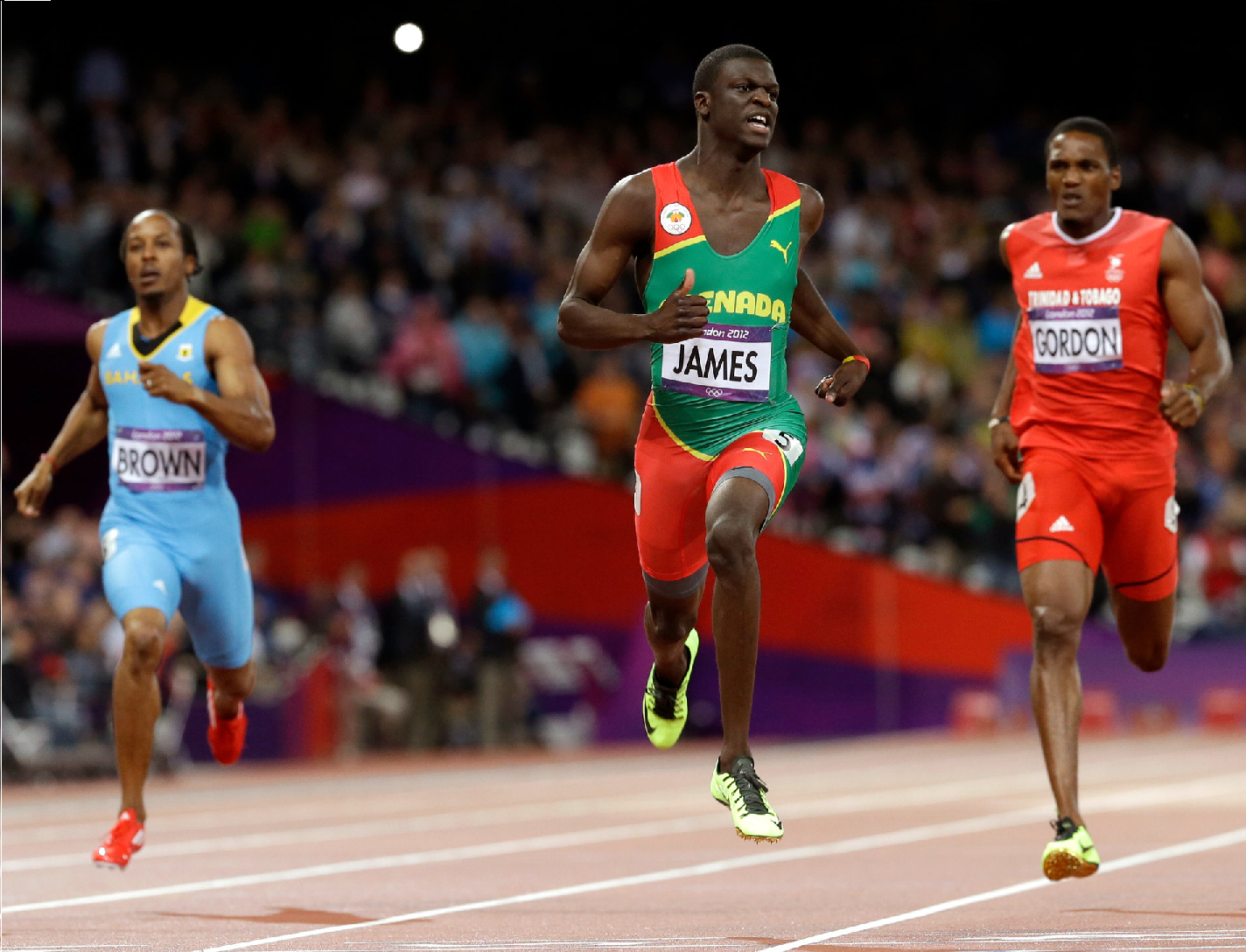
After the gun, James would have a measured start, easing himself into the race while closing down Chris Brown in the lane outside him. He would take the lead around the final bend overtaking Brown and the fast-starting Santos. He would ease through the field, establishing a 4 metre lead before he crossed the line to make history, winning Grenada’s first Olympic gold medal. In the process of winning, James had set a new personal best and national record time of 43.94. The time was also a new world lead, making James the fastest 400m runner in the world that year.
In running 43.94, James had also become the first non-US 400m runner to run under the 44-second barrier. At 19 years old, he was also the second-youngest athlete under that barrier, after 1988 Olympic Champion Steve Lewis. Behind James, the silver medal would be won by Liguelin Santos, winning the Dominican Republic’s third Olympic medal and first in the 400m, and bronze would go to Lalonde Gordon, winning Trinidad and Tobago’s first medal in the 400m since 1964. This result saw the first time that the three Olympic medals had come from athletes from three different Caribbean countries. James’s victory ended a streak of 7 consecutive gold medals by the USA. The 2012 final would even be the first final since the boycotted Moscow Olympics in 1980 to feature zero American athletes and would only be the fourth time that no American athlete had appeared on the podium after 1908, 1920 and 1980.
Following the Olympic triumph, Kirani James would return home to Grenada as a national hero. Thousands gathered at the country’s sole airport to welcome the new Olympic champion home. Prime Minister Tillman Thomas would announce a number of rewards for the 19-year-old. James would first be awarded 500,000 East Caribbean dollars (£141,375 or $185,010) in government bonds and was named a tourism ambassador for Grenada by Prime Minister Thomas. Commemorative stamps would be released in his honour and an athletics stadium named after James would be built. James’s home town of Gouyave would receive a Kirani James museum and a fitness centre. From Columbian Emeralds, James would receive a ring, watch, necklace and bracelet and another monetary contribution of EC$100,000 (£28,275 or $37,002) from the country’s national bank Republic.
Prime Minister Tillman Thomas would also announce the establishment of a ‘national project team’ who “would be mandated to go to every parish and to give guidance to all important interest groups, sporting associations, businesses and the church community” and whose work would “reflect the wishes of all the people as to the kind of legacy we dedicate to the honour of our national hero.” All these announcements and rewards were part of a three-hour-long rally held in James’s honour. The following day, Kirani James would return to the USA to continue his studies at the University of Alabama.
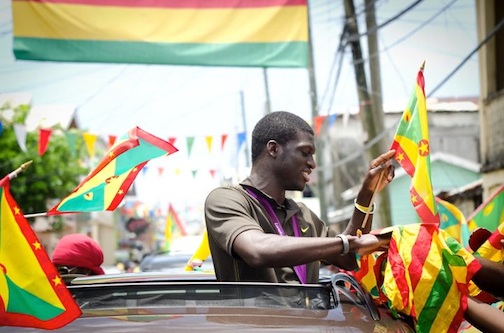
On 6th August 2012, Grenada’s search for an Olympic medal would come to an end thanks to a 19-year-old 400m runner winning gold. Two years later, Kirani James would make history again, winning Grenada’s first ever Commonwealth Games gold medal in Glasgow, winning in a games record 44.24. His win would come just two days after Kurt Felix had won the country’s first medal of any colour by winning bronze in the decathlon. At the next Olympics, James would gain his country’s second Olympic medal. It would not be gold this time around, but he would be part of another piece of sporting history in a race that will be the subject of another article. For now, Kirani James had become a national hero to a country of just over 100,000. In March 2017, The Police Ground stadium in St George’s would be renamed the Kirani James Athletic Stadium as a final way of Grenada celebrating it’s most decorated sporting hero.
 the-score-board.co.uk