
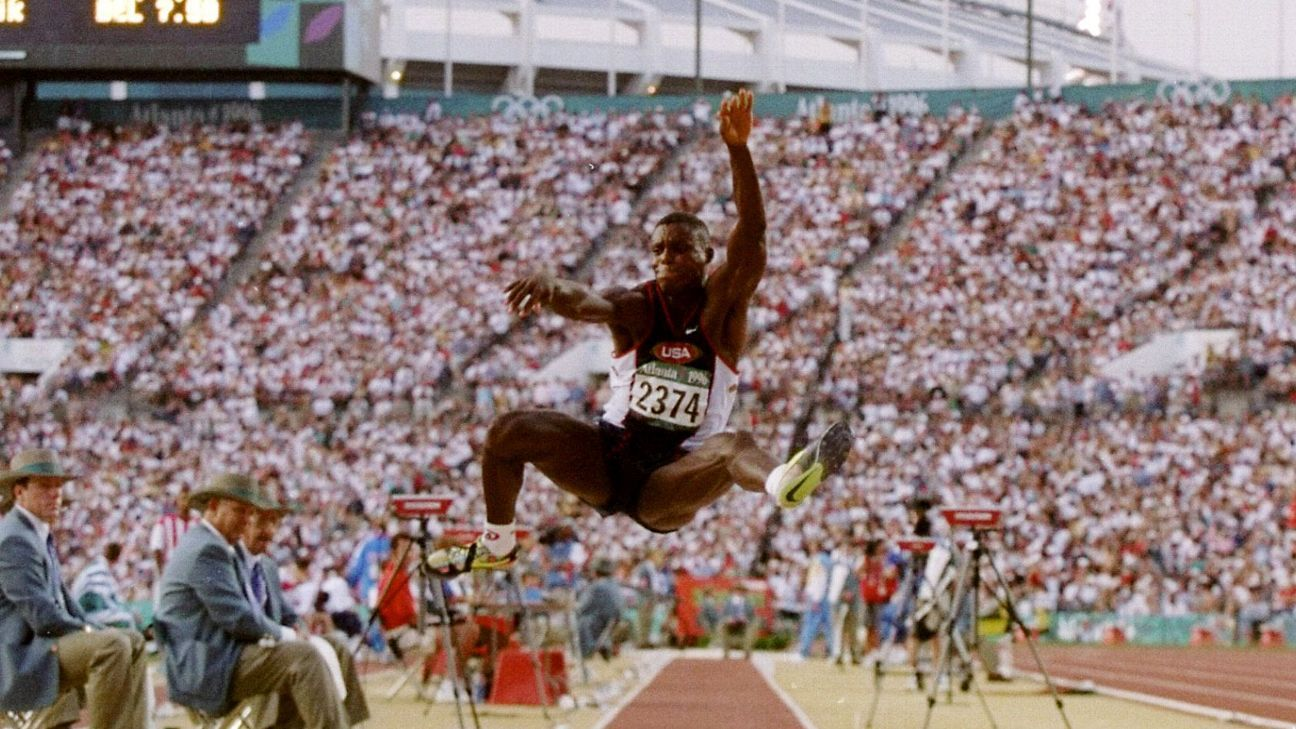
This article will not talk (that much) about his 100m exploits…
Carl Lewis is one of the most famous Olympic athletes of all time. His athletic achievements are such that he is one of a few Olympians who is forever associated with a particular Games. Like Jesse Owens in 1936, Mark Spitz in 1972 and Michael Phelps in 2008, the 1984 Los Angeles Olympics will forever be remembered for the 4 gold medals won by Carl Lewis in the 100m, 200m, the 4x100m relay and the long jump. Four years later, Carl Lewis would become the first man to successfully defend the Olympic 100m title, in a race that is instead remembered for the performance-enhanced actions of Ben Johnson, whose use of steroids saw him beat Lewis to win the gold medal and break the world record, only for his title and record to be revoked after the Canadian tested positive for an anabolic steroid. Lewis’s feat of winning back-to-back Olympic 100m titles is something that has only been equalled by Usain Bolt, who would achieve and later better the feat by winning the 100m title at three consecutive Olympics in 2008, 2012 and 2016. However, there is another feat, another Olympic record that Carl Lewis holds, that ranks higher than his 100m feat and almost equals his LA record. Carl Lewis is one of two Olympians to win a gold medal in a single athletics discipline for four consecutive Olympic Games. Between the 1984 LA Olympics and the 1996 Atlanta Olympics, Lewis would win four consecutive gold medals in the long jump, defeating world record holders along the way. This article will analyse each of these Olympic long jump competitions to see how Carl Lewis achieved a feat that has only been achieved by two other Olympians across all Olympic sports.
1. 1984 Olympic Games- Los Angeles-5-6 August 1984
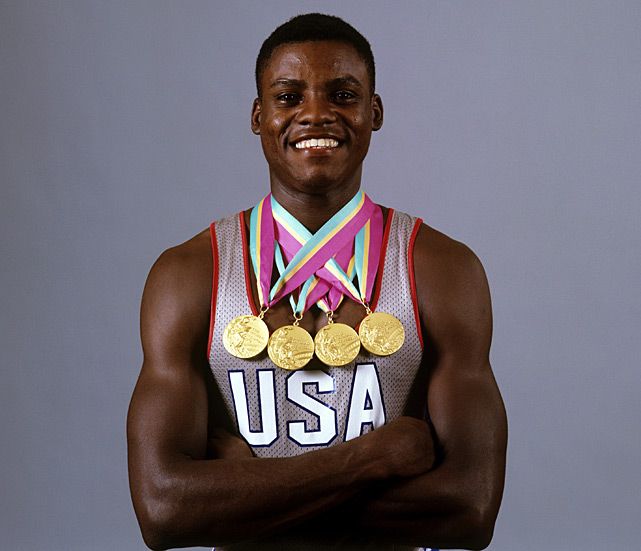
In 1984, the long jump is, for obvious reasons, the least remembered of Carl Lewis’s 4 gold medals. It would in fact be Carl Lewis’s second gold medal of the Games, with the competition taking place two days after the Alabama native’s 100m heroics. Lewis was making his Olympic debut in his home nation. He had qualified for the 1980 Olympics in the long jump but, as has become famous, was precluded from competing as the USA chose to boycott the 1980 Moscow Games due to political tensions with the USSR. Four years later, the 23-year-old Lewis was the heavy favourite to win gold. One year earlier, he had become the inaugural world champion in the event, winning by 30cm in an all-American sweep of the medals after rival Larry Myricks had failed to make the team. Now, the pressure was on Lewis to convert World Championship gold into Olympic gold, with Myricks now competing. In qualification, Lewis would have an easy day’s work. His first round jump of 8.30m was enough to automatically qualify him for the final the following day. He would also head into the final seeded first as his jump was 28cm longer than any other competitor. His chief rivals in the final would be Myricks, Australia’s Gary Honey, Spain’s Antonio Corgos, Japan’s Junichi Usui, Italy’s Giovanni Evangelisti and Joey Wells of the Bahamas, all of whom had qualified for the final automatically. As top seed, Lewis would jump last in the running order.
In the first round, Larry Myricks would clear 8 metres, jumping 8.06, but the man to beat would be Giovanni Evangelisti, whose jump of 8.09 had placed him 1st. Lewis needed to better this jump in order to stake an early claim for gold. Lewis set off down the runway using his 100m speed and leapt out to 8.54m, a full 45cm further than anybody else. After a second round in which none of the major contenders improved, Lewis lined up for his second jump. In his bid to go further, he would step over the line and foul. In the third round, Gary Honey would move into 2nd place after a jump of 8.18m, being the only one to jump over 8m in this round. Carl Lewis, knowing that he still had potentially three rounds of 200m to come in the next few days, decided to pass on his next jump. With nobody improving in round four, Lewis would pass again. Round five would see Larry Myricks move into the bronze medal position with a jump of 8.16m, but Lewis would once again pass on his 5th round jump, not willing to unnecessarily exert himself unless his lead was being threatened. The final round would see Gary Honey and Giovanni Evangelisti both jump out to 8.24, but these distances would only be enough for silver and bronze as Carl Lewis again passed on his final round jump to claim the gold medal by 30cm. He had won the gold with his first round jump and and had only jumped twice during the whole competition. Simply in a class of his own.
1988 Olympic Games-Seoul-24-25 September 1988
Four years later, Carl Lewis would once again head into the 1988 Olympic Games in Seoul as the favourite to retain his Olympic long jump title. He had already retained his 100m title two days earlier in controversial circumstances (see: Ben Johnson). He once again entered the event as the reigning world champion, having jumped a World Championship record 8.67m to retain his title. In South Korea, his main rivals would be World Championship medallists Larry Myricks (USA) and Robert Emmiyan (USSR) in addition to 1984 bronze medallist Giovanni Evangelisti (ITA). Lewis would qualify for the final, but not in the same dominant fashion as that demonstrated in Los Angeles. His jump of 8.06m would rank him second in his qualifying group and third in total for the final behind Larry Myricks (8.19m) and the surprise package Mike Powell, who had jumped 8.34m to be seeded 1st for the final the next day. However, Lewis’s job would be made easier when World Championship silver medallist Robert Emmiyan would fail to finish qualifying, dropping at the first hurdle.
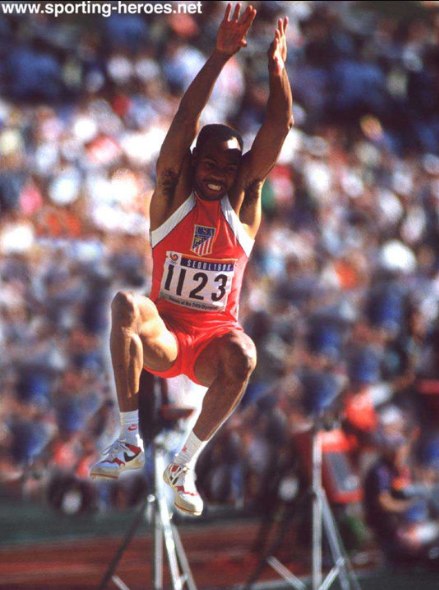
Carl Lewis would jump third-from-last in the Olympic final, with only Myricks and Powell following him in the running order. In the first round, only one athlete had jumped over 8 metres prior to Lewis’s first jump, with Antonio Corgos’s 8.03m the distance to beat thus far. Lewis had the chance to set the standard with his American compatriots and rivals set to come. He certainly would set the standard, jumping 8.41m to take a 40cm lead over Corgos. Myricks was next, jumping 8.14m to move into second behind the Alabama native. Top seed Mike Powell would also fail to better Lewis’s first round jump, with his distance of 8.23 move him into 2nd place. In round two, 1984 bronze medallist Giovanni Evangelisti would move into medal contention with a distance of 8.08, a notable jump but with room to improve to catch the three Americans. With his own second round jump, Carl Lewis would not only back up his first round jump, he would extend his lead further, jumping out to 8.56 metres. Larry Myricks would improve on his own first round jump, moving out to 8.27m to overtake Mike Powell into 2nd, but would still find himself 29cm behind the defending champion after only two rounds. Powell could only manage an 8.11, remaining in 3rd place. After two rounds, Lewis already had the rest of the field on the ropes.
Round three would see Lewis post another huge jump, but the distance of 8.52m wouldn’t be enough to extend his already enormous lead. With Myricks fouling, it was up to Powell to try his luck at narrowing the margin, and he would. The 24-year-old would jump out to 8.49, narrowing Lewis’s lead to 7cm, and posing a serious threat for the gold medal. With his lead now under threat, Lewis had to respond in round four, and he would respond like a true champion. The two-time 100m champion would leap out to 8.72m, the 4th-longest outdoor jump of his career, extending his lead to 23cm in the process. Myricks had no immediate answer, only reaching 8.17m and the determined Powell would foul while attempting to match his senior teammate. With the top three seemingly decided with two rounds remaining, it was now a case of whether Myricks and Powell could prevent Carl Lewis from earning back-to-back Olympic long jump gold medals. Lewis would continue his impressive series, jumping 8.52. His series alone would have been able to sweep the medals, let alone win the gold. Myricks would foul for the second time and Powell would pass on his fifth round, looking to pool his energy into one final huge leap to beat the 27-year-old from Birmingham. I the final round, Lewis would sour his perfect record, fouling out, giving one final opportunity to his compatriots to find a miracle. Myricks would foul a third time, consigning himself to bronze. With a make-or break jump for gold, Mike Powell would complete the set, fouling on his final jump, confirming Carl Lewis’s victory. Despite Lewis’s victory looking comfortable, with a series of jumps that any long jumper would be envious of, it was Mike Powell’s 8.49m jump in the third round that had pushed Carl Lewis to jump 8.72m, to better himself and go beyond what he had been able to do previously. This Olympics would see the birth of a truly epic long jump rivalry.
1992 Olympic Games-Barcelona-5th-6th August 1992
Heading into his third Olympics, Carl Lewis now had a legitimate threat to his Olympic title, 1988 silver medallist Mike Powell. Four years earlier, Lewis had taken gold with a 23cm margin, only being slightly threatened by Powell to better his overall margin of victory. Four years on, Lewis would head into Barcelona as one of the heavy favourites to successfully defend his Olympic title, but not as the favourite. At the World Championships in Tokyo, Lewis had been on the losing end of the greatest long jump battle in the history of the event. In the long jump final, Lewis had set a new personal best distance of 8.87m, the second-longest jump in history, but this distance would only be enough for silver as Mike Powell would break Bob Beamon’s 23-year-old long jump world record, establishing a new world’s best distance of 8.95m to take gold. Powell’s victory had subsequently ended Lewis’s 10-year unbeaten streak in the event. In the run-up to the 1992 Olympics, Powell would best Lewis again, registering an 8.62m jump to win the U.S. Olympic Trials by 9cm. Having been beaten twice now by Powell, Lewis knew he had to be on top form to claim a third consecutive Olympic long jump title.
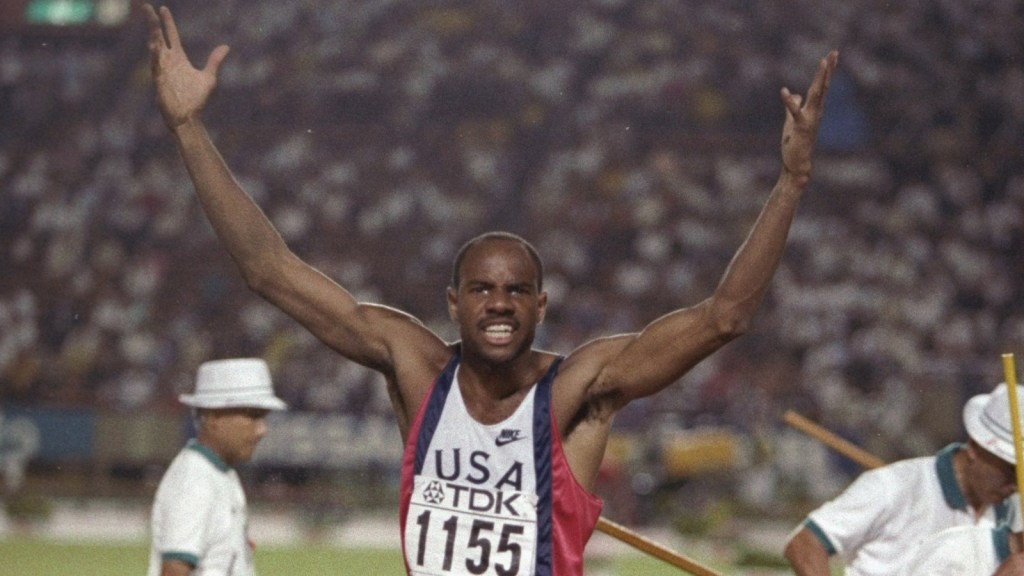
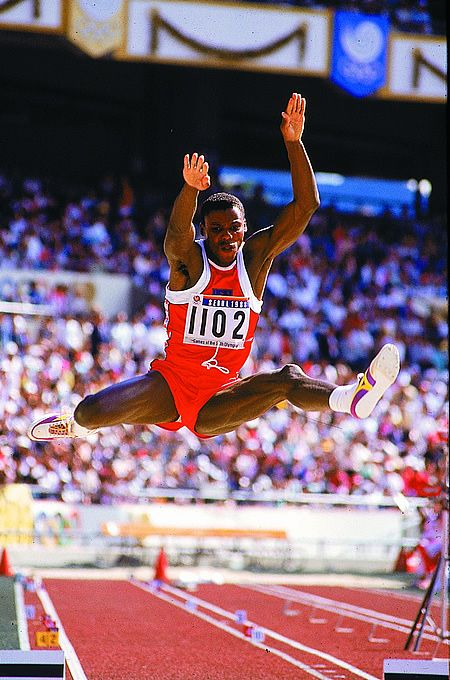
The two chief prospects for gold would be separated in qualifying, but would both win their respective groups and achieve automatic qualification for the final. However, Lewis would head into the final with the advantage, with his mark of 8.68 seeding him first for the final while Powell’s 8.14m would only be enough to seed him 4th behind Geng Huang of China and Konstantinos Koukodimos of Greece (both 8.22m). In the final, only Lewis would register a first round jump beyond 8 metres and what a jump it would be. With Mike Powell registering a distance of 7.95m, Lewis would leap out to 8.67, 5cm less than the winning jump from 1988 and a full 72cm ahead of the rest of the field. Round two would see Powell improve, jumping out to 8.22, while Lewis would reach 8.33, proving his early dominance over the field. With no one else seemingly on their level, it was a battle between the two Americans for the gold. The third round would see Powell improve again, moving out to 8.33 while Lewis fouled. Both men would foul in the fourth round, but Powell would find himself overtaken by fellow American Joe Greene, whose 8.34 jump moved him into the silver medal position with two rounds remaining. Powell would respond reclaiming 2nd place and reducing Lewis’s lead with an 8.53 jump in round five, while Lewis managed 8.50. With gold and silver now theirs after Greene fouled in the final round to take the bronze, Lewis either had to extend his lead or hope that Powell wouldn’t be able to overhaul his 17cm advantage with one jump remaining. Powell would register a huge jump, with the world thinking that he may have beaten Lewis once again to claim the Olympic title. With Powell and the crowd on tenterhooks, , the distance would flash up: 8.64. Lewis had won by 3cm, and as he jumped 8.50 in his final round, he knew that he had regained his Olympic title for the second time, becoming a three-time Olympic long jump champion.
1996 Olympic Games-Atlanta-28th-29th July 1996
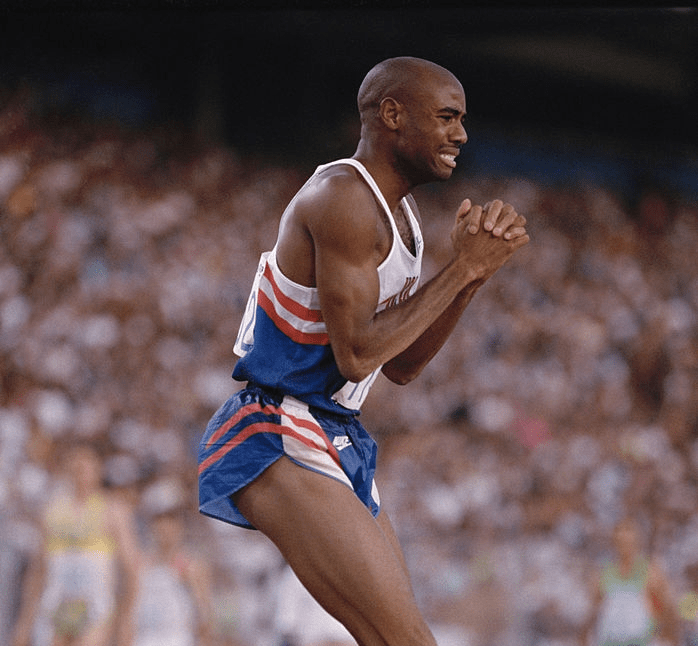
Carl Lewis would compete in his 4th and final Olympic Games in 1996, finishing where he began, in the USA. Now 35 and pondering retirement, the long jump was the event that Lewis was set to compete in at the Atlanta Games. He qualified for the US Olympic team in the long jump for the 5th time (the USA boycotted the 1980 Olympics), another personal record. His participation would be the first major international long jump competition he had competed in since the 1992 Olympics. At the 1993 World Championships in Stuttgart, he chose to compete on the track in the 100m and 200m. He would lose his 100m world title to Olympic champion Linford Christie and would claim bronze in the 200m behind Namibia’s Frankie Fredericks and Great Britain’s John Regis, the last track medal of his career. In his absence, Mike Powell would retain his long jump world title, winning with a jump of 8.59m. The next few years would see the ageing Lewis dogged by injuries causing him to miss the 1995 World Championship entirely, where the long jump competition would be won by 24-year-old Ivan Pedroso of Cuba with a jump of 8.70, while Powell would finish in bronze with 8.29m. Now returning for his 4th Olympics at the age of 35, all eyes would be on whether Carl Lewis could claim a 4th Olympic long jump title.
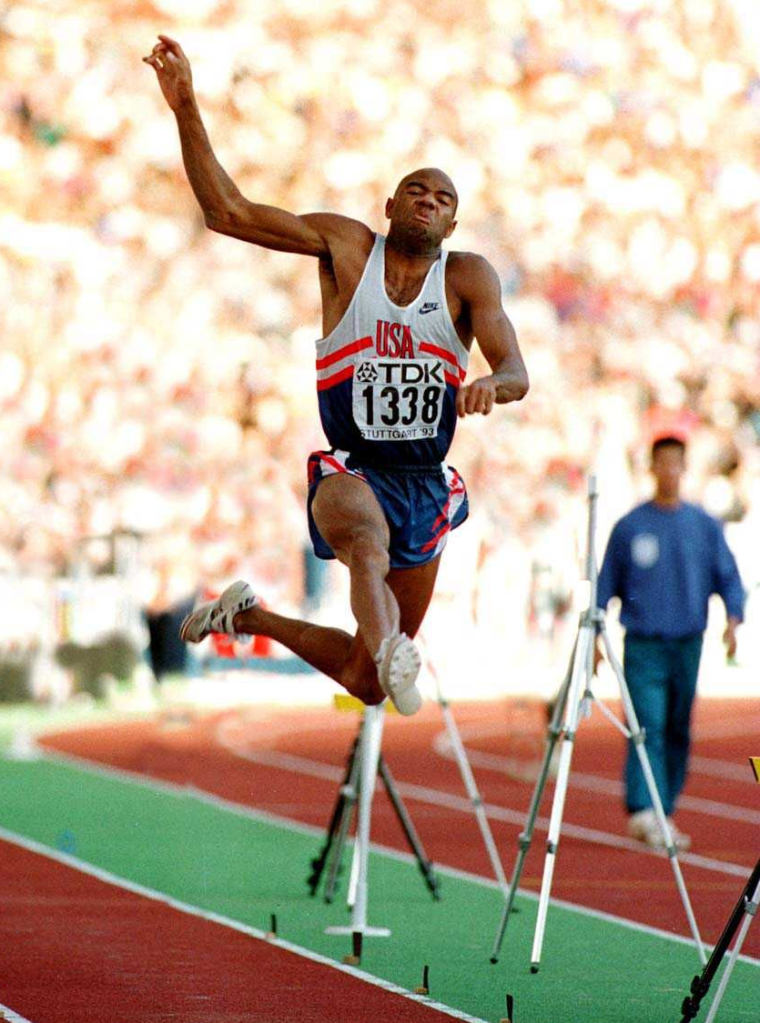
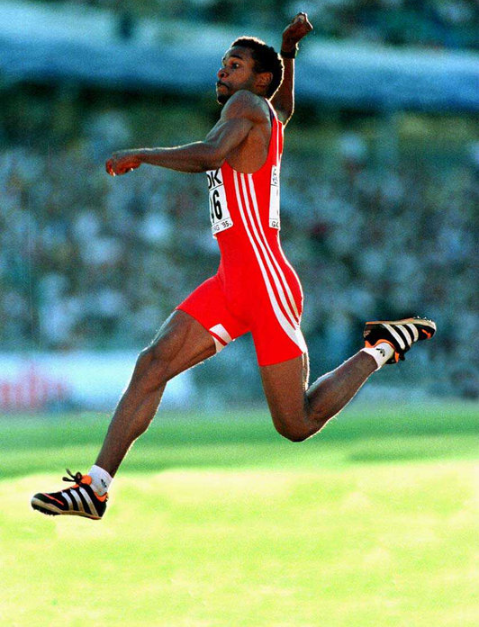
Lewis’s chief rivals for gold would be 2-time world champion and 2-time Olympic silver medallist Mike Powell, 21-year-old 1995 world silver medallist James Beckford of Jamaica and 1995 world champion and 2-time world indoor champion Ivan Pedroso. In the first round of the final, two athletes would jump over 8 metres but neither of these two athletes would be the pre-event favourites. After round one, France’s Emmanuel Bangue would lead with a jump of 8.19 followed by Aleksandr Glovatskiy of Belarus with 8.07, Geng Huang of China with 7.99 and Yuriy Naumkin of Russia with 7.96. Lewis, Beckford and Pedroso would all foul their first round jumps, while Powell would sit 5th with a distance of 7.89. Round two would see registered jumps from all four main contenders. Lewis would jump 8.14, enough to take him into 2nd behind Bangue. However, he would be soon overtaken by Powell, whose 8.17m jump would move him into the silver medal position. Beckford would find himself 4th after a jump of 8.02, while world champion Pedroso could only muster 7.57m, needing a huge improvement to move into the top 8 and avoid getting eliminated after the first three rounds. His third round jump was an improvement, but 7.75m would not be enough to see him progress any further in the competition. One of Carl Lewis’s main rivals for gold had now been eliminated from contention. Now with a safe jump on the board, Lewis needed to stretch his legs and try to bid for gold by putting down a notable jump. He most certainly would, jumping 8.50 to leap into the lead halfway through the competition. Mike Powell could only muster 7.99 to remain in 3rd place, while Bangue fouled. Beckford would improve to 8.13, but this would only be enough for 5th at this stage. Apart from Lewis, the biggest improvement would come from fellow American and 1992 bronze medallist Joe Greene, who would move 2nd after an jump of 8.24, pushing his claim for another Olympic medal.
Lewis would elect to past on his fourth round jump while the other main contenders fouled or failed to improve. Round five would see a similar story, except Lewis would elect to jump, but he would only register a distance of 8.06. In the final round, Lewis would foul his last jump, leaving him to hope and wait for the other competitors to respond. Emmanuel Bangue would register a 6.87, fading after his early start. Joe Greene would also foul his final jump, ending his quest for gold and leaving his medal prospects out of his hands. Powell, now noticeably carrying an injury, attempted his final jump but would pull up after taking off, landing forward in the sand and ending his competition without a medal. The last person to jump would be James Beckford. Currently sitting in 5th, Beckford had one final jump to either spoil Carl Lewis’s party, overtake Joe Greene for silver or Emmanuel Bangue for bronze. His final jump would register as 8.24m, enough for the silver medal, equalling his performance from the World Championships a year earlier. Joe Greene had equalled his performance from Barcelona, adding another Olympic medal to his collection. However, the night and the gold medal would belong once again to Carl Lewis, as it had done for the past 12 years. Becoming only the third man, after sailor Paul Elvstrom and discus thrower Al Oerter, to win the same event for four straight Olympic Games, Lewis had proven himself to be the greatest long jumper of all time and one of the greatest Olympians of all time.
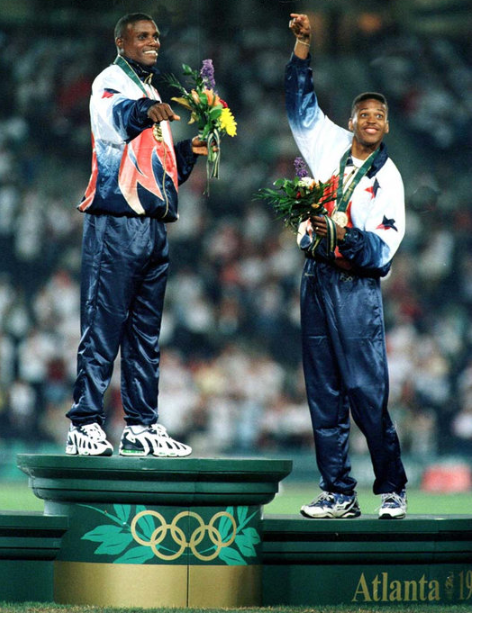
Lewis would retire not long after the 1996 Olympics. He would later become an athletics coach at his alma mater University of Houston. After his disappointing performance in the Olympic final, Mike Powell would also retire from active competition at the age of 32. At the following year’s World Championships in Athens, Ivan Pedroso would recover from his own poor Olympic performance to successfully defend his World Championship title with a jump of 8.42m. He would retain his title again in Seville in 1999, before finally getting his Olympic moment at Sydney 2000. One year later, he would claim his 4th consecutive World Championship gold at Edmonton 2001 before finally losing his crown to Dwight Phillips at Paris 2003. James Beckford would finish 4th in the 1997 final but would fail to replicate his Olympic performance for many years afterwards before attaining a second World Championship silver behind Dwight Phillips in 2003.
Despite this incredible accomplishment, Carl Lewis’ long jump success is not talked about as often as it should. Despite being the greatest long jumper of all time, it is Lewis’s 4 gold medals at Los Angeles 1984 that still grab all the headlines and column inches over 35 years later, as they should. Lewis’s achievement in 1984 is something that only Jesse Owens in 1936 and Fanny Blankers-Koen in 1948 can stake claim to. It is an incredible achievement and Carl Lewis is also rightfully seen as one of the greatest sprinters of all time, having earned two straight Olympic gold medals, three straight World Championship gold medals and a 100m world record in 1991. However, when his sprinting achievements are brought up, a word should be put in for his long jump achievements, an event where he went unbeaten for 10 years (1981-1991) and once required a world record performance to be beaten, was one half of one of the greatest athletics finals of all time, and won four consecutive Olympic gold medals, dominating the competition from age 23 to age 35. Carl Lewis was a multi-faceted athlete, and this writer believes that all of these facets should be recognised equally.
 the-score-board.co.uk