
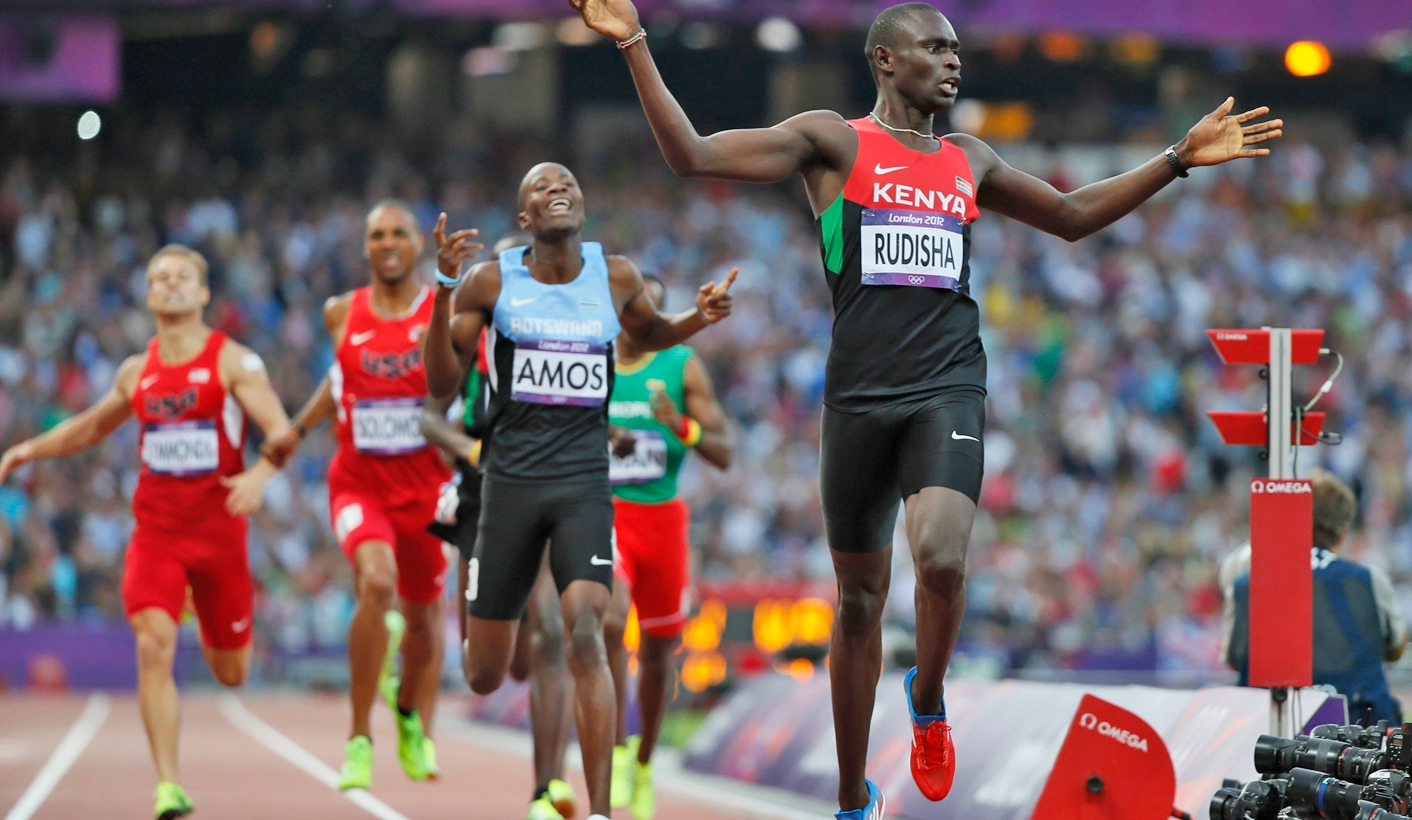
1 minute and 40.91 seconds of brilliance…
Middle-distance running has had its fair share of great Olympic moments. Peter Snell completing tohe 800m and 1500m gold medal double in 1964. The legendary rivalry between Great Britain Sebastian Coe and Steve Ovett in 1980. Hicham El Guerrouj finally winning Olympic gold at the third attempt in 2004. These are all special moments that have rightfully gone down in sporting history, but none of these are as special as another middle distance memory from recent Olympics past. The following article will relive David Rudisha’s world-record breaking 800m run at London 2012 and the greatest 800m final of all time.
Heading into London 2012, David Rudisha was already the stand-out athlete and overwhelming favourite to win the Olympic gold medal. The 23-year-old had already achieved two major feats prior to even arriving in London. After running the second-fastest 800m ever on 10th July 2010 with a time of 1:41:51, the young Kenyan would break Wilson Kipketer’s 13-year-old 800m world record one month later with a time of 1:41:09. Just one week later, Rudisha would lower his own world record to 1:41:01. The following year, Rudisha became the 800m world champion, winning in Daegu with a time of 1:43:91 ahead of Sudan’s Abubaker Kaki and Russia’s Yuri Borzakovski.
In 2012, Rudisha had continued his dominant form, setting a United States all comers 800m record of 1:41:74 in the New York leg of the Diamond League and had qualified for the Olympics with a time of 1:42:12 to win the Kenyan trials. The time was the fastest ever recorded at altitude. At the Olympics officially, Rudisha would ease through his heat, winning with a time of 1:45:90 ahead of Musaef Balla of Qatar and home athlete Andrew Osagie. In the semi-finals, the 6ft 3 Kenyan would once again do enough to reach the final along with Osagie and fastest loser Nick Symmonds in a time of 1:44:35.
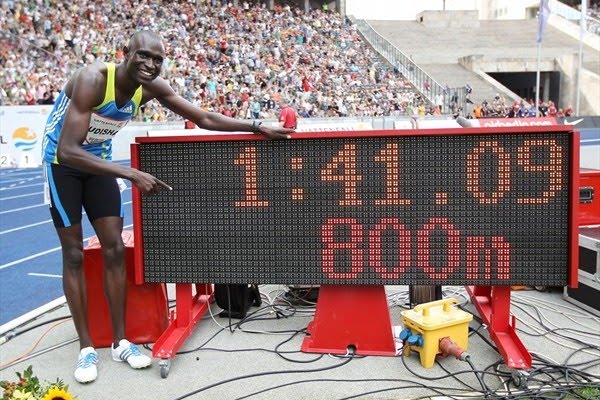
The 2012 Olympic 800m final took place on 9th August 2012. The line-up for the final read: Lane 2-Andrew Osagie (Great Britain), Lane 3-Commonwealth Youth Champion (2011) and World Junior silver medallist (2012) Timothy Kitum (Kenya), Lane 4-World Record holder and World Champion (2011) David Rudisha (Kenya), Lane 5-World Junior Champion (2012) Nijel Amos (Botswana), Lane 6-World Indoor Champion (2012) Mohamed Aman (Ethiopia), Lane 7- World No.5 Duane Solomon (USA), Lane 8-World Championship finalist (2011) Nick Symmonds (USA), Lane 9- World silver medallist (2011) Abukaker Kaki (Sudan).
Once the gun had been fired, Rudisha manoeuvred his way to the head of the field to front-run the race as he traditionally would. He would be closely followed by Kaki, Aman, Amos and Solomon, while the rest of the field had been splintered, either choosing to follow the pace of Rudisha or try to run their own race and catch up in the second 400m. Rudisha would head through 400m in 49:28 seconds, a blisteringly quick pace on world record time.
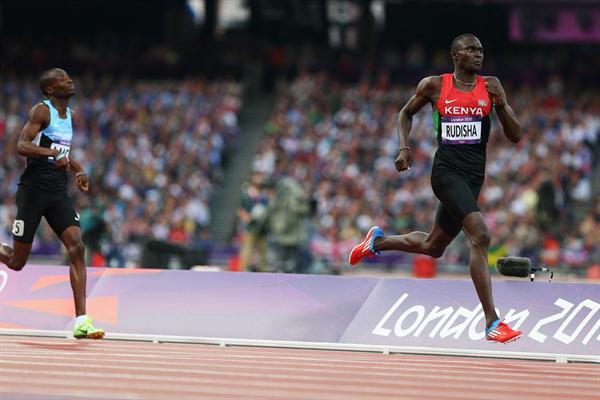
The third 200m would separate the man from the boys as any of the millions watching round the world could see. David Rudisha, striding majestically out in front while Kaki, Aman and Amos starting to kick hard, were already straining to hold on to his coattails. With every long stride Rudisha took, his gap would increase, while those behind realised that they would now be fighting for the silver and bronze medals. It was all about one man, as it had been in the build-up to the final. It was no longer a case of whether Rudisha would win gold, it was now a case of how big his margin of victory would be and more importantly, how fast would he go.
Heading towards 600m, four men were competing for 2nd and 3rd. Timothy Kitum had caught up with Kaki, Aman and Amos while the World Junior Champion from Botswana overtook the World Indoor Champion from Ethiopia. The fading Aman and Kaki would both be overtaken by Kitum as the Commonwealth Youth Champion moved into the bronze medal position. Heading round the final bend in class of his own, David Rudisha would continue to stride powerfully, now gritting his teeth and starting to feel the strain of his incredible effort.
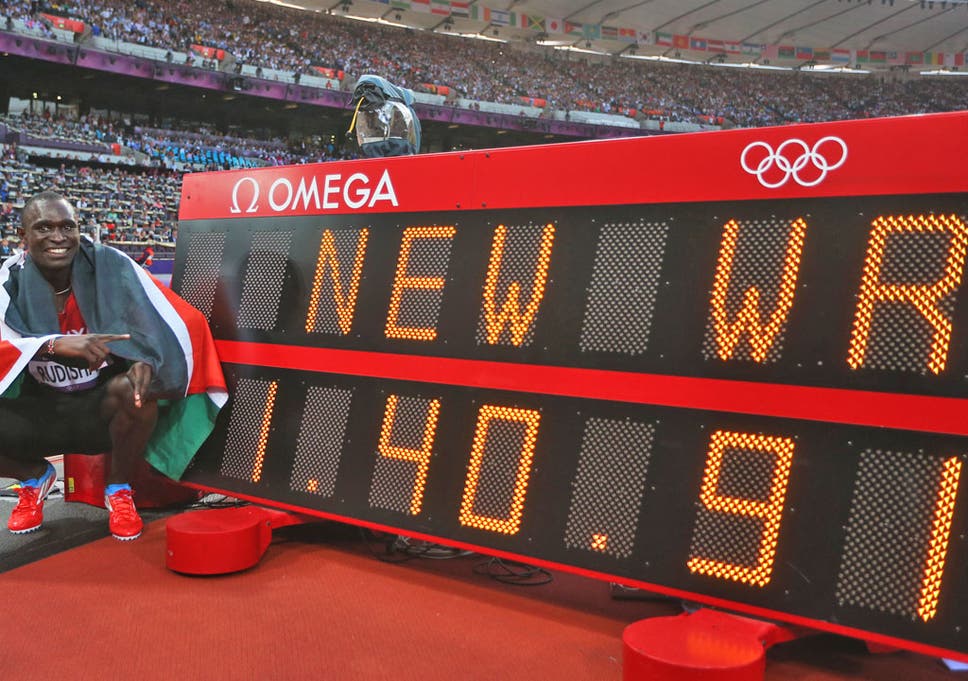
Crossing the line, the clock stopped at 1:40:91, a new world record. Rudisha had taken a full tenth of a second off the previous world record set in 2010, writing his name into the history books for a third time. He had become the first 800m runner since Cuba’s Alberto Juantorena at the 1976 Montreal Olympics to break the world record in an Olympic final. Quite surprisingly, Rudisha became the first reigning 800m world champion to go to win the Olympic gold medal. Rudisha’s victory had never been in doubt. From start to finish, he had been on another level, never making an incorrect stride, never wavering, never fading.
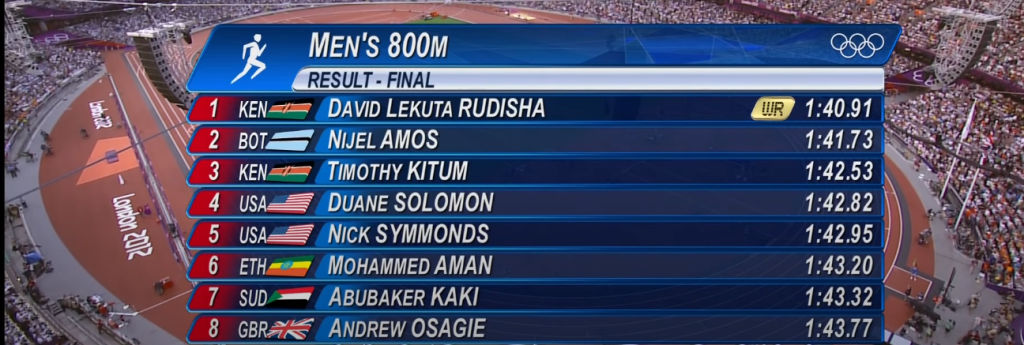
If Rudisha’s world record time immediately stole the headlines, fans, commentators and experts were astounded by what they saw next. Looking at the scoreboard as each man crossed the finish line, letters would appear next to their time. Letters reading NR, PB or SB. National record, personal best or season’s best. Nijel Amos would win the silver medal, Botswana’s first Olympic medal, in a new national and world junior record time of 1:41:73. The young athlete had to be carried from the track on a stretcher after becoming only the 5th man in history to run under 1 minute 42 seconds. Bronze medallist Timothy Kitum would cross in a new personal best time of 1:42:53. Duane Solomon would cross in a personal best 1:42:82. Nick Symmonds would set a new personal best time of 1:42:95. Mohamed Aman, who had faded round the final bend to finish 6th, would set a new Ethiopian record time of 1:43:20. Another fading athlete, Abubaker Kaki would set a season’s best time of 1:43:32 back in 7th.
Even Andrew Osagie of Great Britain, who had never been in a major world athletics final prior to the Olympics, would set a new personal best time of 1:43:77 despite finishing 8th. Every time recorded by the 8 finalists was the fastest time ever recorded for each finishing placing. Every finishing time would have been enough to win the gold medal in Beijing four years earlier faster than Wilfred Bungei’s 1:44:65. Even more amazing is that Osagie’s time of 1:43:77 to finish in 8th place would have won the gold medal in all but three of the previous 26 Olympic 800m finals.
The 2012 Olympic 800m final is now considered to be the greatest 800m final of all time, and it’s not hard to see why. Every finalist, while being carried along by the great David Rudisha, had performed above and beyond their best, which is what every athlete dreams of when performing at an Olympic Games. Tom Rostance, writing for BBC Sport, wrote that “The world may have tuned in to see Usain Bolt on Thursday, but they also saw another athlete guarantee his place in Olympic history. Bolt took all the headlines with his stunning 200m gold, but it was the quiet and unassuming David Rudisha who became the first man to break a world record at the London Games with an equally brilliant performance in the 800m.”
Sports Illustrated’s David Epstein wrote that the 800m final could be “best told…in 16 letters: WR, NR, PB, PB, PB, NR, SB, PB.” Former 800m world record holder Sebastian Coe, head of the London 2012 organising committee, would give special credit to Rudisha calling his victory “the performance of the Games, not just track and field but of the Games…Bolt was good, Rudisha was magnificent. That is quite a big call but it was the most extraordinary piece of running I have probably ever seen.”
In 1 minute and 40.91 seconds, David Lekuta Rudisha wrote his name into sporting history, in a race that will never be forgotten for years to come.
 the-score-board.co.uk