
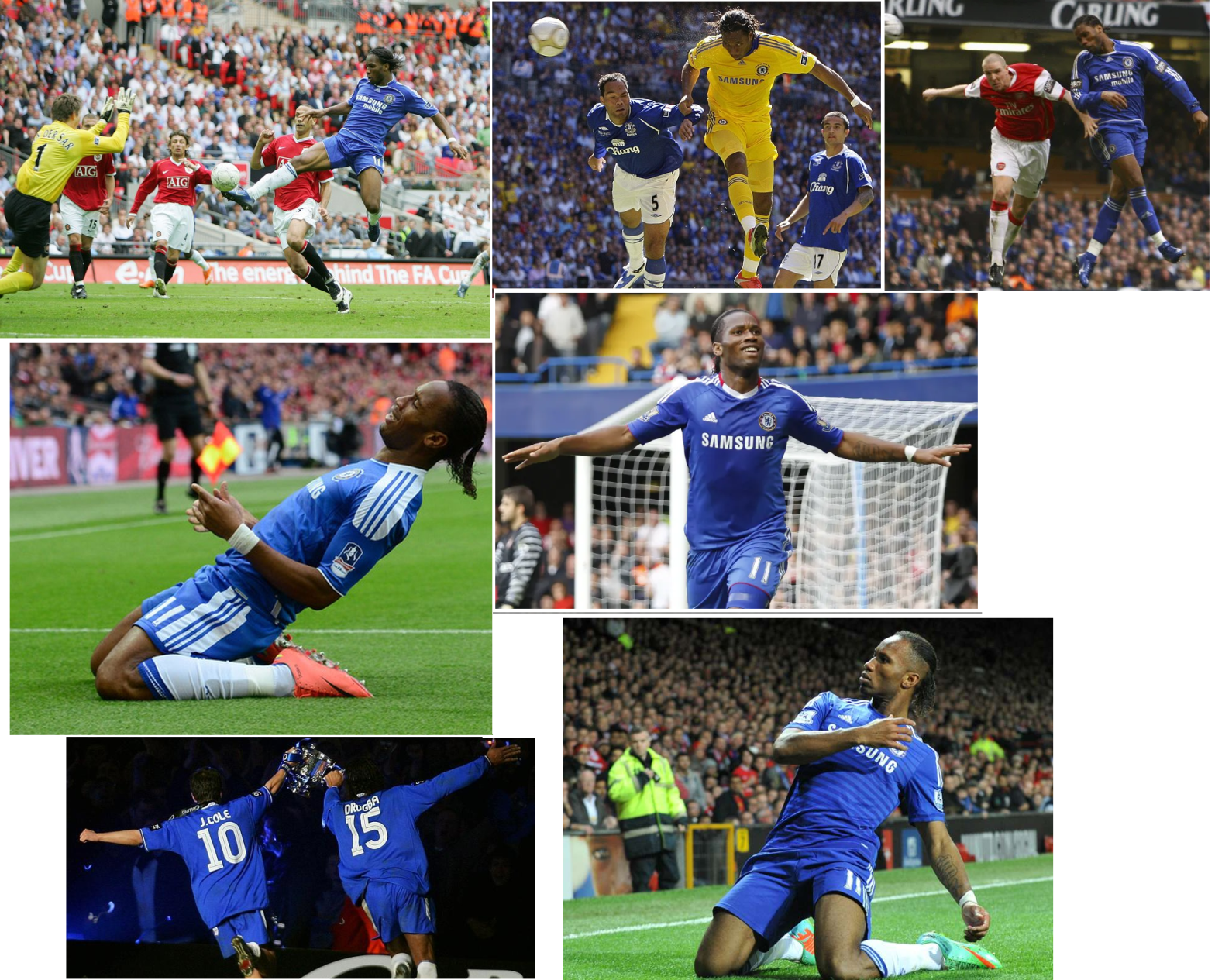
The man to call upon come cup final day…
The word ‘legend’ is far too often overused in football today. Too often very good or even great players are afforded the status of ‘legend’ or ‘legendary’. People are quicker to crown someone with the word ‘legend’ than with the word ‘world-class’. Someone can become a ‘legendary’ player without ever reaching the level of ‘world-class’. One defender can become a ‘legendary figure’ at a League Two club for example, by spending 10 years at the club, making over 600 appearances and scoring over 50 goals. No one would ever consider this player as being ‘world-class’. Only the men playing for the top clubs in the top five leagues in the world: the Premier League, Ligue 1, Bundesliga, La Liga and Serie A can ever be considered for the ‘world-class’ label, but certain players can be given the tag of ‘legend’ no matter what their club is or how good their national team is compared to the rest of the world. All that a player needs to do to earn the rank of ‘legend’ is to have a serious impact on the success of a particular club or national side and be associated with a particularly successful period in the team’s history.
To fans of Chelsea F.C. and the Ivory Coast national team, Didier Drogba is a legend. At his peak, he could be considered a world-class centre-forward who could easily fit into many of the world’s best footballing sides. A tall, strong and skilful striker, Drogba was still a regular scorer at club and international level years past his assumed prime was supposedly over. He is associated with two teams during their rise to prominence on the world stage and their subsequent successes during this period. At international level, Drogba would be the captain and leader of a ‘golden generation’ including the likes of brothers Kolo and Yaya Toure, Gervinho, Didier Zokora and Salomon Kalou that took the Ivory Coast to three consecutive World Cups between 2006 and 2014 (a tournament that they had never qualified for prior to 2006) and the 2016 African Cup of Nations.
At club level, Drogba will be associated with the great Chelsea teams of Jose Mourinho and beyond that, with the investment of Roman Abramovich, were turned from Premier League also-rans into multiple-time champions of England and eventually European champions. He would form part of the spine of the Chelsea side for many years along with goalkeeper Petr Cech, defender and captain John Terry and midfielder Frank Lampard. In seven seasons at Stamford Bridge between 2004 and 2012 followed by a brief return in the 2014/15 season, Drogba would win four Premier League titles, four FA Cups, three League Cups and one Champions League. From all this success, the interesting stat that this article will investigate is Didier Drogba’s incredible record when cometh the cup final. Between 2005 and 2012, Drogba would score in eight major finals for Chelsea. Each of these finals, along with Drogba’s part in them, will be discussed in turn during the following article.
2005 League Cup Final
Didier Drogba joined Chelsea on 20th July 2004 for £24 million from Ligue 1 club Marseille. The 26-year-old Ivorian had only just finished his first season in the south of France, scoring 19 goals in 35 league matches as part of a Marseille team that could only manage a 7th-place finish in the Ligue 1, 22 points behind champions Lyon. Only Djibril Cisse (Auxerre, 26) and Alexander Frei (Rennes, 20) would score more goals in Ligue 1 than Drogba during the 2003-04 season. Drogba also contributed five goals in Marseille’s 2003-04 Champions League campaign, which saw the team exit at the group stage, and six in their subsequent UEFA Cup campaign, where the team would reach the final before losing to Valencia. These additional goals in domestic cup competitions bumped Drogba’s numbers up to 32 goals in 55 appearances. Drogba’s form led to him being awarded the National Union of Professional Footballers (UNFP) Player of the Year Award, the French equivalent of the PFA Player of the Year award. This impressive form caught the attention of new Chelsea manager Jose Mourinho, and he would become the Portuguese coach’s fifth Chelsea signing, following Paulo Ferreira, Petr Cech, Arjen Robben and fellow striker Mateja Kezman into Stamford Bridge.
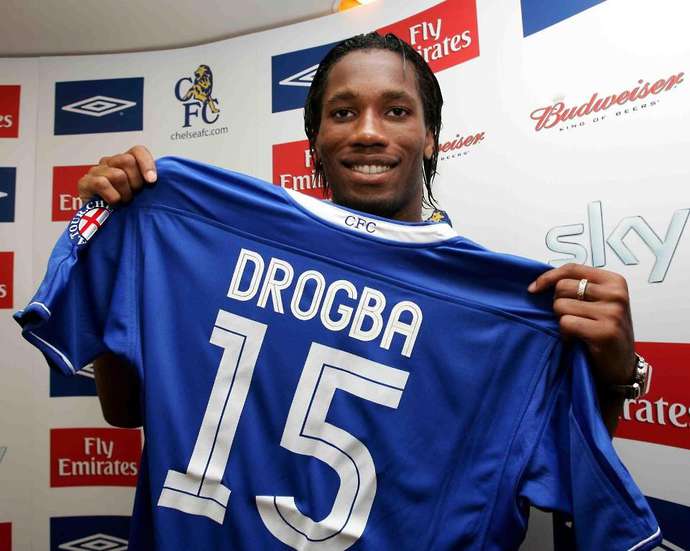
Drogba’s first chance of silverware would arrive on 27th February 2005 with the League Final against Liverpool. The final would see 1st meet 5th in the Premier League standings. After the appointment of recent Champions League winner and self-christened ‘Special One’ Jose Mourinho on 2nd June 2004, and following heavy investment in the transfer window, which saw the club spend £71.6 million on 8 new players, Chelsea had markedly improved from their previous season under Claudio Ranieri. Following an excellent start that saw them sitting behind the still-unbeaten Arsenal for the first 11 matches, Chelsea ascended to the Premier League’s summit following a 1-0 victory over Everton on 6th November 2004 and not been moved since then. By 27th February 2005, Chelsea sat at the top of the Premier League with 68 points after 27 Premier League matches, winning 21, drawing 5 and losing only once (a 1-0 defeat to Manchester City on 16th October). The team had also progressed to the knockout stages of the Champions League, having recently lost the first leg of their last-16 tie to Barcelona 2-1. Three days before that, Newcastle had knocked Chelsea out of the FA Cup at the fifth round stage. At this point in time, Drogba had scored 11 goals in 27 appearances during his debut Chelsea season, with 8 of these coming in the Premier League. His most recent goals had come in a 3-0 win over Portsmouth on 22nd January. Drogba did not score during Chelsea’s run to the League Cup Final, which had seen them defeat West Ham (1-0), Newcastle (2-0 aet), Fulham (2-1) and Manchester United (2-1 agg.). Their opponents Liverpool had defeated Millwall (3-0), Middlesbrough (2-1), Tottenham (1-1 (4-3 pen) and Watford (2-0 agg.) to progress to the League Cup Final for the third time in five seasons after victories in 2001 and 2003. Meanwhile, Chelsea had been without a trophy since winning the FA Cup in 2000.
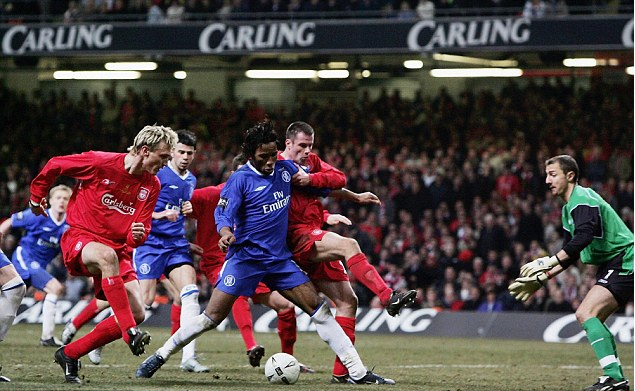
The final would begin with a shockwave. Within the first minute of the match, Liverpool scored, with John Arne Riise converting Fernando Morientes’ cross to the edge of the Chelsea box. Riise’s goal was the fastest goal ever scored in a League Cup Final, a record that would stand for 10 years. Riise almost doubled his tally and Liverpool’s lead after 3 minutes, but his shot would hit Chelsea defender Paulo Ferreira. Following the early setback, Chelsea would start to enter the match, as a Ferreira free kick was cleared by Liverpool. After 28 minutes played, Chelsea would have their first clear-cut goalscoring opportunity, Drogba firing wide at one end of the field after a Chelsea counter-attack as referee Steve Bennett ignored Liverpool’s penalty claims for a foul on Steven Gerrard at the other end. Further attempts from Damien Duff and Joe Cole would also fail to find the target as Chelsea headed into half-time 1-0 behind. The second half would begin with Chelsea applying the pressure to Liverpool’s defence. A cross from Joe Cole found Drogba in the clear, but Jamie Carragher would manage to clear the danger. The ball was soon played back into the Reds’ penalty area and Eidur Gudjohnsen’s header was saved by Liverpool goalkeeper Jerzy Dudek, before the Pole had to quickly save from William Gallas to keep Liverpool’s lead intact. Liverpool had their fair share of chances, as a 64th minute Dietmar Hamann shot was kept out by Petr Cech. 10 minutes later, Steven Gerrard would fail to extend Liverpool’s lead, shooting wide from an Antonio Nunez cross. This would not be the last major action Gerrard would perform in the match. On 79 minutes, Chelsea were awarded a free kick. Paulo Ferreira played the ball into the Liverpool box, where the ball was met by Gerrard aiming to clear his line. However, the Liverpool captain instead inadvertently headed the ball into his own net, gifting an equaliser to Chelsea with the final now even with 11 minutes remaining. Jerzy Dudek had to be alert to stop a Damien Duff shot three minutes later, as Chelsea pushed for the victory. Further shots from both sides would fail to hit the target as the match finished level after 90 minutes, meaning that extra time was now warranted. Chelsea would have the first major chance in extra time, as a Drogba header would hit the post. Towards the end of the first half, a Luis Garcia cross was met by Igor Biscan, but his header would clear the crossbar and Mateja Kezman would see his shot saved by Dudek. The stalemate would soon be broken. In the 107th minute, a long throw into the Liverpool penalty area saw Drogba beat Jamie Carragher to the ball, heading home to give Chelsea the 2-1 lead. Four minutes later and Chelsea would extend their lead, as Mateja Kezman would score following Liverpool’s failed attempt to clear a Frank Lampard free kick. Liverpool would quickly pull a goal back through Antonio Nunez but Chelsea would hang on to claim their first trophy in five years and the first silverware for both Jose Mourinho and Didier Drogba. Following this, Liverpool would get their revenge, beating Chelsea over two legs in the Champions League semi-finals, en route to winning the trophy. Despite this, Chelsea would not look back, clinching their first Premier League title and first top-flight title in 50 years three months later.
2007 League Cup Final
Following a second successive Premier League triumph in 2006, Chelsea would reach their second League Cup final in three seasons when they faced Arsenal on 25th February 2007. At the time of the League Cup Final, Chelsea were still gunning for a third successive Premier League title, something that only been achieved by their current title rivals Manchester United. By 25th February 2007, Chelsea had played 27 matches, winning 18, drawing 6 and losing 3. The week before, Chelsea had thrashed Championship club Norwich City 4-0 to reach the FA Cup quarter-finals. Four days later, a 1-1 draw meant that Chelsea’s Champions League last-16 tie with FC Porto remained in the balance after the first leg. In Didier Drogba’s case, he was now installed as the club’s first-choice striker, following the sales of Mateja Kezman and Eidur Gudjohnsen over the previous two seasons. Now, Didier Drogba was enjoying his best Chelsea season to date. During the current season, Drogba had already scored 26 goals in 40 appearances in all competitions and was on course for his most prolific goalscoring season in England. He had already achieved his best Premier League tally by February, scoring 16 goals in 27 appearances.
Chelsea’s route to the League Cup Final had seen them defeat Blackburn (2-0), Aston Villa (4-0), Newcastle (1-0) and surprise semi-finalists League Two Wycombe 5-1 over two legs. Comparatively, Arsenal had seen off West Brom (2-0) and Everton (1-0), edged a 6-3 classic with Liverpool in the 5th round before defeating local rivals Tottenham in the two-legged semi-final to reach their first League Cup Final since 1993. The League Cup was one of two trophies that Arsene Wenger had not won during his 11 years in charge, along with the Champions League. Meanwhile, Jose Mourinho was looking to win his 4th major trophy in third season at Stamford Bridge.
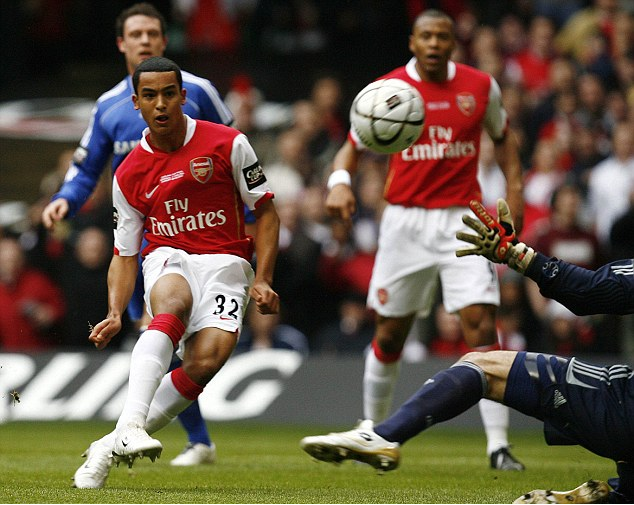
Just like the 2005 final, Chelsea would start the slower of the two sides. The first chances would go to Arsenal as on-loan striker Julio Baptista would see two shots in the first 10 minutes be defended expertly by the Chelsea back five. The second of these would be tipped over the crossbar by Petr Cech, with the resulting corner being cleared by Drogba, only to head out for another Arsenal corner. Theo Walcott would take a quick corner, playing one-two with Abou Diaby, receiving the ball inside the Chelsea penalty area before sidefooting the ball past Cech for his first Arsenal goal. 17-year-old Walcott would continue to cause Chelsea problems, as his cross after 14 minutes would find Julio Baptista, only for the Brazilian to lose his footing inside the penalty area. It would take Chelsea 18 minutes to muster their first shot on the Arsenal goal as Frank Lampard’s shot would hit Kolo Toure. Two minutes later, Chelsea would equalise as Michael Ballack’s ball would find Didier Drogba inside the Arsenal penalty area. Drogba would beat the offside trap before shooting past Manuel Almunia in the Arsenal goal. Arsenal’s lead in the cup final had lasted all of eight minutes following a period of early dominance, and Drogba’s goal would now allow Chelsea to exert their own influence upon the game. The match would head into half-time with the scores still tied.
Following the break, Chelsea would start the second half stronger with the aid of substitute Arjen Robben, as his shot from 20 yards would curl just wide of the Arsenal goal. Cesc Fabregas, one of Arsenal’s star men, would also miss, shooting just wide of Cech after 51 minutes after great interplay with Justin Hoyte. Four minutes later, a Robben corner would see Chelsea captain John Terry attempt a speculative diving header. Unfortunately, he miss the ball but would hit Abou Diaby’s swinging boot, the blow knocking the centre-back out cold. Following 8 minutes of on-field treatment, he would be stretchered off and replaced by John Obi Mikel. In the 75th minute, Frank Lampard’s 25-yard shot hit the Arsenal crossbar before the next goal would finally arrive in the 84th minute. Arsenal would lose possession in the middle of the field, with Michael Essien moving the ball to Arjen Robben out wide on the left hand side. Robben’s cross to the near post would find Didier Drogba, who would head home to put Chelsea ahead with 6 minutes remaining. Four minutes later, Andriy Shevchenko would almost make it 3-1, but his shot would rebound off the crossbar.
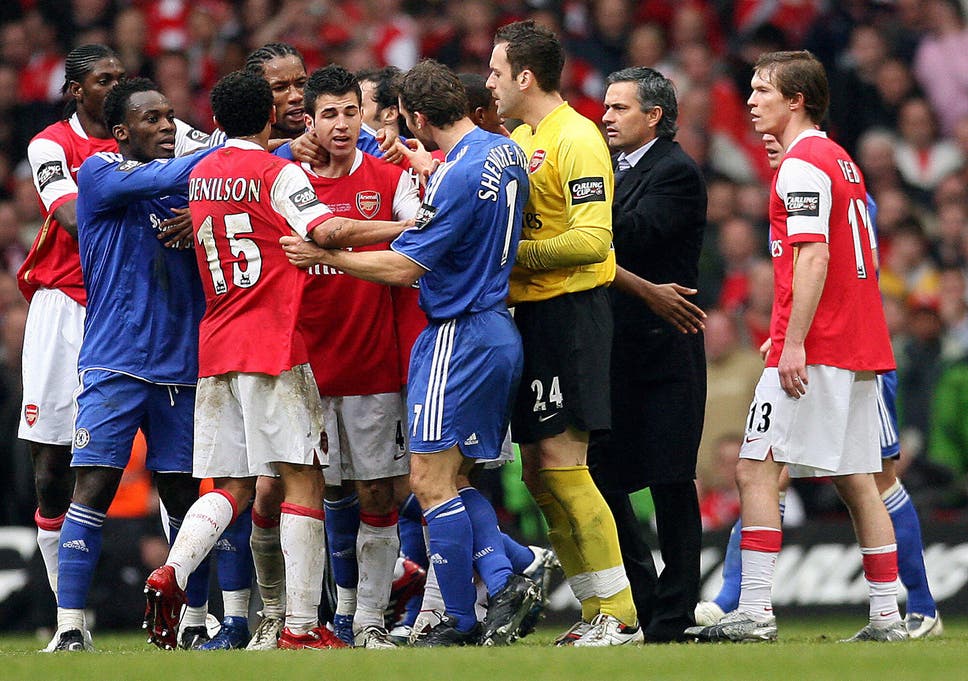
Following Terry’s injury, seven minutes of stoppage time were added on, but the final whistle would not be blown until the 102th minute had elapsed. This further stoppage was caused by a fracas between the two sides that brought play to a standstill. In the 96th minute of play, John Obi Mikel would pull on the shirt of Kolo Toure, who would react by pushing Mikel in the chest. Both men would stand their ground before the rest of both teams piled in, with Mourinho and Wenger acting as peacemakers. This fracas would result in red cards for both Toure and Mikel. Following consultation with his linesman referee Howard Webb would show a third red card to Emmanuel Adebayor, for allegedly striking Chelsea defender Wayne Bridge. Adebayor had to be escorted off the field by Arsenal officials. Six minutes later, Chelsea were celebrating their 4th League Cup and their second in three seasons. Despite the fracas at the end, it was Drogba who would be recognised as Chelsea’s hero on the day.
2007 FA Cup Final
Three months later and Chelsea were in another cup final. This time their opponents would be Manchester United. Six days earlier, Manchester United had ended Chelsea’s two-year run as Premier League champions to claim their 9th Premier League crown by 6 points after a three-season drought. Jose Mourinho and Chelsea were looking to have the last laugh in the last game of the domestic season. This FA Cup Final was special, as it was the first to be played at the new Wembley Stadium, which had opened two months earlier. Manchester United were looking to do the Premier League/FA Cup double for the 4th time, having previously achieved the feat in 1994 (beating Chelsea in the final), 1996 and 1999. Chelsea were looking to claim their own domestic cup double, looking to add the FA Cup to the League Cup, something that had previously been achieved by Arsenal in 1993 and Liverpool in 2001. The Red Devils were looking for a record 12th FA Cup in their 17th final appearance. Chelsea, meanwhile, were looking for their 4th FA Cup in their 8th final appearance, while also trying to achieve a rather unique feat. If they Manchester United, Chelsea would become the team to win the first FA Cup Final at the new Wembley Stadium and win the last FA Cup Final at the old Wembley Stadium, a 2-0 win over Aston Villa in 2000. For such an occasion, a neutral fan couldn’t hope for two more suitable teams. Since his heroics in the League Cup Final, Didier Drogba had doubled his previous goal tally in English football, scoring 32 goals in 59 appearances for Chelsea in all competitions. His 20 goals in the Premier League would see him claim the Golden Boot, three goals ahead of Manchester United’s Cristiano Ronaldo with 17.
Chelsea’s route to the final saw them defeat League Two Macclesfield (6-1), Nottingham Forest (3-0), Norwich City (4-0), Tottenham in a quarter-final replay (2-1) and Blackburn Rovers after extra time in the semi-final (2-1). Manchester United’s route had seen them progress past Aston Villa (2-1) and Portsmouth (2-1), consecutive replay victories over Reading (3-2) and Middlesbrough (1-0) and a 4-1 victory over relegation-troubled Watford in the semi-finals.
The final would start slowly, with both teams struggling to create clear-cut goalscoring chances. Didier Drogba would have the game’s first major attempt on goal, firing wide from 30 yards. Frank Lampard would also find his shot saved by Edwin van der Sar while the Premier League champions struggled to create chances. The game remained goalless at half-time following an underwhelming first half between the country’s top two sides. Manchester United would start the second half brightly through striker Wayne Rooney. Immediately after the restart, Rooney would dribble past two Chelsea defenders before powering a shot towards goal, which forced Petr Cech into a save. 10 minutes later, Rooney would travel 60 yards with the ball, with only a last-ditch challenge from Wayne Bridge denying the 20-year-old a shot on goal. Soon after, Ryan Giggs would also flash a volley wide of the post. Drogba would clip the post with a free kick just outside of the Manchester United 18-yard box. The last major chance of the second half would once again come from Rooney, but his dangerous dribble would be stopped by Petr Cech before the FA Cup Final headed to extra time for the third year running.
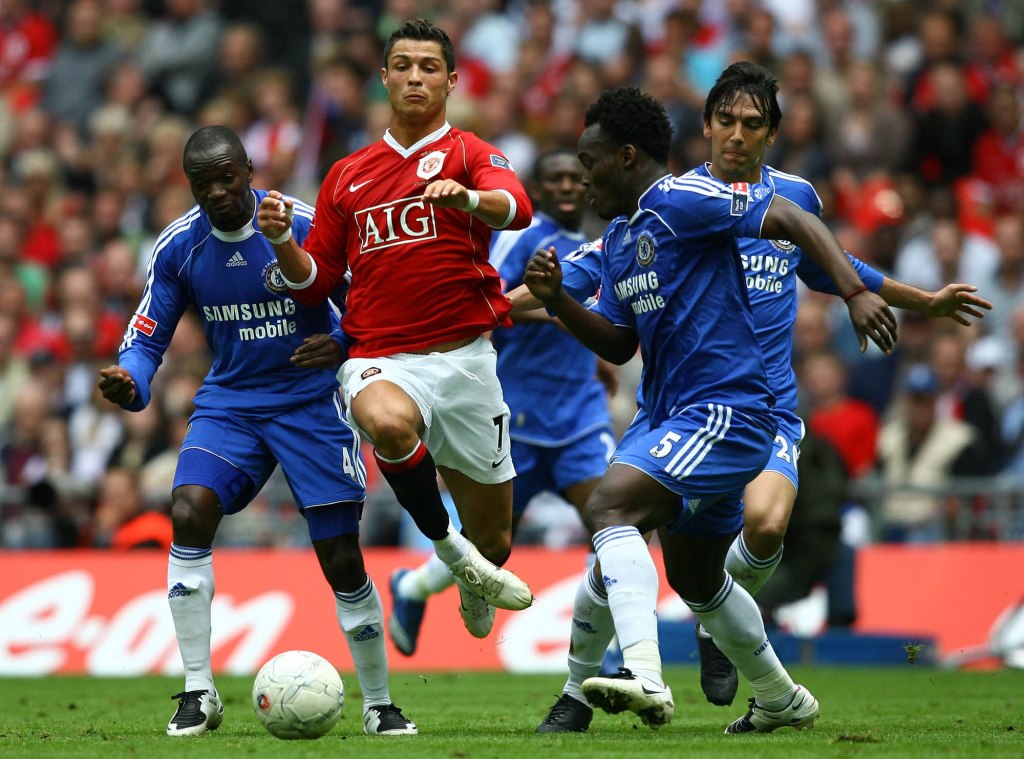
In extra time, Manchester United thought they had taken the lead. Ryan Giggs’ scuffed shot from three yards out was saved on the line by Petr Cech, but Giggs claimed that the shot had crossed the line in Cech’s arms. Later replays showed that the shot had not crossed the line. With penalties looming for the third year in a row, the deadlock would finally be broken in the 116th minute. Collecting the ball just outside the 18-yard box, Didier Drogba would play a one-two with Frank Lampard before volleying the ball past Edwin van der Sar to score the first FA Cup final goal at the new Wembley and settle what had been a distinctly average FA Cup final. When the final whistle, Didier Drogba became the first player to score in both the League and FA Cup finals in the same seasons and win both finals in the same season.
2008 League Cup Final
Nine months later and Chelsea were in another League Cup final against a resurgent Tottenham side that had recovered from a poor start and Martin Jol’s sacking but had found new form through the hiring of Juande Ramos. Chelsea themselves would also enter the final with one notable absentee. Following a middling start to the season, which saw Chelsea sit 11th in the Premier League six matches into the new season, Jose Mourinho would shockingly resign as Chelsea manager on 20th September 2007, with rumours of a rift with club owner Roman Abramovich potentially being the cause. The same day, the club’s recently-appointed director of football Avram Grant would take charge with immediate effect. Under the management of Grant, Chelsea had recovered significantly. On the day of the League Cup final (25th February 2008), Chelsea were sitting 2nd in the Premier League with 55 points after 26 Premier League matches, winning 16, drawing 7 and losing 3. In other competitions, Chelsea were dead level with Olympiakos following the first leg of their Champions League last-16 tie. In the FA Cup, the club had recently beaten League 1 Huddersfield Town to progress to the quarter-finals of the FA Cup, where they would face surprise quarter-finalists Barnsley.
Going into the 2008 League Cup final, the previous season’s cup final goal hero was struggling to replicate his Golden Boot-winning form of a year earlier. Didier Drogba went into his 3rd League Cup final with a record of 9 goals from 17 appearances, in a difficult season for the tall Ivorian. Following the sacking of Mourinho, Drogba had publicly expressed his desire to leave, citing Barcelona, Real Madrid and the two Milan club as possible destinations. A knee injury would soon keep him out for the whole of December and he would spend the month of January at the African Cup of Nations. Following Ivory Coast’s failure to win the African Cup of Nations once again, Drogba would return in time for the League Cup Final, having played just three times for Chelsea in as many months.
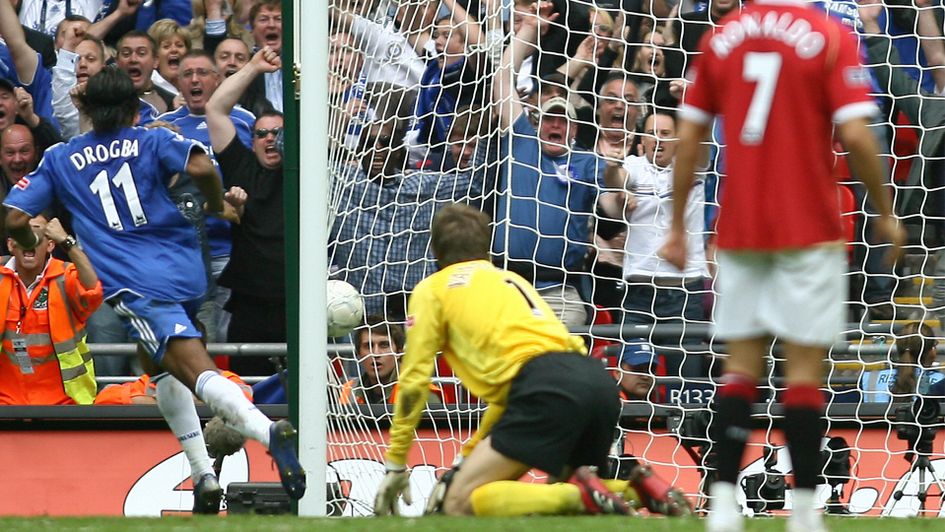
Chelsea’s route to the final would see the team progress at the expense of Hull City (4-0), Leicester City (4-3), Liverpool (2-0) and Everton over a two-legged semi-final (3-1). Meanwhile, Tottenham had defeated Middlesbrough (2-0), Blackpool (2-0), Manchester City (2-0) and thrashed local rivals Arsenal 6-2 on aggregate to reach their first League Cup final since a 2-1 defeat to Blackburn Rovers in 2002. On the day of the final, Spurs would begin the brightest of the two sides and almost took the lead after 30 seconds. Juliano Belletti would give the ball away straight into the path of Robbie Keane, whose 20-yard drive would be deflected wide by the leg of John Terry. Two more Spurs chances would arrive in quick fashion. A Pascal Chimbonda header would hit the crossbar, before Dimitar Berbatov would head wide from Robbie Keane’s cross. Chelsea would withstand this early Spurs flurry, before starting to create chances of their own, as Frank Lampard and Didier Drogba see their shots just head wide of the Tottenham goal. Six minutes before half-time, Chelsea would make their advantage pay. Drogba was tripped just outside the Spurs penalty area and would respond by curling the resulting free-kick into the bottom left-hand of Paul Robinson’s net. Spurs almost scored an immediate equaliser but Keane and Berbatov would fail to convert their chances from close range as Chelsea maintained their one-goal lead into half-time.
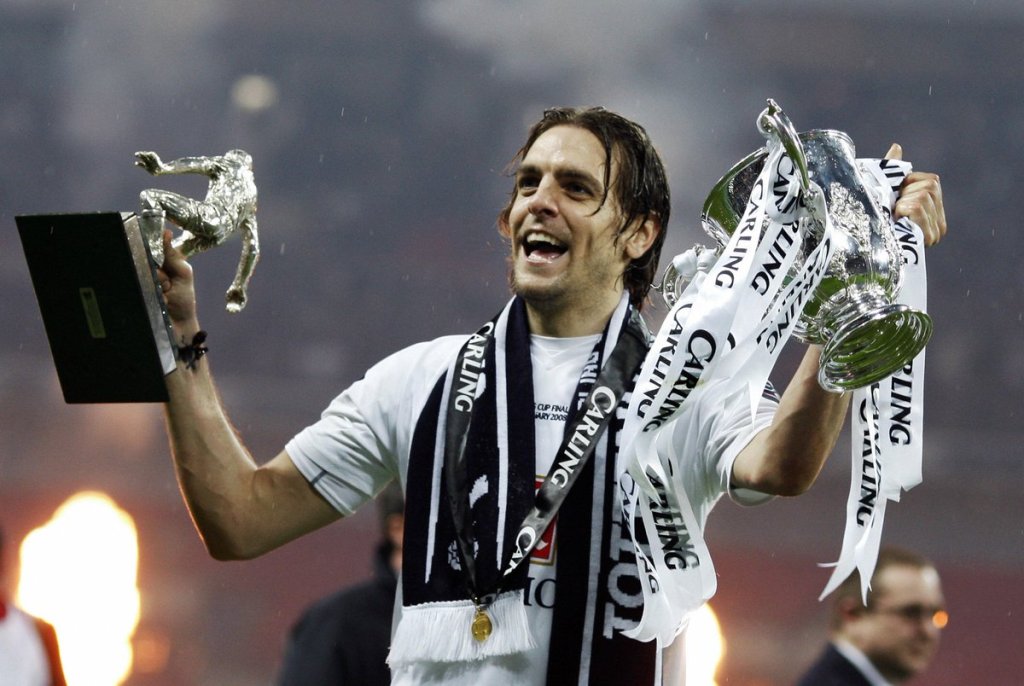
For the first quarter of the second half, Chelsea would maintain their lead while Spurs would struggle to find an equaliser. On 70 minutes, Chelsea would inadvertently gift Spurs an equaliser as Wayne Bridge’s handball would result in a Tottenham penalty. Dimitar Berbatov would send Petr Cech the wrong way and Spurs were now back in the cup final completely against the run of play. Buoyed by their equaliser, Tottenham would begin to look the more dangerous of the two sides as both teams pushed for a winner. Didier Zokora would burst through the middle only for his shot to hit Petr Cech on the head and he would slice the rebound wide. Cech would also be called into action to stop Berbatov once again. Despite the chances, the match would finish 1-1 after 90 minutes and would head into extra time. However, it would not be long into extra time before the winning goal arrived. Jermaine Jenas’s free kick would be punched away by Petr Cech only to rebound off the head of the leaping Jonathan Woodgate and into the Chelsea goal. Chelsea would push for an equaliser but Joe Cole and Salomon Kalou would see their shots saved by Paul Robinson in the Spurs goal. Spurs would hang on to win their first trophy since 1999. At the fourth attempt, Didier Drogba had scored in a cup final that Chelsea had not won.
2009 FA Cup Final
Major cup final #6 would come for Didier Drogba in the form of the 2009 FA Cup Final, which would see Chelsea face Everton. 15 months on from the League Cup final loss to Tottenham, Chelsea entered Wembley with their fourth manager in two years. Despite being in contention for the Premier League title until the final day and taking Chelsea within a John Terry penalty shoot-out miss of their first Champions League title, Avram Grant was let go at the end of the 2007-08 season. His replacement would be Luis Felipe Scolari, who had most recently been the manager of Portugal. In his six years in charge of the national team, he taken the team to the final of Euro 2004, where they would shockingly lose to Greece , and to the World Cup semi-finals, the team’s best result since 1966. Prior to taking the Portugal job, he had also led Brazil to their fifth World Cup trophy in 2002. Taking the Chelsea job would be Scolari’s first club management job since 2001 and he would begin in emphatic style, beating Portsmouth 4-0 on the opening day of the Premier League season. The team would have a brilliant start to the season, losing just one of their first 14 Premier League matches, topping the league for 11 of these weeks. However, this electric run would followed by a major downturn in form as Chelsea slipped from 1st on 22nd November 2008 to 4th on 7th February 2009, winning 4 of the next 11 matches. Luiz Felipe Scolari would be sacked on 9th February 2009, two days after a 0-0 draw with Hull City that Chelsea four points behind leaders Manchester United despite having played two games more.
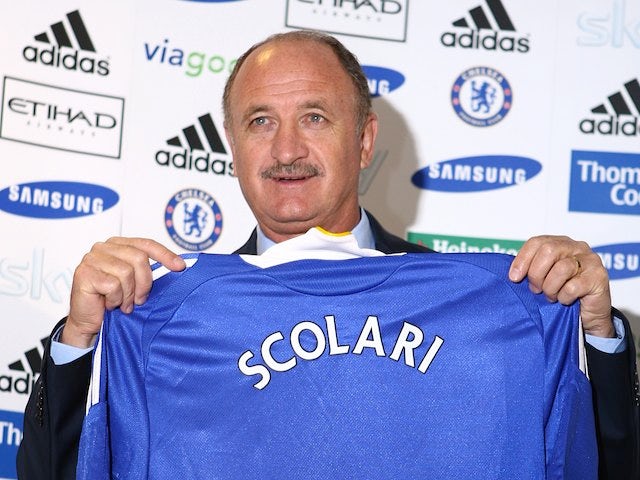
To replace Scolari, Abramovich would turn to another national team coach, Russia manager Guus Hiddink. Hiddink would serve as Chelsea’s manager until the end of the season, before taking up his Russia duties once more. The Hiddink effect was immediate. Of the final 13 matches of the season, Chelsea would win 11, finishing the Premier League season in 3rd place, seven points behind Manchester United and three points behind Liverpool. Hiddink would also lead the team to the Champions League semi-finals, where a 93rd minute Andres Iniesta goal would see Chelsea fall at the hands of Pep Guardiola’s Barcelona by one away goal. For Didier Drogba, this season had been another one to mostly forget. He had ended the previous season in disgrace, being sent off in the Champions League final and missing the subsequent penalty shoot-out. He had fallen out-of-favour under Scolari, making most of his appearances from the bench as the Brazilian utilised a 4-1-4-1 formation with Nicolas Anelka serving as the team’s lone striker. Guus Hiddink’s appointment would see Drogba’s immediate reinstatement to the side, starting of his 21 appearances under the Dutchman, compared with just 8 starts in 21 appearances under Scolari. As a result of his utilisation, Drogba would register his worst Premier League goal return to date, scoring only 5 in 24 appearances. He would eventually make 42 appearances in all competitions with the majority of his 14 goals coming after Scolari’s departure (11) and occurring in the Champions League (5).
Chelsea’s route to the 2009 FA Cup Final had begun with a hiccup as they required a replay to overcome League 1 Southend United (4-1). Following this, Chelsea would comfortably move through the competition, defeating Ipswich Town (3-1), Watford (3-1) and Coventry City (2-0) before seeing off London rivals Arsenal 2-1 at Wembley to reach a second FA Cup Final in three years. Everton began their journey for a first FA Cup since 1995 by defeating League 2 Macclesfield (1-0) before an extra-time winner from Dan Gosling defeated Merseyside rivals Liverpool in a fourth-round replay (1-0). Successive victories would follow against Aston Villa (3-1) and Middlesbrough (2-0). They would face a huge task at Wembley against Manchester United and required a penalty shoot-out to progress to the final at the expense of the Premier League champions (0-0 (4-2p)).
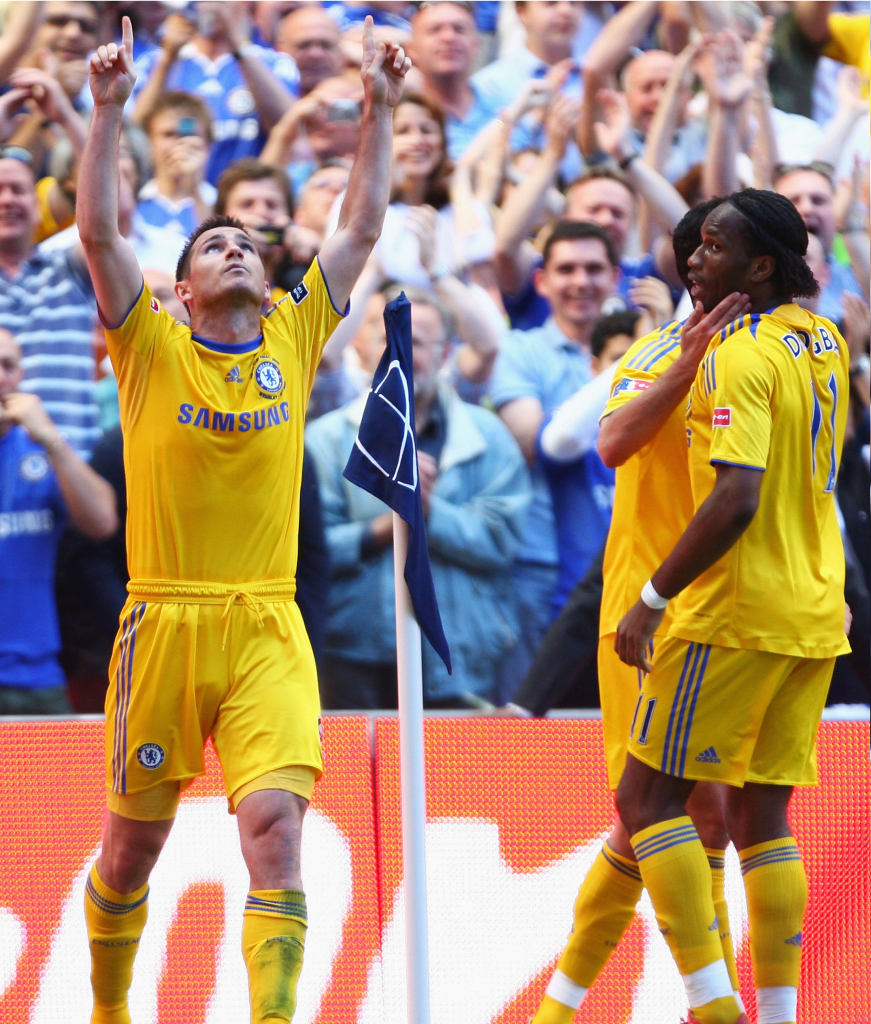
Similar to previous finals discussed in this article thus far, Chelsea would start the slower of the two sides. In fact, they didn’t have an opportunity to get going before conceding the first goal of the final. John Obi Mikel failed to clear a Steven Pienaar cross into the Chelsea box and Maoruane Fellaini would head the ball down to Louis Saha to smash the ball into the bottom left corner of Peter Cech’s goal. Saha’s goal was, and still remains the quickest goal in FA Cup Final history at 25 seconds, breaking a record that had existed for 114 years. Chelsea was shellshocked and a few nervy moments passed as Everton looked for a second goal. Soon it would be Everton who were struggling to deal with Chelsea’s attacking forces as Tony Hibbert received the game’s first yellow card after 8 minutes for clipping the heels of Florent Malouda. Chelsea’s dominance would soon pay as Malouda’s cross would be met by Didier Drogba, who rose above Joleon Lescott to head home his second FA Cup final goal after 21 minutes played. Chelsea were truly in command of the match. Ashley Cole almost became an unlikely FA Cup Final scorer but he would slice his shot wide, showing why he was never a regular scorer during his career. Even after half-time, Chelsea maintained their dominance as Nicolas Anelka broke clear of the Everton defence only to misjudge his shot, with his lob clearing the Everton crossbar. Everton would find a way back into the match, as Leighton Baines clipped a free kick into the box and Saha’s header would miss the goal by inches. Despite these chances, Chelsea would take a step closer to another FA Cup after Frank Lampard’s goal after 72 minutes. Lampard collected a Michael Ballack pass, turned inside Phil Neville onto his left foot and let fly from 25 yards with the ball hitting the top corner. A few minutes later, Florent Malouda almost made it three as his shot from long-range hit the underside of the bar and briefly crossed the goal-line, something that was missed by referee Howard Webb and his assistant. With Everton failing to register a response, Chelsea would secure their 5th FA Cup, and their 2nd FA Cup in 3 years.
2010 FA Cup Final
A year later and Chelsea and Drogba were back in another FA Cup Final, once again with a new manager, but at the end of a very different season. The final on 15th May would see the previous two FA Cup winners face off, as defending champions Chelsea would face 2008 winners Portsmouth, although one look at the league table would tell you that this final saw top face bottom. The previous year, Chelsea had entered the final off the back of an incredible run of 11 wins from their final 13 league matches following the sacking of Luiz Felipe Scolari. This season saw a dominant Chelsea come into the final off the back of a Premier League title win under new manager Carlo Ancelotti. Two-time Champions League winner Ancelotti was hired as Chelsea manager on 1st June 2009 and had kept the majority of the squad that had finished 3rd the previous season. Over the following season, Chelsea would produce one of the greatest Premier League title-winning performances to date. Winning the title by 1 point from Manchester on the final day of the season, the club would set new Premier League records for the most goals scored in a Premier League campaign with 103, the most goals ever scored at home in a single season with 68 and the highest goal difference in Premier League history with +71 as a result of 103 goals scored and 32 goals conceded. Four Chelsea players would have double-figure goal returns as Didier Drogba, Frank Lampard and Florent Malouda would have their best Premier League golascoring seasons scoring 29, 22 and 12 goals respectively, while Nicolas Anelka would also chip in with 11 throughout the season. In 15 Premier League matches, Chelsea would score 3 or more goals. In four of these matches, Chelsea would hit 7 or more goals in victories over Sunderland (7-2), Aston Villa (7-1), Stoke (7-0) and a final day 8-0 win over Wigan Athletic to confirm their third Premier League title. As stated before, Didier Drogba would have his best Chelsea season to date. 29 goals in 32 Premier League appearances would give the 32-year-old Ivorian his second Golden Boot and his sparkling form was replicated across all competitions as he would score a total of 37 goals in 43 total appearances for Chelsea during the 2009-10 season.
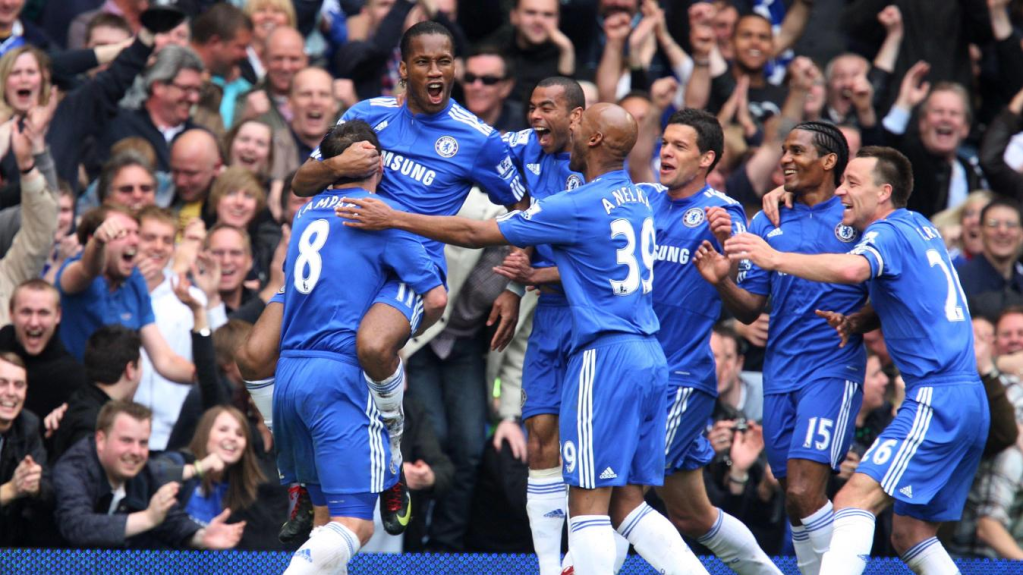
Chelsea’s route to the FA Cup Final would see the club play with the same form that had won them the Premier League in style. Championship clubs Watford (5-0), Preston (2-0) and Cardiff (4-1) were dispatched in the early rounds before goals from Frank Lampard and John Terry saw off Stoke City 2-0. Chelsea would reach a 3rd FA Cup final in 4 seasons with a 3-0 win over Aston Villa at Wembley with the goals being suitably scored by Drogba, Malouda and Lampard. Meanwhile, Portsmouth had belied their lowly standings in the Premier League to surprisingly reach a 2nd FA Cup final in 3 seasons. They would need a replay and a last-minute extra-time goal from Aaron Mokoena to defeat Championship Coventry City in the third round. For the rest of the competition (with the exception of one match), Portsmouth would continually punch above their weight, defeating teams that wold eventually finish above them in the Premier League. Sunderland (2-1), League 1 Southampton (4-1) and Birmingham City would all be dispatched to set up a semi-final tie against a Tottenham side gunning for the Champions League that were managed by Harry Redknapp, the man who had delivered the FA Cup to Fratton Park two years earlier. Against all expectations and form, goals from Frederic Piquionne and Kevin Prince-Boateng would seal a 2-0 extra-time victory and an unlikely trip to Wembley at the end of a dismal season.
You would be hard pressed to find people backing Portsmouth to pull off one of the biggest upsets in FA Cup history, and the new champions of England showed their dominance. The first major shots on target would come from Chelsea as Frank Lampard would have two attempts that just missed the Pompey goal. The first shot would trickle inches wide and the second would hit the outside of the post. After 20 minutes, Portsmouth would also go close as a volley from Kevin-Prince Boateng would be directed into the path of Frederic Piquionne, whose shot from close range was clawed away by Petr Cech. Chelsea would hit the woodwork again before the first half was over. Salomon Kalou would divert his shot onto the Pompey crossbar when it was easier to score while John Terry would later see his header from a Florent Malouda hit the crossbar. The champions did think they had taken the lead before half-time as a Drogba free-kick was turned onto the bar by veteran goalkeeper David James only to bounce down onto the goal-line. Chelsea would appeal but replays showed that the officials were correct in their judgement. Another Drogba shot would hit the post to sum up a first half where only the woodwork had managed to deny Chelsea from taking the lead on multiple occasions.
The final would develop a sting in its tail 10 minutes into the second half. One minute before half-time, influential midfielder Michael Ballack was tackled by Kevin-Prince Boateng. While a perfectly legal tackle, the ankle injury suffered by Ballack as a result of said tackle would rule the Germany captain out of the 2010 World Cup and end his international career. He would be replaced by Juliano Belletti on 44 minutes. 10 minutes on the field and Belletti would bring down Boateng in the penalty area, awarding Portsmouth a penalty and the chance to take a shock lead against the Premier League champions and defending FA Cup holders. To Portsmouth’s dismay, Boateng’s penalty would be easily saved by Petr Cech. Five minutes later, Chelsea were awarded a free kick on the left hand side of the pitch around 25 yards away from the Portsmouth goal. Didier Drogba would step up to take it, and Drogba would score, angling the ball into the bottom corner of David James’s net. This goal was of some significance for Drogba. He had now hit double figures in the FA Cup, scored in all six matches he had played in at Wembley Stadium and most importantly of all, scored in three FA Cup finals, a rare feat in the history of the 139-year-old competition. After taking the lead, Chelsea would try to make the match safe on a number of occasions, but to no avail. They would even be awarded a penalty of their own after Lampard was fouled inside the area by Michael Brown, but he would miss the goal completely. Despite this miss, Chelsea would finish the match strongly to claim their 3rd FA Cup in 4 years and do the League/FA Cup Double for the first time in their history.
2012 FA Cup Final
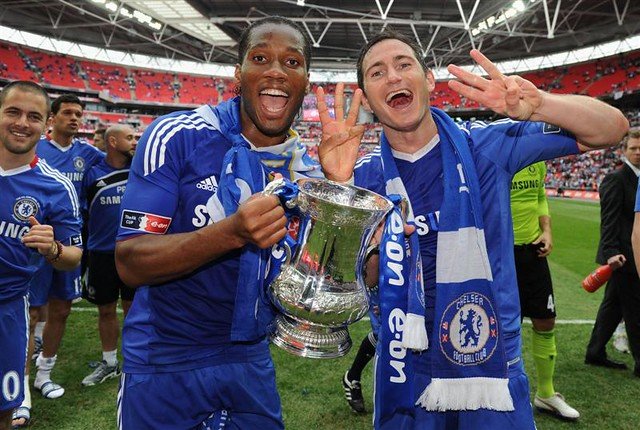
Didier Drogba’s fourth and final FA Cup Final occurred two years later on 5th May 2012. Once again, Chelsea would enter the FA Cup final with a new manager. After the Double-winning season in 2010, Carlo Ancelotti was unfairly sacked for not doing the same the following season, despite finishing 2nd in the Premier League. Former Jose Mourinho protégé Andre Villas-Boas would be hired as his replacement on 22nd June 2011, becoming Chelsea’s 5th new manager in 4 years. Villas-Boas had just led FC Porto to an unprecedented treble-winning season, which included an undefeated league season (the second time this had been achieved in the history of the league), the Portuguese Cup and the UEFA Europa League. As part of this treble, he had become the youngest manager to ever win the Portuguese Primeira Liga and the youngest to ever win a European competition at the age of 33. Signing the likes of Juan Mata, Thibaut Courtois and 18 year-old Romelu Lukaku, Villas-Boas wouldn’t have the best start to his Chelsea career, beginning the Premier League campaign with a 0-0 draw with Stoke. He would respond winning 6 of the next 7 matches, with Chelsea sitting 3rd behind the two leading Manchester clubs after 8 matches played on 23rd October. This peak would not reached again during Villas-Boas’ time in charge as inconsistency would dog his reign. Back-to-back wins against Newcastle and Manchester City would contrast with draws with Wigan and Fulham and a 1-0 defeat to Queens Park Rangers. A three-match winning streak would be followed by a three-match drawing streak. As the season progressed, Chelsea would drift further away from the leaders and even the top 4. AVB would last a total of 27 Premier League matches before getting the sack on 4th March 2012. The day before, a 1-0 defeat to West Brom hadleft Chelsea in 5th place, with the team having won just 3 of their previous 12 league matches. AVB’s assistant manager Roberto di Matteo would take charge on a temporary basis until the end of the season. Di Matteo had become a cult hero at Chelsea, making 175 appearances and scoring 26 goals during his seven seasons at Stamford Bridge between 1996 and his unfortunate retirement in 2002. His most famous moment had occurred in the 1997 FA Cup Final against Middlesbrough, where Di Matteo would put Chelsea ahead after only 42 seconds. Di Matteo would try to right the ship that was Chelsea’s Premier League campaign with 11 matches remaining, but could not stop the team finishing outside the European qualification places in 6th place, the team’s worst league finish since the 2001-02 season. Chelsea’s hope for European football would come from the cup competitions, specifically the FA Cup (which guaranteed a Europa League place) and the Champions League, which will be talked about later. Meanwhile, Didier Drogba was having another off season in the goalscoring department in a season when most of Chelsea’s strikers were struggling to score. For point of reference, in a squad that contained Didier Drogba and Fernando Torres, Daniel Sturridge would be Chelsea’s top scorer in the Premier League (11) and second-highest scorer overall (13) after Frank Lampard (16). Drogba’s 5 league goals equalled his low from the 2008-09 season and his 13 goals overall was the fewest number of goals he had scored in a season for Chelsea in his sevens season at the club. He would hoping for more success in the FA Cup final.
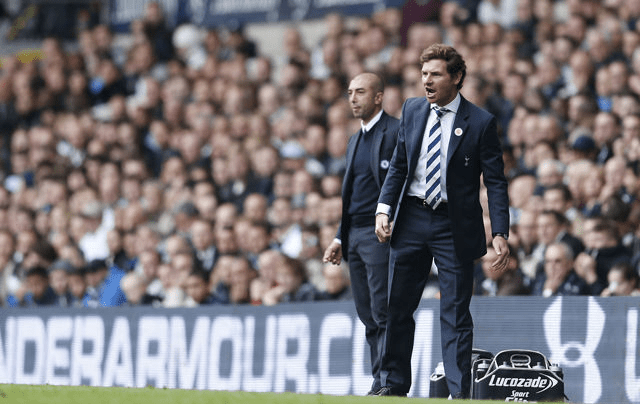
Chelsea’s route to the 2012 final would be a mixed bag, with the early rounds typifying Andre Villas-Boas time in charge. The third round would be a repeat of the 2010 final, but Chelsea would comfortably beat Portsmouth 4-0 at Stamford Bridge. A controversial Juan Mata penalty would be enough to unconvincingly edge past Queens Park Rangers in the fourth round (1-0). The team would even be taken to a replay by Championship club Birmingham City in one of AVB’s final matches. In Roberto di Matteo’s first match in charge, Chelsea would win the replay after goals from Juan Mata and Raul Meireles. Chelsea would then win an entertaining encounter with Leicester City in the quarter-finals (5-2) before thrashing Tottenham at Wembley to make a 4th final in 6 years. Their final opponents Liverpool would begin with a comfortable 5-1 win over Oldham Athletic in the 3rd round. A highly-charged 4th round derby with Manchester United in the wake of the Luis Suarez-Patrice Evra scandal would be settled by an 88th-minute goal from Dirk Kuyt just as the game was heading to a replay (2-1). Another comfortable victory would follow with Brighton being on the end of a 6-1 drubbing. A 2-1 win over Stoke would follow in the quarter-final before a close-fought Merseyside derby at Wembley would be settled by a late header from Andy Carroll in the 87th minute to take Liverpool to their first FA Cup final since 2006.
This final was notable in that both managers were former players looking to win the FA Cup with the same club both as a player and a manager. Roberto di Matteo’s opposite number Kenny Dalglish, who had returned as Liverpool’s manager a year earlier, had achieved this record before. His Liverpool side was looking for the domestic cup Double, having won the League Cup three months earlier. In the final, Chelsea would start quickly as Drogba would fire over the Liverpool crossbar in the first minute. Liverpool had the majority of possession but the recent FA Cup specialists would take the lead after 11 minutes. Young Liverpool midfielder Jay Spearing would lose possession to Ramires in the middle of the park and the Brazilian would charge into the penalty area, firing past Pepe Reina at his near post. After the goal, Juan Mata would be brought down by Steven Gerrard inside the Liverpool penalty area, but his penalty claims would be waived away by Phil Dowd. Liverpool would counter-attack and Craig Bellamy’s shot would be cleared off the line by Branislav Ivanovic. Liverpool were struggling to hold on to possession with lone striker Luis Suarez finding himself isolated on more than one occasion. Liverpool would lose possession again towards the end of the first half, as Frank Lampard would pounce on a misplaced Jordan Henderson pass, but his shot from 40 yards would sail wide. Both teams would struggle to create clear-cut chances with Chelsea still leading 1-0 at half-time. The second half would begin with end-to-end action as both sides tried to create goalscoring chances. Liverpool would have a penalty appeal after 50 minutes after Steven Gerrard was brought down inside the area, but the claims were waived away. Despite both teams having plenty of opportunities to score, Chelsea would once again be the more clinical of the two sides. On 52 minutes, Frank Lampard would find Didier Drogba on the edge of the Liverpool area. Drogba would turn, move past Liverpool defender Martin Skrtel and shoot through the legs of Pepe Reina to double Chelsea’s lead and become the first player to score in four FA Cup finals, a record that is unlikely to ever be matched.
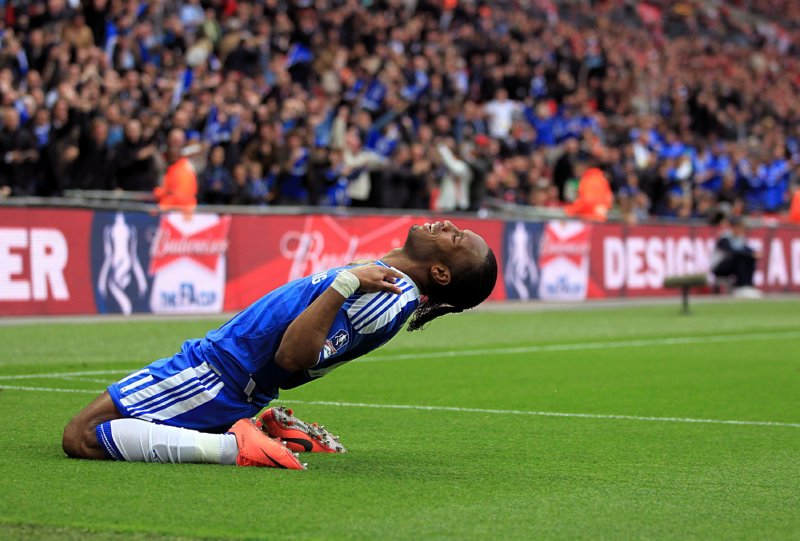
Fearing defeat, Liverpool manager Kenny Dalglish would soon throw caution to the wind bringing on semi-final hero Andy Carroll for Jay Spearing after 54 minutes. 10 minutes later, a Stewart Downing tackle would move the ball into the path of Carroll, who would score past Petr Cech to half the deficit to 2-1. Liverpool would press forward for an equaliser. A Carroll header would drop for Steven Gerrard but his shot would clear the crossbar. Minutes later, Liverpool defender Daniel Agger would head wide from a corner. After further missed opportunities by Liverpool, Carroll almost grabbed an equaliser. In the 81st minute, an Andy Carroll head was touched by Petr Cech onto the underside of the bar and away to safety. Carroll celebrated what he thought to be an equaliser, but ref Phil Dowd would not give the goal after consultation with his linesman. Liverpool would continue to push for an equaliser, but time would run out and Chelsea would win their 4th FA Cup in six seasons and their 7th overall.
2012 Champions League Final
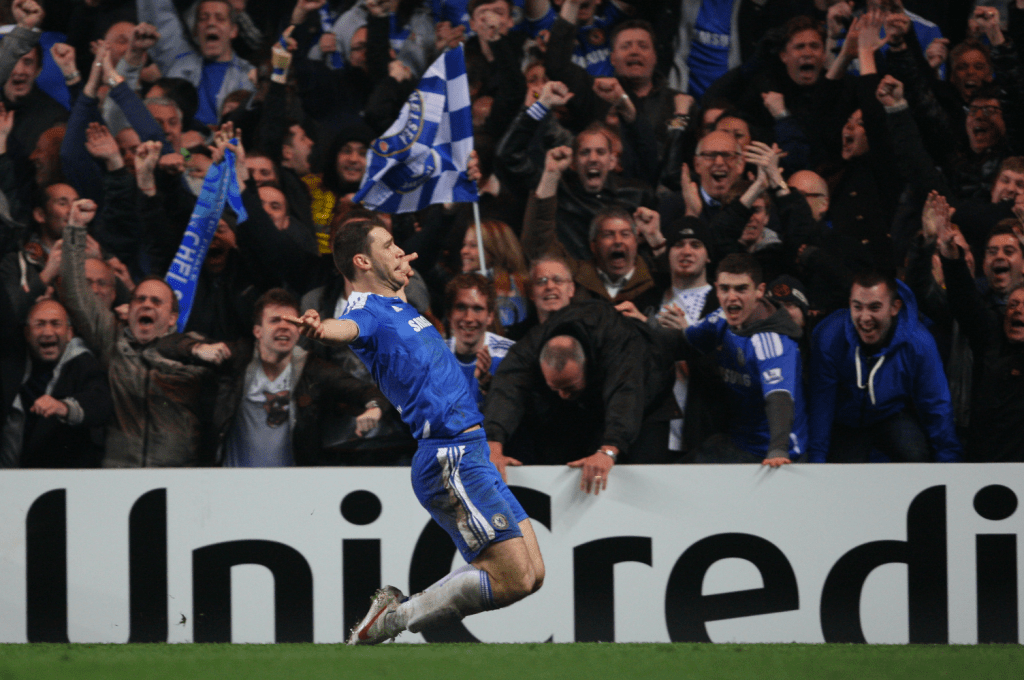
Two weeks after the FA Cup Final and Chelsea were back in another cup final with a chance at making club history, in more ways than one. The date: 19th May 2012. The opponent: Bayern Munich. The venue: the Allianz Arena in Munich, Germany AKA the home stadium of Bayern Munich. The German giants had defied the random selection process to end up playing the biggest match in European football with home advantage. Chelsea had to overcome the partisan crowd and the German giants to win their first Champions League trophy in a match where they were rank underdogs. However, Chelsea’s journey to the final had proven that they could overcome the odds under caretaker manager Roberto di Matteo. Under Andre Villas-Boas, Chelsea had topped a group containing Bayer Leverkusen, Valencia and Genk, winning 3, drawing 2 and losing 1 of the 6 group matches. Two weeks before AVB’s sacking, Chelsea had lost the first leg of their last-16 tie 3-1 away to Napoli. Following wins over Birmingham City and Stoke in his first two matches in charge, Roberto di Matteo knew he had a task on his hands when a Napoli side containing Marek Hamsik, Ezequiel Lavezzi and Edinson Cavani visited Stamford Bridge on 14th March 2012. Carrying over an away goal from the first leg, the minimum Chelsea needed was a 2-0 victory to progress. They would take the lead on the night through Didier Drogba after 29 minutes. Two minutes after half-time, John Terry’s header would make the score 2-0 to Chelsea, and Chelsea were now mathematically through. However, a Gokhan Inler’s away goal after 55 minutes cancelled out Chelsea’s advantage and put the Italian side 4-3 ahead on aggregate. Chelsea now needed to score twice in 35 minutes to progress to the quarter-finals. A Frank Lampard penalty in the 75th minute after a Napoli handball levelled the score on aggregate and would unwittingly send the tie to extra-time. Moments before the first half of extra time would end, Didier Drogba would play the ball across the face of the Napoli goal and Branislav Ivanovic would fire the ball high into the net, completing Chelsea’s comeback against all the odds.
The quarter-finals would bring the prospect of Portuguese giants Benfica. Chelsea would have comparatively smoother sailing through this round, winning the away leg 1-0 after a 75th-minute Salomon Kalou goal and would secure the aggregate win with a 2-1 home victory with Frank Lampard and Raul Meireles providing the goals. That win would lead to the worst possible draw: Pep Guardiola’s Barcelona. Defending champions who had won two of the previous three Champions Leagues. Three consecutive La Liga titles. A team containing Alexis Sanchez, Xavi, Iniesta, Fabregas and 3-time World Player of the Year Lionel Messi. A tight match at Stamford Bridge would see the underdogs win as Didier Drogba’s goal in first-half stoppage time would be enough to give Chelsea a slim advantage heading to the Nou Camp. 6 days later, Barcelona would come out firing, taking the lead on the night through Sergio Busquets after 35 minutes. Two minutes later, John Terry would be controversially sent off by referee Cuneyt Cakir after a bust-up with Alexis Sanchez. Two minutes before half-time, Andres Iniesta would give Barca the lead on aggregate. However this lead would be short-lived as Ramires would score in first-half stoppage time to level the tie and give 10-man Chelsea a precious away goal buffer. Four minutes after the break, Didier Drogba would trip Cesc Fabregas to give Barca a penalty a chance to take the lead through Lionel Messi. However due to a distraction by Petr Cech, the ‘big’ man would smash his penalty against the crossbar to give Chelsea a reprieve. The rest of the match would see a concerted rearguard effort from Chelsea against wave after wave of Barcelona attacks, as Messi would once again hit the woodwork. With Barcelona searching desperately for a winner, Fernando Torres would sprint clear, round goalkeeper Victor Valdes and book Chelsea’s ticket to Munich to face a Bayern side that had comfortably beaten Basel and Marseille before needing penalties to beat Cristiano Ronaldo and Co at the Bernabeu.
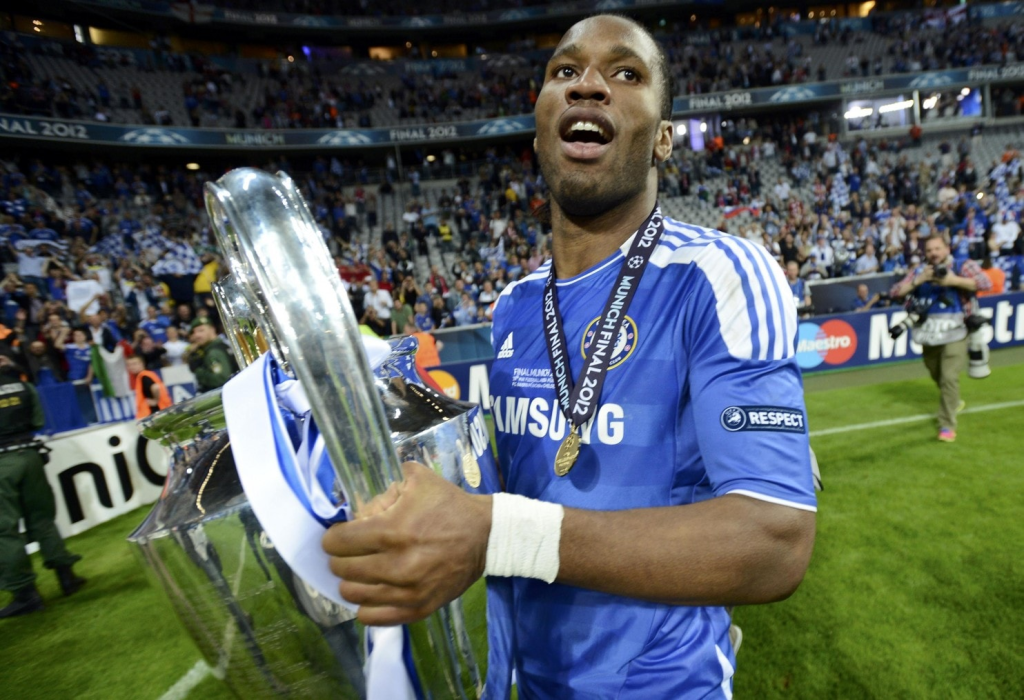
In the final, heavy favourites Bayern would have the superior start, relentlessly attacking a Chelsea back four missing the reassuring presence of captain John Terry. Thomas Muller, Franck Ribery, Arjen Robben and Mario Gomez would pepper the Chelsea goal throughout the 90 minutes. The first meaningful chance would occur after 18 minutes as Thomas Muller would find Mario Gomez in space, but the tall German would miss his kick entirely while through on goal. A few minutes later, Robben would cut in from the left flank and the resulting shot would ricochet off Petr Cech’s shin onto the right-hand goalpost. Later, Muller would skew a volley wide while unmarked and Gomez would clear the crossbar with only Cech to beat. Bayern were wasting opportunity after opportunity with the match remaining goalless at half-time, but the Germans still had the possession to create further chances. The home side would even have a goal ruled out for offside when Franck Ribery would tap the ball home after Robben’s shot had been blocked by Ashley Cole. Later in the second half, it would be Muller’s turn to shoot wide following a ball rebounding off Ribery. Something had to tell eventually and it would with 7 minutes remaining. With 83 minutes gone, an in-swinging cross from Toni Kroos would find Thomas Muller and the German midfielder would make no mistake this time, heading a ball that went in off the underside of the crossbar. It seemed like Bayern had the game won with Muller’s goal, but Chelsea would never give up, such was the importance of the occasion. In the 88th minute, Juan Mata’s near post corner would be met by Didier Drogba, who would direct his header goalward to score in his eighth major cup final for Chelsea. Chelsea had a chance to win the match with the last kick of the game, but Drogba’s free kick would sail over the crossbar. In extra time, the only major incident of note came when Bayern were awarded a penalty after Franck Ribery had been tripped by Didier Drogba. Arjen Robben would step up to take the penalty, which would be saved by Petr Cech. With no winner found after extra-time, penalties were now the deciding factor. Bayern would take first in the shoot-out as captain Philipp Lahm would score the first penalty. Chelsea’s first penalty taker was Juan Mata, who saw his penalty saved by Manuel Neuer. Mario Gomez would be next up for Bayern, and he would duly convert to make the score 2-0 in favour of the home side. Chelsea’s second taker David Luiz would score to get Chelsea on the board. Goakeeper Neuer would actually take Bayern’s third penalty and he would score past his opposite number Cech. Frank Lampard would keep the score ticking at 3-2. Ivica Olic would be next for Bayern, but he would find his shot saved by Cech, who guessed correctly to keep the score at 3-2 before Ashley Cole would level the scores at 3 apiece. Bayern Munich’s fifth and final penalty taker was veteran midfielder Bastian Schweinsteiger, who by scoring would put pressure on Chelsea’s next taker to score and continue the shoot-out. His penalty kick would be turned onto the post by Cech. Chelsea’s final taker would be Didier Drogba. Four years earlier, he had been sent off in the 2008 final and missed Chelsea’s shootout loss to Manchester United. With Schweinsteiger’s miss, Drogba now had the chance to deliver history to the club he had called home since 2004. In what was assumed to be his 342nd and final appearance for the club, Didier Drogba would send the ball into the bottom left-hand corner of the goal before tearfully running away to celebrate with his teammates. Chelsea’s difficult league season had been salvaged with the rare double of the FA Cup and Champions League, something that had only been achieved by Manchester United (1999) and Liverpool (2001) as part of Treble-winning seasons. Another cup final victory for Chelsea, another Man of the Match performance from Drogba.
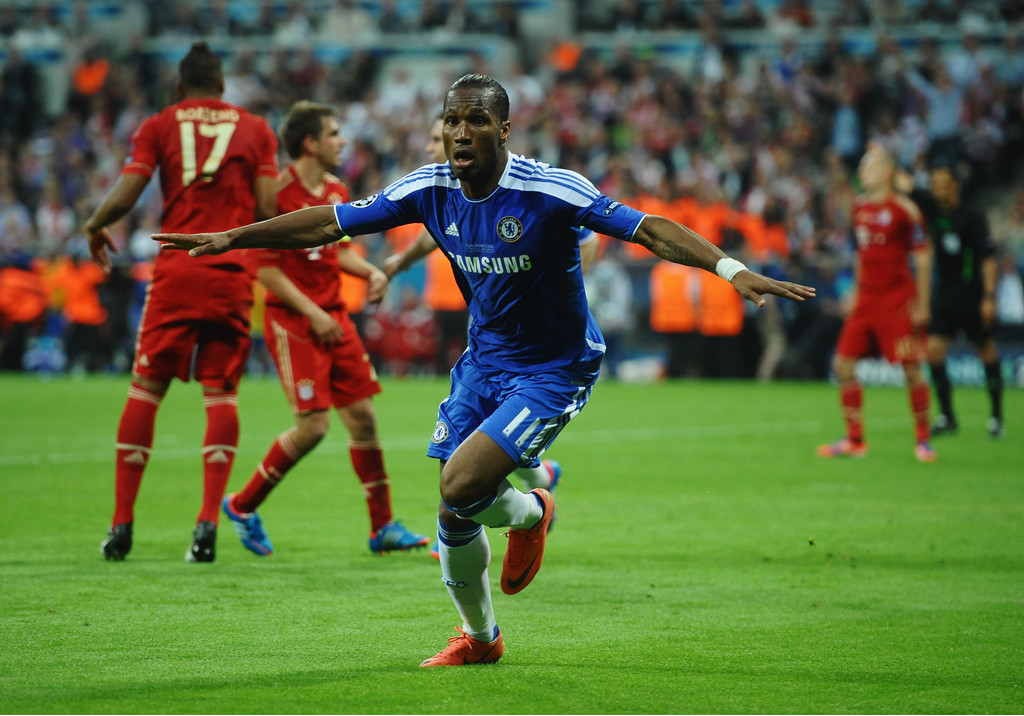
The 2012 Champions League Final would be Didier Drogba’s final match for Chelsea for now. After 157 goals in 342 appearances, he would sign for Chinese Super League club Shanghai Shenhua during the summer of 2012. His Chelsea story was not over however. Two years later, after spells at Shanghai and Galatasaray, the now 36-year-old Drogba would re-sign for Chelsea after the 2014 World Cup. Just like in 2004, he would be signed by Jose Mourinho. Now past his prime, Drogba would find himself a bench player throughout the 2014/15 season, unable to unseat the prolific Diego Costa from the starting centre-forward spot. During his return season at Stamford Bridge, Didier Drogba would make 40 appearances for Chelsea, with 26 of these coming as a substitute. These 40 appearances would produce 7 goals. Chelsea would reach a cup final during this season, the 2015 League Cup Final. Chelsea would defeat Spurs 2-0 to give Mourinho his third League Cup trophy, but Drogba’s incredible final record would not continue here. He would appear as a substitute in the 93rd minute after the match had been won, not enough to make an impact or even score. The League Cup would be one half of a Double-winning season, as the Premier League would follow later. Drogba would once again leave Chelsea at the end of the 2014/15 season to finish his career with Montreal Impact in the MLS, having won his third League Cup and fourth Premier League trophies, bringing his overall total to 12 trophies with Chelsea.
Didier Drogba’s unique cup final record is nothing short of incredible. To score in eight major cup finals across three different competitions over an eight-year period all for the same club, is a record that is unlikely to be matched by any other striker. His three League Cup Final goals and four FA Cup Final goals are both competition records, along with the more notable record of being the only player to score in four FA Cup finals. Of the ten finals he appeared in, Drogba would only fail to score in two: the 2008 Champions League Final, where he would be sent off in extra time and the 2015 League Cup Final, where his late substitution appearance wouldn’t be long enough to add to his goal tally. Of the eight finals he scored in, he would only lose one, the 2008 League Cup Final. On four occasions (2007 League Cup final, 2007, 2010 and 2012 FA Cup finals), Drogba would score the winning goal, delivering his best form for the big occasions.
Didier Drogba is a legendary player and during his career, had attained world-class status. He is one of the greatest players Chelsea Football Club has ever seen, especially of the Premier League era and is one of the greatest African footballers to ever play the sport of football. Despite all the records he may have attained internationally and in the league for Chelsea and the Ivory Coast, the most interesting stats from his career come from the outstanding performances he would give in the cup finals.
 the-score-board.co.uk