
Excellence Shrouded By Scandal, 1999-2000
Manager: David O’Leary
Top Scorer: Michael Bridges (21)
Premier League: 3rd
FA Cup: Fifth Round
League Cup: Fourth Round
UEFA Cup: Semi-Finals
League Record: 21 wins, 6 draws, 11 defeats
Transfers: £-11,685,000
Transfers in £28,310,000
15 June 1999 DF Danny Mills Charlton £4 million
9 July 1999 DF Michael Duberry Chelsea £4.5 million
23 July 1999 FW Michael Bridges Sunderland £5 million
11 August 1999 FW Darren Huckerby Coventry City £4 million
19 August 1999 DF Danny Hay Perth Glory £200,000
17 December 1999 MF Jason Wilcox Blackburn Rovers £3 million
15 January 2000 GK Danny Milosevic Perth Glory £110,000
5 March 2000 GK Shaun Allaway Reading £300,000
Transfers out: £16,625,000
11 June 1999 DF Gunnar Halle Bradford City £200,000
15 June 1999 MF Lee Sharpe Bradford City £200,000
30 June 1999 DF David Wetherall Bradford City £1,400,000
16 July 1999 FW Clyde Wijnhard Huddersfield Town £750,000
4 August 1999 FW Jimmy Floyd Hasselbaink Atlético Madrid £12,000,000
5 August 1999 FW Kevin Dixon York City Loan
6 August 1999 FW Derek Lilley Oxford United £75,000
1 October 1999 FW Paul Shepherd Ayr United Free transfer
22 October 1999 MF Bruno Ribeiro Sheffield United £500,000
12 November 1999 DF Danny Granville Manchester City £1,000,000
17 January 2000 DF Kevin Evans Swansea Loan
9 March 2000 MF Mark Jackson Scunthorpe United Free transfer
23 March 2000 FW Lee Matthews Gillingham Loan
15 April 2000 FW Neil Ross Stockport County Free transfer
12 May 2000 MF Tommy Knarvik SK Brann Free transfer
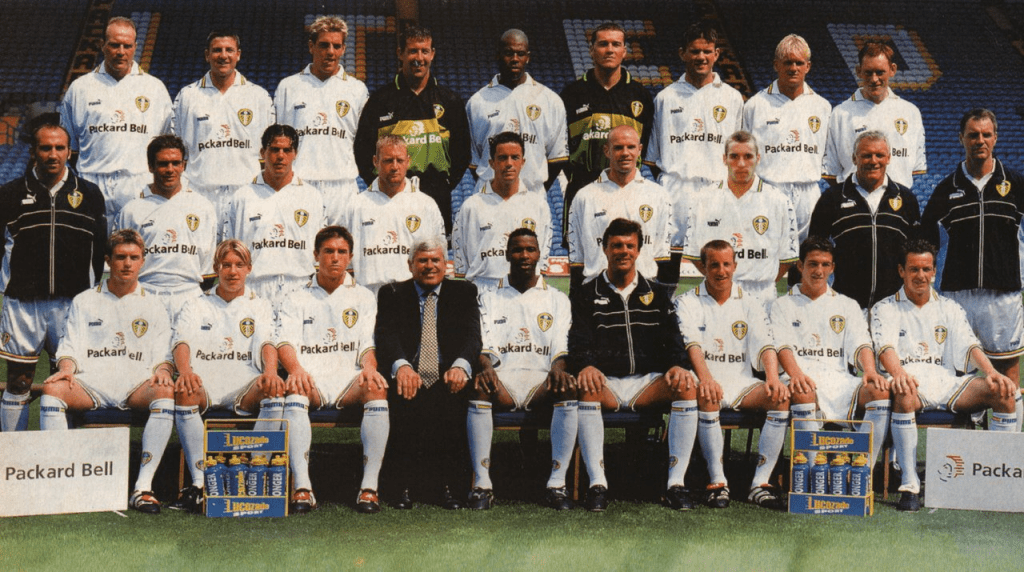
Compared to the quiet transfer business of the summer of 1998 and despite Leeds’s impressive 4th place Premier League finish in the season that followed, David O’Leary seemed keen to bring in his own players and give the team a new identity in his first full season as manager. After being signed for £4.5 million in 1996, Lee Sharpe would be sold to newly-promoted Bradford City for £200,000 after an injury-ravaged three seasons which had resulted in 30 league appearances and 5 goals, all of which had come in his debut season. Joining Sharpe at Bradford would be Gunnar Halle and David Wetherall. Halle had shared right-back duties with Martin Hiden the previous season but was moved out to make way for another signing in his position. Wetherall similarly had managed to make over 20 appearances in all competitions the previous season but played second-choice behind captain Lucas Radebe and youngster Jonathan Woodgate. Striker Clive Wijnhard, who had been signed the previous summer by George Graham for £1.5 million would be sold to Huddersfield Town for half that amount after 4 goals in 25 appearances.
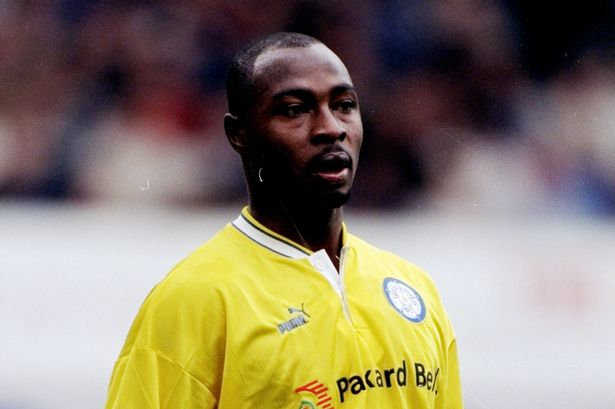
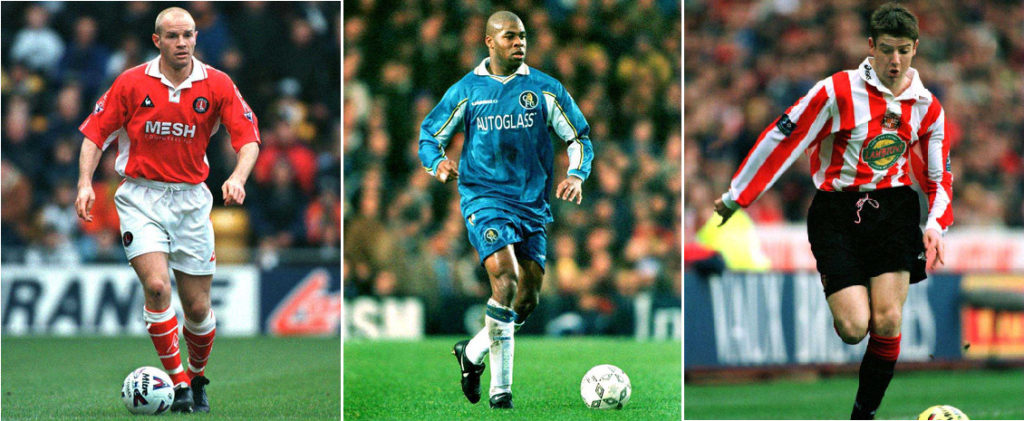
To replace Halle, Wetherall and Wijnhard, O’Leary would buy Danny Mills from Charlton for £4 million, Michael Duberry from Chelsea for £4.5 million and Michael Bridges from Sunderland for £5 million. Bridges had scored 8 goals in 30 appearances the previous season, helping Sunderland gain promotion to the Premier League. However, the big move in the transfer market would come on 4th August when Jimmy Floyd Hasselbaink, the club’s top scorer for the prior two seasons was sold for £12 million to Atletico Madrid. Hasselbaink left with an incredible record, scoring 42 goals in 87 appearances, 34 in 69 in the league, in his two seasons at the club. He had proven himself as a prolific goalscorer, which the rest of Europe had started to take notice of. He would carry his incredible Leeds form with him to Atletico, scoring 24 goals in 34 league games in the 1999-00 season. The signing of Darren Huckerby from Coventry was used to fill the void. Another player who felt like a new signing, despite having been at the club since 1991, was Gary Kelly. Kelly had been the club’s first-choice right-back since the 1993-94 season, missing only 10 of the 198 league games that Leeds would play between 1993 and 1998. He had even been made the club’s captain for 1997-98 season by George Graham, playing 34 out 38 PL games that term. However, shin splints ruled him out for the entirety of the 1998-99 season, Martin Hiden and Gunnar Halle playing instead. After missing an entire season worth of action, Kelly would play 47 games during the 1999-00 season and restricted new signing Danny Mills to 21 appearances in all competitions.
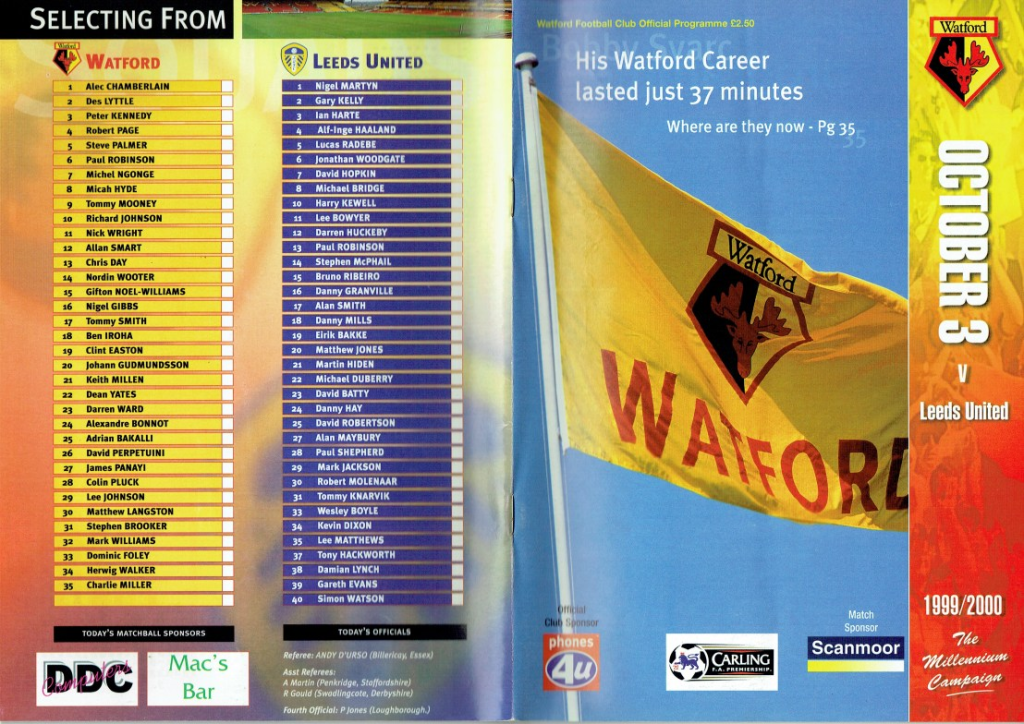
Leeds’ Premier League campaign began slowly, with the team’s first five matches, opening with a goalless draw against Derby before mixing victories against Southampton (3-0) and Sunderland (2-1) with losses to Manchester United (2-0) and Liverpool (2-1). However, this mixed start would not last long before Leeds would embark on their best run of form in years. From the end of August to Boxing Day 1999, Leeds would play 14 league matches, winning 12, drawing 1 (a 4-4 classic against Everton on 24th October) and losing 1 (a surprising 2-0 loss to struggling Wimbledon on 7th November), with a further defeat occurring at the hands of Leicester City in the 4th round of the League Cup. This incredible league form changed Leeds into something that they hadn’t been for a number of seasons: title contenders. A 2-0 victory at home to Middlesbrough on 19th September put Leeds into 2nd place and 2-1 win away at Watford on 3rd October made them the new Premier League leaders overtaking early pacesetters Manchester United. Leeds would continue to hold 1st for the next four weeks, winning matches against Sheffield Wednesday and West Ham United and a dramatic 4-4 draw against Everton on 24th October until a 2-0 loss to Wimbledon on 7th November put Manchester United back in front. This was only a brief two-week respite and a 1-0 victory over Southampton at Elland Road on 28th November, saw Leeds overtake Manchester United again while Alex Ferguson’s men were facing Palmeiras in the Intercontinental Cup. During this time, Leeds would sign a Premier League title winner as winger Jason Wilcox would sign from Blackburn Rovers for £3 million on 17th December 1999. Along with David Batty, Wilcox had been part of the regular starting line-up as Blackburn Rovers shocked Manchester United to win the Premier League title in 1995. Leeds would hold the Premier League leaders’ position for six weeks, even topping the table at Christmas after victories over Chelsea (2-0) and Leicester (2-1). However a 3-1 defeat to Liverpool in late January allowed Manchester United to take control again and never look back, bringing an incredible Leeds run to an end. Leeds would not top the table again but would continue to hold 2nd.
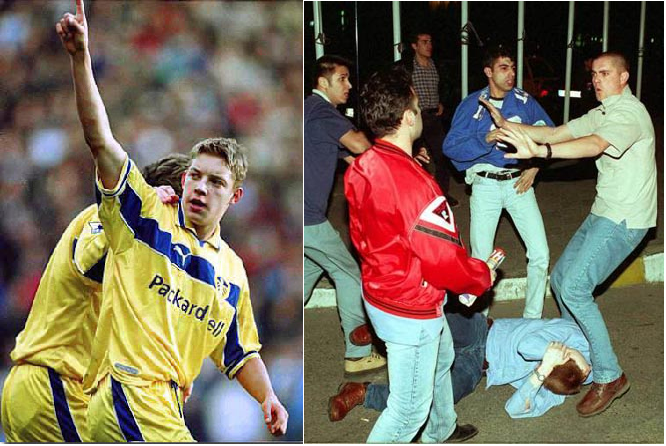
While Leeds’s players were experiencing success on the field, they were courting controversy off of it. In January 2000, an incident would occur that would affect the careers of two of Leeds’s key players for the next two season. Lee Bowyer and Jonathan Woodgate along with some friends were later alleged to have repeatedly punched and kicked an Asian student named Sarfraz Najeib outside of the Majestyk nightclub in Leeds druing an alcohol-fuelled night on the town, leaving him with a fracture leg, cheek and nose. After the group had left the nightclub, one member had knocked Mr Najeib to the ground, pursued him, before repeatedly attacking him once he was knocked to the ground again after being tripped. The group had also attacked the victim’s brother, causing him to bleed. Woodgate and Bowyer were spotted by up two six witnesses with three recognised one or both of them. The two were charged with grievous bodily harm with intent and affray, with a trial starting the following year.
Leeds’s league form was reflected in their success in the UEFA Cup, which at that point was still a straight knockout competition without a group stage. By the time the team had dropped the Premier League lead back to Manchester United, Leeds had progressed to the fourth round, taking big scalps along the way. Partizan Belgrade, the champions of Yugoslavia, were dispatched 4-1 on aggregate in Round 1. This followed by victories over the two best teams in Russia, Lokomotiv and Spartak Moscow. Lokomotiv were thrashed 7-1 on aggregate with a 4-1 victory at Elland Road being followed by a comfortable 3-0 win in Moscow where Leeds had the game won by half-time thanks to goals from Ian Harte and a brace from Michael Bridges. The next stage would be more a squeeze when Leeds faced the Russian champions Spartak. The first leg in Moscow saw the home team prevail 2-1. Leeds took the lead after 14 minutes thanks to Harry Kewell but Spartak would rally through goals from Alesandr Shirko and Robson. Spartak won the match but Leeds had an away goal. The second leg was tight game with needing to win at Elland Road in order to progress to Round 4. It would take until the 84th minute for the all-important goal to be found thanks to captain Lucas Radebe. Leeds would hold out to win the leg and the tie on away goals. The next round would bring them to Roma to face a team containing Cafu, Francesco Totti, Marcus Delvecchio and Vincenzo Montella, who had sneaked past Newcastle thanks to a Francesco Totti penalty.
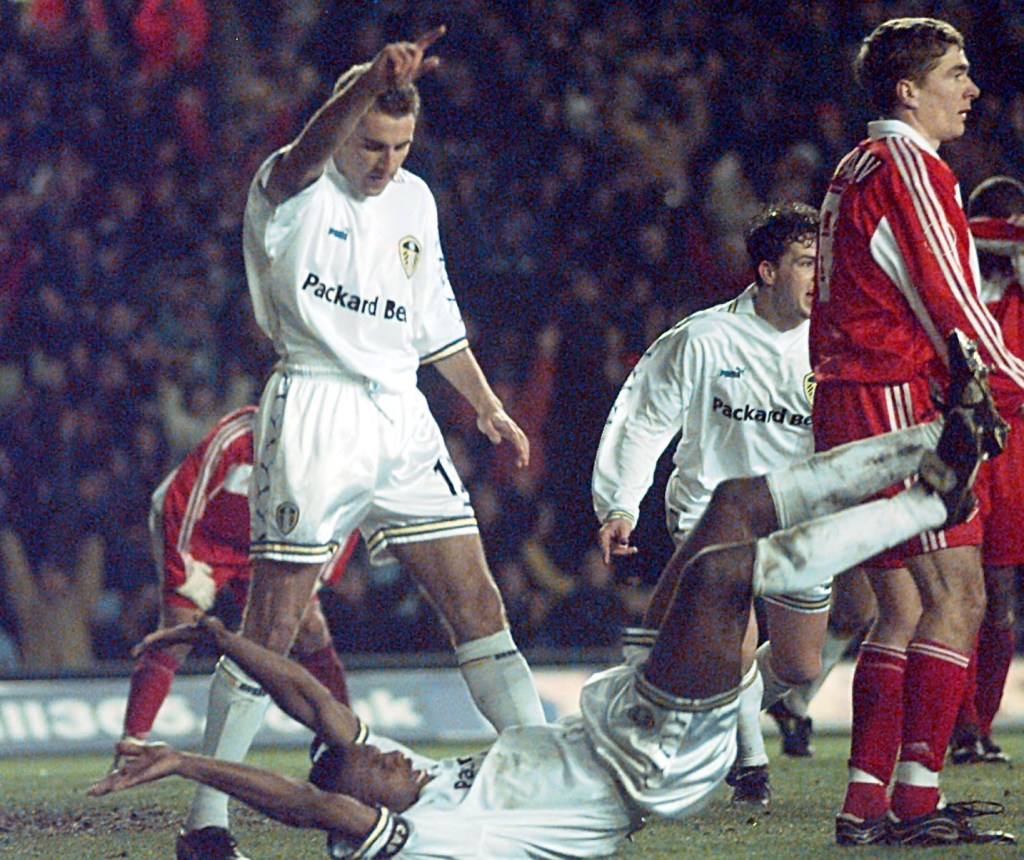
After losing the Premier League’s top position to Manchester United, Leeds would hold 2nd for the next six weeks after the Liverpool defeat, winning 4 out of their next 6. However, Leeds excellent form would run. Four straight losses to Leicester (2-1), Chelsea (1-0), Aston Villa (1-0) and a 4-0 (Henry, Keown, Kanu, Overmars) thrashing at the hands of Arsenal on 16th April dropped Leeds down to 4th and out of Champions League qualification. Leeds’s excellent season seemed to be ending with a whimper. Leeds would scrape over the line thanks to three draws and two wins in their final five matches, eventually finishing in 3rd and achieving Champions League qualification for the first time since 1992, ending the season on a positive. On the flipside, Leeds who had topped the table for 11 weeks throughout the season, eventually finished 22 points behind Manchester United, who would win the league by a whopping 18 points from Arsenal, a record that would stand for 18 years until being broken by Manchester City in 2018.
Meanwhile in Europe, Leeds travelled to the Stadio Olimpico on 2nd March to face Roma in the first leg of the UEFA Cup 4th Round. As the BBC put in 2000, “A combination of luck and a virtuoso performance by goalkeeper Nigel Martyn earned Leeds a Uefa Cup draw against Roma.[1] Barring an early half-chance by Eirik Bakke, Leeds and their five-man defence were on the end of an onslaught of chances from Roma, including nine shots on goal by Francesco Totti alone and needed Nigel Martyn to keep the tie even for the second leg at Elland Road. One week later, a bad-tempered second leg including 7 yellow cards and 2 red cards was eventually settled thanks to Harry Kewell’s 66th minute finish to give Leeds a narrow 1-0 aggregate victory. Leeds would now have to travel further east for their quarterfinal which would be against Slavia Prague, who had eliminated Udinese. The quarterfinal would become an easier challenge thanks to a comfortable first leg victory in Yorkshire where goals from Jason Wilcox, man of the moment Harry Kewell and Lee Bowyer. The second leg in Prague would be decided after 47 minutes when Kewell would score to make the aggregate score 4-0 where a second-half Slavia comeback would not be enough.
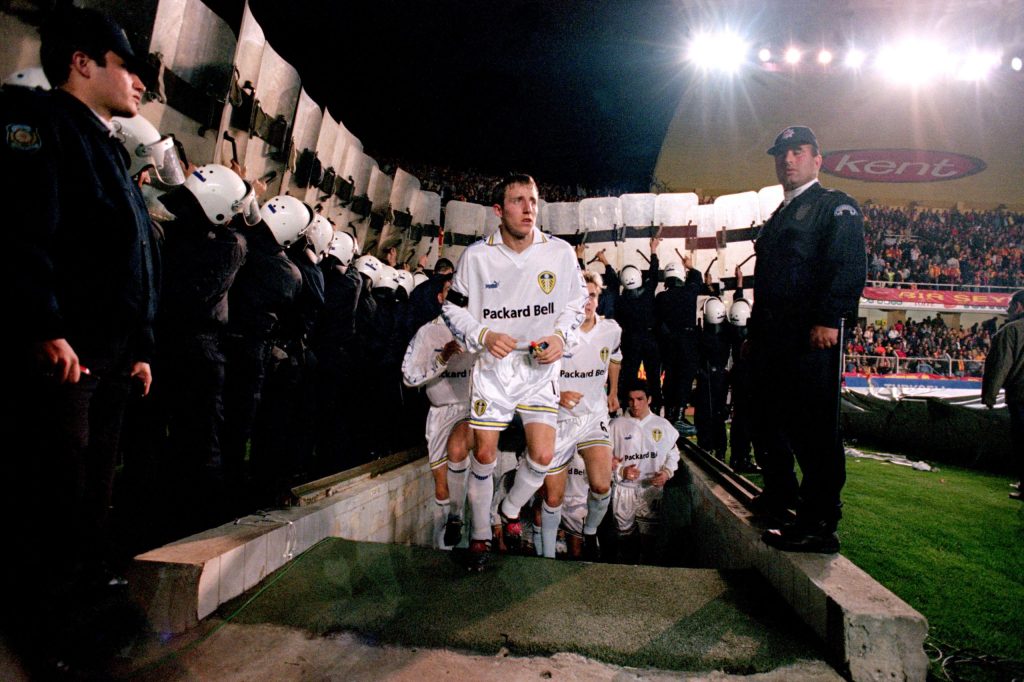
Leeds were through to the semi-finals of the UEFA Cup, their best performance in Europe since losing the 1975 European Cup Final to Bayern Munich. The task facing them came in the form of Turkish champions Galatasaray, who had dropped down to the UEFA Cup after exiting the Champions League at the group stage. Galatasaray would be led by the mighty Hakan Sukur, whose performances for Galatasaray would earn him a move to Inter Milan the following summer. A victory for Leeds would lead them to their first European final in 25 years. The first leg went the way of the hosts with a 2-0 victory for Galatasaray, with Sukur scoring the opener. However, the game was ruined by its build-up. The day before the match, two Leeds supporters were stabbed to death as a result of clashes between rival supporters in Istanbul’s Taksim Square. It is unclear how the clashes began but the four men who were later arrested for the crime were part of a local gang called ‘The Night Watchmen’. It is believed that the incident may have affected United’s play as the team wore black armbands throughout the match. Leeds’ normally resolute defence conceded two goals due to sloppy mistakes, leaving Leeds to require a win in the second leg at Elland Road. The violence of the first leg would have a clear impact on the return leg. As a result of said violence, Galatasaray fans were banned from attending the match, club officials be the only ones who could attend. Turkish restaurant owners in Leeds were asked to close early just in case things became violent. The Galatasaray team coach was attacked by Leeds fans and certain supporters violently clashed with some of the 300 members local police forces who were trying to prevent further reprisals of the original attacks. The atmosphere wasn’t much better inside the stadium. One minute into the match, Leeds fans turned their back away from the pitch as an act of disrespect. A supposed missile was even thrown at Hakan Sukur, knocking him over. The game was more competitive from Leeds’s end but that is not to say the game was bad-tempered with both team ending with 10 men. Heading into the game 2 goals behind on aggregate, Leeds needed a 3-0 victory or more to progress to the final. The task immediately got harder as Gala were given a penalty after five minutes, duly converted by Gheorghe Hagi to give the Turkish side their away goal buffer. A 16 minute equaliser from Eirik Bakke gave Leeds some hope, but the team now needed to score four in order to win the tie. However three minutes before half-time, the match and the tie were effectively put to bed as Sukur made the score 2-1 to Gala on the night and 4-1 on aggregate, especially after Harry Kewell was sent off one minute later. Bakke would score a second goal halfway the second half, but it would not be enough. Leeds were out of the UEFA CUP after an ugly, ugly tie with the Turkish champions. Galatasaray would eventually beat Arsenal in the final in a game also preceded by fan violence, winning 5-4 on penalties to complete a remarkable and rare treble for a Turkish side in addition to Gala becoming the first Turkish side to win a major European competition.
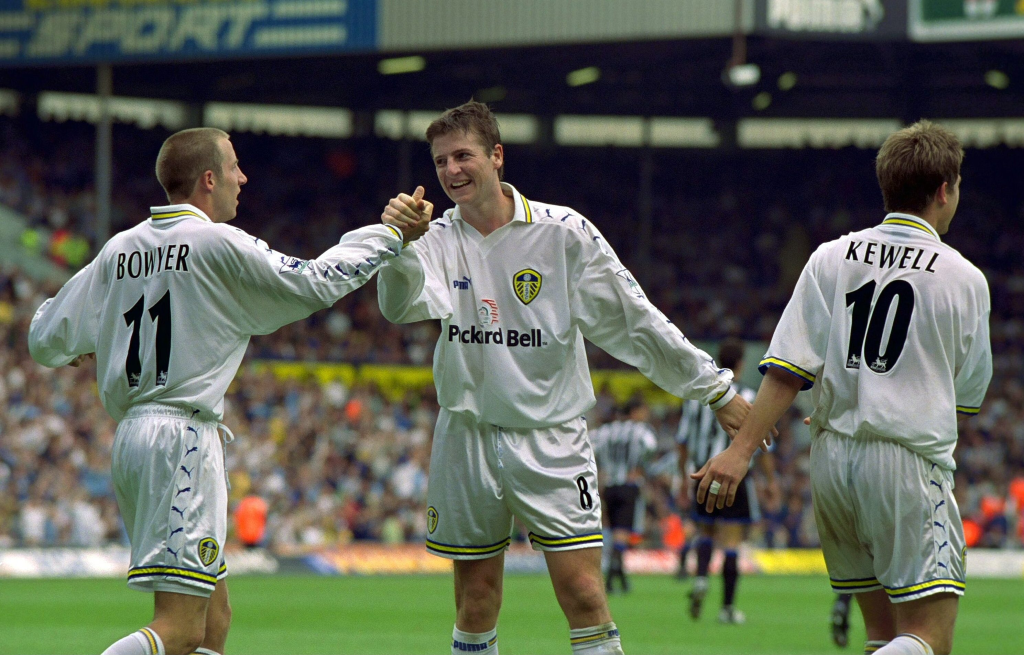
Despite the controversy surrounding the UEFA Cup semi-final and the team’s end-of-season form, the 1999-2000 was Leeds’s best season since their 1992 title win. The team had been Premier League leaders and despite selling their top scorer in Hasselbaink, an able replacement was found in the form of Michael Bridges, who managed to score 21 goals across all competitions including 19 in the league. The team’s excellent season was reflected in the end-of-season awards. Nigel Martyn would be named in the PFA Team of the Year for the third successive season, but this time would be one of four players to make the cut along with Gary Kelly, Ian Harte and Harry Kewell. As in the previous two seasons, 1999-00 would be another one to remember for 23 year-old Kewell. Only Nigel Martyn (55) made more than Kewell’s 53 appearances in all competitions, with the young Australian scoring 17 goals along the way. He also reached double figures in the Premier League, scoring 10 in 36 appearances. His standout performances led to Kewell being named PFA Young Player of the Year, beating out Coventry’s Robbie Keane and Liverpool’s 20 year old midfielder Steven Gerrard for the award. The future was looking bright for Leeds United, with an improvement having occurred season-on-season for the past three years. It would get brighter.
[1] 2nd March 2000 ‘BBC News|FOOTBALL|Leeds ride luck in Rome’ http://news.bbc.co.uk/1/hi/sport/football/664211.stm
 the-score-board.co.uk